
10-Day Germany Itinerary by Train: The Line That Works
This post contains affiliate links. As an Amazon Associate, we earn from qualifying purchases.
A 10-day Germany itinerary by train works best as a one-way line, not a loop: fly into one city and out of another, run five bases with transit capped near three hours per move, and let the ICE do the long legs, the same logic that applies to any multi-city Europe trip by train. Germany’s network spans roughly 40,000 km with around 5,700 stations, and IC, EC, and ICE trains serve over 300 stations daily.
The loop is the part I want you to drop. A circular route forces you to end where you started, which usually means the last two days are a train ride back to an airport you already paid to leave. An open-jaw fare into Frankfurt and out of Munich rarely costs more than a round trip, and it buys you two days of actual travel.
What follows: the route shape, the five bases, the booking window that decides your price, and the three segments where the sources genuinely disagree.
Key Takeaways
- Cap transit at about three hours per move. Anything longer and you’ve booked a rail commute with luggage, not a trip.
- Book Sparpreis tickets early. DB’s cheapest advance fares start low and climb as the contingent sells through.
- S-Bahn, RE, RB, IRE, and IC/EC/ECE trains need no reservation — you can walk on.
- ICE reservations are optional but recommended, and required on certain international IC/EC/ICE trains from 26 June to 31 August.
- Validate machine-bought day and multi-trip tickets if required before departure, or the ticket isn’t valid.
What’s the Best Order for a 10-Day Germany Itinerary by Train?
Start in Frankfurt or Munich, run north or south through Berlin, Dresden, and the Rhine, and finish at Cologne, where the cathedral stands directly outside the main station. That shape keeps every long leg on an ICE corridor and puts the small towns on regional lines.
The reason this ordering works comes down to how DB structures its network. Trains on the most important corridors run at least every hour, and every two hours in the wider network. The ICE links the big cities at speed. Regional trains cover everything else and need no reservation.
IC, EC and ICE trains serve more than 300 stations across Germany every day. The most important corridors carry at least an hourly service, while the wider network runs every two hours. Individual direct services provide access to tourist regions during the day.
That split is the whole planning logic. Long legs go on the fast, expensive, reservation-friendly product. Short legs go on the cheap, unreserved one.
How Much Does the Route Shape Actually Save You?
The route shape saves you a transit day. That’s the number that matters, and it’s the one most itineraries bury.
Five ICE tickets booked in advance run roughly €180–220 total for the five legs of a ten-day trip, according to one route breakdown. Five equivalent domestic flights run €300–500 with luggage, plus four or more hours per journey in airport overhead. The train wins on cost and on time, and it wins by a wider margin than the ticket comparison alone suggests.
I stopped booking round-trip flights into the same city. Flying into Rome and out of Milan on a 10-day Italy itinerary saves a full transit day and usually costs the same or less. The open-jaw fare is rarely the premium people assume it is, as our 5-day Prague and Vienna itinerary shows. The same logic applies here: into Frankfurt, out of Munich, or the reverse.
The classic loop forces you to end where you started. A one-way line gives the route room to breathe.
| Route Shape | Transit Days Lost | Flight Cost Pattern | Best For |
|---|---|---|---|
| One-way line (open-jaw) | 0–1 | Usually same as round trip | Most 10-day trips |
| Circular loop | 2 | Round-trip fare | Fixed return date |
| Linear out-and-back | 2–3 | Round-trip fare | Single-city focus |
Common mistake: Booking the loop because round-trip flights look cheaper. You pay for it in two dead days at the end, and the fare difference is usually smaller than the hotel night you just bought.
Which Cities Earn a Base, and Which Are Just a Stop?
Five bases over ten days is the realistic ceiling. More than that and you’re packing and unpacking instead of seeing anything.
Berlin rewards three nights minimum. Two is a punishment. Dresden works as a single night that breaks the long leg south. Munich takes three, with one day out for Neuschwanstein. Rothenburg ob der Tauber earns a night inside the walls, because it’s busy with coaches at midday and staying over is the way to see it properly. The Rhine gets one night in a river town under a castle, and Cologne closes the line.
The sources disagree on whether Dresden is a stop or a base. One route treats it as an optional break on the Berlin–Munich leg; another builds it in as a fixed day. Both are defensible. If you’d rather not stop, Berlin to Munich direct is about four hours on the fast line.
Berlin–Munich travel time is itself contested. Interrail lists 4h30 on the high-speed ICE. One aggregator says about four hours on the fast line. Plan for 4h30 and you’ll be pleasantly surprised or correctly prepared.
| Base | Nights | Why It Earns the Stop | Transit In |
|---|---|---|---|
| Berlin | 3 | Three nights is the realistic minimum | Frankfurt–Berlin ICE |
| Dresden | 1 | Breaks the long leg to Munich | 2h from Berlin |
| Munich | 3 | One day out to Neuschwanstein | 4h30 from Berlin |
| Rothenburg | 1 | Empty at night, coach-choked at noon | Regional from Munich |
| Rhine / Cologne | 2 | Finish at the cathedral | Regional to Cologne |
Where Does the Rhine Valley Fit?
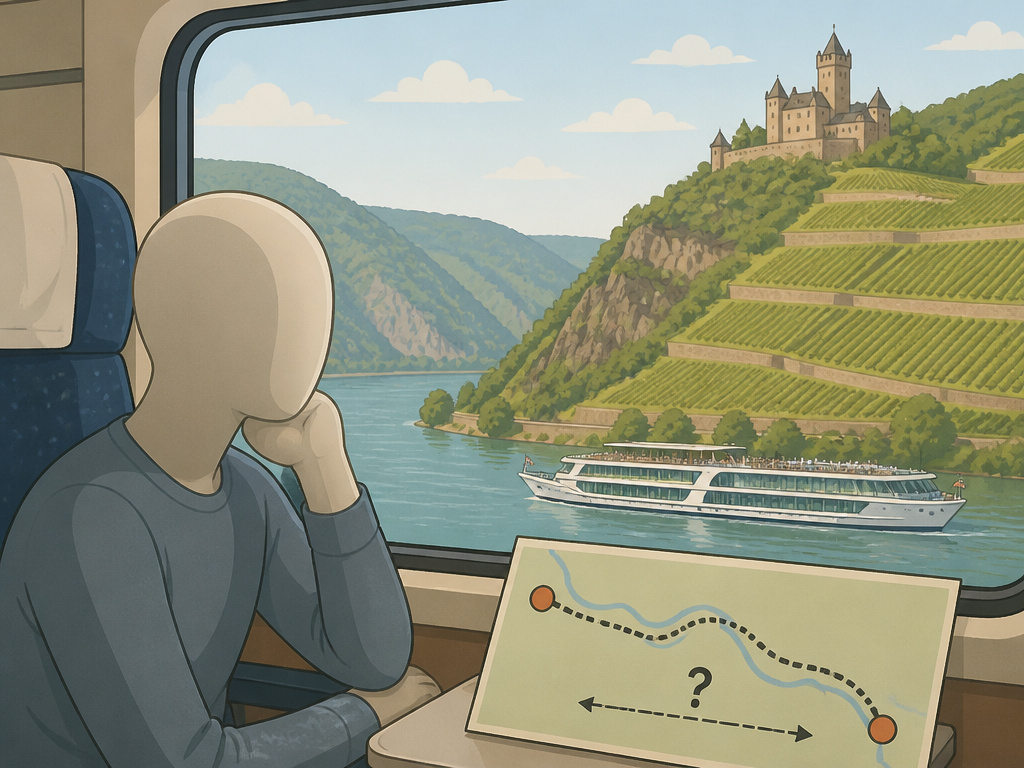
The Rhine Gorge is the stretch where the sources stop agreeing, and you should know that before you plan around a number.
The German National Tourist Board puts the railway route through the Upper Middle Rhine Valley from Bingen to Koblenz at 70 kilometres. One aggregator says 60 km. Another says 65 kilometres with 40 castles along it. Three credible sources, three values, no reconciliation. Treat it as roughly an hour of window-seat scenery and stop counting kilometres.
What nobody disputes is that it’s worth the regional train. The Moselle route from Koblenz to Trier runs past the Kaiser Wilhelm Tunnel, 4,250 metres long and the longest railway tunnel in Germany before the Landrücken tunnel opened. The Hindenburg Dam connecting the mainland to Sylt is eleven kilometres of track through the Wadden Sea.
Where this goes sideways: Treating the Rhine as a day trip from Cologne. You get two hours of scenery and four hours of transit. Stay a night in Bacharach or St Goar and the gorge is yours at 7 a.m., before the river cruises load.
What Do You Actually Pay, and When Do You Book?
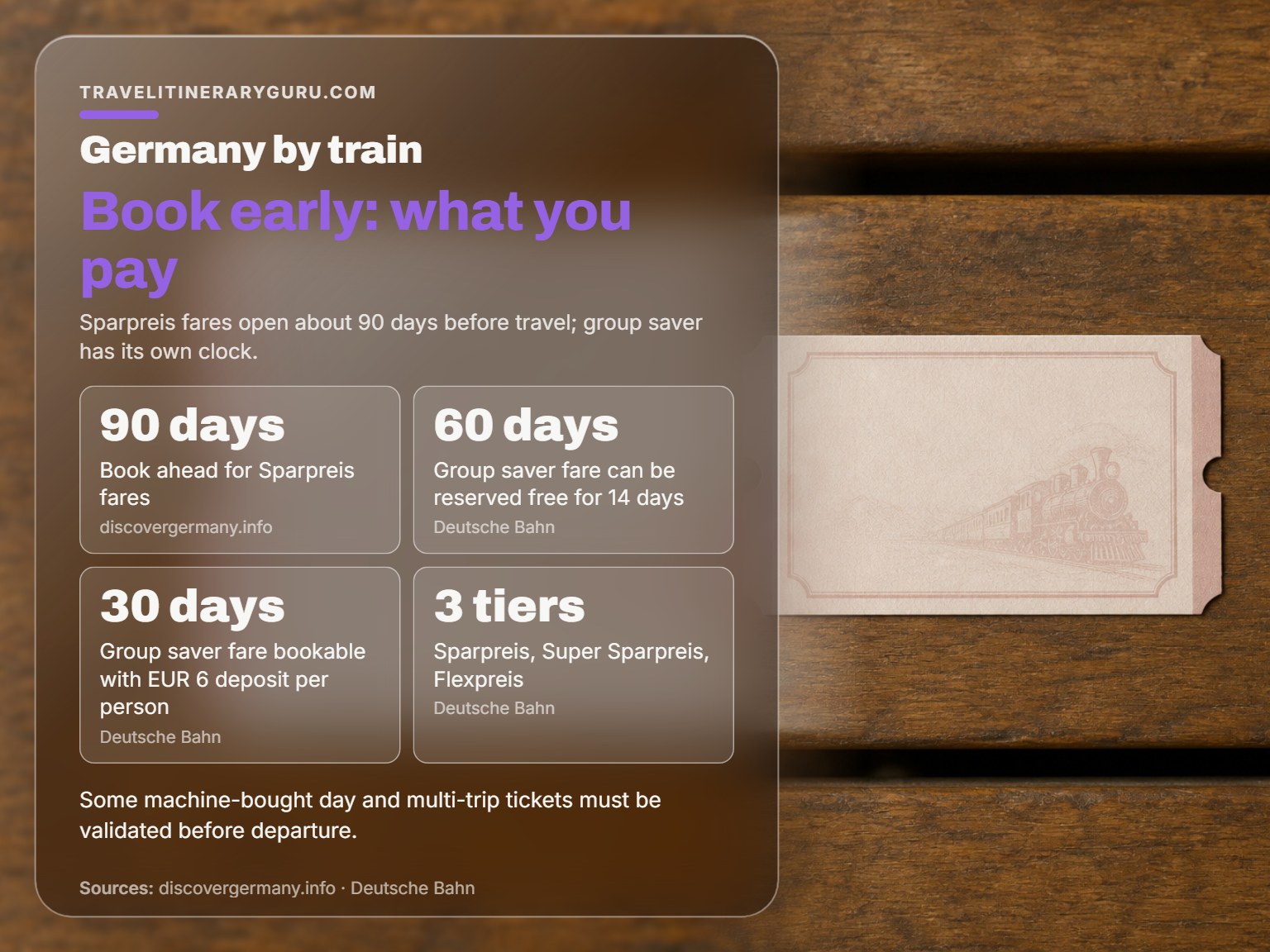
The booking window is the single biggest lever on your ticket price, and it’s the one people miss.
Sparpreis fares open well before travel. Book inside that window and you’re paying for someone else’s indecision. The three tiers are simple once you see them: Sparpreis for cheap fixed-time travel, Super Sparpreis for the cheapest fixed-time travel with the fewest change rights, Flexpreis for staying flexible and possibly taking a later or earlier train, and our guide to European train ticket types breaks down each one.
Groups get a different clock. Up to 60 days before the journey, the group saver fare can be reserved free of charge and without obligation for 14 days. Up to 30 days before, it can be booked with a deposit of €6 per person and direction of travel. That’s a genuinely useful rule for a family or a club trip, and it’s buried in DB’s own timetable notice.
Easy to miss: Some machine-bought day and multi-trip tickets need validating before departure. A ticket you bought and didn’t stamp is not a ticket.
The Deutschlandticket sits outside all of this. It covers regional trains, not ICE, and it’s useful where regional is the only option anyway. If you take enough regional trains, it can be worth it.
Which Ticket Type Matches Your Trip?
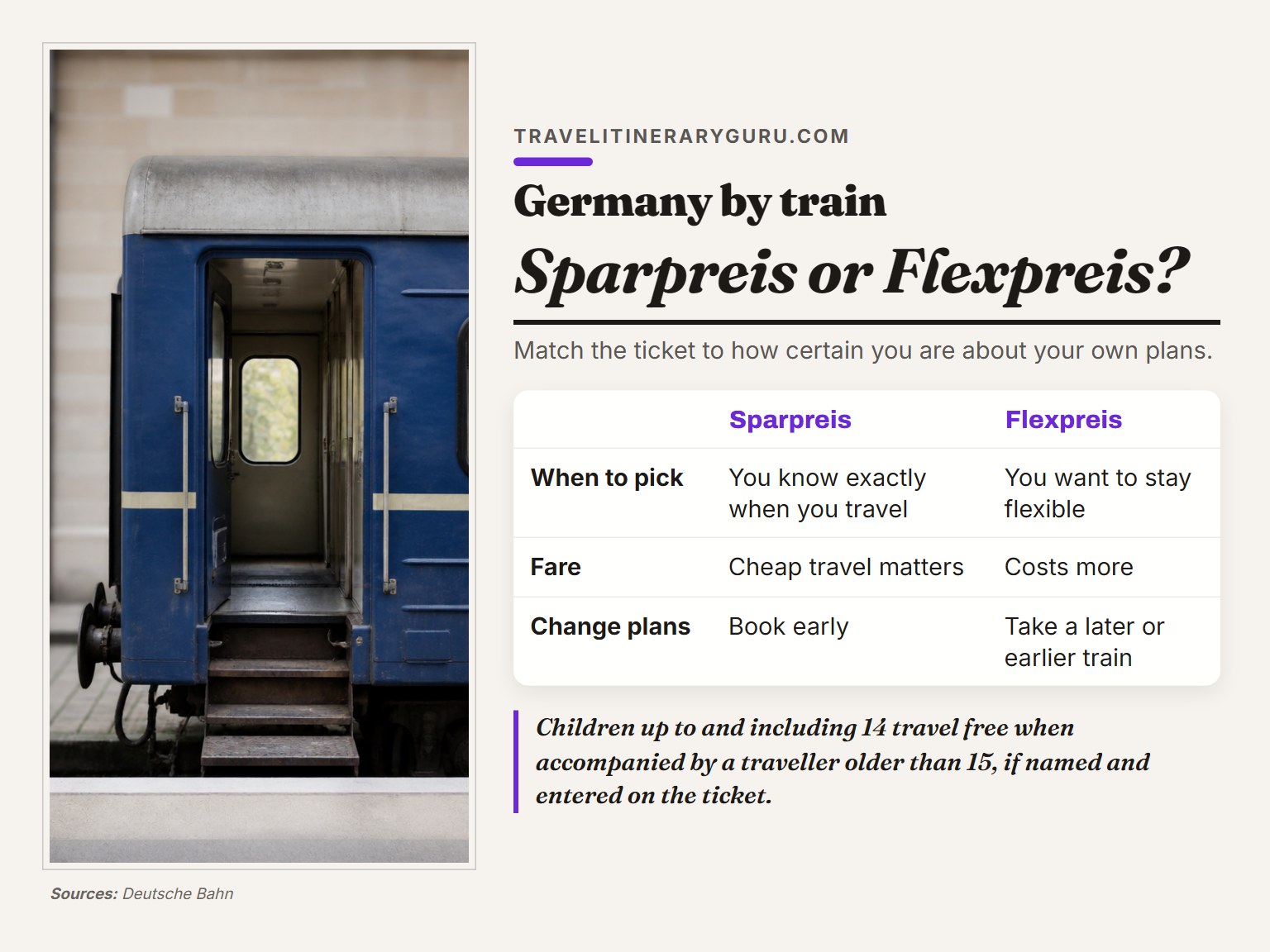
Match the ticket to how certain you are about your own plans. That’s the whole decision.
If you know your travel times and you want the lowest fare, Sparpreis is the answer, and you book it early. If your plans might shift, Flexpreis costs more and saves you a rebooking. If you’re travelling with children, the family rules are generous: children up to and including 14 travel free when accompanied by a traveller older than 15, if they’re named and entered on the ticket, and up to four children of that age group can travel per ticket. That applies on ICE, Intercity, and EC.
One more thing worth knowing: real-time carriage formation display only applies to ICE, IC, and EC trains, and in some regions to regional trains. On a busy platform, that’s the difference between standing at the right door and running the length of the train with a suitcase.
Worth knowing before you start: Seat reservations cost €5.90 per journey and are optional on most ICE routes, but one source says they’re worth it on busy Friday afternoon trains between major cities. Reservations are required on certain international IC/EC/ICE trains from 26 June to 31 August.
The Six-Hour Train Trap
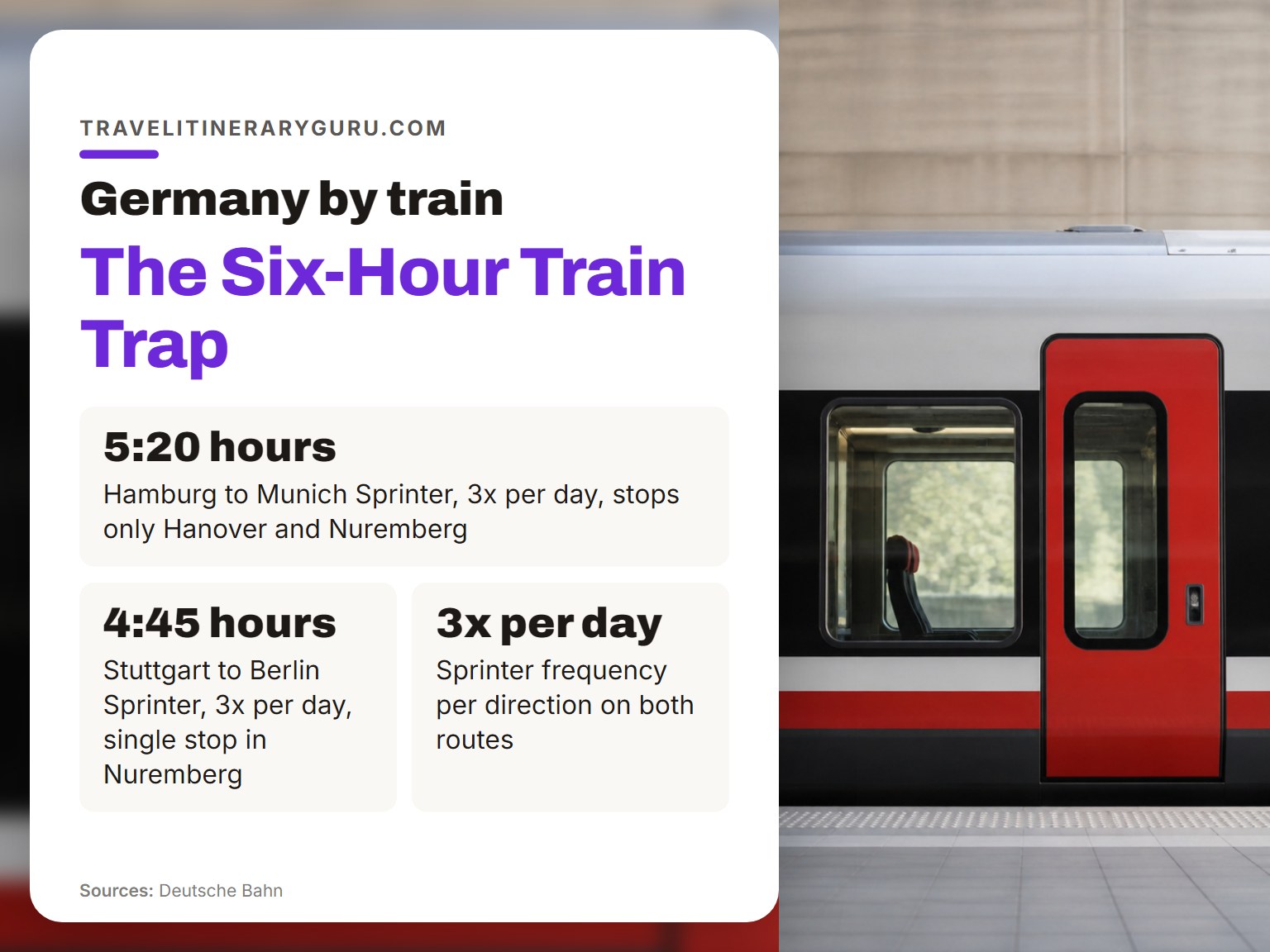
I audited one of my own early itineraries and found consecutive days with long train segments. That’s not a trip. That’s a rail commute with luggage.
Now I cap transit at about three hours per move and build in a full zero-day regularly. The mistake is treating the map as the itinerary. A route that looks efficient on paper can book you six travel days and four actual experiences.
The DB Sprinter services show what the network can do when the stops are stripped out. A new Sprinter between Hamburg and Munich runs three times per day and direction in 5:20 hours with stops only in Hanover and Nuremberg. Stuttgart to Berlin runs three times per day in 4:45 hours with a single stop in Nuremberg. Those are the legs where a long transit is worth it, because the train is doing the work and you’re not changing.
On everything else, hold the three-hour cap.
Frequently Asked Questions
Do I need a car for a 10-day Germany itinerary by train?
No, and the sources agree on this one. A ten-day trip on the rail corridors needs no car at all. A car only starts to pay once you leave the rail corridors for the Romantic Road or the Black Forest. If your route stays on the ICE and regional network, skip the rental.
Is the Deutschlandticket worth it for a 10-day trip?
It depends on how many regional legs you have. The Deutschlandticket covers regional trains, not ICE, and it’s useful for regional legs. If you take enough regional trains, it can be worth it. If your trip is mostly ICE between big cities, it isn’t.
How far ahead should I book ICE tickets?
Book Sparpreis fares as early as you can. DB’s cheapest advance tickets are non-refundable but sometimes changeable for a fee. For group travel, the clock is different: free reservation up to 60 days before the journey, or a €6 per-person deposit up to 30 days before.
How long does Berlin to Munich take by train?
Interrail lists 4h30 on the high-speed ICE. One aggregator says about four hours on the fast line. Plan for 4h30. If you’d rather break the leg, Dresden is about two hours south of Berlin and earns its own day.
Do I need to reserve a seat on German trains?
ICE reservations are optional but recommended, and they’re worth it on busy Friday afternoon trains between major cities. On certain international IC/EC/ICE trains from 26 June to 31 August, reservations are required.
Can I see Neuschwanstein Castle as a day trip from Munich?
Yes, but the last mile isn’t rail. You take the train to Füssen, about two hours, then a shuttle or a scenic 30-minute walk up to the castle. Book the entry before you go.
The Bottom Line
One rule most guides skip: if your route has too many transit days, the itinerary is wrong, not the traveller. Rebuild it around five bases and a three-hour cap before you book anything else.
The practical wisdom you need is this. Book the open-jaw flight first, then the Sparpreis tickets early, then the two or three nights that genuinely need advance booking. Everything else can wait.
The one thing I’d change about my own early trips: I stopped planning every backup. Build the route, hold the cap, and leave one afternoon unbooked. The Rhine at 7 a.m. With no plan is better than the Rhine at noon with a schedule.
If your trip is shorter than ten days, the same logic compresses: fewer bases, same three-hour cap, same early booking approach, much like our 10-day Eastern Europe itinerary by train. The shape doesn’t change. Only the number of stops does.
