
How to Travel With a Stroller: Gate-Check Rules That Work
This post contains affiliate links. As an Amazon Associate, we earn from qualifying purchases.
To travel with a stroller, gate-check it in a labelled protective bag, empty the basket first, secure or remove loose accessories, fold it exactly as the manufacturer instructs, and confirm where the airline will return it. Keep the baggage receipt until the stroller is back in your hands.
That last clause is the one that bites people. Gate-check is not a promise that your stroller comes back to the jet bridge. Stokke’s own gate-check guide lists the aircraft door, the baggage belt, and the oversized-baggage area as possible return points, and says procedures vary by airline. Knowing how to travel with a stroller means accepting that uncertainty. So you can plan the whole trip around collecting it at the door and then watch it ride the belt to arrivals without you.
What follows covers the four things that actually decide whether a stroller travels well: the weight limits printed in the manual, the harness and sleep rules that regulators do not fully agree on, the fold-and-bag procedure that protects the frame, and the airport-and-city handling that separates a smooth trip from a wrestling match.
Key Takeaways
- Empty the basket before gate-check. Stokke advises moving nappies, medication, food, toys and travel documents into hand luggage, because anything left in the basket is gone until the stroller returns.
- Label the bag outside and inside. A second label inside is the backup for when the outer tag tears off in handling.
- A protective bag is not insurance. Stokke states plainly that a bag cannot guarantee airline damage will not occur.
- Never hang bags on the handlebar. The AAP warns this can tip the stroller backward, and the ACCC tells you not to load the handles with shopping or handbags.
- Check the fold before you fly. The YOYO⁵ Bassinet must be removed before folding, but the Seat Pack and Newborn Pack can stay attached.
Why Gate-Check Procedure Varies by Airline
Gate-check is an airline procedure, not a stroller feature. Stokke’s guide is careful about this: even when a stroller meets an airline’s published dimensions, acceptance may depend on the airline’s policy and available cabin space. When you compare a how to travel with a stroller, “check before departure and follow the instructions provided by airline staff at the airport” is the operative line.
A stroller that meets an airline’s published cabin dimensions is not guaranteed a cabin slot. Acceptance depends on the carrier’s current policy and the space available on that specific aircraft, and the stroller must remain folded while onboard.
That gap between “meets the dimensions” and “gets on board” is where most travel-day arguments start. The published number is a threshold, not an entitlement.
If you are still choosing the stroller, the best strollers to take on a plane are the ones whose folded footprint you already know by heart. The overhead bin strollers category exists precisely because that footprint is the whole game. And if your route is long-haul, the international travel strollers shortlist is built around fold size and bag compatibility rather than features you will never use.
The Six-Step Gate-Check Sequence
Stokke lays out six steps. Follow them in order, because step two depends on step one being finished.
- Empty the stroller. Move nappies, medication, comfort items, food, toys and travel documents out of the basket and into hand luggage. Skip this and you are donating a day’s supplies to the baggage system.
- Secure loose accessories. Remove or secure cup holders, parasols, organisers and toys according to the stroller manufacturer’s instructions before folding or transport. Stokke warns specifically not to force the stroller closed around an accessory.
- Fold it correctly. Follow the instructions for your exact model and configuration. Never force the frame closed. On a Chicco Cortina Together, that means locking the front swivel wheels before you fold.
- Use a protective travel bag. A stroller travel bag keeps the frame cleaner and contains loose parts, but it does not stop an airline from damaging the stroller.
- Label the bag clearly. Contact details outside, and a second label inside as a backup.
- Confirm the return point. Ask whether it comes back at the aircraft door, the baggage belt, the oversized-baggage area, or somewhere else entirely.
Easy to miss: The baggage receipt. Stokke says to keep it until the stroller is returned. Without it, you have no claim and no proof the airline ever took custody.
What Are the Weight Limits on a Stroller Before It Tips?
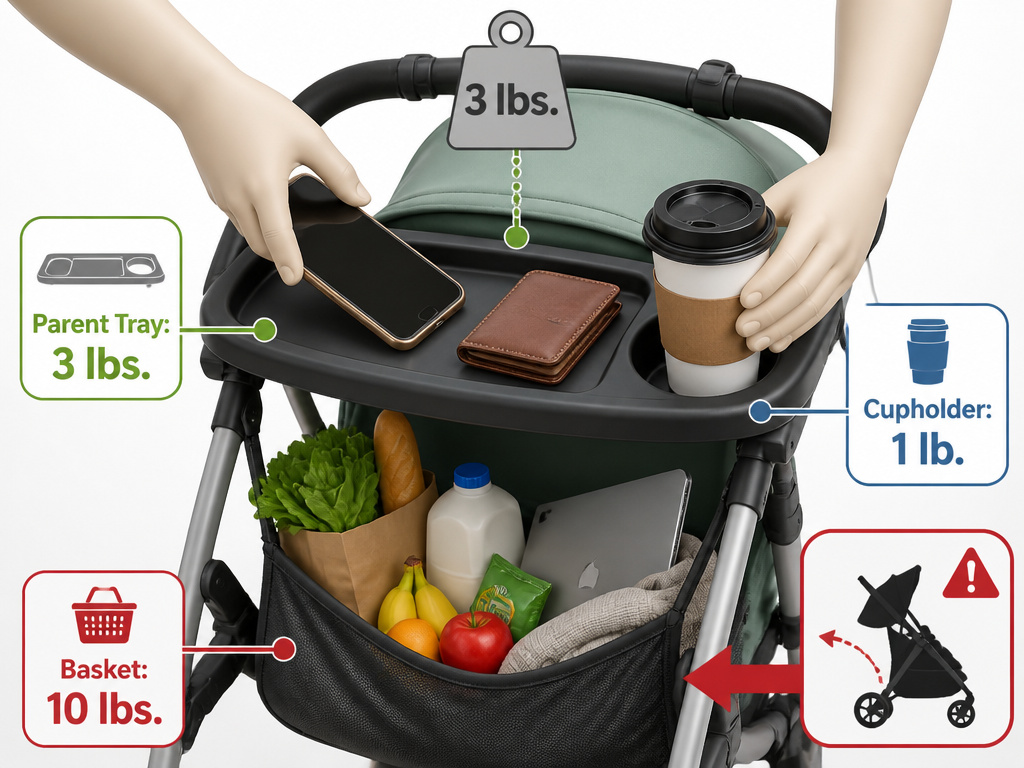
The limits are printed in the manual and almost nobody reads them. For the Chicco Cortina Together, the manual sets 40 lbs (18.14 kg) per seat, a 3 lb (1.4 kg) parent tray maximum, 1 lb (0.45 kg) per cupholder, and a 10 lb (4.5 kg) storage basket maximum. The how to travel with a stroller answer is that those are separate ceilings, not a combined allowance.
That tray figure is the one that surprises people. Three pounds is a phone, a wallet and a coffee. A tablet, a water bottle and a nappy caddy blow past it.
| Load Point | Chicco Cortina Together Limit | What Breaks If You Exceed It |
|---|---|---|
| Each seat | 40 lbs (18.14 kg) | Seat and frame stressed beyond rated capacity |
| Parent tray | 3 lbs (1.4 kg) | Tray mounts and fold mechanism carry the load |
| Each cupholder | 1 lb (0.45 kg) | Cupholder cracks, contents land on the child |
| Storage basket | 10 lbs (4.5 kg) | Basket sags, tipping risk rises |
The AAP explains the mechanism behind that last row. A basket should sit low and near the rear wheels, and the ACCC adds that a centrally located basket underneath the stroller reduces tipping and rocking. Weight up high, on the handlebar, does the opposite: the AAP warns that hanging bags from the handles can make the stroller tip backward.
For a two-child setup, the weight distribution problem doubles. The best double strollers for travel are worth reading before you commit to a side-by-side, because the AAP has one specific warning about those: the footrest should extend all the way across both sitting areas, since a child’s foot can become trapped between separate footrests.
Common mistake: Treating the basket as a shopping bag. Ten pounds is a nappy change kit and a jacket. It is not a grocery run plus a laptop.
Where the Regulators Disagree on Harnesses and Padding
This is the part where “the experts say” falls apart, because the experts do not agree.
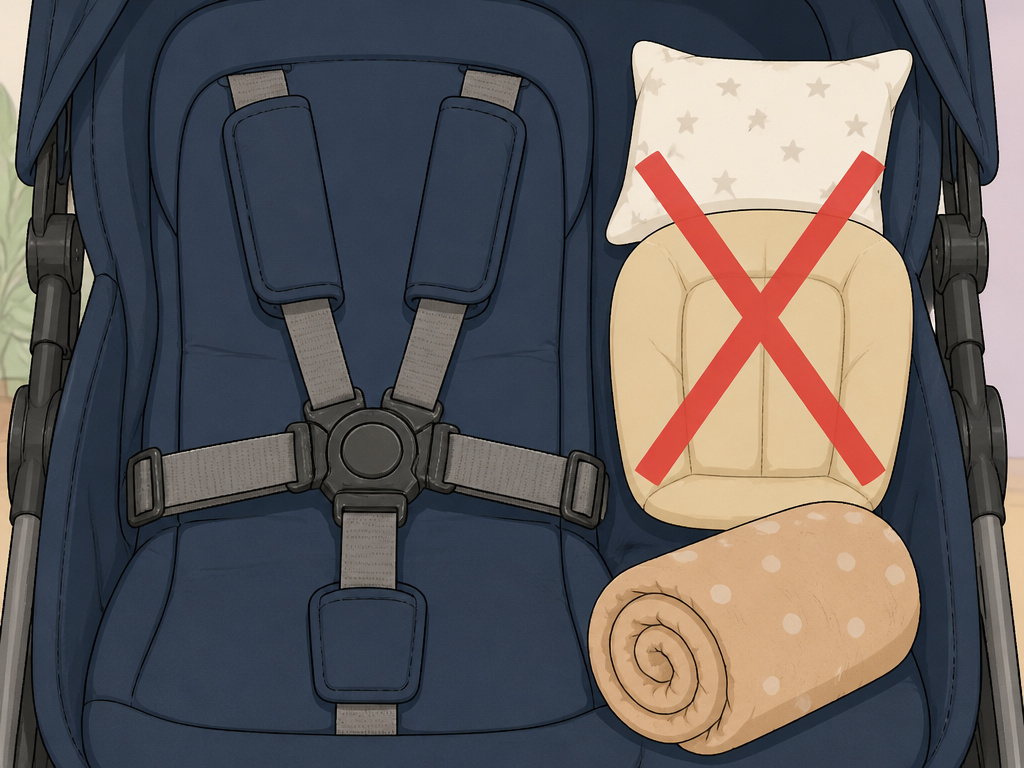
On harnesses, the ACCC is the only one of the three that ranks them. Product Safety Australia states the 5-point restraint harness is the safest, and that a 3-point harness is effective if the waist and crotch straps are firmly fastened. The AAP recommends a five-point harness with straps over both shoulders, hips and between the legs, used whenever the child goes for a ride. Health Canada and the CPSC require a restraint system but do not rank point counts. So “five-point is safest” traces to the ACCC’s ranking, while the AAP recommends a five-point harness without ranking point counts and Health Canada and the CPSC require a restraint system without ranking the type.
On padding, the split is wider.
| Source | Position on Padding | Scope of the Prohibition |
|---|---|---|
| ACCC | Never use extra mattresses, padding, pillows or cushions | Broadest: covers mattresses and cushions |
| Health Canada | Do not use pillows or blankets as padding | Narrower: names pillows and blankets only |
| AAP | Rolled-up baby blankets on either side of the seat if needed | Permits blankets for infant positioning |
| Chicco manual | Does not address aftermarket padding | Silent |
Read that table twice, because it is genuinely contradictory. The ACCC prohibits extra padding outright. Health Canada prohibits pillows and blankets as padding because they can cause suffocation. The AAP recommends rolled-up baby blankets for infants to prevent slouching. Those are three different answers to the same question.
My read: the ACCC is describing padding you add to change the seat’s shape. The AAP is describing positioning for a newborn who slouches. If you are using a blanket to stop a slouch and you can see your baby’s face at all times, you are inside the AAP’s guidance, though the ACCC prohibits extra padding outright and Health Canada prohibits pillows or blankets as padding. If you are building up a seat so a small toddler sits higher, you are in ACCC territory, though Health Canada names only pillows and blankets and the AAP permits rolled-up blankets for infant positioning.
What most people get wrong: Assuming a five-point harness is the law. It is the ACCC’s stated preference and the AAP’s recommendation. Health Canada and the CPSC require a restraint system without ranking the type.
The Fold Rules That Break Strollers at the Gate
Folds are model-specific, and the failure mode is always the same: someone forces a frame closed around an accessory that should have come off first.
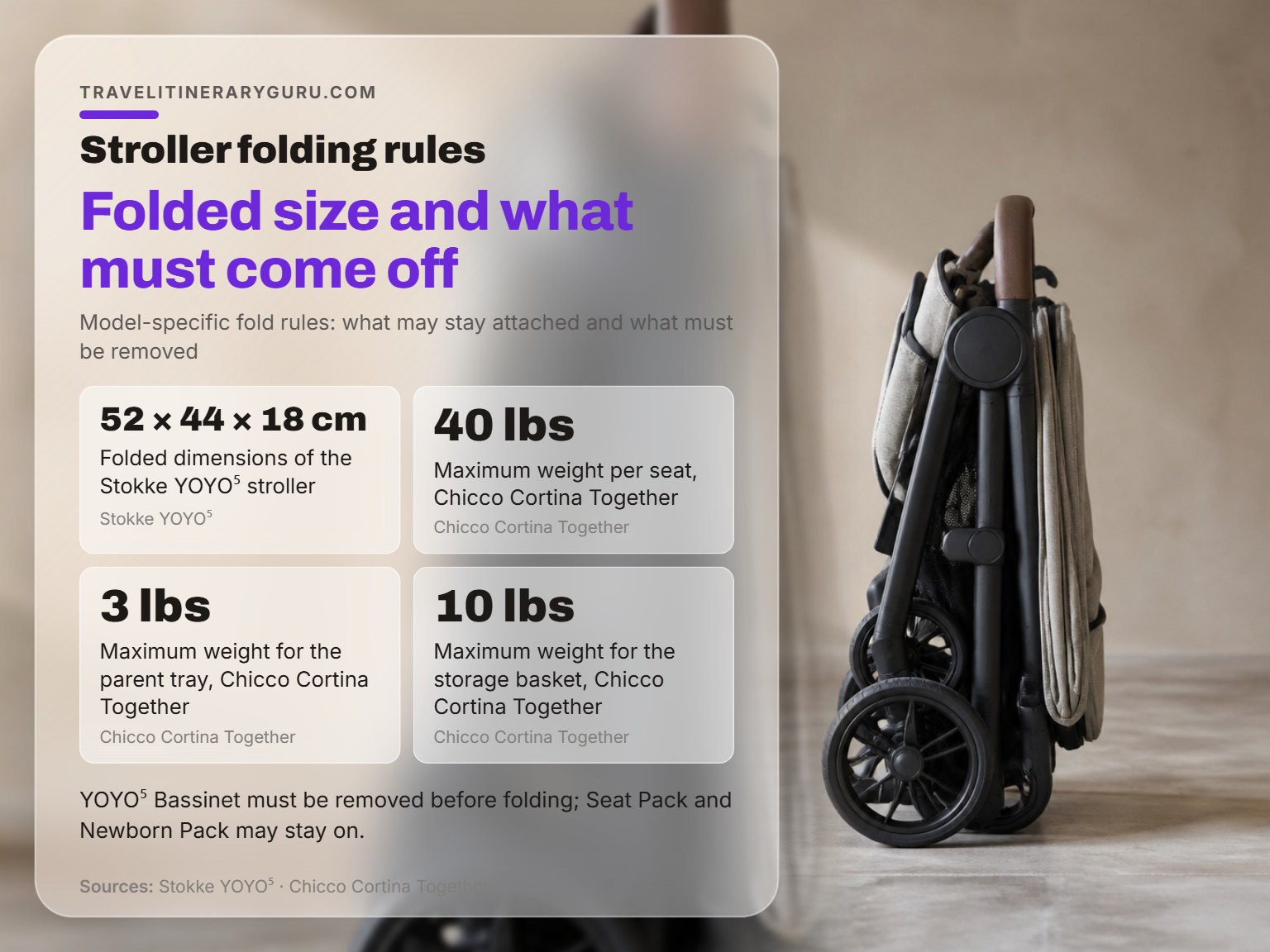
Stokke’s YOYO⁵ is the useful example because its rules differ within one product. The folded dimensions are 52 × 44 × 18 cm. The Seat Pack and Newborn Pack may remain attached when folding. The Bassinet must be removed before folding. Cup holder and parasol may remain attached. Miss the bassinet rule and you are forcing the frame, which is exactly what Stokke tells you not to do.
Skip this if: You are travelling with a bassinet configuration and planning to fold at the gate. Remove the bassinet in the terminal, not at the jet bridge with a queue behind you.
Chicco’s Cortina Together has its own sequence, and two of its steps are pre-flight assembly items rather than travel-day ones. The parent tray must be attached for the stroller to open at all, since it contains the unfold mechanism, and the fold cable must not interfere when you attach it. Chicco also says to remove and discard the red plastic end caps on the rear axle before attaching it.
That matters if you bought secondhand. A used Cortina Together that will not open is usually a missing or mis-seated parent tray, not a broken frame.
If you are travelling somewhere with cobbles, narrow doorways and metro stairs, the strollers for European travel shortlist is built around exactly those constraints. For a lighter everyday option, the lightweight travel strollers category covers the ones that fold small enough to carry one-handed.
Why You Should Never Use a Stroller on an Escalator
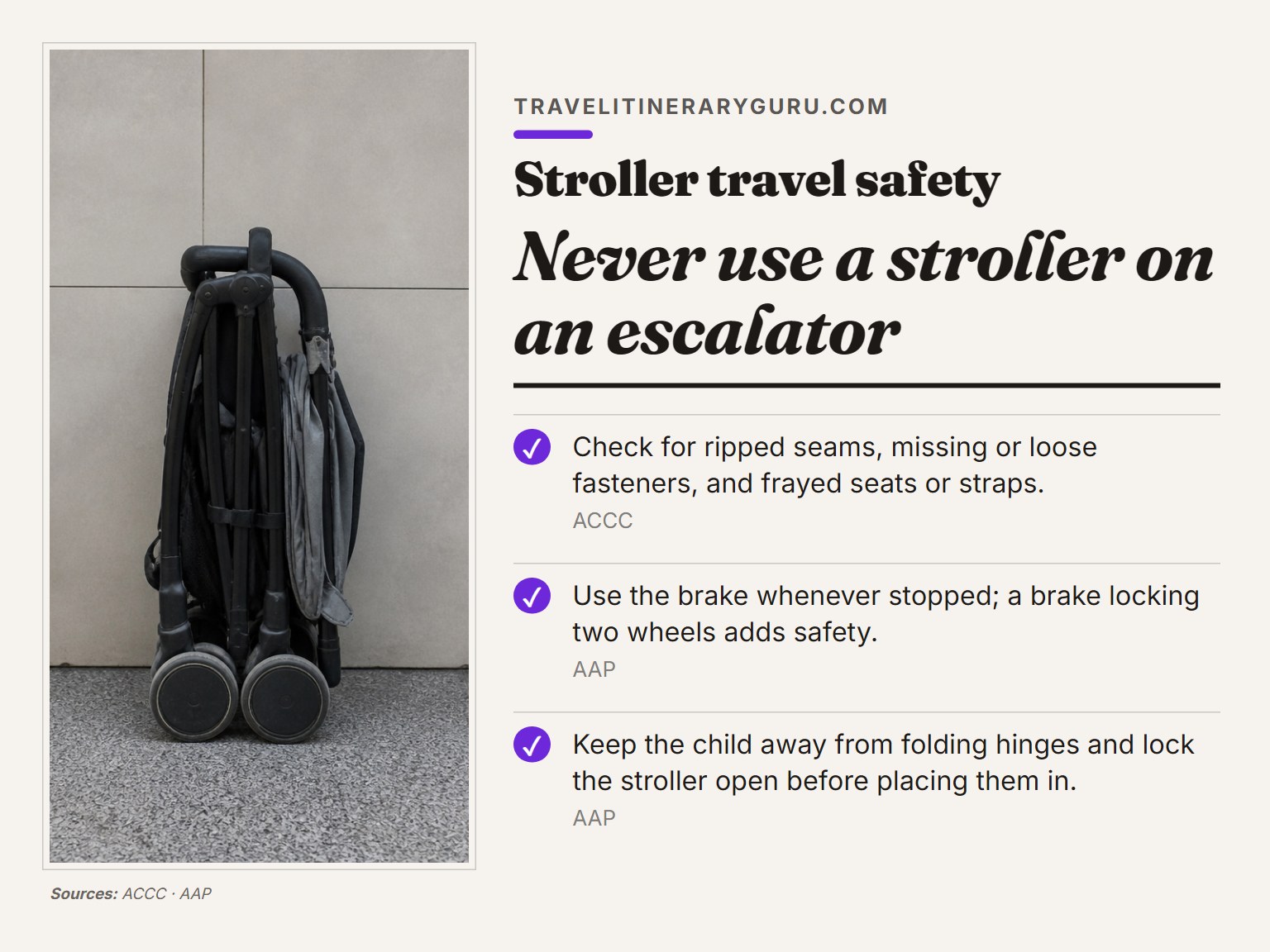
Health Canada is absolute: never use a stroller on an escalator or stairs. Chicco’s manual says never use the stroller on stairs or escalators, but adds a conditional allowance to use extra care when going up or down a step or curb.
Those are not the same rule. Health Canada prohibits stairs and escalators without exception. Chicco prohibits stairs and escalators but treats a single curb step as a handled manoeuvre. The disagreement is narrow, and it matters most in exactly the situation where you are tempted: a station with no lift and a short flight of steps.
The CPSC’s regulation tells you why the hardware is built the way it is. The federal rule seeks to minimise risk of deaths and injuries tied to stability, brakes, restraint systems, latches and folding mechanisms, structural integrity, cords, wheels, and openings on convertible and multi-positional grab bars. The performance requirements include parking brake requirements, static load, stability, occupant retention, impact testing, passive containment and foot openings, wheel and swivel assembly detachment, and head entrapment with a car seat on a stroller.
That list is the checklist you run before any trip. The federal stroller safety requirements are the reason a stroller that passes is stable under a static load, holds its occupant through an impact test, and will not shed a wheel assembly.
Look at the hardware before you leave. A worn brake that no longer locks both wheels, a frayed harness strap, a ripped seam at the basket mount. The ACCC advises checking for exactly that: ripped seams, missing or loose fasteners, and frayed seats or straps. The AAP adds that a brake locking two wheels rather than one provides an extra measure of safety, and that you should use the brake whenever you are stopped.
Before you start: Two hazards on any stroller trip. First, folding hinges will catch small fingers, so keep the child at a safe distance when opening and closing it and lock it open before you put them in. Second, an unattended stroller rolls, so use the brake every time you stop and keep the tether strap around your wrist.
Sleep, Recline and the Rules Nobody Reads
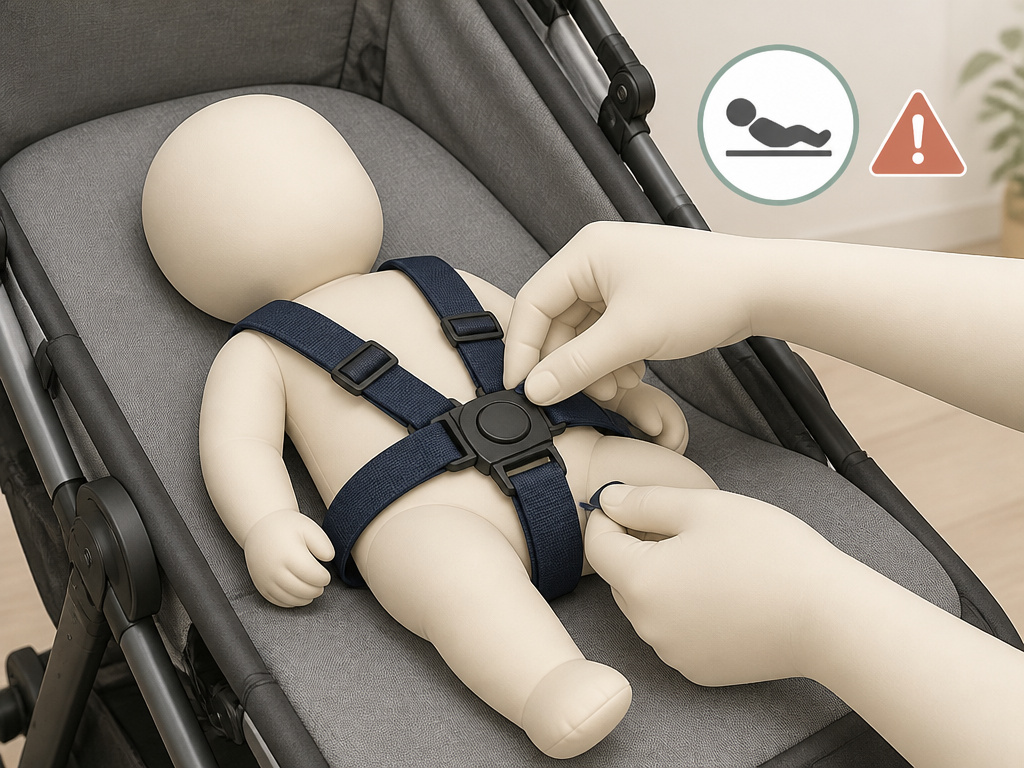
Three separate safety issues live here, and all three are easy to miss.
The first is sleep. The ACCC states it is unsafe for a baby or toddler to sleep in a pram or stroller because it is not a safe sleeping environment, and that sleeping in a stroller can increase the risk of injury or sudden death from suffocation because the baby may be inclined and restrained. Health Canada advises moving a sleeping baby to a safe sleep space on arrival, noting stroller sleep can put a baby in positions that make it difficult to breathe. The AAP takes a third position: if they fall asleep in their stroller, make sure you can see them at all times, while the ACCC states it is unsafe for a baby or toddler to sleep in a pram or stroller.
So the ACCC says stroller sleep is unsafe, Health Canada says move them when you arrive, and the AAP permits it under supervision. If you are on a long transfer and your baby drops off, the AAP permits supervised stroller sleep if you can see them at all times, Health Canada advises moving them to a safe sleep space on arrival, and the ACCC states stroller sleep is unsafe.
The second is recline position. Chicco’s manual carries a warning that standard harness advice does not cover: a child may slip into the leg openings and strangle, and you should never use the seat in a reclined carriage position unless the straps are fastened to close off the leg opening. If you recline the seat for a newborn and leave the leg opening open, you have created the exact hazard the manual describes.
The third is developmental. The ACCC states you should never place a baby under 6 months in a seated upright position, and that babies under one year should not use convertible tricycles in tricycle mode. Neither the CPSC nor Health Canada carries that restriction. If you are travelling with a newborn and eyeing a stroller that only sits upright, the ACCC advises never placing a baby under 6 months in a seated upright position, while neither the CPSC nor Health Canada carries that restriction.
For a newborn, the travel strollers that accept a bassinet or a car seat give you the lie-flat option. The strollers for air travel category is worth a look if your trip is mostly terminals and jet bridges. And if you are weighing an umbrella fold against a full-size frame, the umbrella stroller options are lighter but usually sit upright, which matters under 6 months.
How to Handle the Stroller Once You Land
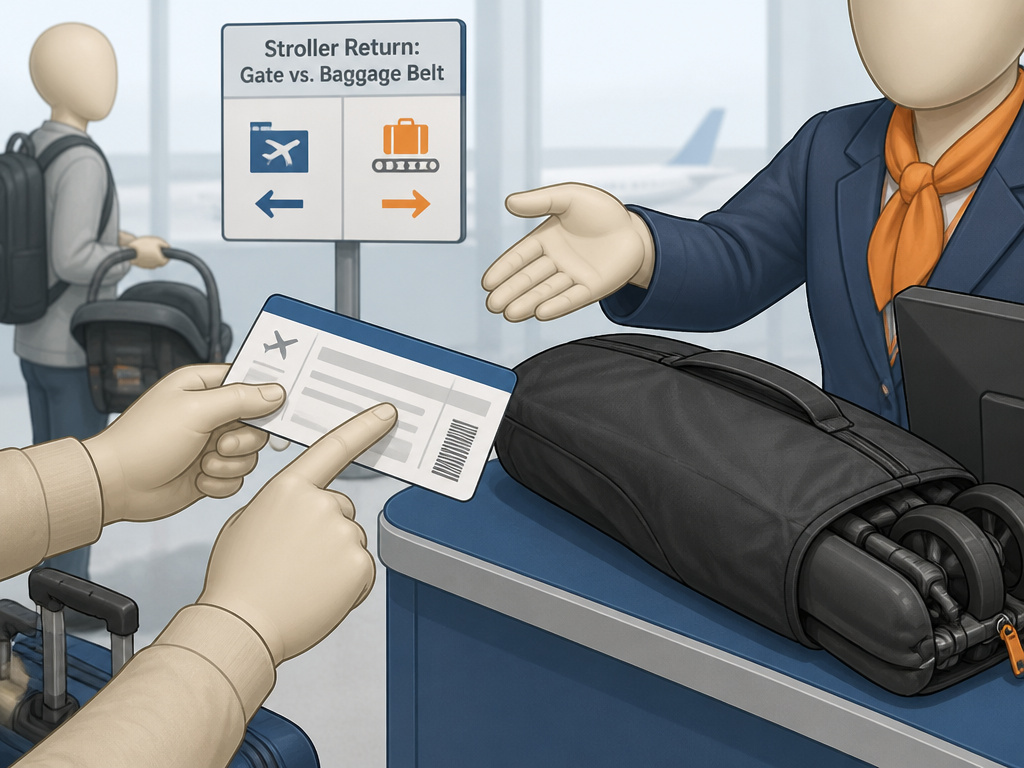
The gate-check rules apply on the way home too, and the return point may be different at each airport.
Stokke’s step six is the one people skip: confirm where the stroller will be returned. Ask at the gate before boarding. On a tight connection, a stroller that comes back at the baggage belt instead of the door turns a 40-minute transfer into a sprint through arrivals.
Two more things worth doing. First, follow the manufacturer’s instruction on accessories. Stokke says to secure or remove loose accessories according to the manufacturer’s instructions before folding or transport. Second, use the stroller’s own carrying solution. Stokke recommends carrying the folded YOYO⁵ in its backpack accessory or in the protective bag supplied with the stroller.
The airport travel strollers shortlist is built around that exact workflow, and the plane strollers picks are the ones whose fold you can do in a queue without swearing.
One last thing on the harness. Chicco advises always securing the child with the carrier harness when using the carrier in the stroller, and checking that a child already in the carrier is secured. That check takes two seconds and it is the one people forget when they are rushing to board.
Frequently Asked Questions
Can you take a stroller on a plane?
Sometimes, and it depends on the airline rather than the stroller. Stokke notes that even when a stroller meets an airline’s published dimensions, acceptance may depend on the airline’s policy and available cabin space. Check the current policy before departure, and follow what airport staff tell you on the day.
Do you have to gate-check a stroller?
Not always, but if you do, prepare it as travel equipment rather than handing it over loose. Empty the basket, secure or remove accessories per the manufacturer’s instructions, fold it correctly, bag it, label it inside and out, and keep the baggage receipt until it comes back.
Is it safe for a baby to sleep in a stroller?
Sources disagree. The ACCC states it is unsafe because a stroller is not a safe sleeping environment and the inclined, restrained position can increase suffocation risk. Health Canada advises moving a sleeping baby to a safe sleep space on arrival. The AAP permits supervised stroller sleep if you can see them at all times.
What is the weight limit for a stroller basket?
It varies by model. The Chicco Cortina Together storage basket is rated to 10 lbs (4.5 kg), with the parent tray at 3 lbs (1.4 kg) and each cupholder at 1 lb (0.45 kg). Check your own manual, because those are separate ceilings rather than one combined allowance.
Should you use a stroller on an escalator?
Health Canada says never use a stroller on an escalator or stairs, with no exception. Chicco’s manual prohibits stairs and escalators but allows extra care when going up or down a step or curb. Where the two conflict, Health Canada prohibits stairs and escalators without exception, while Chicco prohibits them but allows extra care when going up or down a step or curb.
What should you remove before folding a stroller?
It depends on the model and configuration. On the Stokke YOYO⁵, the Bassinet must be removed before folding, while the Seat Pack and Newborn Pack may stay attached. Stokke also warns not to force the stroller closed around an accessory, and to secure or remove loose accessories before transport.
The Bottom Line
One rule most travel guides skip: confirm the gate-check return point before you board, and keep the baggage receipt until the stroller is physically back in your hands. Everything else on this page assumes you can prove the airline took custody. Without the receipt, you cannot.
If you want a first step this week, do this. Take your stroller out, fold it once, time it, and check the manual for the bassinet or accessory removal rule. Then weigh what you normally put in the basket. If it is over the rated limit, you already know what your first airport mistake would have been.
I will be honest with you about where this advice has a ceiling. The sleep question is genuinely unresolved across three regulators, and I am not going to pretend otherwise. If your baby sleeps in the stroller on a long transfer, the AAP’s supervised position and Health Canada’s arrival rule are both defensible, and the ACCC would tell you to avoid it entirely. Pick the one you can actually execute at 2 a.m. In a terminal.
The rest is mechanical. Empty the basket, bag it, label it twice, and ask where it comes back.
