
How to Protect Your Money While Traveling: Step-by-Step
This post contains affiliate links. As an Amazon Associate, we earn from qualifying purchases.
To protect your money while traveling, carry two cards (one credit, one debit) plus a small cash reserve, tell your bank your travel dates, and always choose local currency at the terminal. In the U.S., federal law caps your liability for unauthorized card charges, but only if you notify the bank within its stated timeframes.
That notification window is the part that decides whether a stolen card costs you nothing or costs you plenty. The FDIC is blunt about it: liability protection applies “if your card is lost or stolen, but you must notify the bank or card issuer within certain timeframes.” Miss the window and the protection thins out fast. Knowing how to protect your money while traveling starts with acting on that window.
What follows is the order that actually matters: what to carry, how to pay, where to keep it, and what breaks when you’re already abroad.
Key Takeaways
- Carry two cards minimum. The FDIC says take at least two major credit cards plus your debit card, and leave the rest secured at home.
- Skip the ATM cash advance on a credit card. The FDIC notes it can incur hefty fees; the Government of Canada goes further and says don’t do it at all.
- Always decline the terminal’s offer to charge you in your home currency. The FDIC says choose the local currency and let your financial institution do the exchange, and the Government of Canada says always choose to be charged in the currency of the country you’re in.
- Leave only what you need in the debit account. UW-Madison International Travel recommends keeping just the likely spend in the account you’re drawing from.
- Cash is for transit, tips, and small stuff. The FDIC’s guidance is to carry only enough for local transit, tips, and other small expenses.
What Should You Carry in a Two-Card Travel Wallet?
Two major credit cards plus a debit card for ATMs. That’s the whole wallet. Everything past that is optimization you can skip.
The FDIC’s advice is specific: take at least two major credit cards with available credit that should meet your foreseeable needs, in addition to your bank debit or ATM card. Leave unnecessary cards secured at home. If one card gets skimmed or frozen, you still have a way to pay for dinner.
The FDIC travel money tips page states that federal law limits liability for unauthorized charges on a lost or stolen credit or debit card, provided the bank or card issuer is notified within certain timeframes. Liability protection is therefore conditional on the speed of the report, not on the card type.
Here’s the part nobody tells you. Card acceptance is not universal, and the FDIC’s card-first rule runs into a wall in places where merchants pay a fee to the card company. The Government of Canada’s travel money page says it plainly: merchants in some destinations prefer cash because of that fee. So you carry both.
Why Two Cards Beat One Card Every Time
A frozen account is not a hypothetical. It happens, usually at the worst possible moment, and it happens to people who did everything right.
The Government of Canada tells travelers to make sure their bank has up-to-date contact details, including a cellphone number, plus information on where and when they’ll be traveling, so the account isn’t flagged for unusual activity. That’s the fix for most freezes. It doesn’t catch all of them.
The FDIC’s guidance on card blocking is the piece that surprises people. When you check into a hotel or rent a car, the clerk can ask the bank to reserve part of your credit line to cover the expected cost. For a hotel, that’s usually the room cost for the length of stay plus incidentals. For a rental car, it’s the rental plus fuel charges. If you leave home with a card near its limit, transactions after you hit the ceiling can be rejected.
Where this goes sideways: Arriving with a card already near its limit. The hotel block lands first, and every purchase after it gets declined until the block clears.
The two-card setup is the cheapest how to protect your money while traveling insurance. It costs you nothing to carry and it removes the single most common failure mode.
Cash: How Much, and Where Does It Live?
Cash is for the gaps. Transit, tips, the market stall that doesn’t take cards, the taxi driver whose terminal is “broken.”
The FDIC’s line is worth memorizing: only carry enough cash for local transit, tips, and other small expenses. The agency is direct about the rest: do not take large sums of cash anywhere, because if it’s lost or stolen you cannot replace it.
The Government of Canada adds a practical floor. Bring enough cash to get by for a couple of days, and keep it in a money belt or split across several different pockets, in case your wallet is lost or stolen or your bank accidentally freezes your cards. UW-Madison International Travel makes the same call, recommending a money belt or other hidden place for money, a credit card, and a copy of your passport.
I never carry more cash than I’d shrug off losing. Usually that’s enough to cover a couple of days of small expenses. The rest stays in the hotel safe or split between two bags, because how to protect your money while traveling means pickpockets don’t announce themselves.
If you want to go deeper on the physical side of that, the hidden travel wallets that actually stay hidden are the ones with a flat profile and no visible strap.
How Do You Pay Without Getting Nicked on Fees?
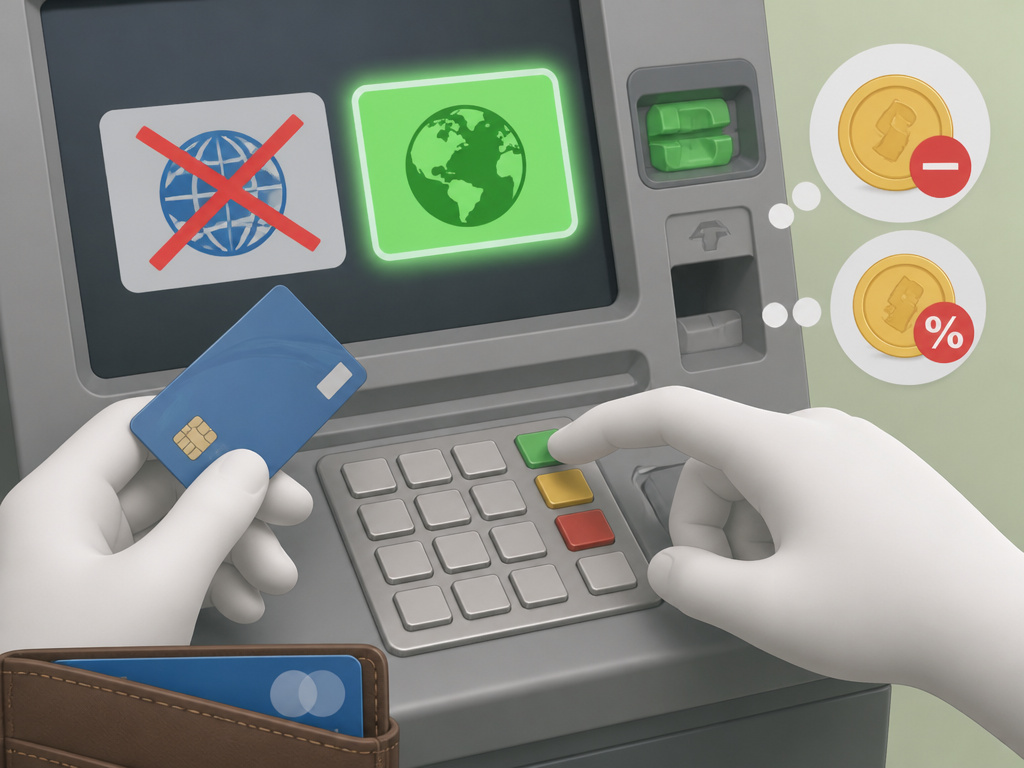
Use the card for purchases, use the debit card for ATM cash, and never let the terminal do the conversion for you.
The FDIC’s rule on currency conversion is unambiguous. If your card doesn’t charge foreign transaction or currency conversion fees, choose the local currency during the process and let your financial institution do the exchange, because that will be more in your favor than converting at checkout. The Government of Canada frames it more strictly: always choose to be charged in the currency of the country you’re in, or you’ll pay high conversion rates and transaction fees.
Here’s where the sources split, and it’s worth knowing before you’re standing at an ATM.
| Question | FDIC position | Government of Canada position |
|---|---|---|
| Credit card at an ATM | Can incur hefty fees; debit may cost less | Don’t do it; fees and interest are very high |
| Debit card at an ATM | Cheaper option for cash | Expect extra fees; withdraw larger, less often |
| Framing | Fee-optimization decision | Near-prohibition on credit-card cash |
Both sources agree on the direction. The FDIC frames it as a comparison; Canada frames it as a rule. If you take one thing from the disagreement, take this: debit card for ATM cash, credit card for purchases, and check your bank’s fee schedule before you leave. The FDIC recommends asking your bank about ATM and foreign transaction fees before you travel.
The foreign transaction fees that look small on paper add up fast over a longer trip, which is why the card you pick matters more than the ATM you use.
What most people get wrong: Accepting the terminal’s “pay in your home currency” option. The markup lands on the transaction and your bank never gets the chance to convert at a better rate.
ATMs, PINs, and the Unattended-Terminal Trap
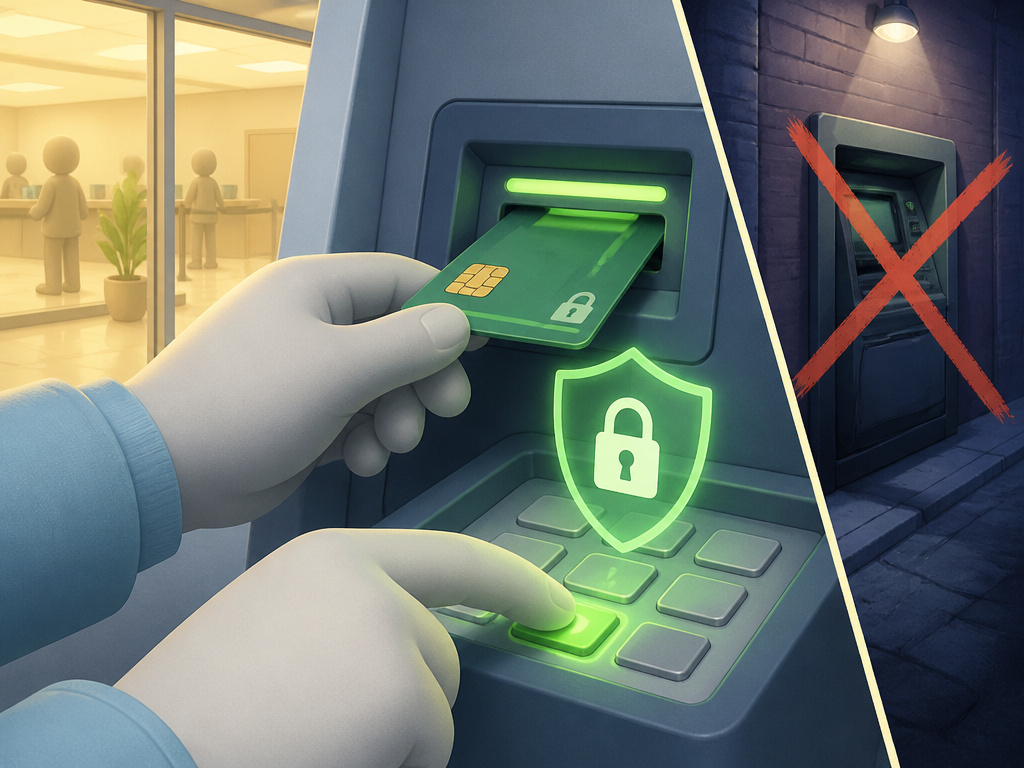
PINs are required at ATMs and at some unattended terminals, including ticket kiosks, parking lots, and gas stations. A card that works fine at a staffed bank counter can still demand a PIN at an unattended kiosk.
That’s from Wells Fargo’s travel security page, and it’s the detail that catches people who only carry a signature-verified card. If you’re traveling internationally, Wells Fargo suggests considering an RSA SecurID device in case digital access codes aren’t available. Check with your mobile carrier about international calling and text options too, since the code has to reach you somehow.
UW-Madison International Travel recommends changing your PIN while abroad and again as soon as you depart for home, and notes that some credit card companies allow PIN changes by phone. That’s a small ritual that closes a real gap.
On the ground, the rules are simple. The Government of Canada says to always use bank-affiliated ATMs when you’re outside the country, and to check whether your financial institution has international branches or partners where you can use your debit card fee-free. Withdraw larger amounts less often to minimize fees.
I see this advice a lot, and here’s why it falls apart on the ground: the ATM inside the bank branch closes when the branch closes. If you need cash at night, you’re at the lobby machine or nothing. Use ATMs during business hours inside a bank, supermarket, or large commercial building when you can.
If you’re planning around cash access, the ATMs abroad that sit inside a lit bank lobby are the ones worth walking to.
Where Does the Money Actually Sleep?
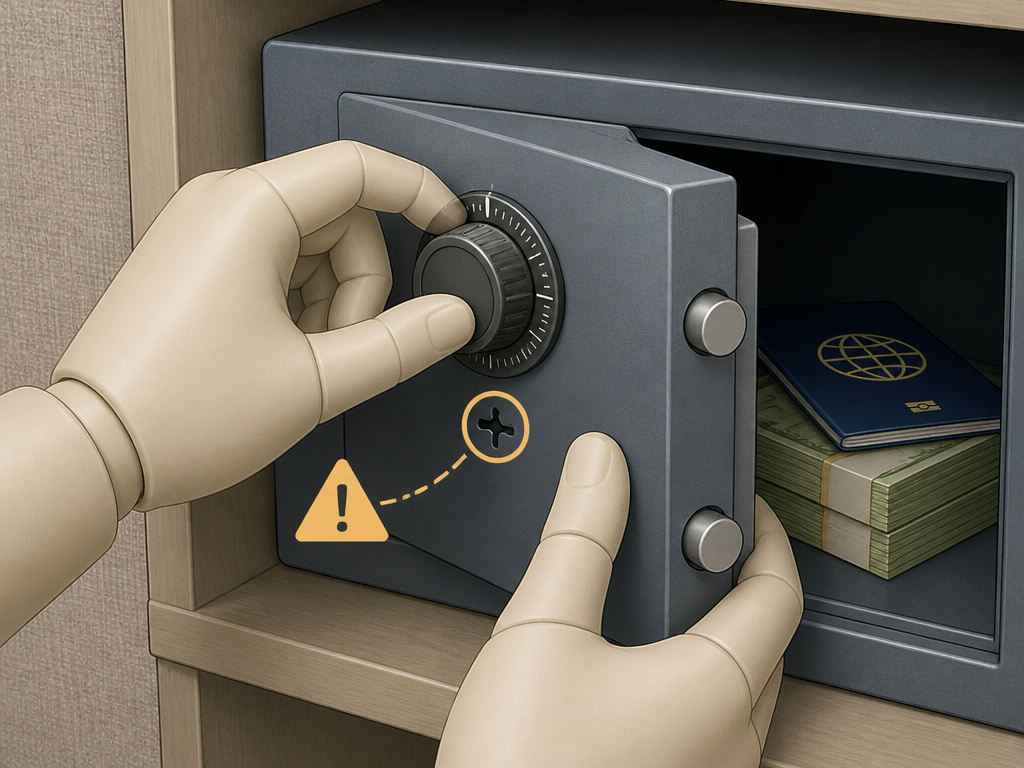
Hotel safes are better than leaving cash on the nightstand. They are not a vault, and the FDIC is the only source in this set that says so out loud.
The FDIC notes that keeping cash, jewelry, and your passport in the hotel safe might add a level of security compared to leaving it out. Then it undercuts itself: some hotel safes may have a master key or a special override code to open the door. When someone other than you can get in, your stored items are not completely safe. And remember to take the valuables out when you leave.
That’s the honest version. A safe with a master key is a locked drawer, not a security system.
The passport question is where the sources genuinely conflict. The FDIC says keeping your passport and other valuables in the hotel safe might add an additional level of security compared to leaving it out. UW-Madison International Travel points out that some countries require you to carry your original passport. Both are right, and they can’t both be followed.
Easy to miss: Passport-carry law. In countries that require the original on your person, the hotel safe is the wrong answer, and the fine for not carrying it is real.
The resolution is to check the rule for your specific destination before you leave. If the country requires the original, the passport stays on you in a hidden place. If it doesn’t, the safe is the better call. Either way, the hotel room safe only works if you actually remember to open it before checkout.
The Scams That Target Travelers Specifically
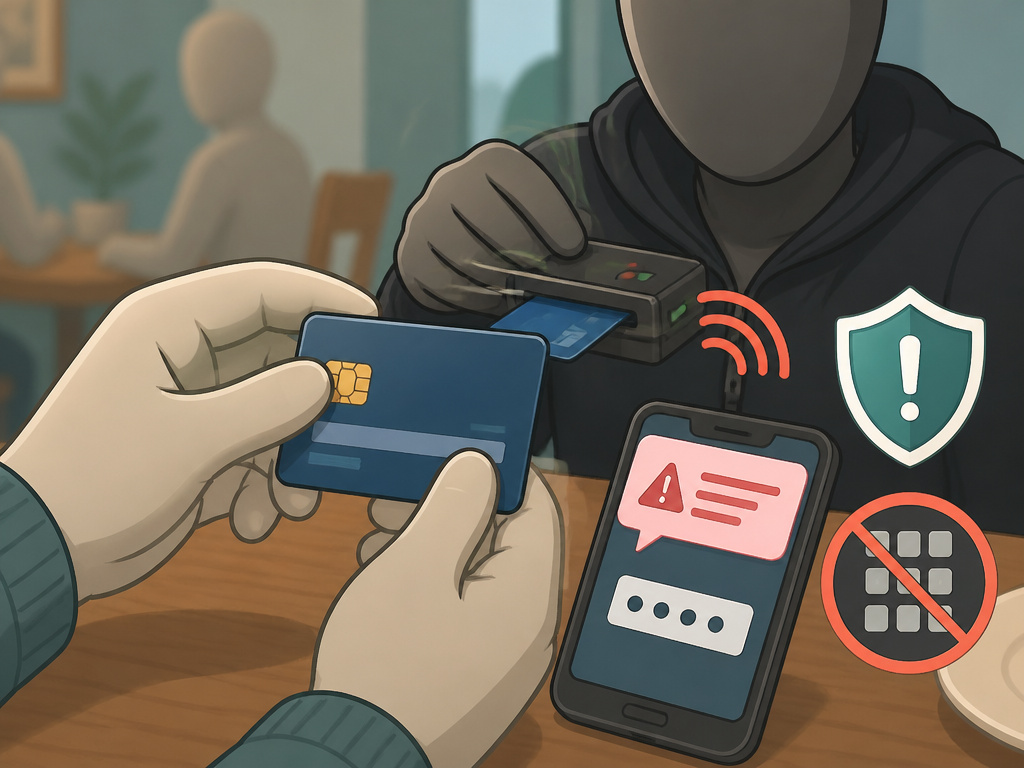
The Government of Canada flags card cloning as a real risk at some destinations, particularly in restaurants. That’s a failure mode no U.S. Source in this set names, and it’s the one that gets people who never lose their card at all.
The mechanics are simple. Your card leaves your sight for a minute, and the number gets copied. Keeping the card in view when it’s processed is the cheapest defense.
Then there’s the alert problem. Wells Fargo warns that scammers may fake messages about suspicious account activity, especially while you’re traveling. The real bank doesn’t ask you to confirm your PIN over a text. The FDIC’s rule is absolute: never give anyone your personal identification number.
Wells Fargo also recommends running malware and security scans on your devices after using different networks during your travels, and UW-Madison International Travel says to always manually enter your username and password while abroad rather than letting a browser save and autofill them.
The travel scams that work best are the ones that look like the bank you already trust, so slow down before you tap anything.
What Happens When It All Goes Wrong Anyway?
This is where the sources diverge hardest, and it’s the gap most guides paper over.
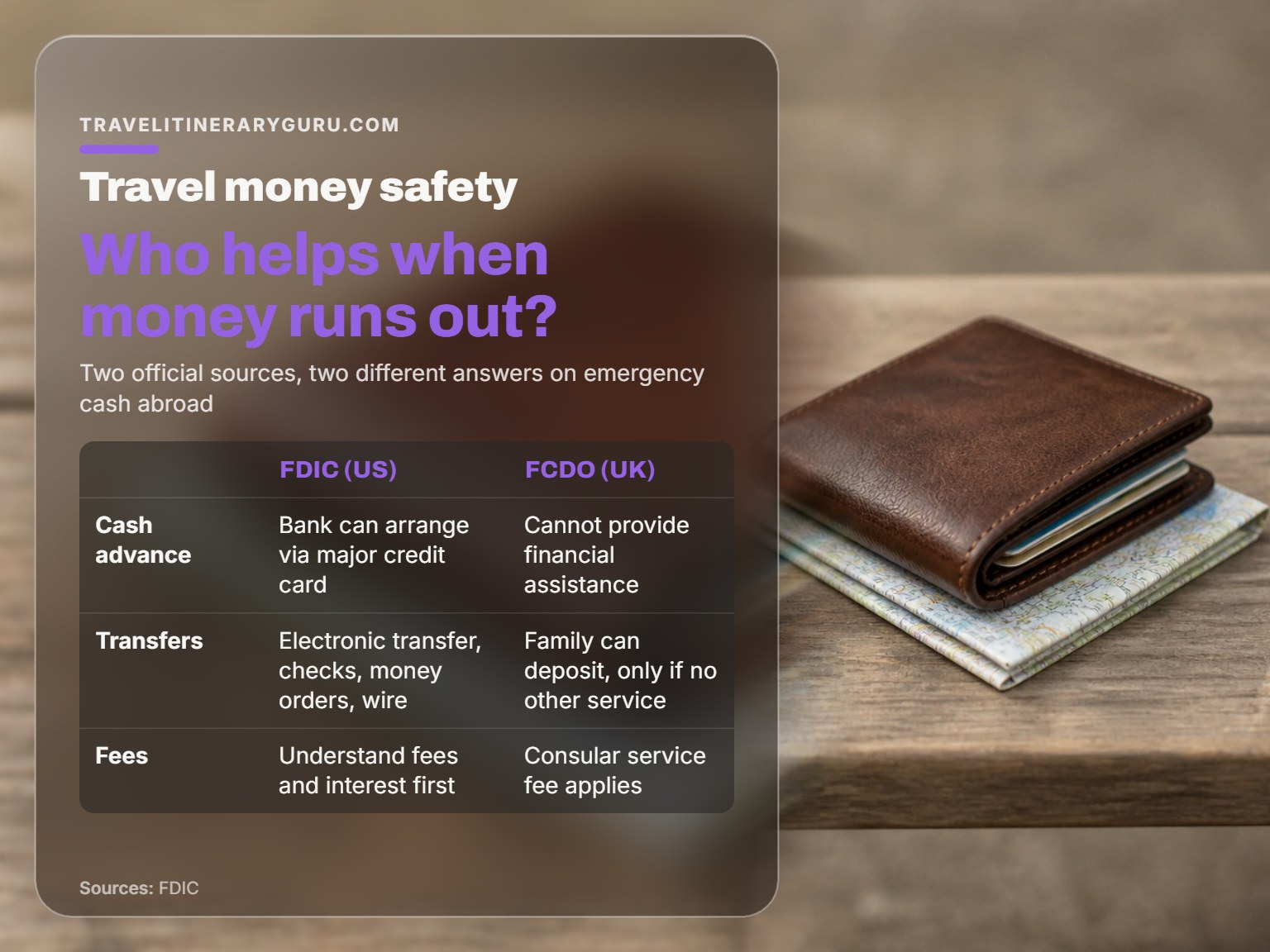
The FDIC’s position is that help exists. A nearby bank can arrange a cash advance on a major credit card, though you should understand the fees and interest first. You can also ask the bank to transfer money electronically from your account back home, or arrange traveler’s checks, money orders, or a wire to your hotel.
GOV.UK is the counterweight. The FCDO cannot provide financial assistance or pay your bills. In exceptional circumstances, family or friends can deposit money with the FCDO, but only if no other transfer service is available, it usually takes longer, and a consular service fee applies. You’ll need to visit the nearest British embassy, high commission, or consulate in person.
Skip this if: You assumed your government would cover a stranded-traveler emergency. The FCDO states outright that it cannot pay your bills, and the deposit route is a last resort with a fee attached.
That’s why the backup source of funds matters. The Government of Canada’s advice is to purchase travel insurance and always carry a backup source of funds in case of emergency or an unexpected delay. That’s the same lesson I learned the hard way after a minor injury abroad. I don’t travel without insurance now.
Frequently Asked Questions
Should I notify my bank before I travel?
Four of the six sources in this set say yes. The FDIC says to call your credit card companies and place a travel alert. UW-Madison International Travel, Wells Fargo, and the Government of Canada all instruct you to notify the issuer with your travel dates. GOV.UK is the outlier, saying you may also need to tell your bank, which is permissive rather than directive. Notifying costs nothing and prevents most freezes.
Is it better to use a credit card or a debit card at an ATM abroad?
The two sources disagree on framing. The FDIC says a credit-card cash advance can incur hefty fees while using your debit card at an ATM may cost you less, treating it as a fee comparison. The Government of Canada says you should not use your credit card at an ATM at all, because the fees and interest are usually very high. Both point the same direction: debit card for cash.
What should I do if my card is lost or stolen abroad?
Report it to your bank or card issuer immediately. The FDIC is explicit that federal law limits your liability for unauthorized charges only if you notify the bank within certain timeframes. Wells Fargo notes that if your card was in a digital wallet and you still have your device, the bank may be able to update the wallet with your new card while you wait for the replacement.
Is a hotel safe actually safe?
It’s better than leaving valuables out, but it’s not absolute. The FDIC warns that some hotel safes may have a master key or a special override code, meaning someone other than you can open the door. If that’s the case, your stored items aren’t completely secure. Use the safe, but don’t treat it as a vault.
How much cash should I carry while traveling?
The FDIC says carry only enough for local transit, tips, and small expenses, and warns against taking large sums anywhere because lost cash cannot be replaced. The Government of Canada suggests enough to get by for a couple of days, kept in a money belt or split across several pockets. Split the difference: a couple of days’ worth, spread across two places.
The Bottom Line
The single best money move in travel is a no-foreign-transaction-fee debit card and a backup credit card. Everything else is optimization. Two cards, one small cash fold, and a bank that knows your travel dates covers the large majority of trips.
Here’s the threshold that decides whether you’re actually covered. If you’re carrying a card near its limit, fix that before you leave, because the hotel block lands first and every purchase after it gets declined. And if you’re heading anywhere that requires the original passport on your person, the hotel safe is off the table for that document.
One rule most guides skip: check the passport-carry law for your destination before you pack. That single check resolves the FDIC-versus-UW-Madison conflict, and it’s the difference between a safe that works and a fine at a checkpoint.
I’ll be honest with you. The card setup is the easy part. The hard part is remembering that the terminal’s “pay in your home currency” prompt is a markup, not a courtesy, and that your government will not wire you money when you’re stuck. Build the backup before you need it.
