How to Find a Licensed Tour Guide: Step-by-Step
This post contains affiliate links. As an Amazon Associate, we earn from qualifying purchases.
To find a licensed tour guide, start with the government register. Slovenia, the Dominican Republic, and Sri Lanka all publish official lookups you can query yourself, and Slovenia drops any guide who misses the 31 January renewal deadline. South Africa and Japan verify guides a different way, so the check changes.
The 31 January date is the part worth sitting with. A guide who held a valid Slovenian license last year can vanish from the public register on 1 February for no reason other than a missed renewal, and the register itself notes that such a person may have left the profession or may be guiding in violation of the law. So when a name is missing, ask why before you draw a conclusion.
What follows: four government lookups you can query today, two countries that verify guides in a completely different way, and the register fields that carry no proof behind them at all.
Key Takeaways
- Three countries publish official guide registers. Slovenia, the Dominican Republic, and Sri Lanka all run public lookups you can query yourself before you book anything.
- Slovenia’s renewal deadline is 31 January. Miss it and the guide is removed from the online register after 1 February, even if nothing else about them changed.
- South Africa has no public lookup. Verification runs on a physical badge and ID card checked during spot inspections by policing authorities.
- An agency booking guarantees nothing. Japan’s own tourism organization says to check and confirm that a Licensed Guide Interpreter is conducting the tour.
- Language proficiency is self-declared. On the Slovenian register, languages, countries guided, and days guided carry no proof requirement at all.
What a Government Guide Register Actually Proves
A government guide register proves one narrow thing: that a named person held a valid license on the day the record was published.
A government tourist guide register is a public database maintained by a national tourism authority. Entries carry a registration number, a license status, and an expiration date. The record confirms that an individual passed the required examination and renewed registration for the current period. Guiding skill, historical knowledge, and client satisfaction are not part of the record.
I’ve paid for the substitute version of this and regretted it. At the Rijksmuseum I downloaded a self-guided app that turned out to be an audio guide with a map bolted on, and I spent more of the visit fighting Bluetooth pairing than looking at paintings. The best museum commentary I’ve had came from a free podcast episode I’d downloaded before the trip: no app, no login, forty minutes of a historian talking while I walked. Neither was a licensed guide, and both were sold as the next best thing.
That’s the gap a register fills. A named person holds a current license issued by a named authority, which is a floor no app offers. Whether they’re any good is a separate question, and the register stays silent on it.
If you’re weighing a downloaded audio guide vs human tour guide, the register settles only half the argument. It tells you the human is credentialed. It says nothing about whether they’re worth listening to for three hours.
What the Register Does Not Tell You
Registration is a minimum standard, and every country sets its own. Slovenia’s register publishes language proficiency, countries guided, and days guided from the previous year on the guide’s own word, because no proof is required for those fields. Read those columns as claims a guide is making about themselves.
A current license also won’t stop a guide from being dull, or from padding a route with souvenir-shop stops. That’s a separate problem, and there’s a whole method for how to spot a bad guided tour once the paperwork checks out.
Which Countries Publish a Guide Register You Can Search?
Three countries covered here publish a lookup you can run yourself in a browser: Slovenia, the Dominican Republic, and Sri Lanka. Each one is run by a national authority rather than a review platform, which is the whole point.
Slovenia and the Dominican Republic both offer searchable registers, and that model works best for a traveler sitting at a laptop three weeks before a trip. The Dominican Republic’s version is run by the Ministry of Tourism and shows license status and an expiration date alongside the guide’s name, province, and tourist zone. Santo Domingo, Punta Cana, and Puerto Plata carry the highest number of listed guides.
The Tucard is the physical half of that system. It’s the official credential, it stays the property of the Ministry of Tourism, it can’t be transferred, and it has to be returned on request. Scan the QR code on it and the guide’s record comes up on a phone screen, which is a genuinely fast check at the meeting point.
Sri Lanka’s register works differently again. Registration numbers follow a letter prefix plus four digits, so a chauffeur-category guide might be listed as C-1013. Licenses are dated to a specific day rather than a rolling period, and the register shows the format plainly: “Valid till 31st December 2027.”
The disagreement worth knowing about is how to find a licensed tour guide at all. Slovenia and the Dominican Republic publish searchable registers. Japan doesn’t, and its national tourism organization warns that an agency booking doesn’t guarantee a Licensed Guide Interpreter will conduct the tour. South Africa doesn’t either, and relies on a physical badge and ID card checked during spot inspections by policing authorities.
| Country | How you verify | What it can’t confirm |
|---|---|---|
| Slovenia | Searchable online register, renewed annually | Whether the guide is any good |
| Dominican Republic | Ministry of Tourism lookup, plus QR code on the Tucard | Which guide the agency will send |
| Japan | Confirm the Licensed Guide Interpreter when booking | Whether that person conducts the tour |
| South Africa | Physical badge and ID card, checked at spot inspections | Nothing, unless you ask in person |
Once the model is clear, guided tour selection gets easier, because half the options fall away. And if you’re still deciding what kind of guide fits the trip at all, the types of guided tours breakdown is worth a look before you start querying registers.
Slovenia’s Register: The 31 January Rule and the Green Card
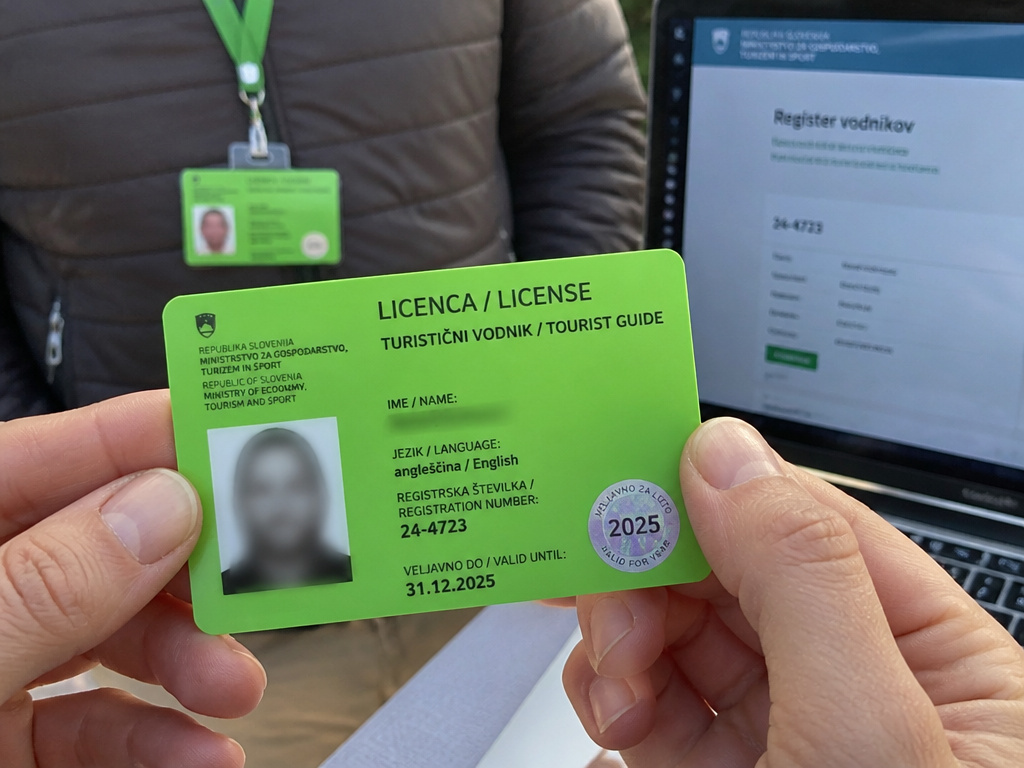
Slovenia’s online register runs under Article 35 of the Promotion of Tourism Development Act, published in Official Gazette RS No. 13/2018. Article 36 is the clause that matters to a traveler, because it imposes an annual renewal obligation on every guide.
The renewal has to be filed by 31 January of the current year, and it requires the guide to submit data on the number of days they spent guiding and the countries they guided for the previous year. Anyone who fails that obligation is removed from the online register after 1 February.
Treat a register entry as a dated photograph. Slovenia retakes it every 31 January, and anyone who misses the sitting is gone from the public file after 1 February.
What the Green License Card Actually Shows
The card is entirely green plastic and bilingual in Slovenian and English, carrying the logo of the Ministry for Economic Development and Technology and the Tourism and Hospitality Chamber of Slovenia. It’s issued in the guide’s name with a photograph, a registration number, and a sticker showing the current year.
That sticker is the field that certifies the annual renewal happened. It’s the fastest visual check you’ll ever make on a guide, and it takes about two seconds.
Guides are required to display the card in a prominent place while performing their tasks, so asking to see it isn’t rude. It’s the rule.
Common mistake: Reading a register entry as a reference check. Slovenian language proficiency, countries guided, and days guided are published on the guide’s own word, with no proof required.
Is a Licensed Guide Interpreter Guaranteed in Japan?
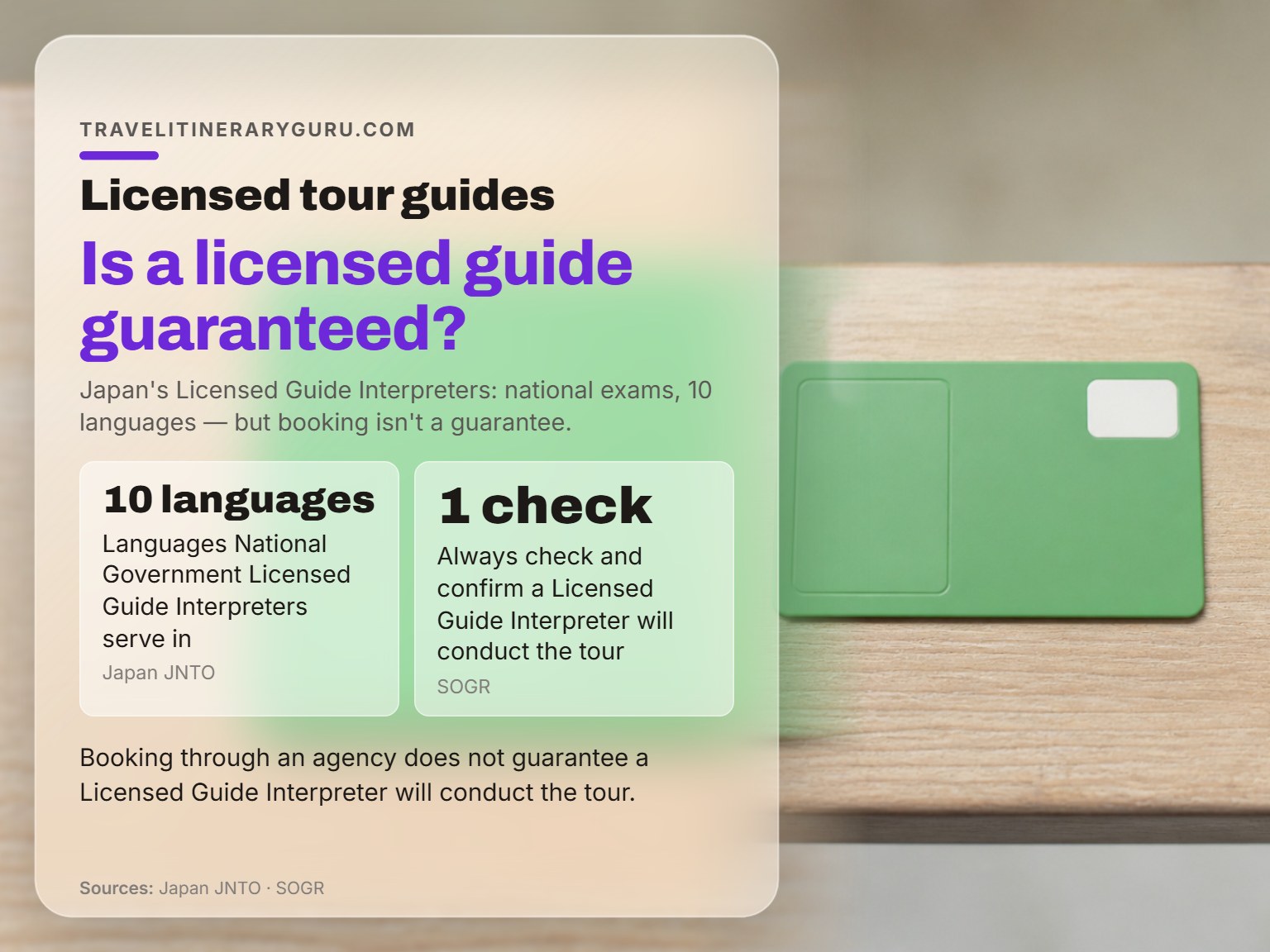
Japan’s guide system is the most exam-heavy one covered here, and it’s also the one where a perfectly legal booking can still leave you without the guide you thought you hired.
National Government Licensed Guide Interpreters have passed national examinations, and their services are available in 10 languages: English, French, German, Spanish, Italian, Portuguese, Russian, Chinese, Korean, and Thai.
You request one when you book your trip, or you book tours through a travel agency. JNTO’s own guidance says to always check and confirm that a Licensed Guide Interpreter will be conducting the tour, because it isn’t a guarantee.
I get why an agency booking feels like enough. It isn’t, and Japan is the clearest example. The tour can run exactly as sold with someone other than a Licensed Guide Interpreter at the front, and nothing about the booking will have been dishonest.
Most Licensed Guide Interpreters work as independent professionals, though you can also make a request through a national organization. Guides operate at both national and regional levels, which matters if you’d rather have someone based in the region you’re actually touring.
For Japan I’d book through a specialist rather than a general marketplace. The license check is still yours to make either way. For the days where interpretation is the entire point, choose a provider that specializes in licensed guides.
South Africa Verifies Guides With a Badge and an ID Card
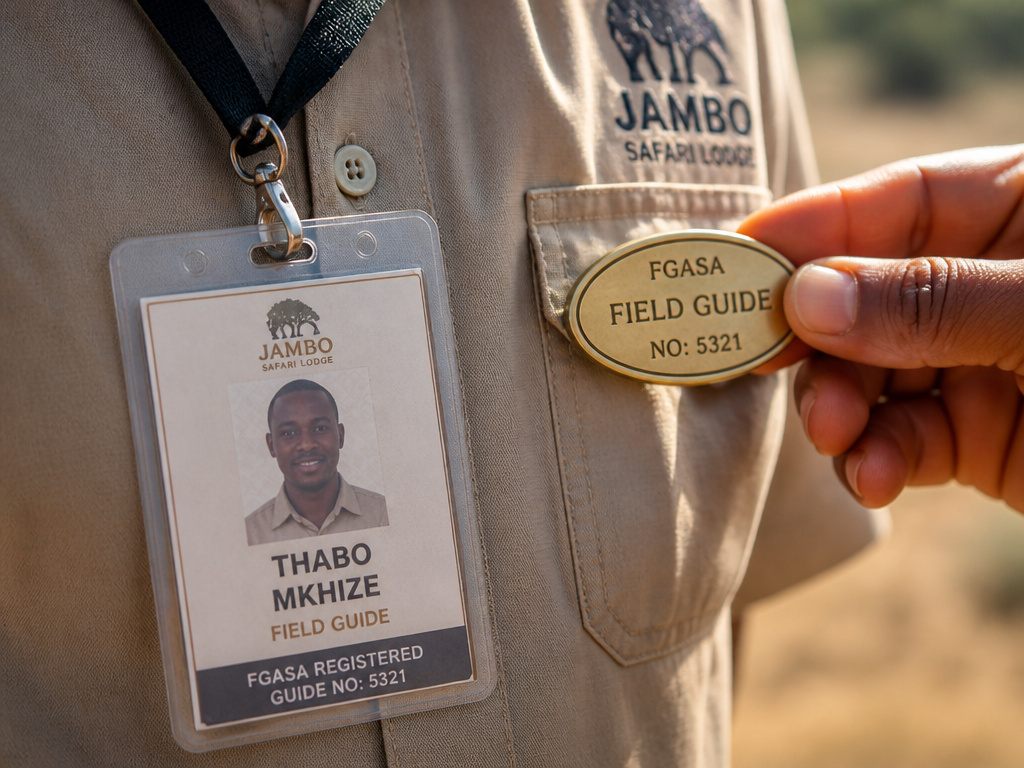
South Africa runs its verification on paper and plastic. A guide there carries a physical badge and an ID card, and policing authorities check them during spot inspections. There’s no public lookup to run before you go, which means the check happens in person.
The framework behind it is the Tourism Act No. 3 of 2014, which defines the scope of tourist guiding and establishes the offices of the National Registrar and the Provincial Registrars. The Department of Tourism’s guidance on how registered tourist guides are identified is the document to read before you travel.
The Six Things South Africa Requires Before Registration
- Proof of competence recognized by SAQA.
- A valid first aid certificate from an institution recognized by the Department of Labour.
- A signed application form, plus the prescribed fee.
- A signed copy of the code of conduct and ethics.
- Proof of South African citizenship, or for a non-citizen, a valid working visa granting permission to guide.
- Four passport-size photographs.
Training and assessment come first, with an accredited institution, before anyone registers with a Provincial Registrar. CATHSSETA is the Sector Education and Training Authority covering Culture, Arts, Tourism, Hospitality and Sport, and it accredits the training providers and quality-assures the programs.
Category systems don’t travel between countries, and it’s worth knowing which one you’re looking at. South Africa splits guides three ways, into nature, culture, and adventure, then crosses that with area: a site guide works one site, a provincial guide works one or more provinces, and a provincial guide competent to guide in all nine provinces is usually called a national guide. Sri Lanka uses two categories instead, National for coach groups and Chauffeur for car and van groups. Neither system maps onto the other, so “national guide” means something different in each country.
Where this goes sideways: Hiring an adventure guide who can’t produce a first aid certificate. Abseiling and mountain climbing fall under South Africa’s adventure category, and the certificate is a registration requirement for a reason.
The Register Fields That Carry No Proof
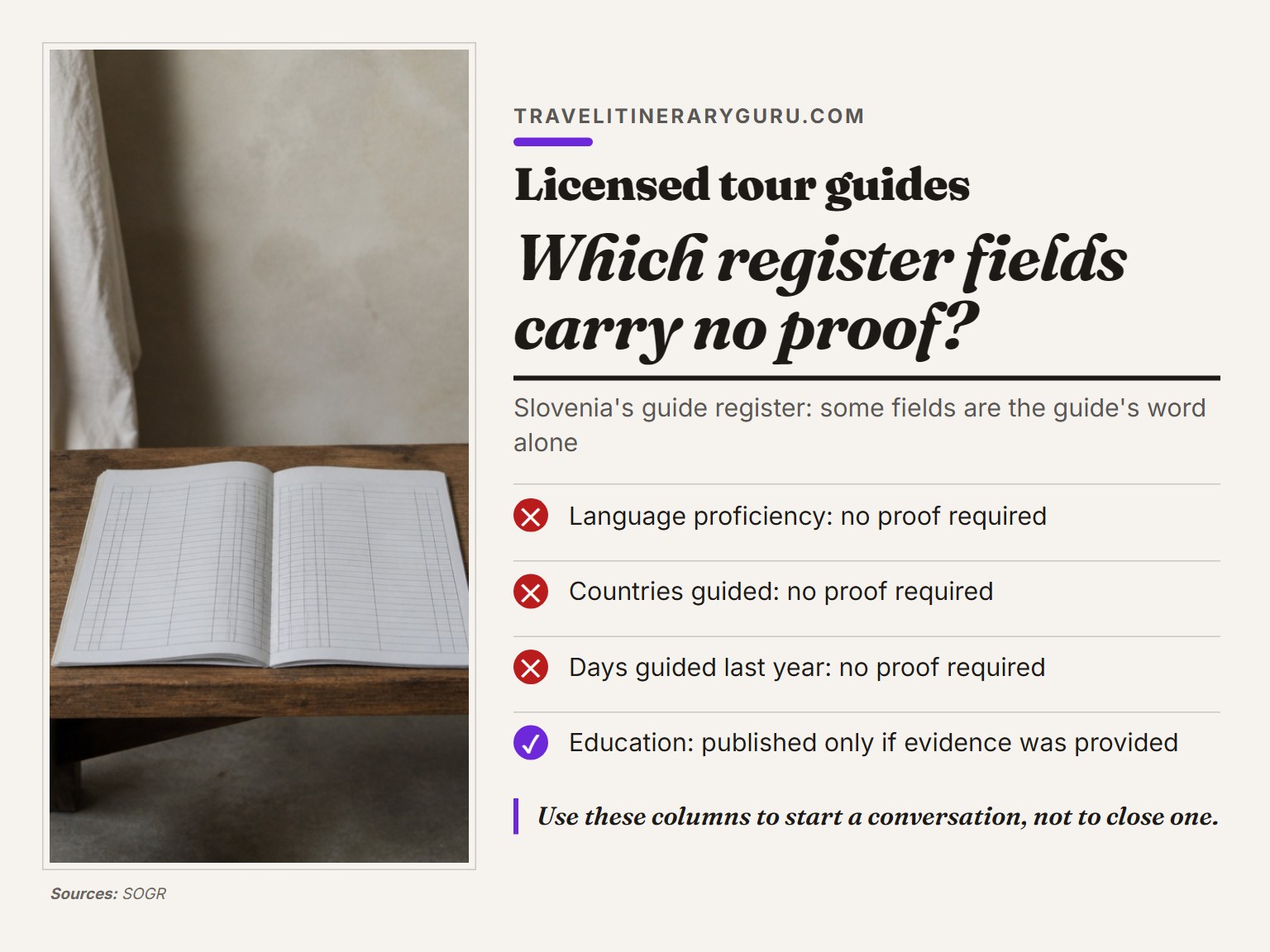
You open a guide’s register entry, see three languages listed, and quietly upgrade your estimate of them. Nobody verified any of it.
Slovenia’s register publishes foreign language proficiency, the countries a guide has guided in, and the number of days guided in the previous year. The register states plainly that this data is the responsibility of the individual alone, since no proof is required.
| Field on the entry | Who stands behind it | What that means for you |
|---|---|---|
| Registration number | The issuing authority | Traceable to the body that issued it |
| License status and date | The issuing authority | Tells you the license is live for this period |
| Language proficiency | The guide alone | No proof required |
| Countries guided | The guide alone | No proof required |
| Days guided last year | The guide alone | No proof required |
| Education | The guide, with evidence | Published only if evidence was provided |
The practical read: use those columns to start a conversation, not to close one. If a guide lists German and you need German, ask them to describe the last tour they ran in it. The answer tells you more than the column does.
Contact details work the same way. Slovenian entries show an email address and phone number only when the guide has given written consent to publish their personal data, so a sparse entry isn’t automatically a warning sign. Education data appears only when the individual has provided evidence of completion.
A register check is the first line of guided tour preparation, and it takes less time than reading the reviews.
How to Find a Licensed Tour Guide Before You Pay
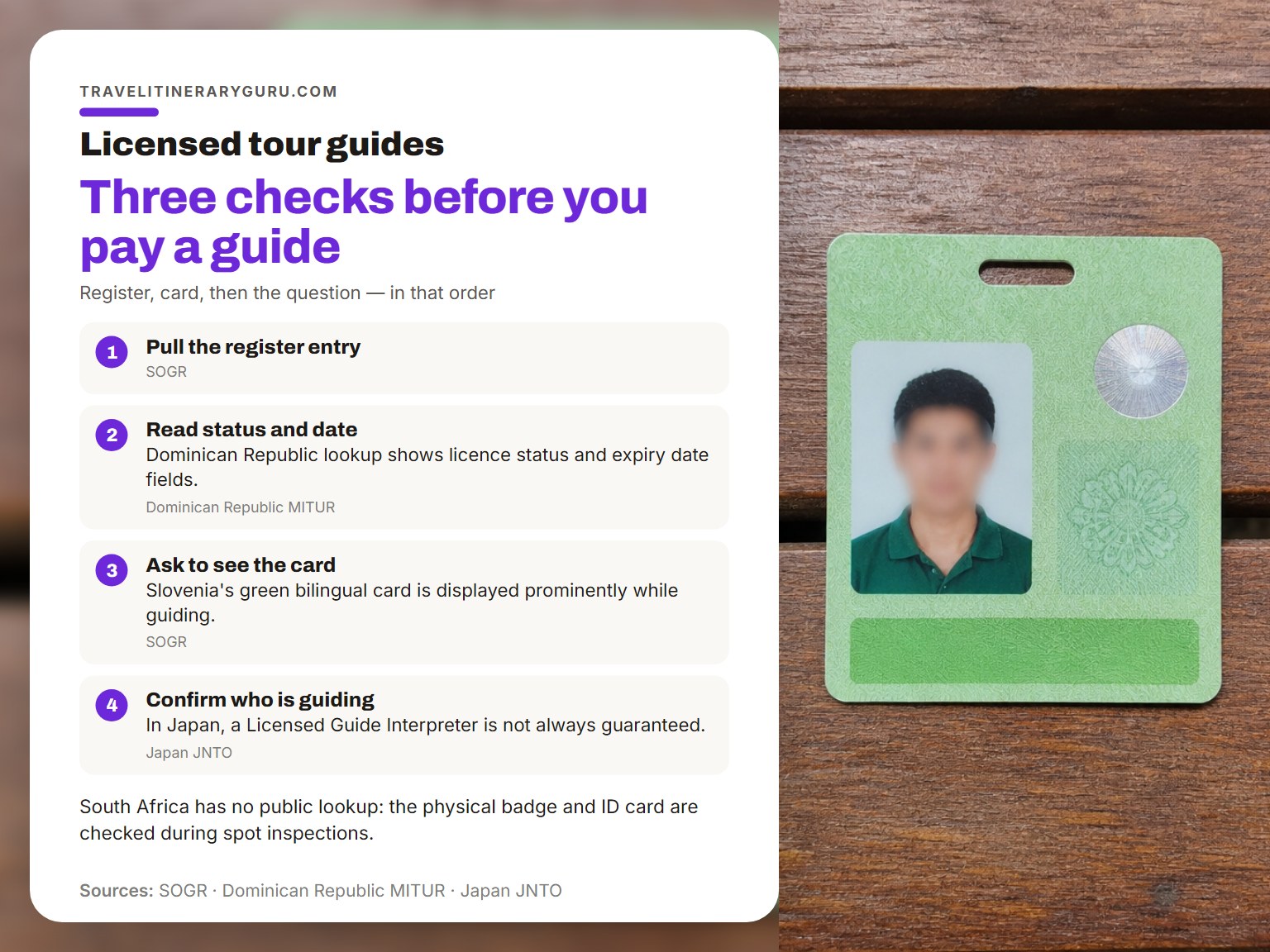
Three checks, in this order: the register, the card, and the question.
Before you start: Adventure guiding carries real risk, and the paperwork is the only warning you get. South Africa requires a valid first aid certificate from an institution recognized by the Department of Labour before registration, so ask to see it on any abseiling, climbing, or hiking tour. On a register entry, confirm the license status and expiration date; at the site, ask for the card. A guide who can produce neither is one you walk away from.
- Pull the register entry. In Slovenia, the Dominican Republic, or Sri Lanka, search the guide’s name or registration number. Skip this and you’re taking the agency’s word for a fact you can verify in a browser yourself.
- Read the status and the date. A license status field and an expiration date are the two columns that matter. An expired date means the guide is not currently registered, and no volume of good reviews changes that.
- Ask to see the card. Slovenia’s card is displayed in a prominent place while the guide works, so the request is expected. In South Africa there’s no register to fall back on, so the physical badge and ID card are the only check available.
- Test the self-declared fields. Language proficiency, countries guided, and days guided carry no proof requirement on the Slovenian register. Ask a specific question about the specific claim you’re relying on.
- Confirm who is actually guiding. In Japan, confirmation happens at booking, because a Licensed Guide Interpreter isn’t guaranteed even when the tour is sold as one. Ask in writing and keep the reply.
The uncomfortable part is that I’ve booked guides without running any of this, more than once, and gotten lucky. Luck is not a method.
There’s a softer half to this too, and it’s the questions to ask before booking a guided tour that decide whether a licensed guide is a good one. The same three checks apply if you’re booking a free walking tour instead.
None of that takes longer than reading the reviews you were going to read anyway.
Frequently Asked Questions
How do I know if a tour guide is licensed?
Check the issuing authority’s own record. Slovenia, the Dominican Republic, and Sri Lanka all publish lookups where you can search a guide’s name or registration number and see license status. Japan and South Africa don’t publish a public register, so verification happens at booking or in person.
What does a tourist guide license card look like?
It varies by country. Slovenia’s card is entirely green plastic and bilingual in Slovenian and English, with a photograph, a registration number, and a sticker showing the current year. The Dominican Republic issues the Tucard, which carries a QR code that pulls up the guide’s record when scanned.
Can a non-citizen work as a licensed tour guide?
In South Africa, yes, but citizenship alone won’t do it. A non-South African applicant must hold a valid working visa granting permission to work as a tourist guide, alongside the same competence, first aid, and code-of-conduct requirements every applicant faces.
How often do guide licenses expire?
It depends entirely on the country. Slovenia requires annual renewal by 31 January, and guides who miss it are removed from the online register after 1 February. Sri Lanka dates licenses to a specific day instead, so a card might read “Valid till 31st December 2027.”
Why would a legitimate guide be missing from a register?
Renewal deadlines lapse, consent forms go unsigned, and education data only appears when evidence is submitted. On the Slovenian register, contact details show up only with the guide’s written consent, so a minimal entry can belong to someone fully licensed.
The Bottom Line
Do this before you book anything: open the register for the country you’re visiting and search the guide’s name. Three of the six countries covered here let you do that from a browser, and it takes less time than reading one review.
None of this tells you whether a guide is worth listening to. A current license is a floor, and plenty of licensed guides are boring. The register answers one question completely, and you should treat it that way.
If I had to choose between a licensed guide with flat delivery and a brilliant unlicensed one, I’d take the licensed guide on any site where safety or access is involved. On a city you can walk, neither is necessary, and the money is better spent on a museum ticket and a long lunch.
One last thing worth saying plainly. A missing register entry can mean a lapsed renewal, an unsigned consent form, or a guide who simply stopped paying attention to paperwork. That’s the whole method behind how to find a licensed tour guide: find the issuing authority, query its record, and ask the two questions the record can’t answer.
