
How to Choose Between a Cruise and a Land Trip: Pack Once?
This post contains affiliate links. As an Amazon Associate, we earn from qualifying purchases.
How to choose between a cruise and a land trip comes down to three measurable things: how many times you pack a bag, what each day actually costs once extras are added, and how much time you really get ashore. A peer-reviewed PLOS ONE study of 6,863,092 travel questionnaires found cruise passengers reported less stomach upset than land package travellers (4.8% vs 7.2%), but the same study warns that travellers misclassify norovirus as seasickness, so the health comparison is messier than it looks.
That packing count is the one most people skip. On Viking’s 2027 Iconic Western Mediterranean you unpack once in Barcelona and next pack on the last morning in Civitavecchia. On Trafalgar’s Best of Italy Premium, you sleep in Rome, Florence, Venice, Assisi, Sorrento, and Rome again. Five hotel changes in eleven days.
What follows walks through the actual decision points: hotel-change math by named itinerary, per-day cost from operator from-prices, the port-time trap, and the source disagreements nobody puts in the brochure.
Key Takeaways
- Cruise base fares look cheaper until you add the extras. Daylin Travel lists service charges, drinks, specialty dining, internet, excursions, flights, bags, hotel nights, and transfers as separate line items.
- A port name is not a full day in the city. Check arrival, departure, and the all-aboard deadline before you count a destination as “seen.”
- Solo travellers get an asymmetric deal. Trafalgar matches roommates at the twin price on nearly all its solo tours; no cruise source in this set makes an equivalent claim.
- The health comparison is real but muddy. Cruise passengers reported lower stomach upset (4.8% vs 7.2%), yet the same study flags norovirus-as-seasickness misclassification.
How Many Times Will You Actually Pack a Bag?
Bag count is the cleanest way to answer how to choose between a cruise and a land trip. It strips out the marketing language about “immersion” and “convenience” and leaves a number you can hold in your hand.
Seabound counted start-to-finish bag packs from each operator’s published itinerary. Here is what those counts look like side by side.
| Itinerary | Days | Bag Packs |
|---|---|---|
| Viking Iconic Western Mediterranean | 8 | 1 |
| Viking Danube Waltz | 8 | 1 |
| Cosmos Rome, Florence & Venice | 7 | 3 |
| Princess Denali Explorer cruisetour | 11 | 4 |
| Trafalgar Best of Italy Premium | 11 | 6 |
The cruise counts are not zero because you still pack once at the start and once at the end. The land counts climb because every hotel change is a pack. Trafalgar handles one suitcase a person at each hotel, so you are not hauling bags yourself. You are still packing them.
A traveller who moves hotels every one to three nights spends time on packing, check-out, transit, and check-in at each move. Over an eleven-day tour with five changes, that adds up to a meaningful chunk of the trip spent on logistics rather than in the places you flew to see.
Cosmos does not include hotel porterage at all, by its own FAQ. That detail matters if you have a heavy bag and a bad back.
I get why the “unpack once” pitch sounds like marketing. Then I counted my own bags on a multi-city Italy trip and landed at more packs than I had planned for. The number was not the problem. The problem was that I had not planned for it.
What Does a Cruise Day Actually Cost Once You Add Everything?
Per-day cost is where the cruise-versus-land argument gets decided, and it is also where the two sides of this debate genuinely disagree.
AAA frames a cruise as “one booking that covers your room, meals and transport” and calls it “all-in-one value.” Daylin Travel opens with the opposite: “The per-person fare is only the beginning.” Both are describing the same product. They are weighting the inclusions differently.
Here is the per-day math from each operator’s 2027 from-price, per person, sharing, before flights.
| Operator and Itinerary | Days | Approx. Per Day |
|---|---|---|
| Princess Denali Explorer cruisetour | 11 | ~$120 |
| Cosmos Prague, Vienna & Budapest (sale) | 7 | ~$182 |
| Viking Danube Waltz | 8 | ~$250 |
| Viking Iconic Western Mediterranean | 8 | ~$325 |
| Trafalgar Best of Italy Premium | 11 | ~$370 |
| Viking Alaska + Denali Explorer | 16 | ~$675 |
The cheapest line on that chart is not automatically the cheapest trip. A cruise day includes dinner. A tour day usually does not. Trafalgar’s Italy tour leaves five of its eleven nights for you to fund.
Shore excursions split the same way. Viking gives one tour a port. Big-ship lines generally sell theirs separately, and those add up fast.
Then tips. Viking adds about $20 a person a day. On Trafalgar, its own guidance of $5-7 a day for the Travel Director and $3-5 for the driver comes to roughly $88-$132 each on that 11-day tour.
Where this goes sideways: Comparing a cruise fare to a land tour fare without normalising what each includes. A Viking fare with one excursion per port and onboard meals is not the same product as a Trafalgar fare with hotels and some meals included. Neither includes flights. Put both on a per-day, per-person scale before you decide.
The per-day tool that matters is the one you fill in yourself. Take the cruise you are considering and the land tour you are considering. Divide each fare by its day count. Then add the dinners, excursions, and tips that each one leaves out. That number is the one to compare.
Is a Cruise or a Land Trip Healthier? What the Data Actually Says
The only large-N comparative dataset on how to choose between a cruise and a land trip is a PLOS ONE study published 10 January 2014, covering summer 2000 through winter 2008. It looked at 6,863,092 questionnaires, 6.6% of them from cruise passengers.
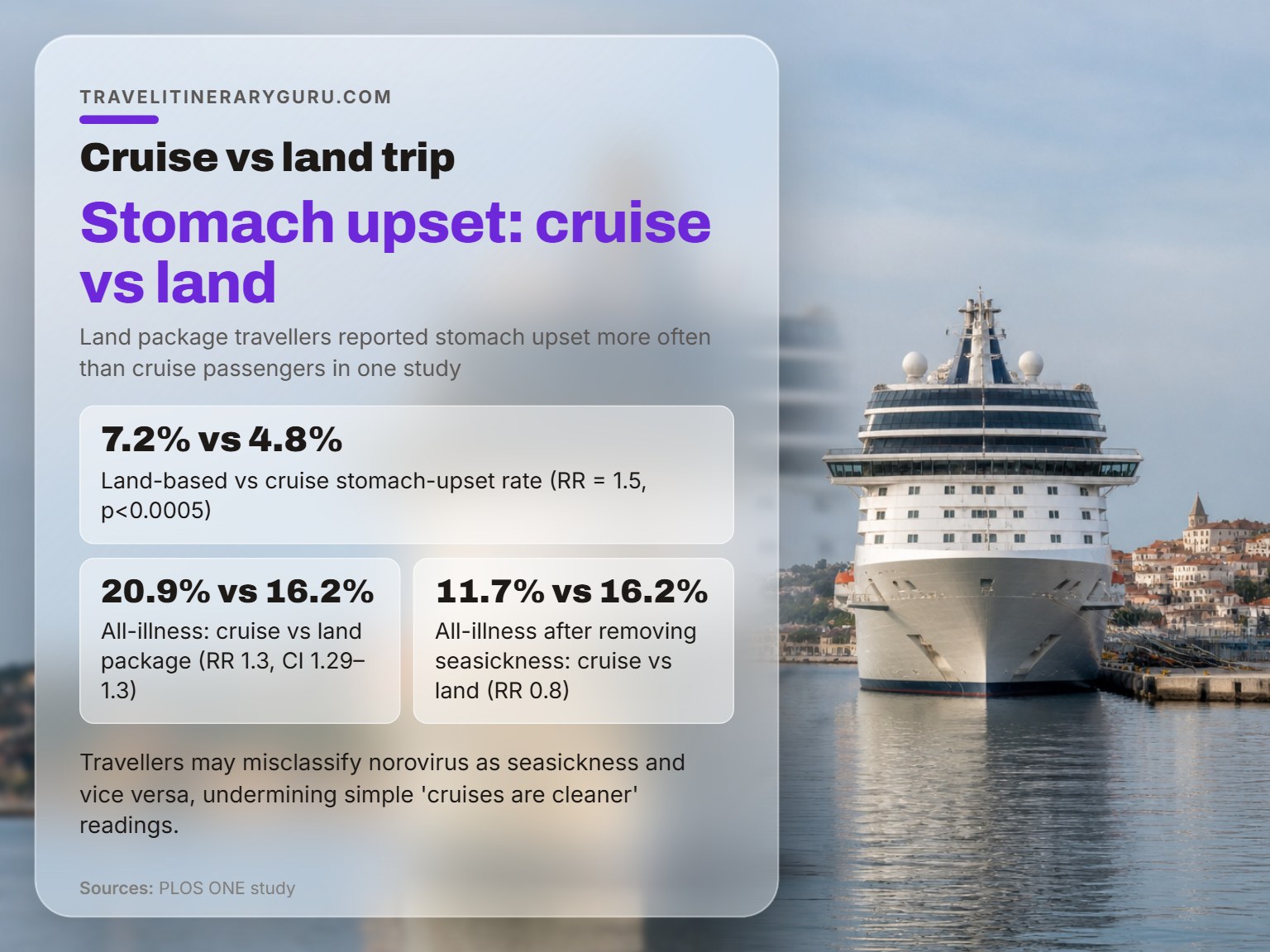
Land-based package travellers reported stomach upset at 7.2%. Cruise passengers reported 4.8%. That is a relative risk of 1.5, p<0.0005.
The all-illness comparison flips depending on how you count. Including everything, cruise passengers reported more illness overall: 20.9% versus 16.2%, relative risk 1.3. Strip out seasickness, which accounted for 10.2% of cruise illness, and the picture reverses: 11.7% cruise versus 16.2% land, relative risk 0.8.
The trend line also moved. Cruise stomach-upset rates fell from 7.1% in 2000 to 3.1% in 2008.
Where you go matters more than which format you pick. The highest land-based rates were reported by travellers to Egypt and the Dominican Republic, both above 25%. The highest cruise-based rates were on Egypt-departing cruises at 14.8% and Turkey cruises at 8.8%.
The study itself flags a methodological problem worth knowing. Travellers may misclassify norovirus as seasickness and vice versa. The study’s own >24-hour stomach-upset definition only partially corrects for it.
So the honest answer is: cruise passengers reported lower stomach upset, but the data has known holes. Anyone who tells you cruises are definitively cleaner is overselling a 2014 study that says so with caveats.
When Does a Port Name Stop Meaning a Full Day in the City?
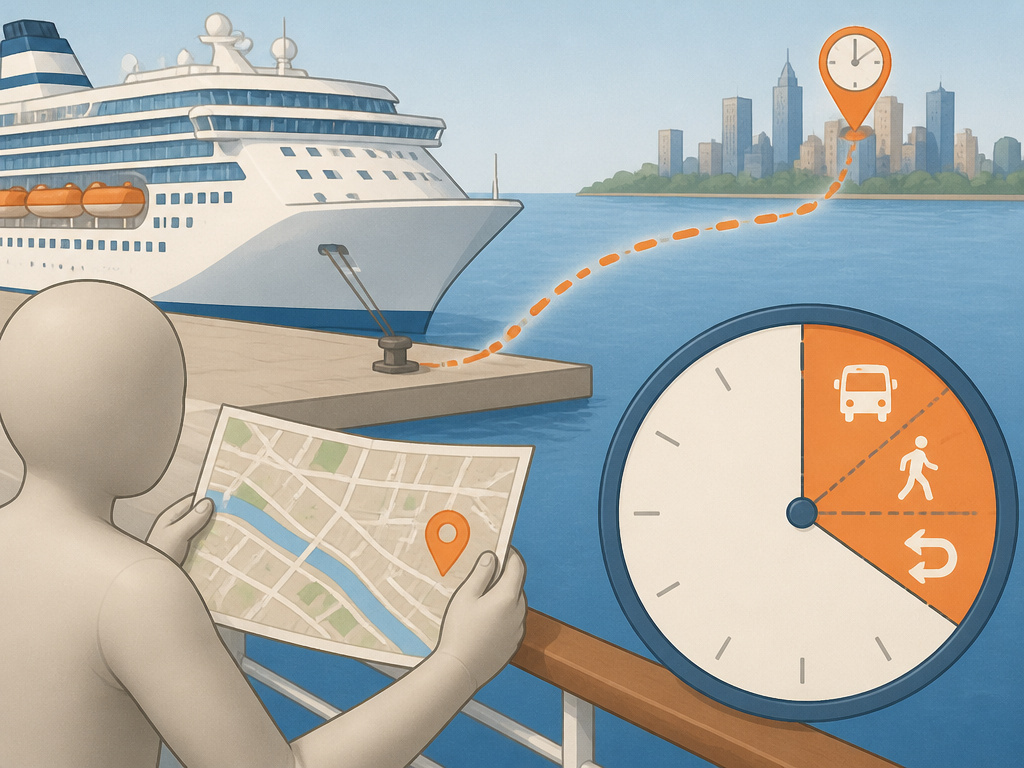
Port time is the quietest trap in cruise planning. Daylin Travel puts it bluntly: a port name does not mean a full day in the city.
Check arrival, departure, and the all-aboard deadline for every call. Then subtract disembarkation, the distance from port to your intended destination, transport time, and a return buffer. What is left is your actual window.
Florence is the clearest example. Ships do not dock in Florence itself, and the transfer from the cruise port to Florence takes additional time each way. Viking’s 8-day Iconic Western Mediterranean itinerary lists two days for Florence and Pisa. Many itineraries list Florence as a single port call.
Land travel has its own version of this problem. Transfer days between cities also consume hours. The difference is that on land you decide when to leave.
Common mistake: Booking an independent shore excursion that returns too close to all-aboard. The operator may not be responsible for the consequences if you miss the ship. Retain a return buffer and you will sleep better.
MSC offers excursion themes and levels depending on itinerary, and that variability is worth checking before you assume a specific experience is available on your sailing. With an external operator, confirm compatibility with your call and retain a return buffer. Do not assume a ship guarantee.
If your port is a tender port, the calculus changes again. Seabound flags rain at sea or a tender port as a cruise-specific failure mode that would spoil your one big day. There is no land equivalent because there is no tender.
Cruise or Land Trip for Families, Solos, and Mobility-Limited Travellers?
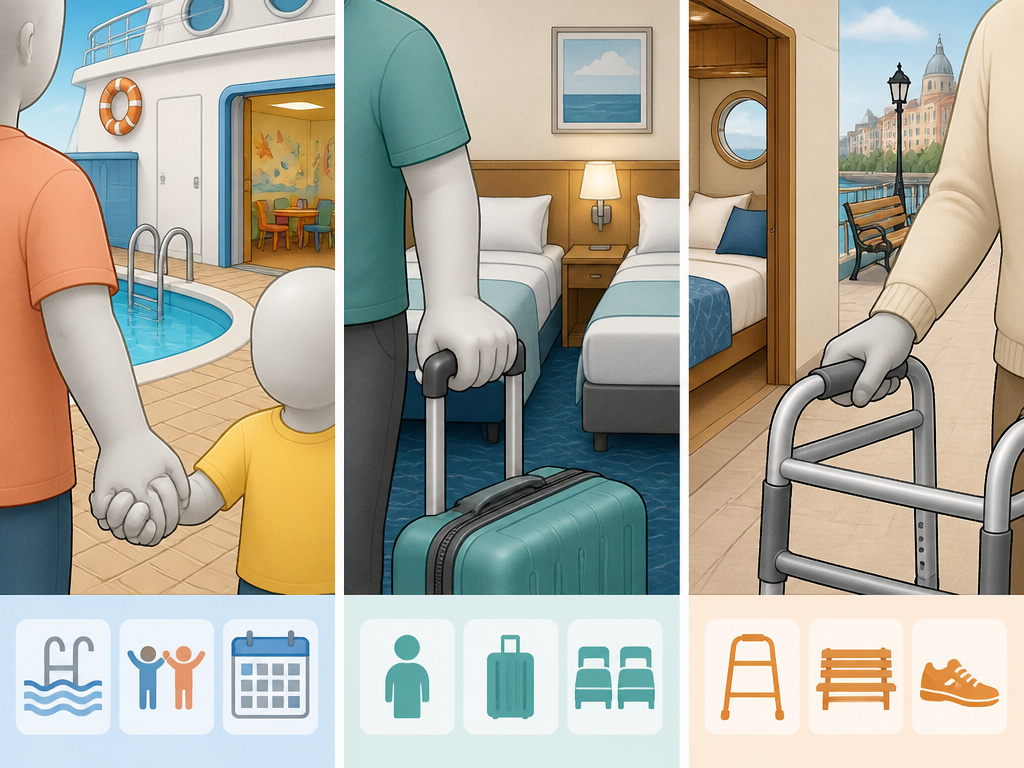
The generic advice breaks down here because the answer genuinely depends on who is travelling. The sources disagree on this, and the disagreement is worth showing rather than smoothing over.
Seabound says take a cruise if you are travelling with kids who need a pool and a kids’ club, while Daylin Travel notes one teenager may love onboard activities and another may prefer exploring cities. Daylin Travel pushes back: one teenager may love onboard activities, another may prefer exploring cities. Include their priorities rather than assuming all children want the same experience.
On mobility, Seabound’s position is that a cruise suits someone in the group who walks slowly or wants to skip a day because the ship carries your room, while Daylin Travel implies land can be managed with planning if you consider daily walking distances, rest, and room logistics. Daylin Travel implies land can be managed with planning, but you should consider daily walking distances, rest, and room logistics. Both are describing real trade-offs, not contradictions.
Solo travel is the clearest asymmetry. Trafalgar matches roommates at the twin price on nearly all its solo tours. No cruise source in this set makes an equivalent claim. That does not mean cruises are bad for solos. It means the land-tour side has a documented solo policy and the cruise side does not, at least not in this research set.
The part nobody mentions: With children, ask about age requirements and schedules for youth programs, cabin sleeping arrangements, and what happens on port days. Ask about schedules for youth programs on port days, which can change what your “kids’ club” cruise looks like the moment you dock.
Here is the decision table I would actually use with a real group.
| Traveller Type | Lean Cruise If | Lean Land If |
|---|---|---|
| Family with young kids | Pool and kids’ club matter more than depth | Kids want real cities, not onboard activities |
| Solo traveller | You want built-in social contact and structure | You want the Trafalgar twin-price roommate match |
| Mobility-limited | Someone needs to skip days without missing the trip | The group can plan rest windows into daily pacing |
| Multi-generational group | Different energy levels need different options | Everyone shares the same pace and interests |
Where Do Cruise and Land Trips Disagree About “All-Inclusive”?
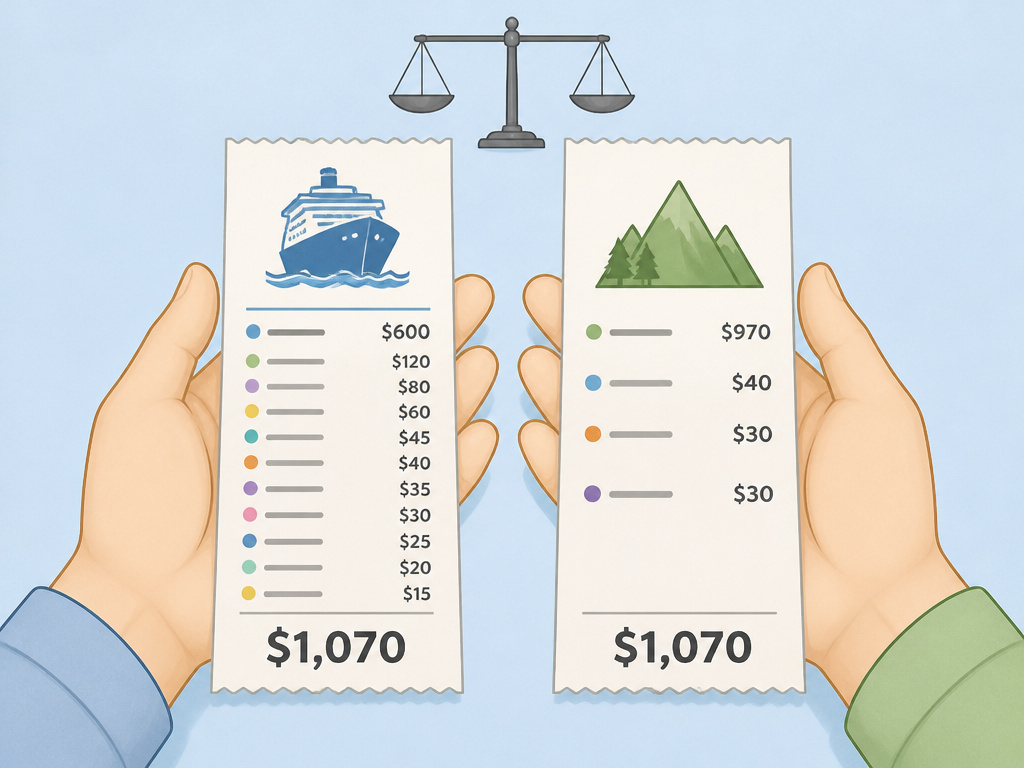
The word “all-inclusive” is doing different work depending on who is using it, and the disagreement is not semantic. It changes what you actually pay.
AAA describes a cruise package as covering your cabin, daily housekeeping, port-to-port movement, and evening entertainment in one upfront price, while Daylin Travel counters that the per-person fare is only the beginning and lists service charges, drinks, specialty dining, internet, excursions, flights, bags, hotel nights, and transfers as add-ons. It also notes that add-ons like drink packages and crew gratuities are often separate costs.
Daylin Travel goes further, listing service charges, drinks, specialty dining, internet, excursions, flights, bags, hotel nights, and transfers as items to verify. NCL, cited by Daylin Travel, lists accommodation, meals in included venues, and various onboard activities as included, alongside services that may cost extra.
Both are true. The gap is in how much of your total spend the “included” portion represents. For a light drinker who eats in the main dining room and skips paid excursions, the bundled portion is large. For a heavy drinker who books specialty dining and private tours, the bundled portion shrinks fast.
Skip this if: You are not a heavy drinker. Run the math against your actual habits before you add a drink package.
The same logic applies on land. A tour that includes 10 breakfasts and 5 dinners leaves you funding the rest. Cosmos does not include hotel porterage, by its own FAQ. Trafalgar handles one suitcase per person at each hotel but does not include every meal.
The right comparison is total trip cost for equivalent dates, travellers, and duration. Daylin Travel’s illustrative exercise makes the point: two alternatives for two people can both total US$5,500 despite starting from different base prices. Option A was US$3,200 base plus US$1,400 flights plus US$900 extras. Option B was US$4,700 flights and stays plus US$800 meals and activities. Same total. Different structure.
Which Format Fits Your First Trip to a Specific Region?
The answer changes by destination, and the sources disagree on the two most common cases.
For a first trip to Europe’s interior, Seabound leans land tour because Italy, Central Europe, and Britain’s best places sit away from the piers, while Vacay Alchemist counters that a cruise can be a strong option for sampling multiple destinations in one region before deciding where to return for a longer, deeper land trip. Vacay Alchemist counters that a cruise can be a strong option for sampling multiple destinations in one region before deciding where to return for a longer, deeper land trip. Both are describing the same trip from different angles.
For Alaska, Seabound leans cruise with land nights added at one end, but also says take a land tour if you want Denali for more than an afternoon. But Seabound also says take a land tour if you want Denali for more than an afternoon. A cruisetour like Princess Denali Explorer‘s 11-day itinerary counts four bag packs, which is the hybrid answer to the Alaska question.
For the Mediterranean coast and the Greek islands, Seabound leans cruise, while for Florence, Prague, or Denali it leans land; Vacay Alchemist counters that a cruise can be a strong option for sampling multiple destinations in one region before deciding where to return for a longer, deeper land trip. The pattern is geographic: coastlines and islands favour ships, and inland cities favour hotels.
Easy to miss: A cruise lets you test-drive a city before committing to a longer land trip. AAA makes this point directly. If you are not sure whether you would actually enjoy a city, a port call is a cheap way to find out. If you already know you love it, a port call is a frustrating tease.
Many experienced travellers combine both styles, pairing a cruise with a city stay before or after sailing. CruisePilot calls this out as a common pattern. That hybrid approach is often the honest answer for first-time Europe travellers who want coastlines and inland cities in the same trip.
If you are travelling with children, a family cruise has its own set of factors worth reviewing first. And if you are leaning land, the package tour pros and cons and choosing a guided tour guides cover the equivalent decisions on that side.
Frequently Asked Questions
Is a cruise cheaper than a land trip?
Not necessarily. Daylin Travel’s illustrative example shows two alternatives for two people both totalling US$5,500 despite different starting prices. The right comparison is total cost including flights, transfers, and extras for equivalent dates, travellers, and duration. Base cruise pricing often looks cheaper, but add-ons can close the gap.
How many times will I pack a bag on a cruise versus a land tour?
On Viking’s 8-day Iconic Western Mediterranean you pack once. On Trafalgar’s 11-day Best of Italy Premium you pack six times. The difference is the hotel-change interval. Land tours move hotels every one to three nights, while a cruise ship carries your room with you.
Are shore excursions included in the cruise fare?
It depends on the line. Viking gives one tour per port. Big-ship lines generally sell excursions separately, and those add up fast. MSC offers excursion themes and levels depending on itinerary. Always check your specific fare before assuming an excursion is included.
Is cruising healthier than land travel?
The PLOS ONE study found cruise passengers reported less stomach upset (4.8% vs 7.2%), but the same study flags that travellers may misclassify norovirus as seasickness. Once seasickness is removed, cruise passengers also reported less overall illness (11.7% vs 16.2%). The data is real but has known methodological gaps.
Can I combine a cruise with a land trip?
Yes, and many experienced travellers do. CruisePilot notes that pairing a cruise with a city stay before or after sailing is a common pattern. The hybrid approach often works best for first-time Europe travellers.
Which is better for solo travellers?
Trafalgar matches roommates at the twin price on nearly all its solo tours, which is a documented solo advantage on the land side. No cruise source in this research set makes an equivalent claim. That does not mean cruises are bad for solos, but the land-tour side has a clearer solo policy.
The Bottom Line
One threshold decides most of these cases: count the hotel changes, because the packing and transit time adds up. That is the number to check first.
If you want a first step this week, open the itinerary you are considering and count the bag packs. Not the destinations. The packs. Then divide the fare by the day count and add back the dinners, excursions, and tips that are not included. If the per-day number surprises you, that is the signal.
Here is the concession: this all changes if you are travelling with a group that has genuinely different energy levels. A cruise can absorb that difference well, because the ship carries the room and the person who needs to skip a day can skip it without derailing anyone else. If that is your group, the pack count matters less than the fact that everyone can find their own pace.
If you travel for restaurants and bars, the land side of this comparison deserves more weight than I have given it here. The math still holds. The weighting is yours to adjust.
