
How to Choose an Accessible Cruise Cabin: What to Verify
This post contains affiliate links. As an Amazon Associate, we earn from qualifying purchases.
To choose an accessible cruise cabin, you have to verify the specific features you need before you pay, because “accessible” isn’t a standardized term. Door clear width, roll-in shower, threshold height, and bed clearance all vary by ship and even by cabin within the same category, which is why knowing how to choose an accessible cruise cabin means checking each detail yourself.
That last part is where most how to choose an accessible cruise cabin bookings go wrong. Two cabins labeled the same thing on the same deck can have completely different bathroom layouts, and the deck plan won’t tell you which one you’re getting.
I’ve watched people book what they thought was a roll-in shower and end up with a shower tray and a step. So the rest of this walks through the door widths, the shower types, the threshold questions, and the exact wording to get in writing before you commit.
Key Takeaways
- Ask for clear width in inches, not “wide enough”, the US Access Board figure is 32 inches (815 mm), and Royal Caribbean‘s fleet runs 32 to 34 inches depending on ship.
- Confirm roll-in vs. Transfer shower, a cabin can be fully compliant and still have no roll-in shower at all.
- Check tender ports before you book, because some ports are reached only by small boat and aren’t wheelchair-accessible in any swell.
- Get the cabin’s features confirmed in writing before you pay; a label on a deck plan isn’t a commitment.
- Book well beyond the 48-hour assistance minimum, accessible cabins are a small, fixed number per ship and sell out first.
What Does “Accessible” Actually Guarantee on a Cruise Ship?
On a US-flagged vessel, “accessible” is a compliance floor set by regulation, not a product tier. The governing document is the Access Board passenger vessel lodging chapter, which sets out Table 224.2 for stateroom counts and §805 for what an accessible room must contain.
That how to choose an accessible cruise cabin distinction matters because a cabin can meet the letter of the rules and still not fit your chair.
The Access Board’s Table 224.2 sets accessible stateroom counts by vessel size, with a 5 percent cap exception that only affects the fourth through sixth rows of the table. A 101-stateroom vessel would require 7 accessible staterooms (6.9 percent) under the table, but only 6 (5.05 percent rounded up) under the exception.
Here’s the practical version. Compliance tells you the cabin passed inspection. It doesn’t tell you whether the shower has a lip, whether the bed has clearance on both sides, or whether the balcony door has a raised threshold you can’t cross without a ramp.
I get why the label feels like a guarantee. It isn’t one. The Accessible Escapes cruise accessibility guide puts it bluntly: a cabin can be technically accessible without being appropriate for your particular mobility needs.
Fully Accessible vs. Ambulatory Accessible: Which Cabin Type Do You Need?
These are two different cabins with two different feature sets, and not every line offers both. Pick the wrong one and you’ll spend the week working around a bathroom you can’t use independently.
A Fully Accessible cabin is built for someone who needs to maneuver a wheelchair or scooter throughout the cabin and bathroom. That typically means a wider stateroom and bathroom doorway, extra maneuvering space, a roll-in shower with a fold-down or removable seat, grab bars, a handheld showerhead, ramped or flush thresholds, a lowered sink or vanity, and reachable closet rods.
An Ambulatory Accessible cabin is for someone who has trouble walking or stepping into a standard shower but doesn’t need full wheelchair maneuvering space. It may have grab bars and an accessible shower configuration, but it may not have a roll-in shower or enough clear floor space to turn a power wheelchair.
Common mistake: Assuming every “accessible” cabin on a ship has the same layout. On Holland America’s Eurodam, some cabins are labeled Fully Accessible and others are Fully Accessible–Single Side Approach. That second label means you can’t get to both sides of the bed.
Accessible Escapes notes that Virgin Voyages, Holland America, Carnival, and Princess offer ambulatory accessible cabins. If you need one and your preferred line doesn’t have them, that alone can decide your booking.
| Cabin Type | Built For | Key Feature | Watch Out For |
|---|---|---|---|
| Fully Accessible | Wheelchair or scooter throughout | Roll-in shower, turning space | Still varies by ship and cabin |
| Ambulatory Accessible | Short walks, shower transfer | Grab bars, accessible shower | May have a step into the bathroom |
| Standard + modified features | Guests who walk short distances | Walk-in shower, shower seat | Not a full accessible cabin |
That third row is worth knowing about. Some ships offer cabins with modified features, a walk-in shower, extra grab bars, or a shower seat, for guests who can walk short distances. A shower stool, bed rails, or a raised toilet seat can often be supplied to a standard cabin on request. Ask what’s available, because it may free up an accessible cabin for someone who needs it more.
What Door Width and Turning Space Should You Ask About?
Door clear width is the number that decides whether your chair fits, and it’s the one most people ask about wrong. “Is the door wide enough?” gets you a yes or no. Ask for the clear width in inches.
The regulatory minimum for accessible stateroom entrance and passage doors is a 32 inch (815 mm) clear entrance door, per the Access Board’s PVAAC summary. Royal Caribbean states its accessible stateroom doors across the fleet run 32 to 34 inches depending on the ship, and bathroom doors match that range, while the Access Board’s PVAAC summary specifies a 32 inch (815 mm) clear entrance door as the compliance minimum.
Those two figures aren’t the same thing. The 32 inch number is a compliance minimum. The 32 to 34 inch figure is a fleet range. Don’t assume you’re getting 34 inches because you booked an accessible cabin on a line that advertises the upper end.
Turning space matters just as much. Royal Caribbean states its accessible staterooms have a five-foot turning radius in the sleeping areas, bathrooms, and sitting areas, while Accessible Escapes notes a cabin can be technically accessible without being appropriate for your particular mobility needs. Accessible Escapes suggests sixty inches as a useful standard to ask about for a power wheelchair, but notes the actual dimensions of the specific cabin matter more than the generic label.
So the question to ask isn’t “is the door wide enough.” It’s “what is the clear width in inches of the cabin door and the bathroom door on cabin number X, and is there a raised threshold at either one?”
Where the Roll-In Shower Question Gets Complicated
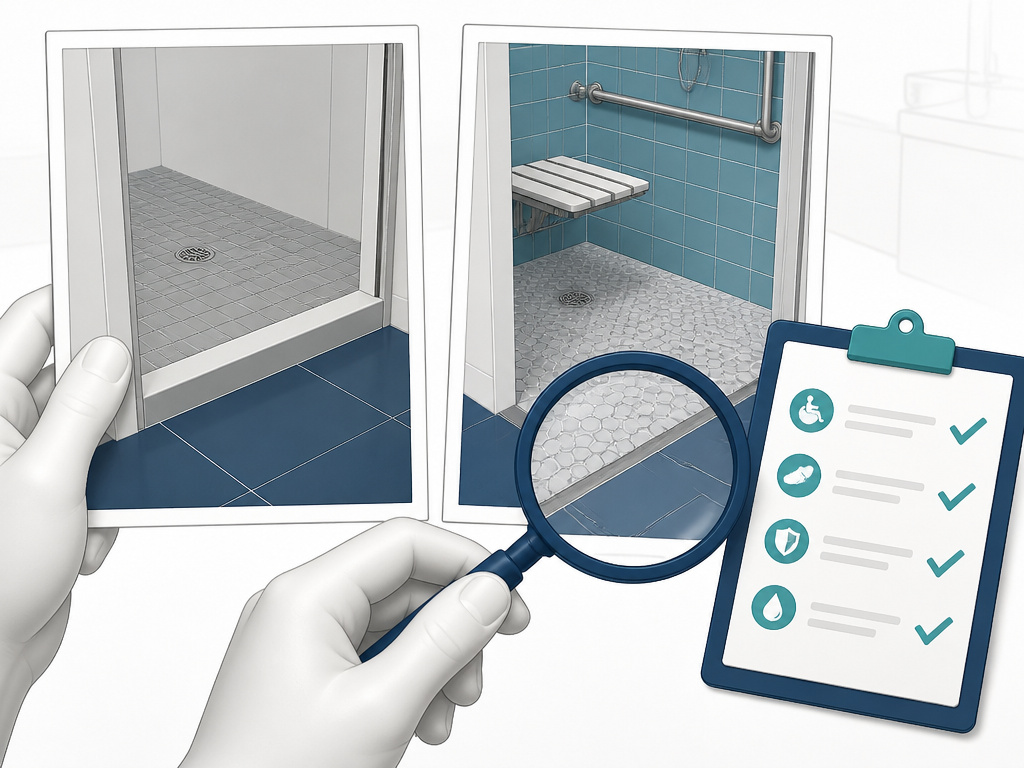
A roll-in shower is not guaranteed just because a cabin is accessible. This is the single biggest gap between what people expect and what they get.
The Access Board splits accessible staterooms between transfer-shower rooms and roll-in rooms. Under Table 224.2, a vessel with 51 to 75 total staterooms requires 3 transfer-shower rooms plus 1 roll-in room, for 4 accessible staterooms total. A vessel with 101 to 150 staterooms requires 5 transfer-shower rooms plus 2 roll-in rooms, for 7 accessible staterooms.
Read that again. On a 51-to-75 stateroom vessel, three of the four accessible cabins have transfer showers, not roll-in showers.
Royal Caribbean states its accessible staterooms have ramped thresholds and roll-in showers in bathrooms. That’s a fleet-level claim about one line. It doesn’t hold across every cruise line, and it doesn’t hold for every cabin category on every ship.
What most people get wrong: Booking an accessible cabin and assuming the shower is a roll-in. Ask specifically whether the shower has no lip, whether there’s a fold-down seat, whether there’s a handheld showerhead, and whether there are grab bars. Those are four separate questions.
Accessible Escapes has a useful example. On Holland America’s Koningsdam, accessible staterooms have generous accessible routes, but some Ambulatory Accessible rooms still have a step into the bathroom and a shower threshold. That’s a real ship with a real limitation that the label doesn’t surface.
The Balcony Threshold Nobody Warns You About
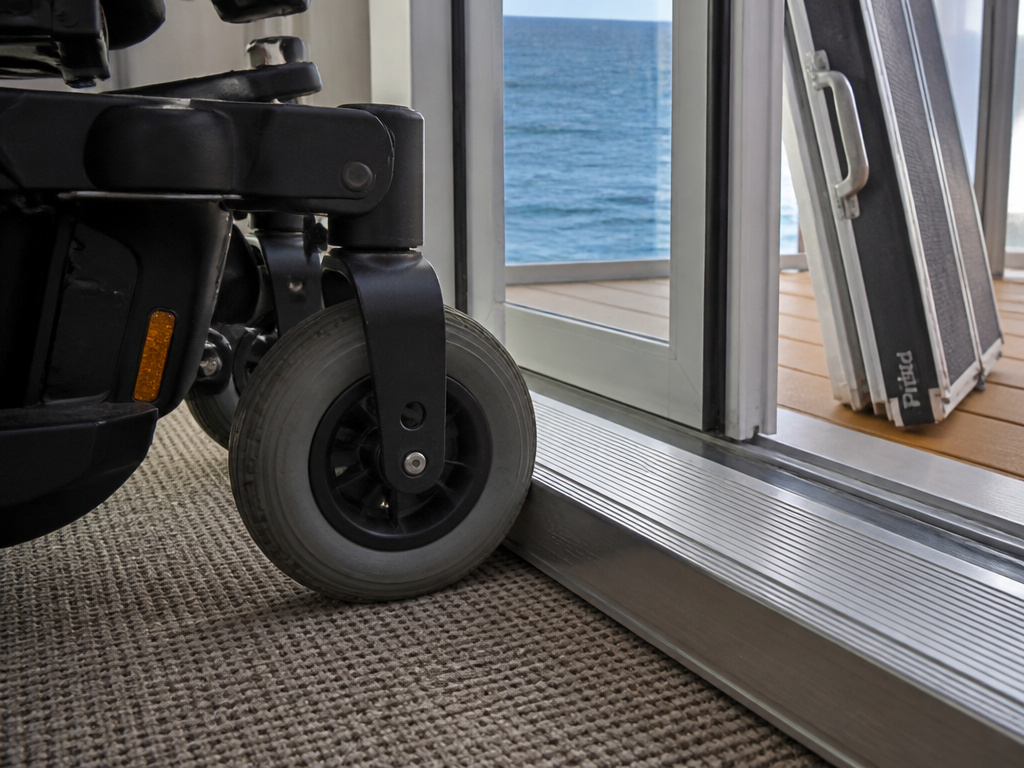
If a private balcony matters to you, the threshold between the cabin and the balcony is the question to ask. Many ships have a raised lip at the balcony door that may not be navigable in a power wheelchair without a ramp, and ramps aren’t always available.
That’s from Accessible Escapes, and it’s the kind of detail that turns a balcony cabin from a feature into a problem.
Celebrity Cruises and Holland America Line generally offer strong accessible balcony access, though conditions still vary by ship and cabin. Celebrity’s newer ships, particularly the Edge class, were purpose-built with accessibility in mind, with balcony access generally better than the fleet average and cabin layouts that reduce long corridor walks.
If a balcony is a priority and you use a power chair, ask two things: what’s the threshold height at the balcony door, and is a ramp available if the lip is too high to cross.
Why the Tender Port Question Decides Your Itinerary
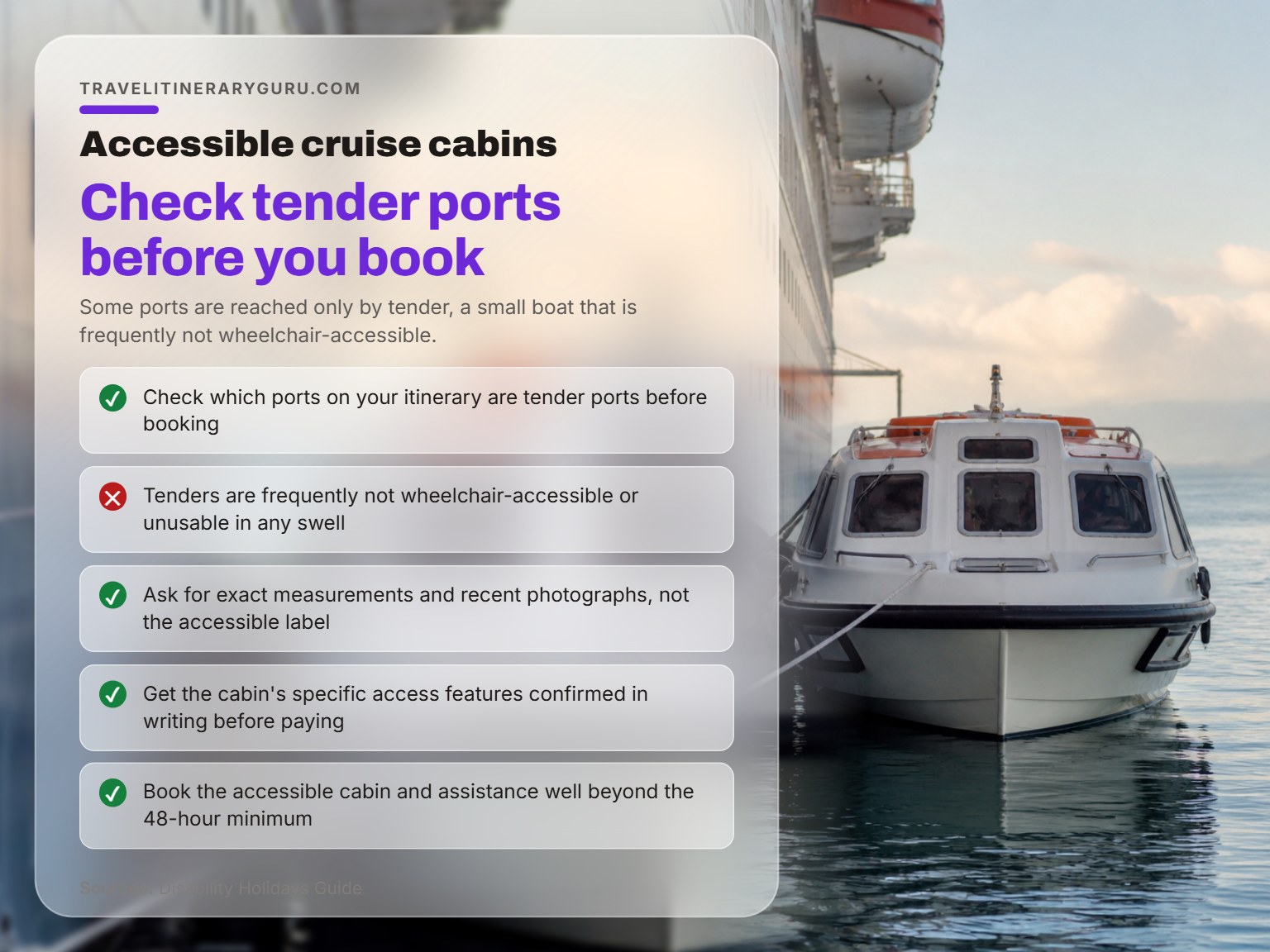
Getting on the ship is the easy part. Getting off at the ports is where the itinerary can fall apart.
Some ports have a dock the ship ties up against, so you roll off on a level gangway. Others are reached only by tender, a small boat that ferries passengers ashore. Tenders are frequently not wheelchair-accessible and can be unusable in any swell.
Check which ports on your itinerary are tender ports before you book. That single check decides where you can realistically go ashore, and it’s the detail most people miss until they’re standing at the gangway.
Skip this if: You’re booking a cruise purely for the ship and don’t plan to disembark. For everyone else, a tender-heavy itinerary on a mobility aid is a different trip than the brochure shows.
If you’re planning shore time independently rather than through the cruise line, the same logic that applies to accessible guided tour selection applies here: the operator’s accessibility claims need verifying, not trusting.
What to Get in Writing Before You Pay
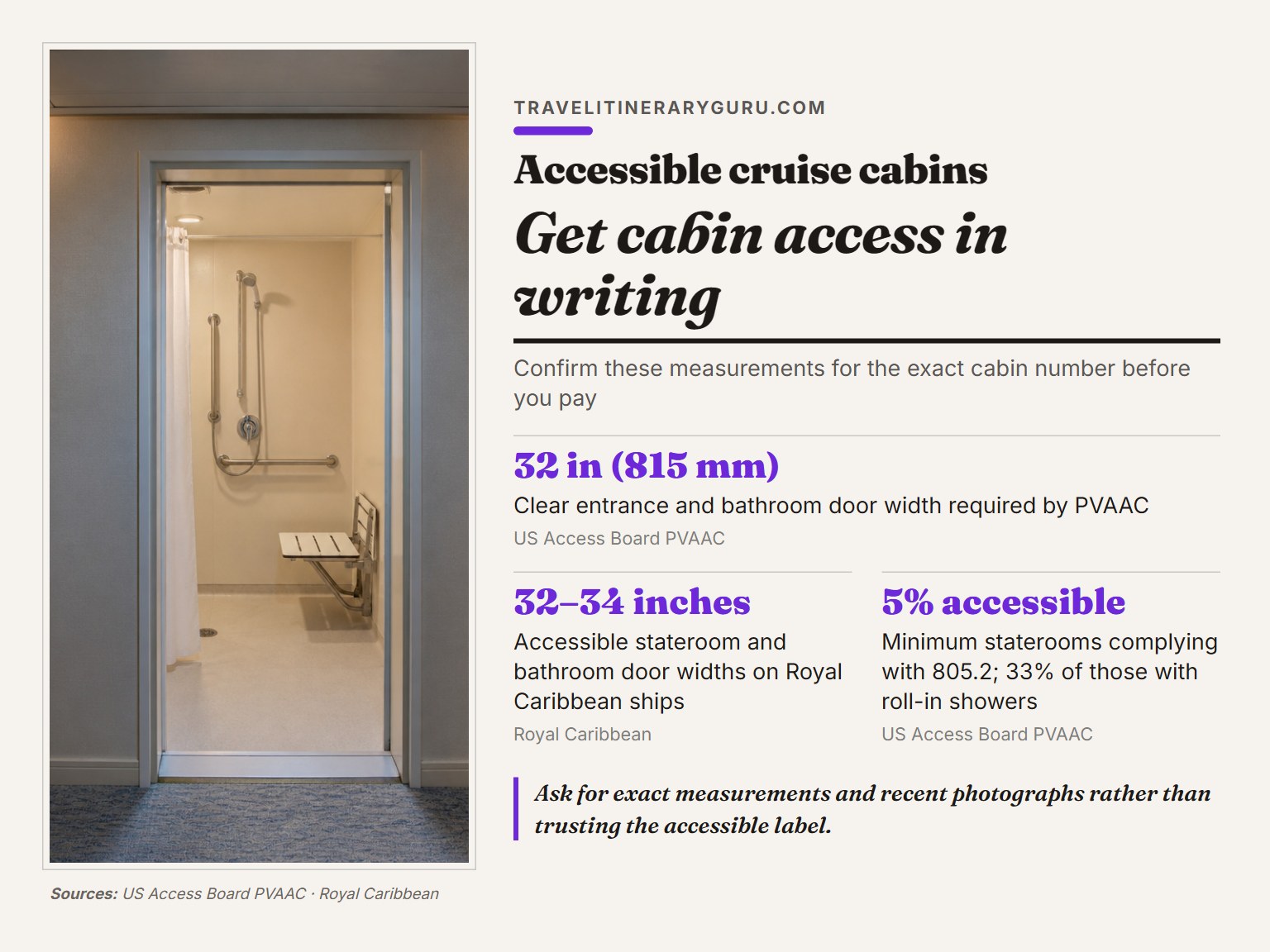
Get the cabin’s specific access features confirmed in writing before you pay. That’s the advice from Disability Holidays Guide, and it’s the single highest-value step in this whole process.
Accessible Escapes goes further: tell the cruise line exactly what features you require, particularly whether you need a roll-in shower, how much maneuvering space you need, and whether you need access to both sides of the bed, and confirm those requirements in writing before cruise documents are issued.
Here’s the checklist I’d want answered in writing for the exact cabin number:
- Clear width in inches of the cabin door and the bathroom door.
- Whether there’s a raised threshold at either door, and at the balcony door if applicable.
- Shower type, roll-in with no lip, or transfer with a tray. Plus fold-down seat, handheld showerhead, and grab bars.
- Bed clearance, can you get to both sides of the bed, or is this a single-side-approach cabin?
- Distance to the nearest elevator bank, and which elevators serve the main dining room, theater, and pool deck.
That last one isn’t cosmetic. A beautifully designed cabin at the far end of a long corridor can be tiring for someone who walks with difficulty or propels a manual chair. Midship cabins also tend to feel less motion in rough seas.
If you’re also handling the flight side of the trip, the same verification discipline applies to flying with a wheelchair, the airline’s written confirmation matters more than what the booking agent told you.
| Question | What to Ask | Why It Matters |
|---|---|---|
| Door width | Clear width in inches, both doors | 32 inches is the floor, not a guarantee |
| Threshold | Raised lip at any door? | Balcony lips block power chairs without a ramp |
| Shower | Roll-in with no lip, or transfer? | Three of four accessible cabins on some ships are transfer |
| Bed | Both sides accessible? | Some cabins are single-side approach only |
| Location | Distance to elevator bank | Corridor length adds up over a week |
Booking Timing and What to Do If Nothing’s Available
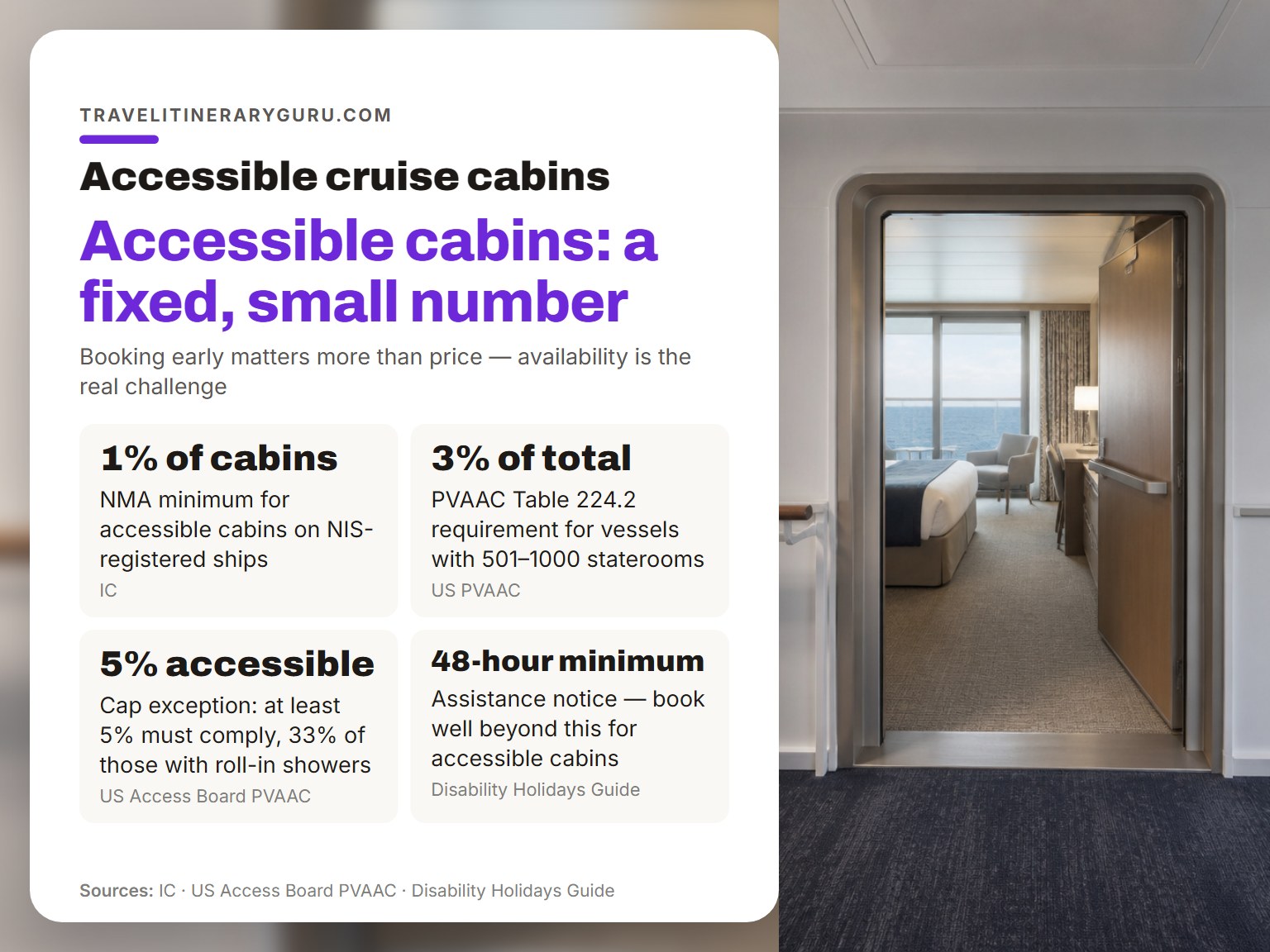
Accessible cabins are a small, fixed number on each ship and typically sell out first. Disability Holidays Guide advises booking well beyond the 48-hour minimum for assistance, because accessible cabins go before standard ones do.
Accessible Ocean Cruises states accessible cabins are generally priced like the standard cabins in the same category, while Disability Holidays Guide emphasizes that accessible cabins are a small, fixed number on each ship and sell out first, so booking early matters more than for a standard cabin. The challenge is availability, not price. That’s worth knowing if you’ve been quoted a premium, ask why.
If no accessible cabin is available on your sailing, you have options. Ask to be wait-listed. Look at other sailings on the same ship. Consider a standard cabin with an accessible bathroom option if your needs allow. Some lines also offer cabins with modified features, such as a step-free shower, for ambulatory guests.
Policies on medical notes vary by line. Many ask you to confirm on a form that you or someone in your party needs the cabin’s accessible features, and some reserve the right to move guests who book one without that need. Ask when you book, not after.
Worth knowing before you start: Flag state changes the rules. Norwegian International Ship Register vessels fall under Norwegian Maritime Authority interpretations, which set accessible cabin minimums at 1 percent of cabins, a different floor than the US Access Board table produces.
That’s not a detail you need to memorize. It’s a reason to ask which regulatory regime the ship operates under if you’re comparing two lines on paper.
Frequently Asked Questions
How wide are accessible cruise cabin doors?
The Access Board’s PVAAC summary specifies a 32 inch (815 mm) clear entrance door as the compliance minimum, while Royal Caribbean states its accessible stateroom doors run 32 to 34 inches depending on the ship. Royal Caribbean states its accessible stateroom doors run 32 to 34 inches depending on the ship. Ask for the clear width in inches on the specific cabin you’re booking, because the range isn’t a guarantee.
Do all accessible cruise cabins have roll-in showers?
No. The Access Board’s Table 224.2 splits accessible staterooms between transfer-shower rooms and roll-in rooms, while Royal Caribbean states its accessible staterooms have roll-in showers, and Accessible Escapes notes an Ambulatory Accessible cabin may not provide a roll-in shower. On a vessel with 51 to 75 staterooms, three of the four accessible cabins have transfer showers, not roll-in showers. Royal Caribbean states its accessible staterooms do have roll-in showers, but that’s a fleet-level claim for one line.
What’s the difference between a fully accessible and an ambulatory accessible cabin?
Fully accessible cabin is built for maneuvering a wheelchair or scooter throughout the cabin and bathroom, with a roll-in shower and turning space. An ambulatory accessible cabin is for guests who have trouble walking or stepping into a standard shower but don’t need full wheelchair maneuvering space. It may not have a roll-in shower or enough clear floor space to turn a power wheelchair.
Should I book a balcony cabin if I use a power wheelchair?
Ask about the threshold between the cabin and the balcony first. Many ships have a raised lip at the balcony door that may not be navigable in a power wheelchair without a ramp, and ramps aren’t always available. Celebrity Cruises and Holland America Line generally offer strong accessible balcony access, but conditions vary by ship and cabin.
How far in advance should I book an accessible cruise cabin?
As early as you can. Each ship has only a small, fixed number of accessible cabins, and they’re usually the first to sell out. Book well beyond the 48-hour minimum for assistance, and get the cabin’s specific access features confirmed in writing before you pay.
Are accessible cruise cabins more expensive than standard cabins?
Accessible Ocean Cruises states accessible cabins are generally priced like the standard cabins in the same category, and the challenge is availability rather than price, while Disability Holidays Guide emphasizes that accessible cabins are a small, fixed number on each ship and sell out first, so booking early matters more than for a standard cabin. If you’re quoted a premium, ask why, the accessible cabin in the same category shouldn’t carry one.
The Bottom Line
One rule I’d put above everything else here: if you can’t get the cabin’s specific access features confirmed in writing before you pay, don’t book that cabin. A verbal “yes, it’s accessible” from a call center isn’t a commitment. A written confirmation of door width, shower type, threshold height, and bed clearance is.
The second rule is about sequencing. Verify the cabin first, then verify the ports. A perfect cabin on a tender-heavy itinerary is a different trip than the one you thought you booked, and the tender question is the one that’s hardest to fix after final payment.
And if you’re comparing this against a land-based option, the same verification logic applies to how to find accessible hotel rooms, the label means less than the measurements. The difference on a ship is that you can’t check out and walk to the next place if the bathroom doesn’t work. You’re on that cabin for the whole voyage.
So ask the five questions. Get the answers in writing. Then book.
