
How to Choose a Women-Only Group Tour: What to Ask
This post contains affiliate links. As an Amazon Associate, we earn from qualifying purchases.
I’m going to be honest with you before we start: I have a blind spot here. I plan trips for a living, and I have learned to defer to people who have actually lived the solo female travel experience rather than pretend I know what that’s like from a desk. If you want to know how to choose a women-only group tour, these are the people to ask. So this piece leans on the operators and researchers who have done the work.
To choose a women-only group tour, check five things before you pay: the maximum group size, whether a female leader travels with the group for the whole trip, how solo travellers are paired in rooms, what the price actually includes, and whether the itinerary is women-only on paper or in practice.
That’s the short version of how to choose a women-only group tour. The long version has a few traps in it that most booking pages are designed to walk you past.
Here’s the part nobody tells you. What you rank as important at the moment of booking is not what you value most once you’re back home. A 2006 University of Zagreb study of 130 past clients of an Australian all-female walking-tour company measured this directly, and the results should change how you read a tour description.
What follows: the five checks in order, the group-size disagreement the industry has never settled, and the one question that separates a real women-only tour from a relabelled package.
Key Takeaways
- Ask for the maximum, not the typical. Wovoyage warns “small group” can mean 10 or 40, while CBI describes women-only groups only as “small groups” without a numeric threshold.
- A female leader for the whole trip is Wovoyage’s recommendation, while Women Traveling Together sends a company tour leader on every tour and CBI describes female guides as the general market norm.
- Room pairing is the hidden cost. Wovoyage says most women on group trips travel alone and warns that a low headline price often assumes you’re bringing a friend, while CBI advises negotiating deals for solo travellers who want single rooms and WTT arranges room sharing for those who want to save money.
- Wovoyage advises reading Google reviews, not the testimonials page. Reviews that name the trip leader are usually genuine.
- Confidence in the leader was rated important both before and after the trip, according to the Zagreb study, while group composition and shared accommodation gained importance only after it.
What the Research Says Women Actually Want
Confidence in the tour leader, confidence in the destination and its culture, and not being treated as a mass tourist were rated important both before and after the trip in the Zagreb study. That part is unsurprising.
The interesting finding is what changed. Travelling with all-female company, being cared for and pampered, and sharing accommodation all increased in importance after the tour. Travelling with all-female company, being cared for and pampered, and sharing accommodation all increased in importance after the tour.
An all-female travel survey of 130 past clients found that confidence in the tour leader, the destination and its culture, and avoiding a mass-tourist experience rated as important both before and after travel. Group composition and shared accommodation gained importance only after the trip.
Read that again and it reframes the whole decision. You are shopping on destination and itinerary. You will remember the leader and the group.
One caveat worth stating plainly: that sample was 130 past clients of a single Australian all-female walking-tour company, so treat those findings as directional rather than settled. If you’re 28 and booking your first group trip, treat those findings as directional rather than settled.
What Is a Realistic Group Size for a Women-Only Tour?
The honest answer to how to choose a women-only group tour is that no source in this market agrees on a number, and anyone telling you there’s a standard is selling something.
Wovoyage’s position is that “small group” can mean 10 or 40, and that you should ask for both the typical size and the maximum. Their stated sweet spot is somewhere between 8 and 15 travellers. My Lady Trip splits the market differently: small boutique groups at 8 to 12 people, large commercial groups at 25 or more. CBI, the Netherlands Centre for the Promotion of Imports, describes women-only groups only as “small groups” and attaches no number at all.
Three positions, one question. Here’s how they line up.
| Source | What They Say About Size | What It Means for You |
|---|---|---|
| Wovoyage | “Small group” can mean 10 or 40; 8 to 15 is the sweet spot | Ask for maximum, not typical |
| My Lady Trip | Boutique is 8 to 12; commercial is 25+ | Treat 25+ as a different product |
| CBI | Describes groups only as “small groups” | No numeric threshold exists |
Wovoyage’s practical move is to ask for the maximum in writing and then decide whether you’d still enjoy the trip at that number, while CBI attaches no numeric threshold to “small groups” at all. If a company dodges the question, that’s your answer.
Where this goes sideways: Booking on the typical group size. Operators quote the average because it’s smaller, then fill the departure to the maximum. You find out at the airport gate, and you’re committed.
Size matters for a mechanical reason, not just a vibe reason. A group has to fit in one vehicle on most of these itineraries. Once you exceed the seat count, the operator either splits the group across two vans, which breaks the shared experience, or moves to a coach, which changes the entire rhythm of the day. That’s why the 8 to 15 range keeps showing up: it is Wovoyage’s stated sweet spot for group size.
Who Should Lead the Tour, and Does It Matter?

This is where the sources genuinely split, and the split is more useful than a consensus would be.
Women Traveling Together, running since 1997 and operating more than 100 tours a year, sends a WTT Tour Leader on every tour. That leader is a company employee. The company’s stated principles don’t require that person to be local.
CBI describes the market norm differently: women-only tours are generally led by female guides. That’s a description of what usually happens, not a quality standard.
My Lady Trip treats leadership as the differentiator. Their framing is blunt, a generic guide following a script versus a local woman who knows the secrets of the land, and they work exclusively with local female guides.
Wovoyage lands closer to My Lady Trip but with a different emphasis: a company sends a female trip leader for the whole trip rather than handing you from one local guide to the next.
Common mistake: Assuming “female guide” and “female trip leader” are the same thing. A local guide is excellent at history and context. A trip leader handles the hotel check-in, the driver, the missed connection and the sick traveller at 2 a.m. Those are different jobs.
My read: you want both, and you should ask for both. A local female guide who knows the region is worth more than a scripted generalist. A trip leader who stays with the group from arrival to departure is worth more than a rotating cast. If a company can only offer one, ask which one and why.
For a broader look at how to evaluate a guided tour before you commit, the same logic applies across the category.
The Room Pairing Question That Changes the Price

Most women on group trips travel alone. Wovoyage states this directly, and it’s the single most useful piece of pricing information in this whole decision.
Wovoyage’s recommended model is a twin room shared with another woman from the group, with a private room offered as a paid upgrade, while CBI advises negotiating deals for solo travellers who want single rooms and WTT arranges room sharing for those who want to save money. Wovoyage recommends exactly that structure and warns about the alternative: a low headline price that quietly assumes you’re travelling with a friend.
Women Traveling Together arranges room sharing for those who want to save money, which is the same principle from a different angle.
CBI takes a third position, aimed at operators rather than travellers: negotiate good deals for solo female travellers who want single rooms, because single room occupancy supplements can be very expensive. That’s advice to the supply side, and it tells you the supplement is a real cost you should price in before you compare two tours.
| Source | Position on Solo Travellers | What to Ask |
|---|---|---|
| Wovoyage | Pair with another woman by default; private room as paid choice | Is pairing automatic or optional? |
| Women Traveling Together | Room sharing arranged for cost savings | Can I request a specific pairing? |
| CBI | Negotiate deals on single rooms; supplements are costly | What’s the supplement, and when is it due? |
Wovoyage’s question to ask is not “do you have single rooms” but “if I book as a solo traveller, what happens by default, and what does the alternative cost,” while CBI advises negotiating deals for solo travellers who want single rooms and WTT arranges room sharing for those who want to save money. Those are different questions and they produce different numbers.
I once booked a group experience without confirming one participant’s needs upfront, and one person couldn’t take part in the main activity. That was a hard lesson in asking more questions before money changes hands. Rooming is the same category of question.
Is the Trip Actually Women-Only, or Just Labelled That Way?
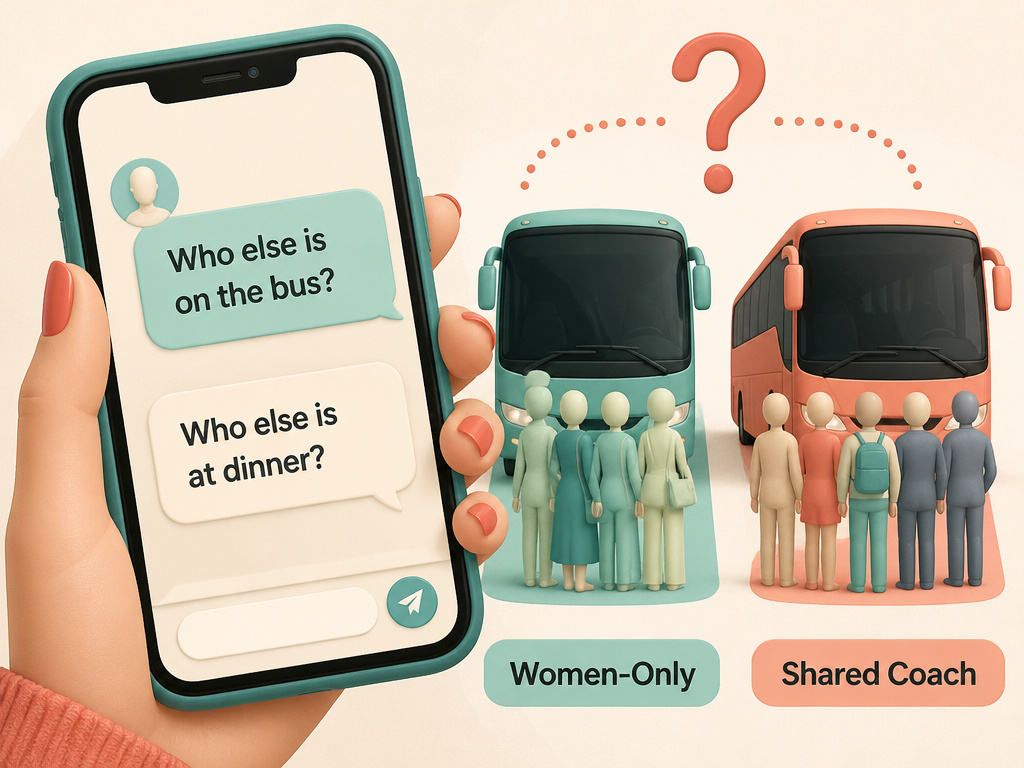
Some trips are women-only on paper but share coaches, tables or activities with mixed groups. Wovoyage documents this and tells buyers to ask directly who else will be on the bus and at dinner.
That’s not a small detail. If the whole reason you booked is the group dynamic the Zagreb study measured, the relaxed, congenial atmosphere, the shared interests, the absence of competition and tension, then a shared coach undoes it. You’ve paid for a women-only experience and received a women-only seating arrangement.
Ask the question in plain language: who else is on the bus, and who else is at dinner. If the answer is vague, that’s information.
Easy to miss: The single supplement trap. A headline price that assumes twin-share looks cheaper than the tour next to it. Add the private-room upgrade and it isn’t. Compare the real total, not the advertised one.
How to Read Reviews Without Getting Fooled
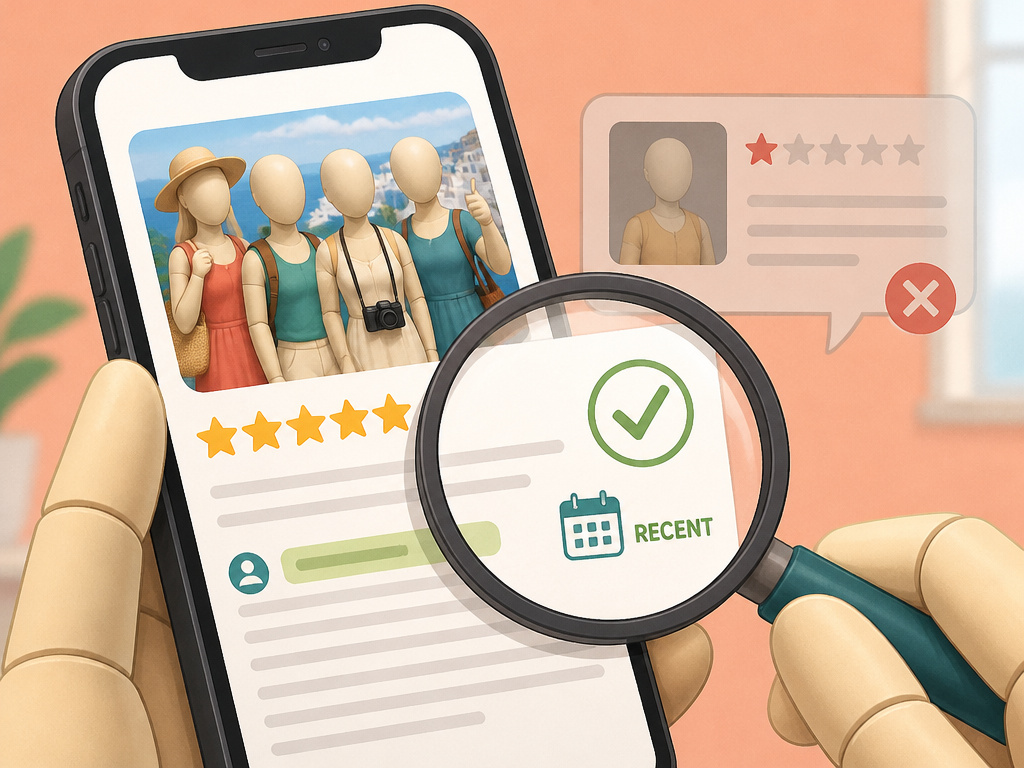
Wovoyage advises reading the company’s Google reviews, not only the testimonials on its own site. Look for photos of real groups rather than stock images.
Wovoyage’s specific tell worth hunting for: reviews that mention the trip leader by name are usually genuine, because a fake review doesn’t know who led the Tuesday departure.
Two more things to check while you’re in there. Whether any review describes a price that grew after booking, which Wovoyage flags as one of the most frequent complaints about group tours. And whether the reviews are recent enough to reflect the current operation rather than a version of the company that no longer exists.
If you’re comparing a small group tour against a private option, the review-reading method is the same. Look for named people and specific dates.
What Should Be Included Before You Pay
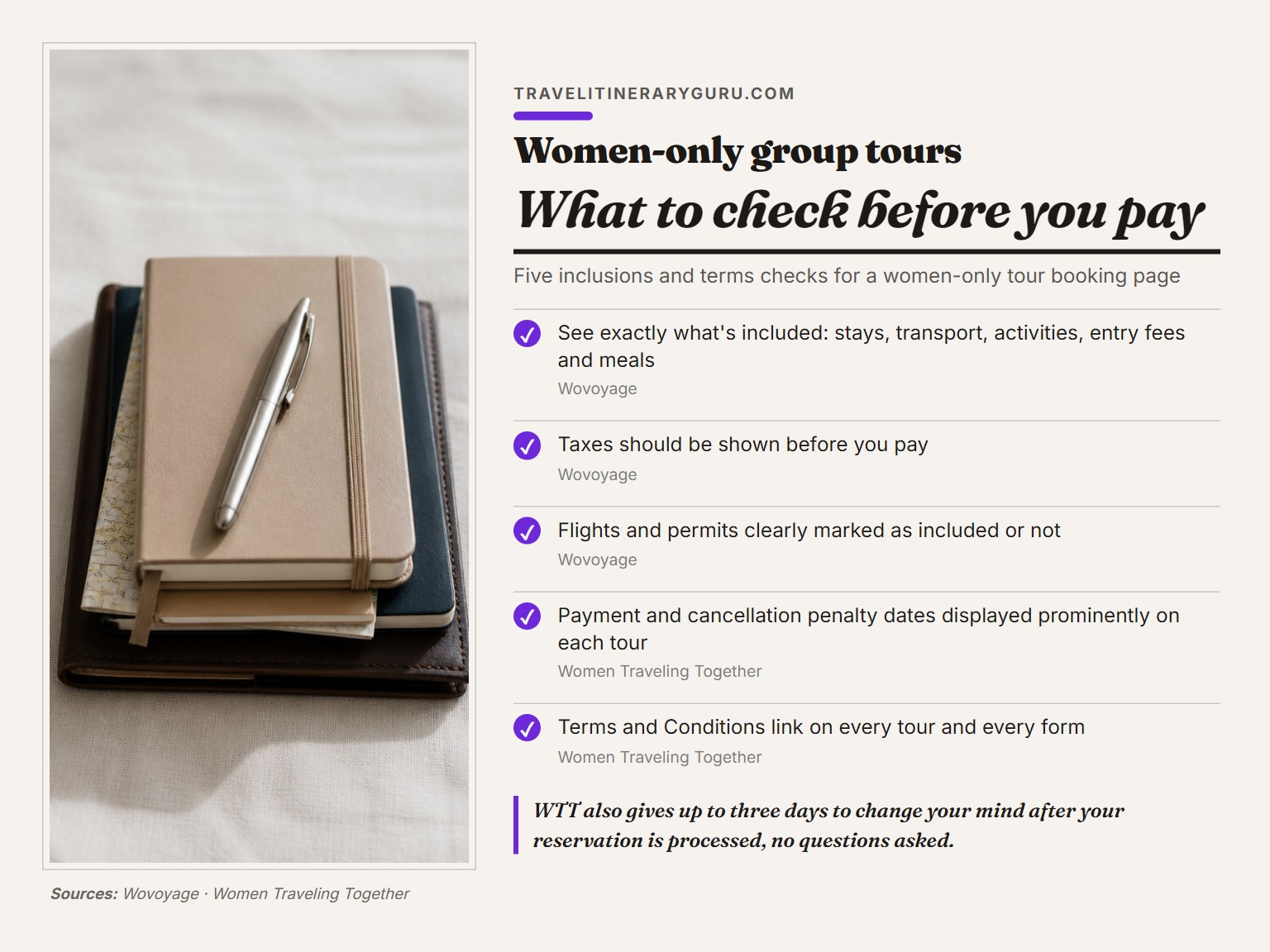
You should see exactly what’s included: stays, transport, activities, entry fees and meals. Taxes should be shown before you pay, and flights and permits should be clearly marked as included or not.
That list comes from Wovoyage, and it maps cleanly onto what Women Traveling Together publishes as a principle: show exactly what the tour costs, with no hidden fees and no small print, display payment and cancellation penalty dates prominently on each tour, and make the terms accessible with a link on every tour and every form.
WTT goes one step further with a policy worth knowing about: up to three days to change your mind after the reservation is processed, no questions asked. That’s a specific, checkable commitment, and it’s the kind of thing you can ask any operator about.
Here’s my practical checklist for the booking page itself:
- Find the inclusions list and confirm it names meals by type, not just “some meals included.”
- Check whether taxes appear before the payment screen or after it.
- Confirm whether flights and permits are marked included or excluded, in writing.
- Locate the cancellation penalty dates and check they’re dated, not just described.
- Look for the terms and conditions link on the booking form itself, not buried in the footer.
If you’re booking as part of a girls trip with friends rather than solo, run the same five checks. The rooming question gets easier. The group-size question doesn’t.
The Questions Worth Asking Before You Book
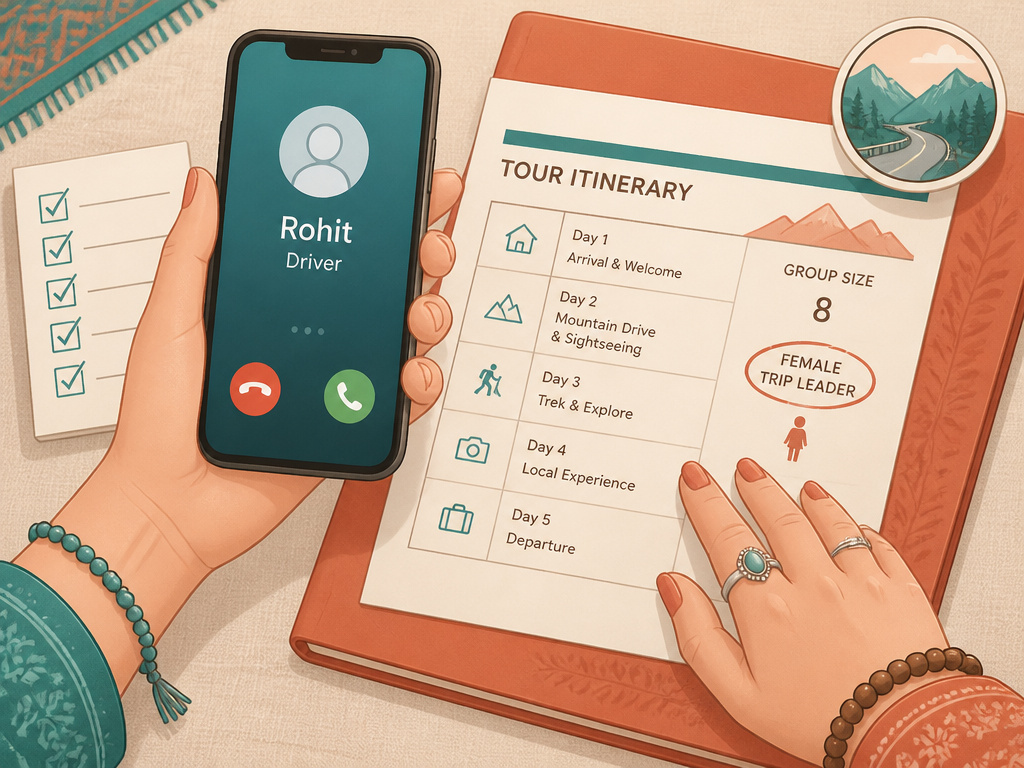
Wovoyage’s short version of this is a starting frame: a women-only tour company sends a female trip leader for the whole trip, keeps groups small, pairs solo travellers with another woman instead of charging a single supplement, books stays and drivers it has checked, and answers the phone at any hour.
That last one sounds trivial until you’re in a mountain region at night. Wovoyage specifically flags mountain roads in Ladakh, Kashmir and Meghalaya as routes where you want regular drivers the company knows, not whoever is free that day. Ask whether the company has used the same drivers before.
For a fuller set of questions to ask before you commit, build the list around the five checks above and add anything specific to your destination.
Worth knowing before you start: A company that answers every question with a brochure sentence is telling you something. The operators worth booking answer the rooming question with a number and the driver question with a name.
Where a Group Tour Fits in a Bigger Trip
My own position, and it’s a minority one: a group tour is a tool, not a holiday format. The mistake is taking one for the whole trip rather than for the one leg that actually needs it.
I use them as a single-leg solution. A three-day trek, a border crossing, a region where independent logistics are genuinely hard. You get the leader, the checked accommodation and the driver for the segment where those things matter, then you go independent for the rest.
The group tour pros and cons shift depending on whether you’re treating it as the whole trip or one leg of it. If you’re weighing a private tour against a small group departure, the calculation is different again, private removes the group-size question entirely and replaces it with a cost question.
Where I’d push back on the standard advice: the “small group” label is doing less work than it used to. A group at the top of a company’s range is not small, and the van is still full. Ask for the number.
Frequently Asked Questions
What counts as a small group on a women-only tour?
There’s no agreed threshold. Wovoyage states that “small group” can mean anywhere from 10 to 40 travellers and recommends asking for both the typical and maximum size. My Lady Trip draws the line at 8 to 12 for boutique groups and 25 or more for commercial ones. CBI describes women-only groups as “small groups” without attaching a number.
Should a women-only tour have a female leader?
It depends on which part of the market you ask. CBI describes female guides as the general norm for women-only tours. Wovoyage recommends a female trip leader who stays with the group for the whole trip rather than handing you between local guides. Women Traveling Together sends a company tour leader on every departure, without requiring that person to be local.
How do solo travellers handle rooms on these tours?
Most women on group trips travel alone. Wovoyage’s recommended model is a twin room shared with another woman from the group by default, with a private room available as a paid upgrade, while CBI advises negotiating deals for solo travellers who want single rooms and WTT arranges room sharing for those who want to save money. CBI notes that single room supplements can be very expensive and advises operators to negotiate deals for solo travellers who want their own room.
What should I check before paying a deposit?
Confirm what’s included: stays, transport, activities, entry fees and meals. Check that taxes appear before you pay and that flights and permits are clearly marked as included or excluded. Locate the cancellation penalty dates and confirm they’re dated. Women Traveling Together publishes all of this on each tour page and offers up to three days to change your mind after booking.
Are reviews on the operator’s own site reliable?
Wovoyage advises reading the company’s Google reviews rather than only the testimonials on its own site, and looking for photos of real groups rather than stock images. Reviews that mention the trip leader by name are usually genuine, because a fabricated review wouldn’t know who led the tour.
The Bottom Line
If you take one thing from this, take the pre-tour versus post-tour gap. You will book on destination and itinerary. You will remember the leader and the group. The Zagreb study measured that shift, and it should move the weight of your questions away from the brochure and onto the two things you can’t see in a photo.
Here’s your first step this week, and it’s one email. Ask the operator for the maximum group size, whether a female trip leader travels with the group for the entire trip, and what happens by default if you book as a solo traveller. Three questions. If the reply is specific and dated, you’re probably dealing with a real operation. If it’s a paragraph of adjectives, you have your answer.
One concession, because this advice has a limit. The Zagreb sample was 130 past clients of one Australian all-female walking-tour company. If you’re younger, booking your first group trip, or travelling with a specific accessibility or dietary requirement, the leader-and-group framing still holds but the specifics may not. Ask more, assume less.
Prepare for a group tour the same way you’d prepare for any trip where someone else controls the schedule: know what you’ve agreed to before you arrive, and know which afternoon you’re keeping for yourself.
