
How to Choose a Wine Tasting Tour: Read the Listing First
This post contains affiliate links. As an Amazon Associate, we earn from qualifying purchases.
To choose a wine tasting tour, settle three things before you pay: the price unit (per vehicle or per person), the hours actually spent at cellars, and the number of wines poured. A private tour priced per vehicle can flip cheaper than a per-person group tour once you are four or five people.
That flip is the whole game, and almost nobody checks it. The listing shows one unit. You compare it against another listing showing a different unit. The numbers look comparable and they are not. Knowing how to choose a wine tasting tour means checking the unit before you compare.
What follows is how to read a listing the way a contract lawyer would, which questions actually separate an operator from a brochure, and the three specific cases where you should skip the tour entirely and arrange the day yourself.
Key Takeaways
- Compare price by unit, not by headline. A per-vehicle private tour and a per-person group tour are not the same number, and the cheaper-looking one flips at four or five people.
- Three to four estates is a full day. The Franschhoek Wine Tram‘s own guide recommends 3 to 4 estates; a listing promising five or six stops is selling you a list.
- Ask the minimum-run number before you book. Some operators only run a tour once enough customers are booked, so a confirmed tour can be cancelled for low numbers.
- Read the three-star reviews first. They tend to describe what the day contained; five-star reviews tend to describe how the reviewer felt.
- No official tasting pour size exists. The NIAAA counts a standard drink of wine as 5 fluid ounces at 12% ABV, and no source could confirm how a taste compares to that.
Why the Price Unit Is the First Thing You Check
A private tour is often priced for the vehicle, with a limit on the number of guests, and the listing may show only one unit. A group tour is priced per person. Put those two side by side and the how to choose a wine tasting tour comparison is meaningless until you multiply.
That is the single most actionable number in this whole category. Run the math at your actual party size, not at one.
The other half of the pricing question is what the number covers. Operators split hard on this, and the split is worth understanding before you decide one side is right.
| Pricing Model | What It Covers | Where It Bites |
|---|---|---|
| All-inclusive | Transport, guide, tasting fees, one food element | Higher headline; no wallet at each stop |
| Tasting fees extra | Transport and guide only | You pay at every cellar on top of the tour |
| A la carte | Pay-as-you-go at each venue | Works if your wine club waives fees |
| Low base, extras unknown | Unclear until you ask | Final bill surprises people |
Grapeline’s guide makes the case for the pay-as-you-go model: if you are a wine club member at the wineries you are visiting, most clubs offer complimentary tastings, and steady bottle purchasers often get fees waived. LocalTastingTours argues the opposite, that the best tours bundle transport, guide fees, tasting fees at every venue, and at least one food element into a single price. VIP Winery Vacations takes a third position, framing exclusions as a trap: a lower base price does not always mean a lower final bill.
Three operators, three positions. None of them is lying. The right answer depends on whether you already hold club memberships in that region.
What most people get wrong: Comparing a per-vehicle private quote against a per-person group quote without multiplying. Grapeline holds that the private option is a lot more expensive for small groups but that for larger groups the price difference becomes inconsequential, while winetours.travel holds that the cheaper-looking option can flip once you are four or five people.
What Three Answers Decide Whether a Listing Is Worth Pursuing?
Three answers decide how to choose a wine tasting tour: how many hours are spent at cellars, how many wines are poured, and what the price unit is. If a listing gives none of them and the operator will not answer, move on. That costs you one email.
Hours are the one people misread most. A duration on a listing almost always runs from pickup to drop-off, so the time at the cellars is what is left after the roads. A “six-hour Chianti tour” leaving from Florence is not six hours in Chianti.
Wines poured is the second. “Includes wine tasting” means at least one tasting and says nothing about how many wines or which ones. “Tasting of several wines” means a flight, and “several” is the operator’s word.
The price unit is the third, and it is the one from the section above.
Get all three in writing. A written reply that says “4 wines at each of 3 cellars, tastings included, per vehicle up to 6” is the contract you actually have, and it is worth more than the listing page.
How Many Wineries Should a Wine Tour Visit in a Day?
This is where the sources genuinely disagree, and the disagreement is useful.
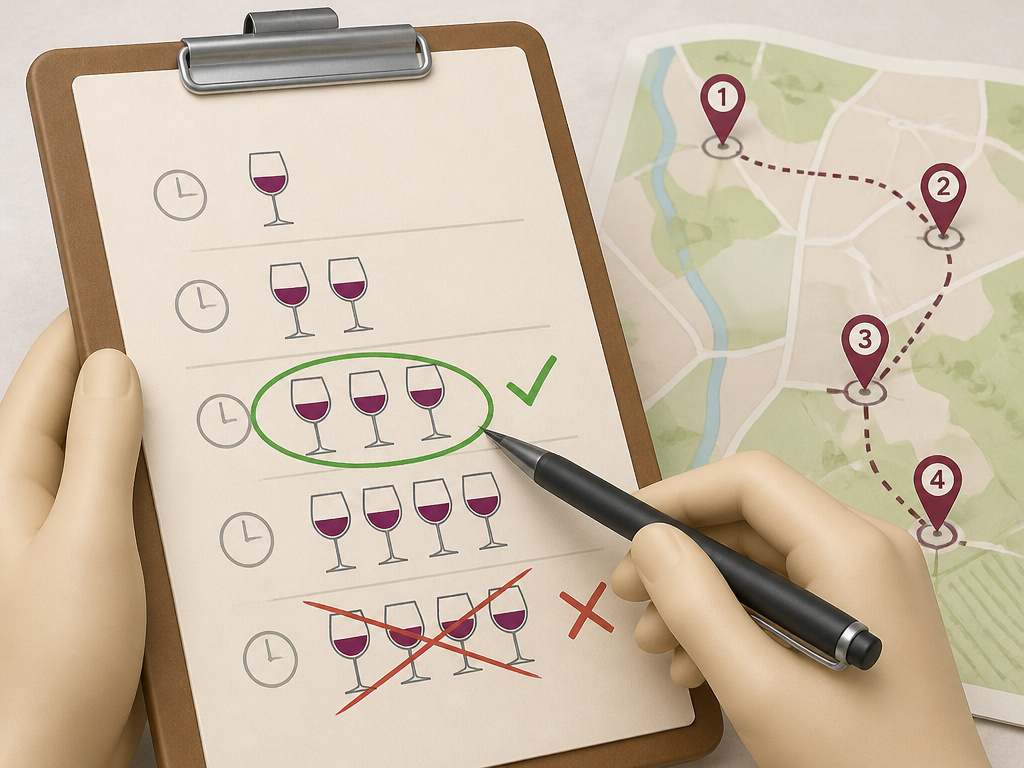
The Franschhoek Wine Tram’s own guide recommends visiting 3 to 4 wine estates in a day. Take that as the yardstick. A listing that promises five or six stops is promising a list, not a realistic day. LocalTastingTours is blunter: be wary of tours that promise six or seven wineries in a single day, because that pace serves the operator’s schedule, not your experience.
So the range is roughly three to four, with five as a stretch, while LocalTastingTours warns against tours promising six or seven wineries in a single day.
What a stop actually contains is the hidden variable. “Visits 3 wineries” means three stops, and one may be a tour, one a short pour at a counter, one a shop with a bar. Nothing says they last the same time. “Winery visit” or “cellar tour” can mean a walk through the production area before the tasting, or it can mean the tasting room alone.
Ask how long each stop is, and whether there is a cellar visit or only a tasting.
Skip this if: you have a specific winery in mind that only takes appointments. A five-stop fixed tour is the wrong tool for that. Book direct and ask whether they arrange a car.
What the Vehicle Decides Before You Even Book
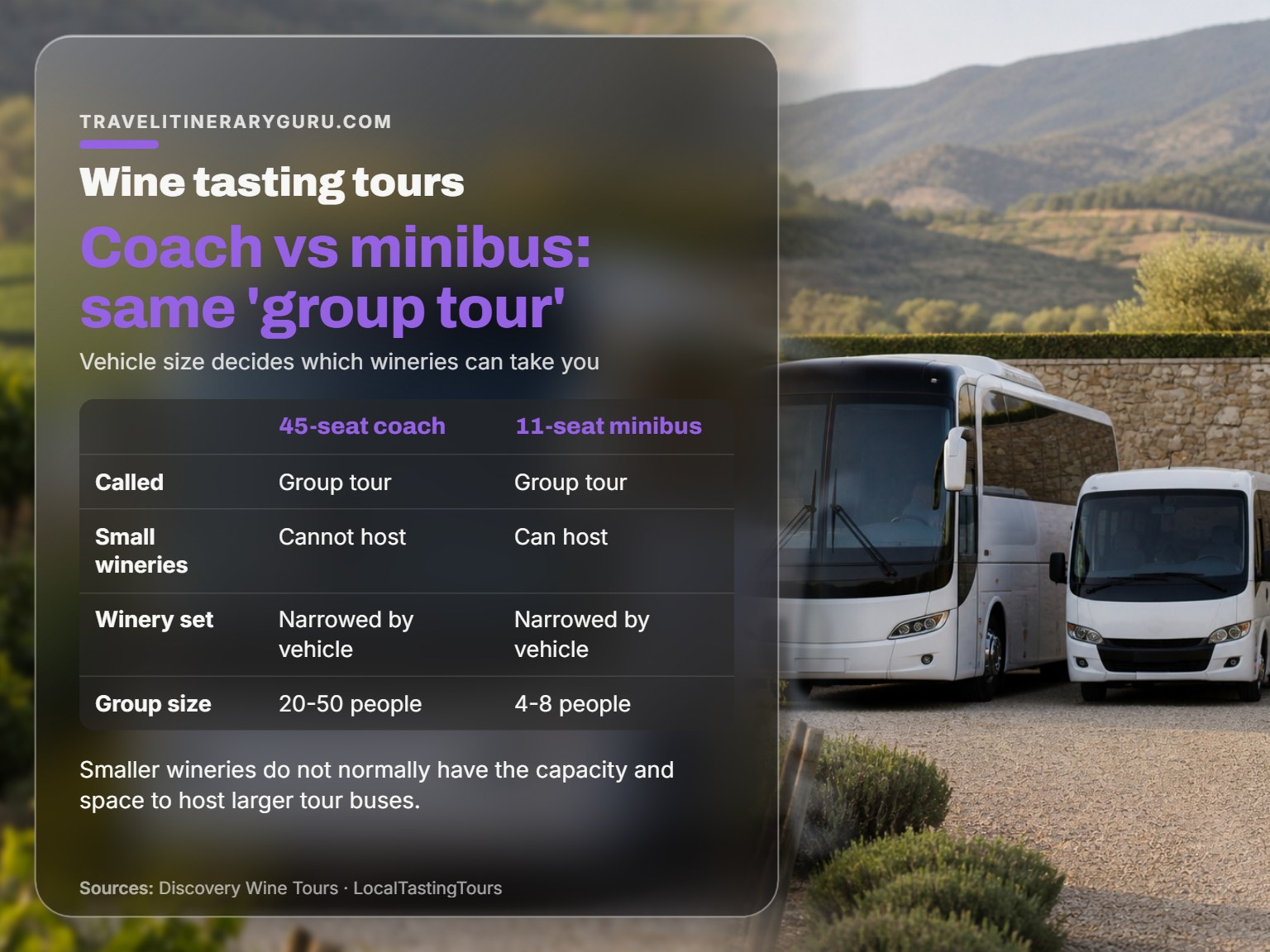
Vehicle choice narrows the winery set, and most people never connect the two. Smaller wineries do not normally have the capacity and space to host larger tour buses. A 45-seat coach tour structurally cannot deliver a small-producer itinerary, because the small producers cannot take the coach.
Both a 45-seat coach and an 11-seat minibus get sold as “group tours.” That is the same phrase covering a 45-seat coach and an 11-seat minibus.
Here is the honest part of the tradeoff. On a bike you will visit fewer cellars, and the last hill is decided by your legs, not by the booking. On a vintage scooter the stops are short and the day is about the ride, so ask how many tastings it includes. On a minibus the limit is the itinerary.
Book a bike day only after checking the hills on the route and the closing time of the last cellar. That second one catches people. You plan a leisurely loop, the last estate shuts at five, and the afternoon compresses into a sprint.
One more vehicle note that surprises people: many wineries prohibit limos and party buses, wanting to avoid patrons who have been riding around for hours with an all-you-can-drink on-board bar. The vehicle you book can close doors before you arrive.
Easy to miss: the minimum-run threshold. Some operators only run tours with a minimum number of customers, so a tour you booked can be cancelled for low numbers. Ask how many are currently booked and what the minimum and maximum are.
What “Small Group” Actually Means in a Listing
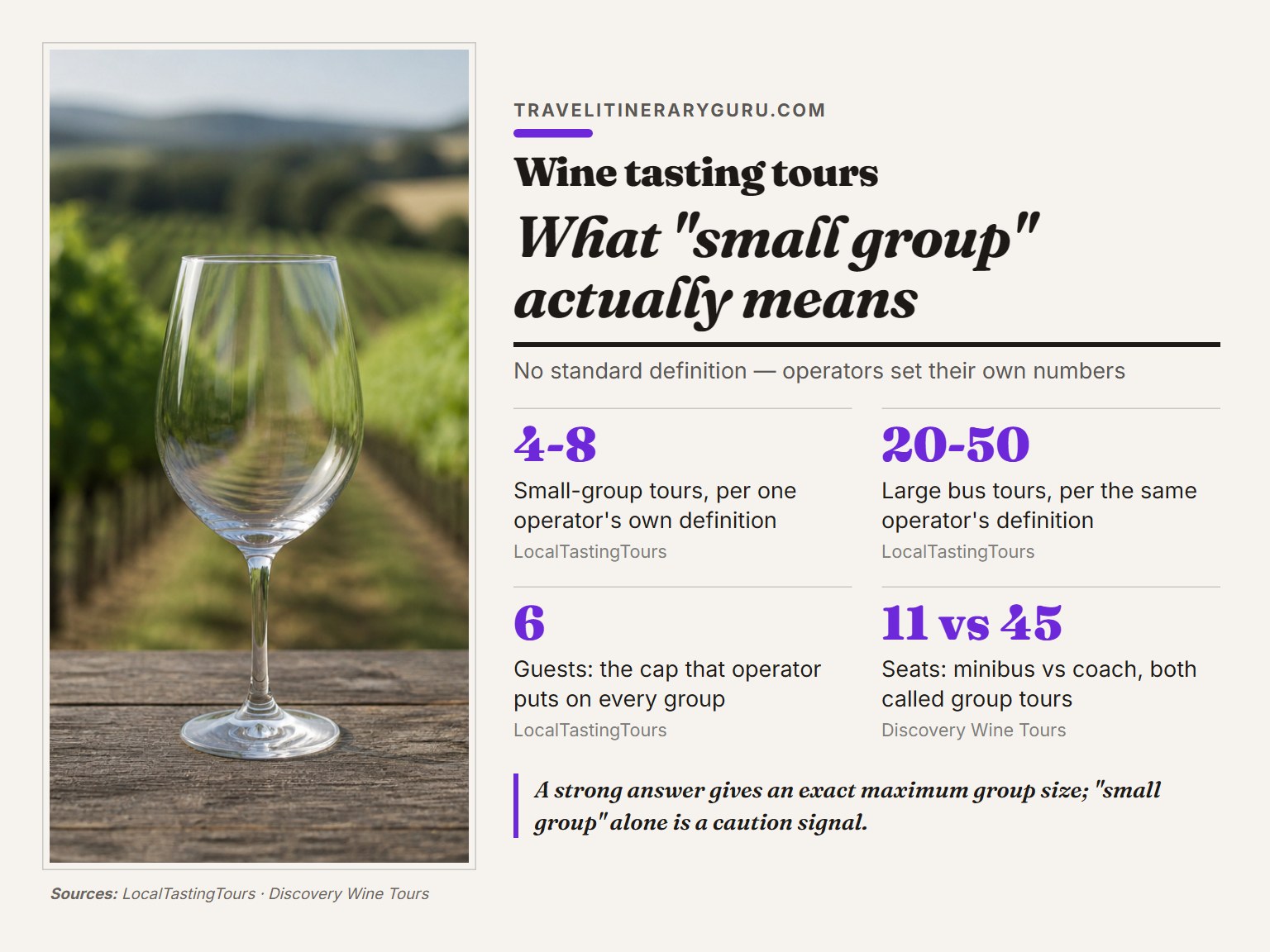
There is no agreed definition. That is not a marketing complaint, it is a documented gap: no official source could be confirmed for any standard definition of “small group.”
Operators fill the vacuum with their own numbers. LocalTastingTours defines small-group tours as 4-8 people and large bus tours as 20-50, and caps every group at six guests. Discovery Wine Tours treats an 11-seater minibus as definitionally smaller and a 45-seat coach as large, implying a de facto threshold without stating one.
The practical move is to stop reading the phrase and start reading the number. Ask what the maximum group size is. A strong answer gives an exact number. A caution signal is only the phrase “small group.”
If you are weighing a small group tour against a private vehicle, group size is the single biggest differentiator between the two experiences, and it is the variable you can actually pin down before booking.
Who Hosts You, and Does It Matter?
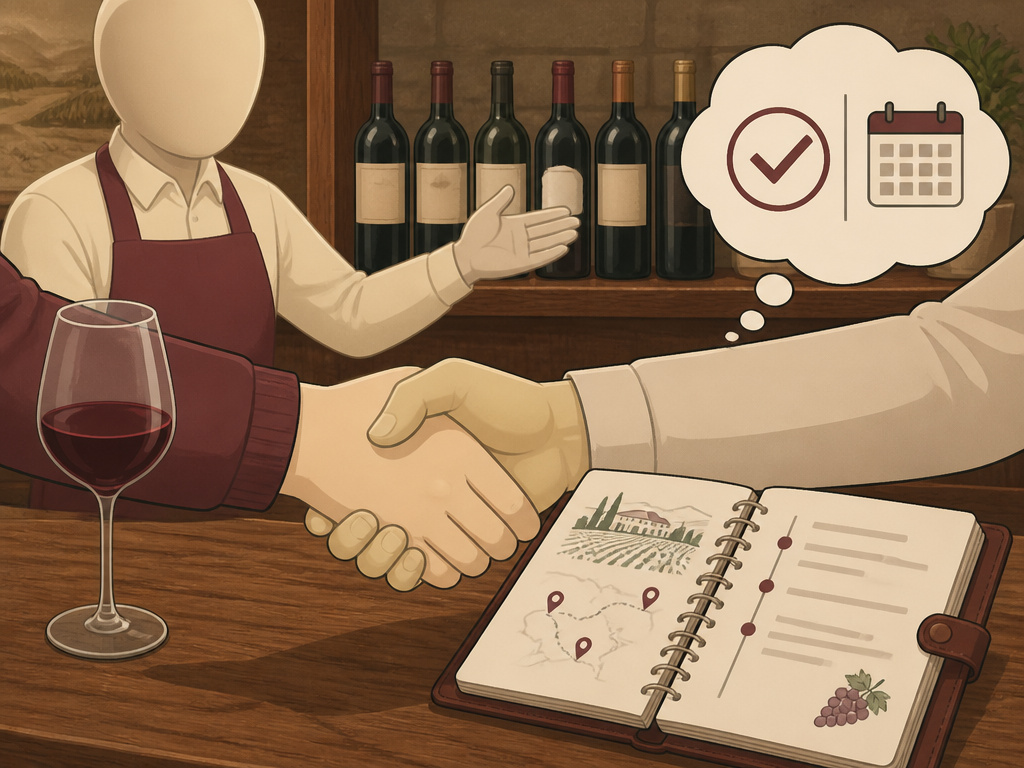
It matters more than the itinerary. A reservation puts your name on a schedule. A relationship changes who meets you, what gets poured, and how much time people give you.
That distinction comes from an operator who watched it play out. The product that got delivered was not the product that had been designed.
So ask how each winery made the itinerary. Was it chosen because the operator knows the family, likes the wines, and understands the experience? Or because the tasting room had space?
Then ask who hosts the trip. A strong answer names a host with a clear role. A caution signal is a host who changes or is never identified. Follow it up with what experience that host has; relevant food, wine, hospitality, or regional experience is the strong answer, and generic tourism experience is the weak one.
Guide credentials sit in the same bucket. Ask whether your guide is a certified sommelier, a local wine professional, or a driver with a script. LocalTastingTours frames it exactly that way, and it is the right framing.
The part nobody mentions: a specialist operator and a generalist operator will get you different receptions at the same winery. The company’s approach affects the type of experience, the reception at the wineries, and even which wineries you can visit.
The Three Cases Where You Should Skip the Tour
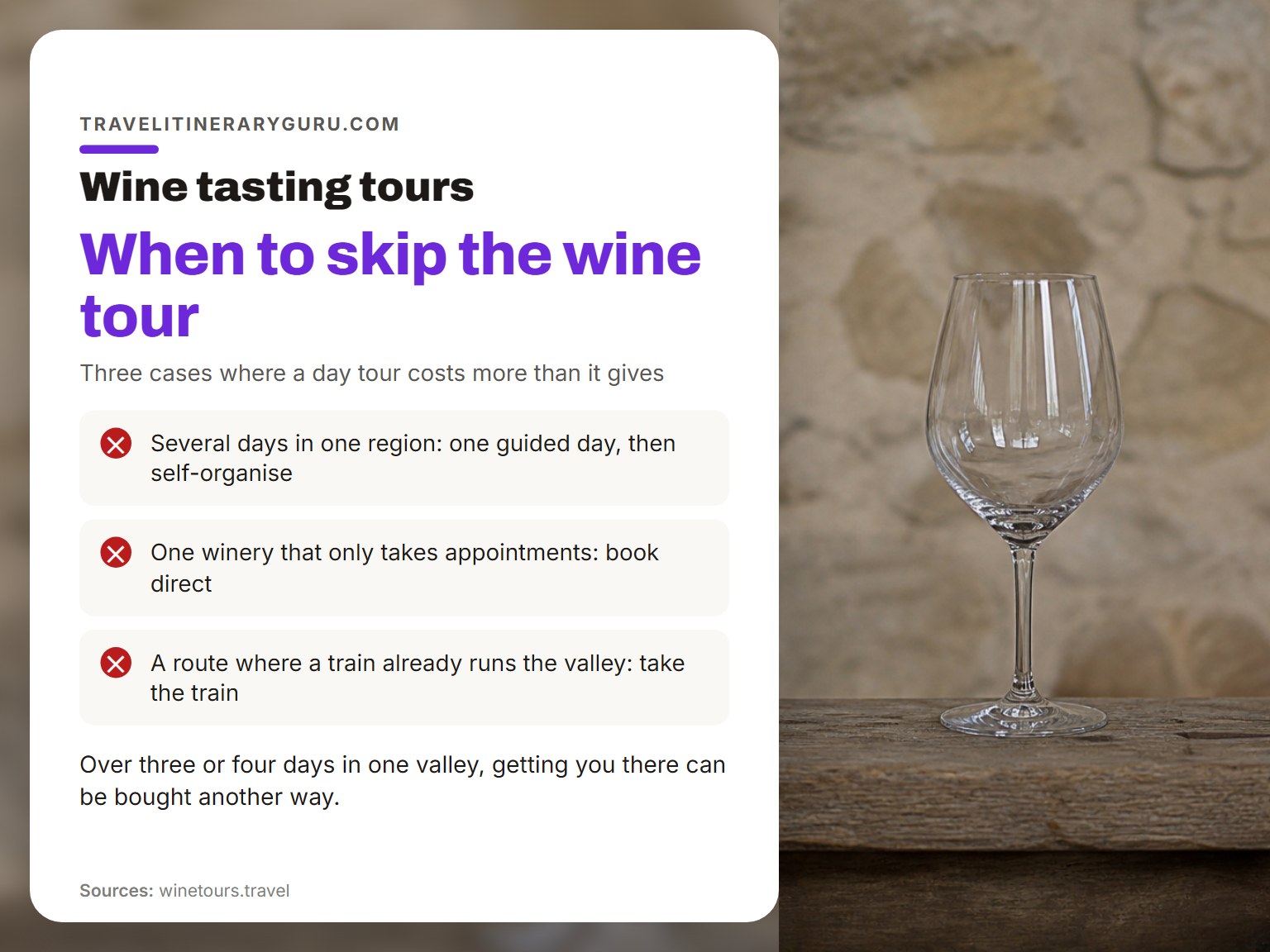
A page that sells tours and never tells you when to skip one is a brochure. So here are the three cases, and they are not rare.
Several days in one region. Over three or four days in one valley, the one thing the tour really sells, getting you there, can be bought another way. A driver for selected days, a train, a bike. One guided day, then self-organise.
One winery that only takes appointments. Covered above. Book direct.
A route where a train already runs the valley. If the transport problem is already solved, you are paying a tour premium for a problem you do not have.
Note that the first case is where the sources split. LocalTastingTours presents the guided small-group tour as the best experience without qualifying it for multi-day stays, while winetours.travel recommends one guided day then self-organising over three or four days in one valley. That is a reasonable position for a single day. It gets expensive across four.
| Situation | Tour Worth It? | What to Do Instead |
|---|---|---|
| One day, unfamiliar region | Yes | Book the small-group day |
| Three to four days, one valley | One day only | Guided day, then self-organise |
| Pre-chosen appointment-only winery | No | Book direct, ask about a car |
| Train already runs the route | No | Take the train |
| Large group, one vehicle needed | Yes, private | Per-vehicle pricing wins here |
The Safety Question Nobody Puts First
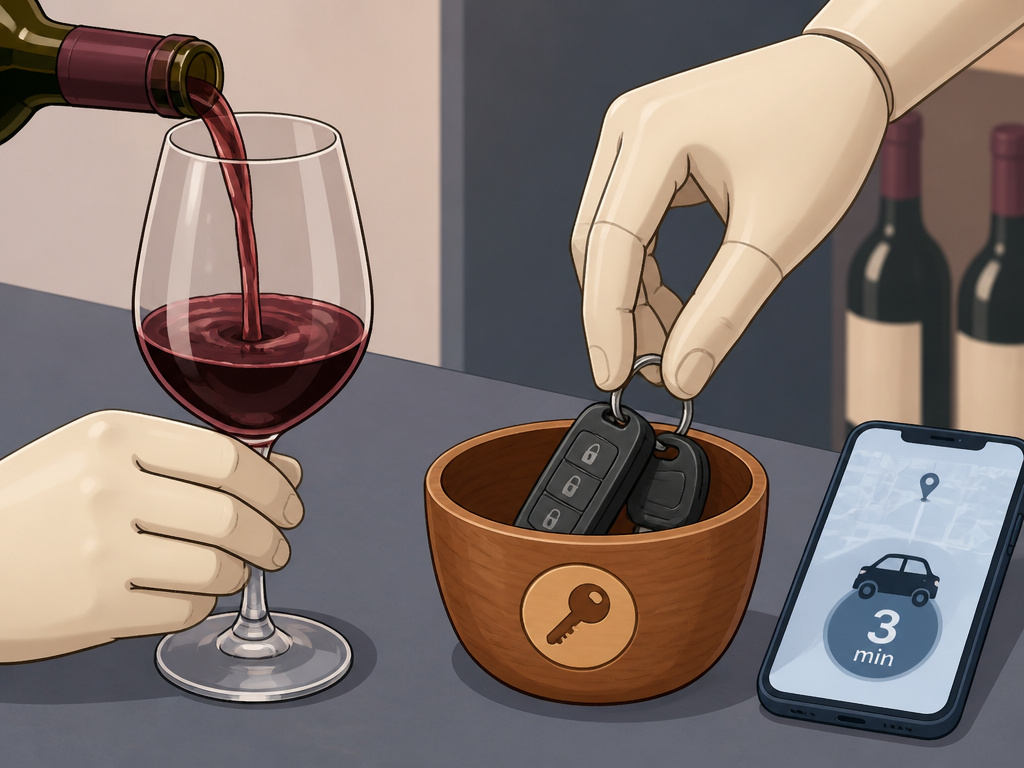
Zero is the safest number, and the legal limits differ by place.
The Napa tourism board tells visitors to arrange alternative transportation ahead of time. That is a tourism board, not a regulator, so treat it as local advice rather than a rule. It is still the right advice.
Spitting changes the arithmetic, but not as much as people hope. The NIAAA counts a standard drink of wine as 5 fluid ounces at 12% alcohol by volume. No official tasting pour size could be confirmed, so do not assume a taste is a small fraction of a standard drink. It might be. Nobody has published the number.
Limits change, and this is not legal advice. Check the official source for the place where you will actually drive.
Before you start: confirm who is driving before the first pour, not after the third. Assign a designated driver or book transport with a named vehicle and pickup time. If you are driving yourself, check the legal limit for that country or state the week you travel, because they move.
Reading Reviews Without Getting Fooled
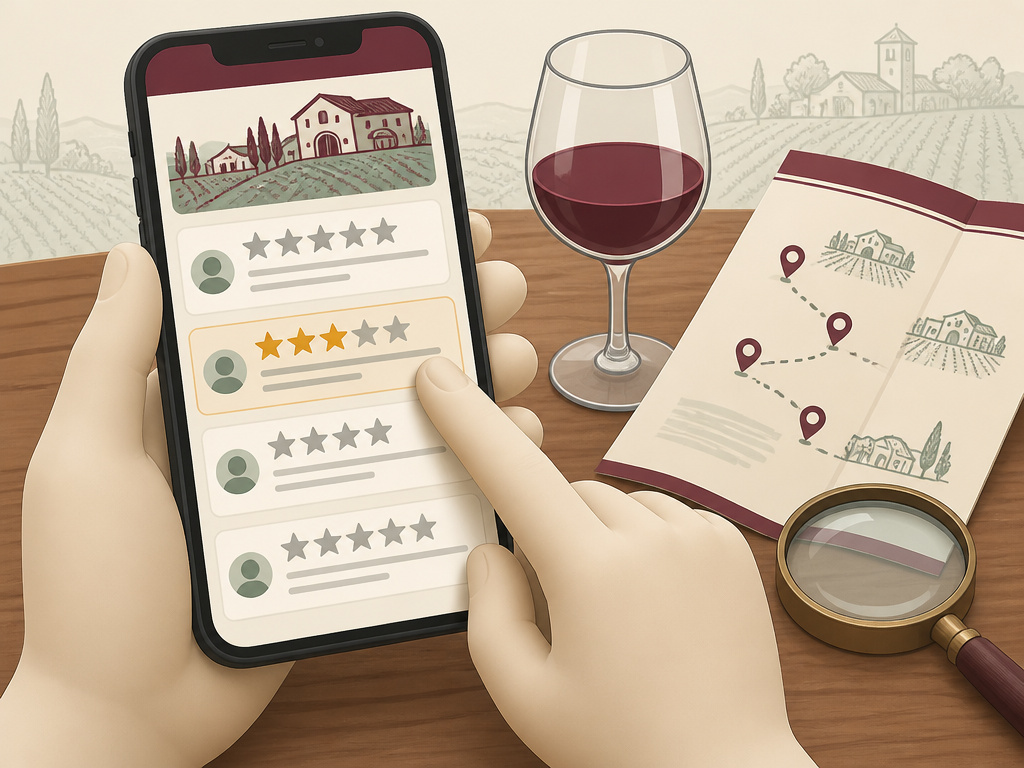
Read the three-star reviews first. They tend to say what the day contained. A five-star review often says how the reviewer felt.
That is the whole method. Three-star reviewers are disappointed enough to itemise and not angry enough to exaggerate. You get stop counts, wait times, and what the lunch actually was.
For operator-level questions, look for repeated, specific guest details. Vague praise and polished testimonials are the caution signal. So is a testimonial that describes the feeling of the day without ever naming a winery.
If you want a structured set of questions to ask before you commit, build them from the three answers above and add the minimum-run number.
A Note on What I Get Wrong Here
I am genuinely bad at budget travel. I default to mid-range comfort and have to consciously force myself to plan cheaply, which means my instinct on this topic skews more expensive than it should for some readers. The per-vehicle private option is the one I reach for first, and for a party of two it is usually the wrong call.
I also have a real blind spot on solo travel safety specifics in wine regions. I can give you the general framework, and I have learned to defer to writers who have lived it rather than pretend I know what that is like. What I will say: the transport question is a safety question, and it is the one item on this list I would not improvise.
Frequently Asked Questions
Is a private wine tour cheaper than a group tour?
It depends entirely on your party size, and the price unit is why. A private tour is often priced per vehicle with a guest limit, while a group tour is priced per person. Grapeline holds that for small groups the private option is a lot more expensive, while winetours.travel holds that the cheaper-looking option can flip once you are four or five people. For larger groups the difference becomes inconsequential, and at four or five people the cheaper-looking option can flip.
How many wineries should we visit in one day?
Three to four is the number the Franschhoek Wine Tram’s own guide recommends, while LocalTastingTours warns against tours promising six or seven wineries in a single day. The Franschhoek Wine Tram’s own guide recommends 3 to 4 estates in a day, and a listing promising five or six stops is promising a list rather than a day. LocalTastingTours warns specifically against tours promising six or seven wineries, since that pace serves the operator’s schedule.
What does “small group” mean on a wine tour listing?
Nothing standard. No official definition of the term could be confirmed, so the phrase carries whatever the operator decides it carries. LocalTastingTours treats 4-8 people as small group and caps its own tours at six guests. Discovery Wine Tours treats an 11-seater minibus as smaller and a 45-seat coach as large. Ask for the maximum number in writing.
Should tasting fees be included in the tour price?
Operators disagree, and both models are legitimate. LocalTastingTours argues the best tours bundle transport, guide fees, tasting fees at every venue, and at least one food element into one price. Grapeline points out that pay-as-you-go suits wine club members, since most clubs offer complimentary tastings. VIP Winery Vacations frames exclusions as a trap where a low base price hides a high final bill. Ask what the realistic final cost is and whether likely extras are easy to estimate.
Is a wine tour worth it on a multi-day stay?
Usually for one day, not for all of them. Over three or four days in one valley, the thing the tour really sells, getting you there, can be bought another way. Book one guided day to orient yourself and meet the region, then arrange the rest yourself.
What is a standard drink of wine?
The NIAAA counts a standard drink of wine as 5 fluid ounces at 12% alcohol by volume. No official tasting pour size could be confirmed, so do not assume a taste is a small fraction of a standard drink. If you are driving, that uncertainty is a reason to arrange transport rather than estimate.
The Bottom Line
One rule most guides skip: if a listing cannot tell you the price unit, the hours at cellars, and the number of wines poured, do not book it. Send the question. If the reply does not arrive, that is your answer, and it cost you one email.
Your first move this week is smaller than that. Open the listing you are considering, find the price unit, and multiply it by your actual party size. Then do the same for the alternative. You will know whether the comparison you were about to make was ever real.
Everything above assumes a region you do not know yet. If you already know the valley, already hold club memberships at three of the estates, and already have a driver, the calculus changes and most of this advice is overhead. That is the case where the tour sells you nothing, and the honest move is to skip it. I get why people book it anyway. It feels like the safe choice. But here is what actually happens: you pay a premium for transport you already had, and you spend the day on someone else’s schedule in a place you already understand.
That is the thing about wine tours. The good ones solve a problem you actually have. The rest solve a problem you already solved and charge you for it.
