
How to Choose a Travel Backpack for Carry-On Travel
This post contains affiliate links. As an Amazon Associate, we earn from qualifying purchases.
To choose a travel backpack for carry-on travel, match the bag to the rule your airline enforces. REI puts the carry-on limit at 45 linear inches (L+W+H), which is a 22 x 14 x 9 inch bag. Pack Hacker notes that liter ratings are not standardized, so two 40-liter bags can differ.
That 45-linear-inch figure is dimensional, and it’s the reason a bag sold as 35 liters can still fail a gate check. REI’s own guidance says a fully loaded 35-liter pack may be over the limit for what counts as a personal item. Tortuga goes the other way and states flatly that 45 liters is the maximum on most US airlines. Same category, three incompatible answers.
The rest of this walks the linear-inch math, what volume actually buys you, how to choose a travel backpack for carry-on travel by fitting a harness to your torso, and the two specs in the Osprey manual that most comparisons get wrong. Ten seconds with a spec sheet should tell you whether a bag clears your airline.
Key Takeaways
- 45 linear inches (L+W+H) is the only carry-on number with a published source behind it, and REI’s worked example is 22 x 14 x 9 inches.
- Liter ratings are not standardized, so compare dimensions before volume.
- A 35-liter pack is not automatically personal-item legal. REI warns a fully loaded one may exceed the limit.
- Harness fit beats feature count. The padded section should end 1 to 2 inches below your armpits.
- Check whether the stated volume includes a daypack before you compare two packs.
The 45-Linear-Inch Rule, and Why Nobody Agrees on It
Airlines publish carry-on limits in linear inches, and that’s the number to build the purchase around.
Carry-on sizing is governed by linear inches, the sum of a bag’s length, width, and height. REI’s worked example is 22 by 14 by 9 inches, which totals 45 linear inches. Volume ratings in liters describe internal capacity and are not standardized between manufacturers, so two bags sold as the same size may measure differently.
Three sources, three different definitions of the same limit:
| Source | Position on the carry-on ceiling | What it leaves you |
|---|---|---|
| Tortuga | 45 liters is the maximum on most US airlines | A hard volume cap with no regulator named |
| REI | 45 linear inches (L+W+H) | Dimensional, so shape matters as much as size |
| Pack Hacker | No industry standard for liter ratings | Two 40 L bags can measure differently |
| Osprey | The 55 carries on in two pieces | A manufacturer’s claim that no airline has agreed to |
Nobody agrees on the number.
REI’s version is the most useful because it’s arithmetic you can do at home. Add the height, width, and depth printed on the spec sheet, and compare the total to 45. A bag measuring 22 x 14 x 9 inches lands exactly on the line.
Tortuga’s version is simpler and less forgiving. It treats 45 liters as the ceiling, which holds up until you buy a bag whose liter rating was measured generously. Pack Hacker’s point explains why that happens. A brand’s 40 liters and another brand’s 40 liters are not the same measurement, and there’s no standard forcing them to be.
The dimensional math gets messier by carrier, and a carry-on size guide that tracks individual airline rules is worth keeping bookmarked. If you’d rather shop from a shortlist, the current carry-on travel backpacks split cleanly into 35-liter and 45-liter camps.
How to Choose a Travel Backpack for Carry-On Travel: Volume First
Wirecutter treats 35 liters as the practical week-long size and 45 liters as the overhead-maximizing size.
REI’s guidance points somewhere narrower. It describes the Cotopaxi Allpa 35 L Travel Pack as able to compartmentalize a long weekend’s worth of gear, and warns that a fully loaded 35-liter pack may be over the personal-item limit. So the same volume is a week in one source and a long weekend in another.
Seven days, one bag.
It won’t work for everyone.
Common mistake: Buying a 35-liter bag on the assumption it doubles as a personal item. REI’s guidance says a fully loaded 35-liter pack may exceed the personal-item limit, and you’ll discover that at the gate on the outbound leg when the sizer comes out.
What each size band actually buys you:
- 35 liters is Wirecutter’s week-long size, and REI’s top carry-on pick sits there.
- 45 liters is Wirecutter’s overhead-maximizing size, and Tortuga’s stated ceiling for most US airlines.
- 30 to 38 liters is the Bellroy Transit Travel Pack Pro‘s expansion range, which is useful if you want one bag for short and long trips.
- 55 to 65 liters is a two-piece system rather than a single bag, per the Osprey manual.
Wirecutter carry-on bag testing is where the 35/45 framing comes from, and it’s worth reading next to REI’s guidance because the two disagree. If you’re set on the smaller end, the 35L travel backpacks worth shortlisting are worth a look.
Torso Length and Harness Fit: The Numbers That Decide Comfort
The padded harness should end 1 to 2 inches below your armpits, and the sternum strap should sit about 2 inches below your collarbone.
Those two measurements come straight from the Osprey Farpoint and Fairview owner’s manual, and they’re the difference between a pack you forget about and one you’re constantly shifting.
The Two Torso Ranges in the Osprey Line
The Farpoint, the men’s version, is a one-size fit covering a 17 to 21 inch torso (43 to 53 cm). The Fairview, the women’s version, covers 15 to 19 inches (38 to 48 cm).
Fit first.
A pack that’s too long in the torso puts the hipbelt across your stomach instead of your hips, and before long you feel the load pulling backward off your shoulders. The frame is doing exactly what it’s designed to do, and the weight is landing somewhere that can’t carry it.
Osprey’s suspension uses a 4 mm LightWire peripheral frame to move load from the harness to the hipbelt, with an Atilon framesheet spreading it across the backpanel. That’s the mechanism. The hipbelt has to be sitting on your hips for any of it to work.
- Adjust the torso length first. The Farpoint and Fairview both have adjustable torso fit; set it before you touch the shoulder straps, or the hipbelt lands in the wrong place and stays there.
- Check the harness height against your armpits. The padded section should end 1 to 2 inches below them. Ride it higher and the straps dig into your neck on the walk from the station.
- Set the sternum strap about 2 inches below your collarbone. Too high restricts your breathing on stairs; too low and it does nothing at all.
- Load the pack to its rated range before you judge it. The Farpoint 40 and Fairview 40 are rated for 20 to 40 lb (9 to 18 kg).
Hip Belt: Necessary or Not?
Pack Hacker sits in the middle on this one. Its position is that hip belts help a lot with heavier loads and long carries, but aren’t necessary if you pack minimally in a smaller bag. Osprey builds a breathable, stowaway reverse spacermesh hipbelt into the Farpoint and Fairview as standard.
I’d take the hipbelt every time on a trip where I’m walking between a station and a hotel. Pack Hacker’s point about minimal loads is fair, but a stowaway belt costs you nothing in packing space when it’s folded away.
3 Specs in the Osprey Manual That Change the Comparison
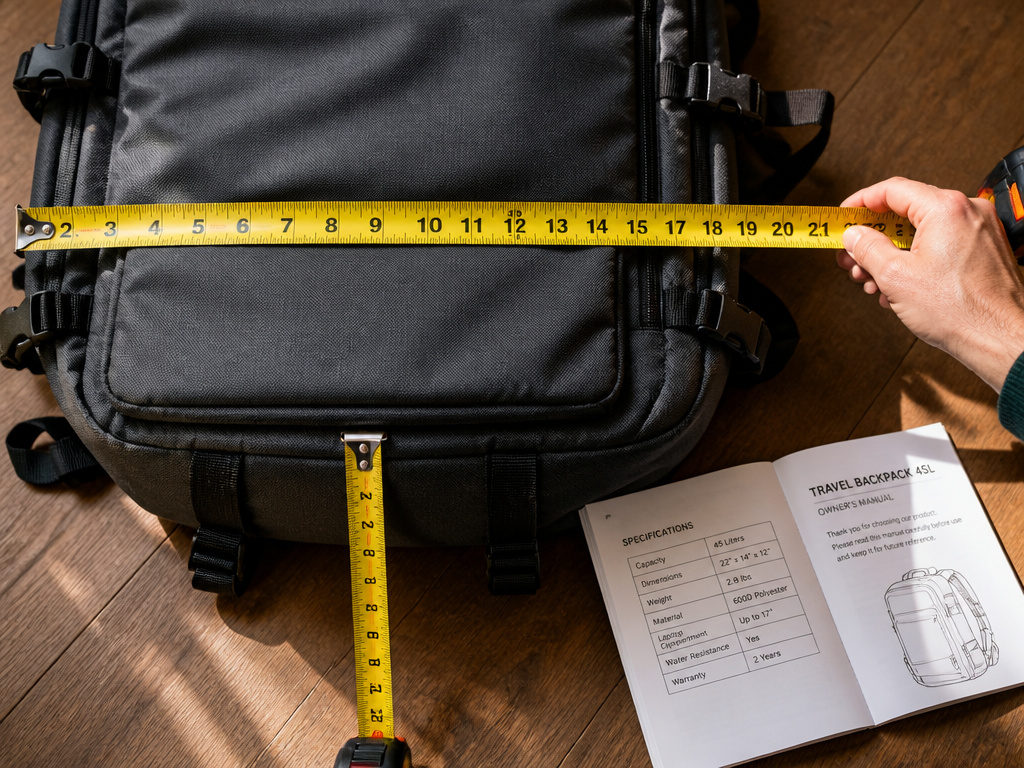
The Farpoint and Fairview owner’s manual is the most useful document in this category, and three numbers in it do more work than the marketing copy.
| Model | Volume | Weight | Dimensions (h x w x d) |
|---|---|---|---|
| Farpoint / Fairview 40 | 36 L (2,197 cu in) | 2.40 kg (5.29 lb) | 22 x 15 x 12 in (54 x 39 x 31 cm) |
| Farpoint / Fairview 55 | 65 L (3,967 cu in) | 2.80 kg (6.17 lb) | 27.5 x 16 x 13 in (70 x 41 x 34 cm) |
| Travel Daypack | 15 L (915 cu in) | 0.54 kg (1.19 lb) | 18.5 x 11 x 8 in (47 x 28 x 20 cm) |
Read the footnotes.
The first spec: the 55’s volume and weight include the removable Travel Daypack, but its dimensions exclude it. So the 65-liter figure describes a two-piece system, and the 27.5 x 16 x 13 inch measurement describes only the chassis. Comparing that 65 against another brand’s 65 is comparing different things.
The second spec: the 40’s dimensions are 22 x 15 x 12 inches. REI’s stated limit for most airlines is 45. Osprey labels the 40 as domestic carry-on size, and by volume it’s a 36-liter bag, but the arithmetic puts it over the dimensional line. That gap is the single most useful thing to know before you buy.
The third spec: the manual’s spec table repeats the 40 and 55 figures verbatim in the 70 and 80 rows. Those numbers are unusable.
Add your three dimensions. If the total tops 45 inches, you’re past the carry-on category and into negotiation territory.
The bag that fits overhead and the bag that fits under the seat are governed by different numbers.
Can a 55-Liter Pack Really Fit in the Overhead?
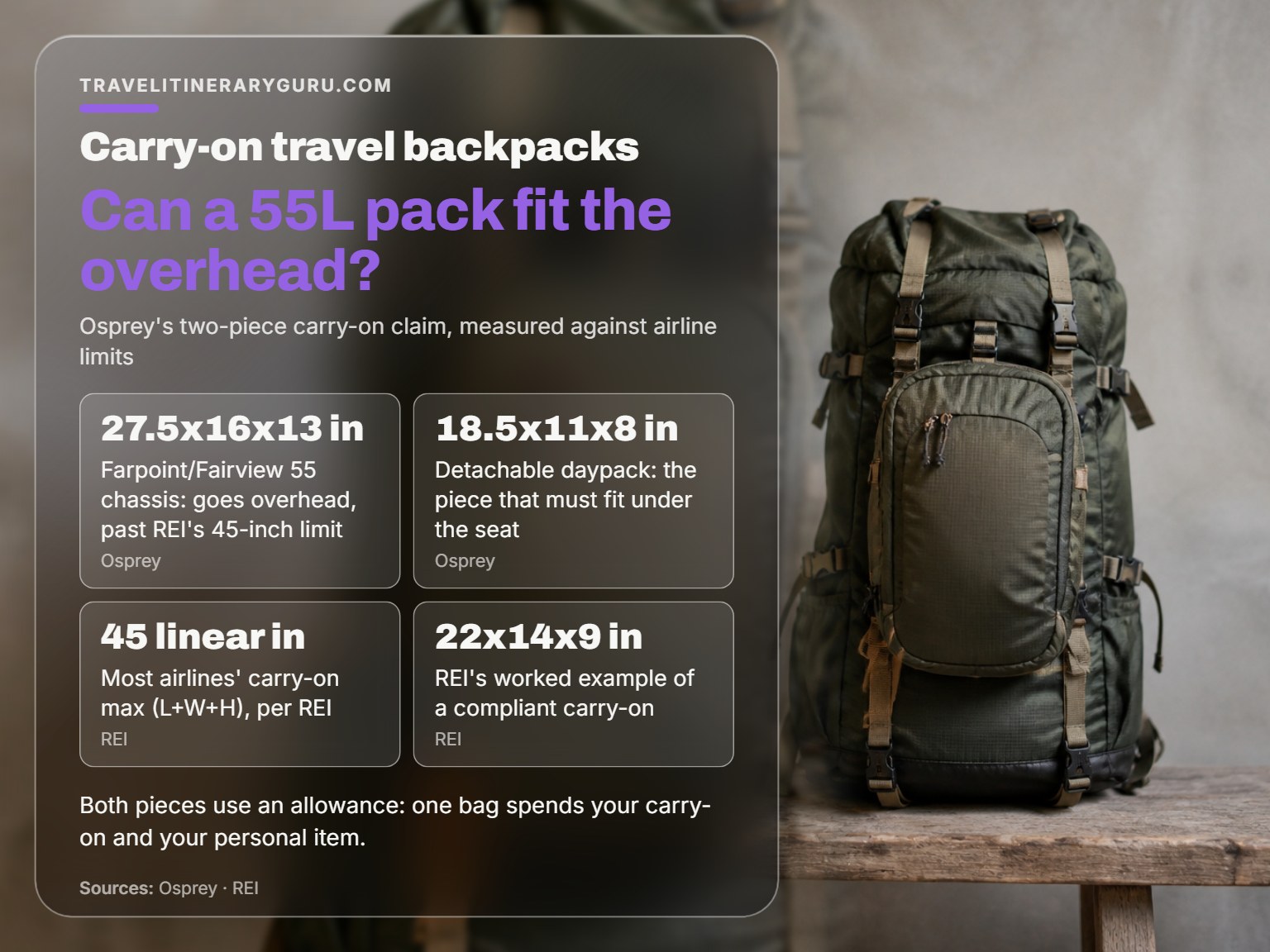
Osprey’s manual says yes, with a caveat that changes the whole calculation.
The claim is that the Farpoint and Fairview 55 can be carried on in two pieces: the body as an overhead bag and the daypack as a personal item. Osprey describes the setup as domestic carry-on size with the daypack under the seat and the chassis overhead.
The Two-Piece Carry-On Trick
- The daypack detaches from the main harness and travels separately.
- The daypack measures 18.5 x 11 x 8 inches, and that’s the piece that has to fit under the seat.
- The chassis goes overhead at 27.5 x 16 x 13 inches.
- Both pieces use up an allowance, so you’ve spent your carry-on and your personal item on one bag.
Check the aircraft.
Where this goes sideways: Treating a manufacturer’s “domestic carry-on size” label as an airline rule. The Farpoint 55’s chassis measures 27.5 x 16 x 13 inches, well past REI’s 45-inch figure, so a gate agent on a regional aircraft can make you check it.
REI’s framing and Osprey’s claim sit awkwardly together, and it’s worth saying so plainly. REI also notes that international and budget carriers are stricter with size and weight allowances. Wirecutter’s position is that larger bags tend not to be carry-on-friendly, especially in Europe, so be prepared to check them.
Travelers who’d rather skip the overhead bin entirely should look at backpacks that fit under the seat, which stay inside the personal-item envelope.
Is a Dedicated Travel Backpack Worth It If You Only Fly Twice a Year?
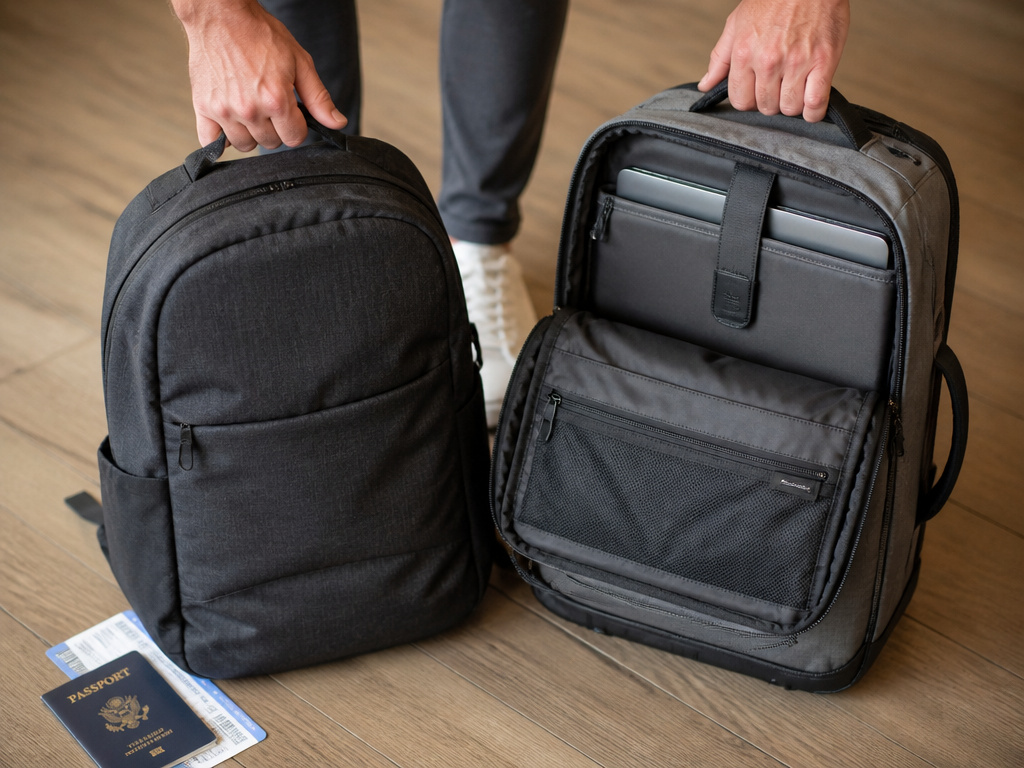
Tortuga says it plainly: if you don’t travel much, you shouldn’t invest in a dedicated technical travel backpack.
Wirecutter doesn’t add that caveat. Its carry-on picks are recommended for most situations, with the Cotopaxi Allpa 35L Del Dia as the small option, the Peak Design Travel Backpack 45L as the large one, the Patagonia Black Hole MLC 45L for working out of, and the Osprey Farpoint 40 and Fairview 40 for long journeys on foot.
So which is it? Tortuga’s threshold is the more useful one. If you don’t travel much and you’re not walking far with the bag, a general-purpose backpack does the job.
Skip it.
When to Skip the Technical Pack
- You don’t travel much, mostly to one climate.
- You already own a backpack that’s carry-on sized, easy to pack, and comfortable. Those are Tortuga’s four criteria, and they’re a reasonable test.
- You’re checking a bag anyway, so the size-and-weight balance a travel backpack is built around buys you nothing.
Two other categories are worth a look before you commit. If you carry a laptop, laptop backpacks with a dedicated sleeve do the same job with better protection; the Osprey Farpoint and Fairview 40 include a quick-access 16-inch laptop sleeve, and the Able Carry Max Backpack fits up to a 17-inch computer. If you’d rather not carry the weight at all, carry-on wheeled backpacks solve the same problem without the harness.
My itineraries run too full, and I’ve had to learn to build in do-nothing blocks. The same correction applies to a bag.
For bags that fall outside the carry-on category entirely, the Wirecutter backpack buying guide covers the larger end of the range.
Frequently Asked Questions
Is 45 liters too big for a carry-on?
It depends which rule you follow. Tortuga treats 45 liters as the maximum on most US airlines, while REI frames the limit as 45 linear inches. A 45-liter bag with a slim profile can clear the dimensional test; a boxy one may not. Check the three dimensions before the volume.
Do I need a hip belt on a carry-on travel backpack?
Pack Hacker’s position is that hip belts help with heavier loads and long carries but aren’t necessary if you pack minimally in a smaller bag. Osprey builds one into the Farpoint and Fairview as standard, and it stows away when you don’t want it. If you’ll walk a long way with the bag loaded, take the belt.
What size travel backpack fits under an airplane seat?
REI warns that a fully loaded 35-liter pack may be over the personal-item limit, so volume alone won’t tell you. The Osprey Travel Daypack, at 18.5 x 11 x 8 inches, is sized for that space. Measure the packed bag, not the empty one.
Why do two 40-liter backpacks measure differently?
Pack Hacker’s answer is that there’s no industry standard for liter ratings, so what one brand calls 40 liters another brand may not. Compare the height, width, and depth on the spec sheet instead. Add them together and you have a number you can actually check.
Is a carry-on travel backpack worth it if I only fly twice a year?
Tortuga’s advice is no: if you don’t travel much, skip the dedicated technical pack. Wirecutter recommends specific carry-on travel backpacks for most situations without that caveat. If you’re not walking far with the bag, a general-purpose backpack is the cheaper answer.
The Bottom Line
Here’s the test I’d run before you buy anything. Pull your current bag out, measure the three dimensions, and add them up. If the total tops 45 inches, you’re relying on a gate agent’s mood rather than a rule.
That’s the one number worth memorizing. Everything else, from liter ratings to harness branding, is downstream of it.
The advice changes if you’re flying regional aircraft or budget carriers in Europe. REI flags both as stricter on size and weight, and Wirecutter’s read is that larger bags usually get checked on those routes. In that case, buy a bag that clears 45 linear inches with an inch to spare rather than one that lands exactly on the line.
So that’s how to choose a travel backpack for carry-on travel: add the three dimensions, compare the total to 45 inches, and buy accordingly. And if you don’t travel much and you’re not walking far with the bag, buy the boring general-purpose backpack and put the difference toward the trip itself.
