
How to Avoid Road Trip Fatigue: The 4-Hour Rule
This post contains affiliate links. As an Amazon Associate, we earn from qualifying purchases.
To avoid road trip fatigue, sleep is the only countermeasure that addresses the cause. Everything else, coffee, cold air, loud music, snacks, buys minutes, not hours. Authorities broadly agree on the core rules, get adequate sleep the night before, take regular breaks, and never push through the signs of drowsiness, though they differ on specifics: NHTSA urges seven to eight hours of sleep per night, the National Sleep Foundation recommends stops every 100 miles or two hours, and RoSPA (citing UK Highway Code Rule 91) calls for a minimum 15-minute break after every two hours of driving. Drivers who have slept less than five hours are generally not fit to drive safely.
That last threshold matters more than most trip-planning advice admits. A driver who slept five hours feels functional. They’ve done it before. They’ll do it again. But the collision data says their risk is already climbing, and the gap between “feels fine” and “is fine” is where road trip fatigue turns into a crash report. Knowing how to avoid road trip fatigue starts with recognising that gap.
What follows is a working plan: the sleep math, the microsleep problem, the break intervals different authorities actually recommend, and the tactics that don’t work no matter how many truckers swear by them.
Key Takeaways
- Sleep is the only real fix. Lowering windows, cranking music, and snacking are named by the National Sleep Foundation as ineffective methods drivers commonly report using. Only sleep addresses the cause.
- Under five hours of sleep means you’re not fit to drive, according to the National Sleep Foundation’s threshold, though the collision-rate data from RoSPA (citing the AAA Foundation for Traffic Safety) suggests risk climbs earlier: drivers who slept five to six hours had 1.9 times the collision rate of drivers who slept seven, and those who slept four hours or less had 11.5 times the collision rate.
- A four-second microsleep at 100 km/h covers more than 110 metres, per Transport for NSW. At 55 mph, NHTSA says four to five seconds means more than 100 yards traveled unconscious.
- Transport for NSW advises waiting 30 minutes after waking before driving, because sleep inertia, the grogginess window after waking, generally lasts 15 to 30 minutes; NHTSA offers no post-waking wait guidance, focusing instead on getting a good night’s sleep before a long trip.
- NHTSA says peak drowsiness runs midnight to 6 a.m. And again in the late afternoon, with FMCSA pinning the afternoon window at 2 to 4 p.m.; Transport for NSW frames the night window more broadly as ‘late at night and early in the morning’ without fixing clock hours.
How Long Can You Actually Drive Before Fatigue Sets In? The honest answer is that time-on-task matters less than time-of-day. A study cited by the FMCSA found that driver alertness was related to “time-of-day” more so than “time-on-task.” That’s a useful correction to the standard “take a break every two hours” framing, because it means the clock on the wall may matter more than the clock on the dash.
A microsleep is a brief, unintended loss of consciousness lasting a few seconds to a few minutes. At 100 km/h, a four-second microsleep means driving more than 110 metres with your eyes off the road. At 55 mph, four to five seconds means more than 100 yards traveled while unconscious.
That’s from Transport for NSW and NHTSA respectively, and the two numbers land in the same place. A microsleep is a full gap in awareness at highway speed, and the car keeps moving through all of it.
I’ve learned this the hard way on long drives where the first sign of trouble was a rumble strip, not a yawn. By the time your tires are telling you something, you’ve already lost the seconds that mattered.
What the Sleep Debt Actually Costs You
The National Sleep Foundation’s position statement draws a hard line: drivers are generally not fit to drive safely if they’ve had less than five hours of sleep the previous night. That’s stricter than the “seven to eight hours” line most people have heard, and it’s deliberately so.
The collision-rate data from the AAA Foundation for Traffic Safety, cited by RoSPA, shows why the line sits where it does. Compared to drivers who had slept seven hours in the last 24 hours:
| Sleep in Last 24 Hours | Collision Rate vs. 7-Hour Baseline | What It Feels Like |
|---|---|---|
| 7 hours | Baseline | Normal |
| 5-6 hours | 1.9x | “A little tired” |
| 4 hours or less | 11.5x | “I can push through” |
The middle row is the dangerous one. A driver at 1.9x collision risk doesn’t feel impaired. They feel like someone who woke up early. That’s why the National Sleep Foundation’s five-hour floor reads as conservative, it’s not measuring how you feel, it’s measuring what your reaction time is doing without your permission when you compare a how to avoid road trip fatigue.
Why Midnight to 6 a.m. Is the Worst Window
Fatigue-related crashes aren’t evenly distributed across the day. NHTSA’s data shows they occur most frequently between midnight and 6 a.m. And again in the late afternoon, because those are the two daily dips in circadian rhythm, the body’s internal sleep clock.
FMCSA gets more specific on the afternoon window, naming 2 to 4 p.m. Transport for NSW frames the night window as “late at night and early in the morning” without fixing clock hours, but adds a number the other sources don’t: the risk of a fatal fatigue-related crash is four times greater late at night and early in the morning.
There’s a second-layer problem here that most road trip planning skips entirely. Fatigue-related crashes are twice as likely to be fatal than other crashes, per Transport for NSW. Drivers who are asleep can’t brake. That’s the whole mechanism in one sentence, and it explains the crash profile NHTSA describes: single driver, no passengers, running off the road at high speed with no evidence of braking.
Worth knowing before you start: A crash with no braking isn’t a driver who made a mistake. It’s a driver who was unconscious for the last four seconds. The absence of skid marks is the signature.
What 17 Hours Awake Does to Your Driving Transport for NSW puts a number on cumulative sleep debt that most US sources don’t: being awake for about 17 hours has a similar effect on your driving as a blood alcohol concentration of 0.05.
Seventeen hours awake isn’t an extreme scenario. Wake at 6 a.m., drive through the afternoon, hit the road again after dinner, you’re there before the evening news.
The Sleep Inertia Trap Nobody Plans For Sleep inertia is a fatigue risk that standard advice often overlooks. Transport for NSW defines it as the high risk of fatigue immediately after waking, generally lasting 15 to 30 minutes. Their guidance is blunt: wait 30 minutes after waking before driving.
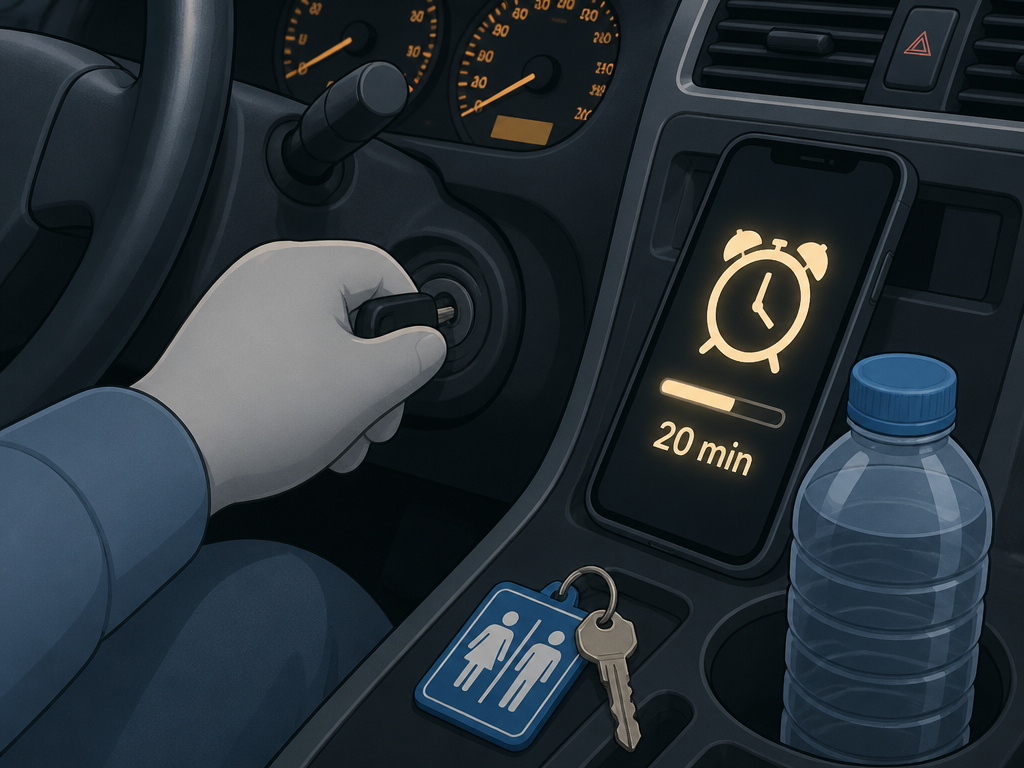
That contradicts the most common road trip pattern in existence. You pull into a rest area at 2 a.m., set an alarm for 20 minutes, wake up, splash water on your face, and drive off. According to the NSW guidance, you just drove off during the worst 15 minutes of your entire day.
NHTSA’s guidance doesn’t mention a post-waking wait period, it says to get a good night’s sleep before a long trip and to pull over for a short 20-minute nap in a safe place when drowsy. The two positions aren’t contradictory so much as incomplete on top of each other. NHTSA focuses on the sleep-before; NSW focuses on the waking-after.
Here’s the practical resolution: if you’re napping mid-trip, build in a buffer after you wake. Walk to the bathroom. Refill a water bottle. Give your body 15 minutes before you’re back in the driver’s seat.
How Often Should You Stop, and For How Long?
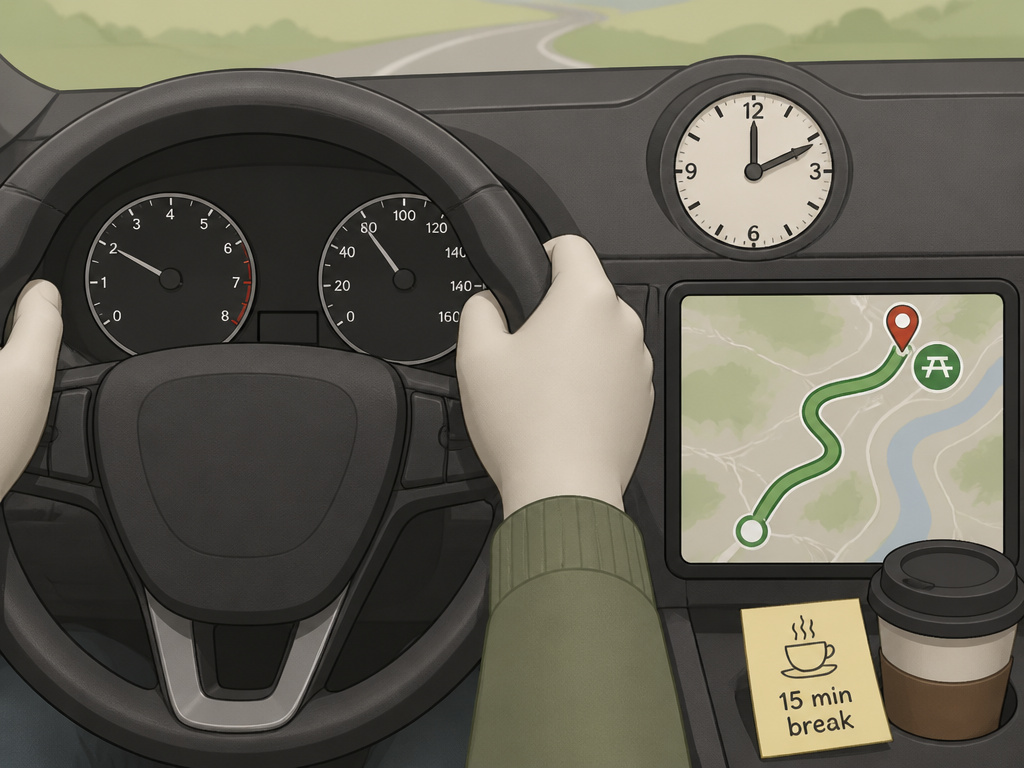
This is where the sources genuinely disagree, and the disagreement is worth showing rather than smoothing over.
| Authority | Break Interval | Duration |
|---|---|---|
| National Sleep Foundation | Every 100 miles or two hours | Not specified |
| RoSPA (UK Highway Code Rule 91) | Every two hours | Minimum 15 minutes |
| Transport for NSW | Regular breaks, even if not tired | Not specified |
The National Sleep Foundation’s interval is distance-based or time-based, whichever comes first. RoSPA’s is time-based with a hard minimum on duration. Transport for NSW skips the interval entirely and just says to take breaks regularly and share the driving with a friend or family member when you can.
If you want one rule that satisfies all three, it’s this: stop every two hours, for at least 15 minutes, before you feel like you need to. The “before you feel like it” part is what makes it work. By the time you feel like stopping, you’ve already been driving impaired for some stretch of road.
One more practical detail from Transport for NSW that catches people out: rest areas are open 24/7, but camping is prohibited. If you need more than a short nap, you’re looking at a campsite, hotel, or motel, not a highway pull-off.
Where this goes sideways: Planning to “just push through” the last two hours to reach your destination. The last two hours of a long drive are statistically the most dangerous, and the arrival adrenaline that gets you through them doesn’t protect you, it masks the impairment until you’re already parked.
The Tactics That Don’t Work (and Why Drivers Still Use Them) The National Sleep Foundation’s position statement names three methods drivers commonly report using that don’t address the cause: lowering the windows, increasing music volume, and eating a snack.
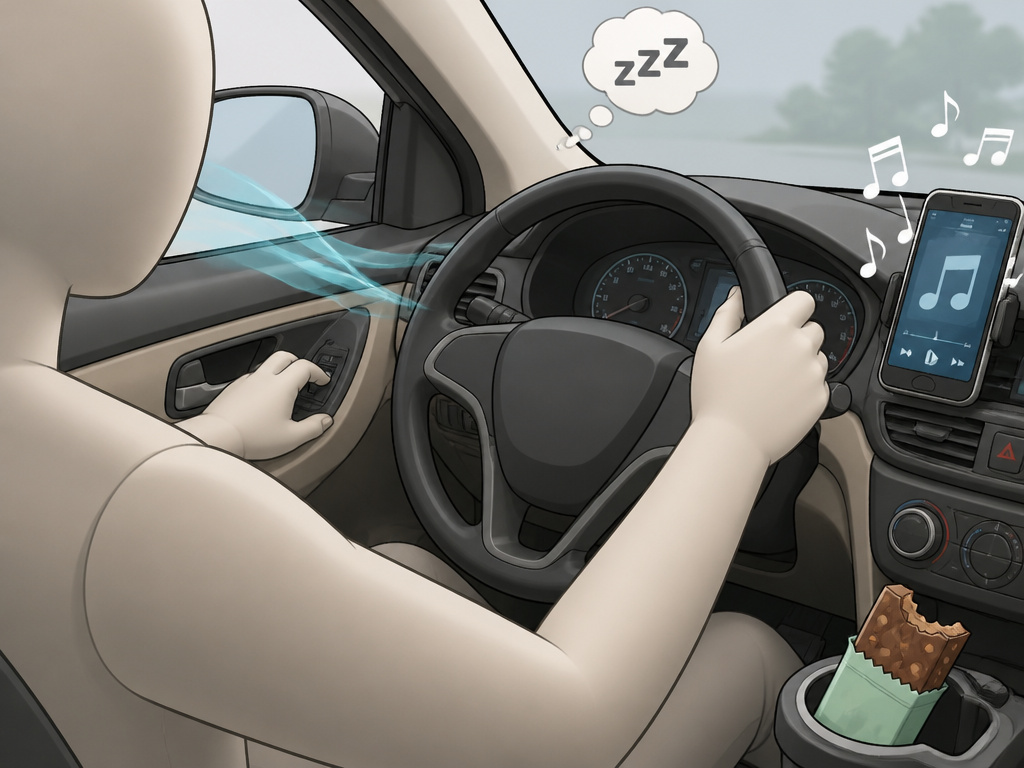
I get why they sound right. Cold air wakes you up. Loud music keeps your brain engaged. A snack gives you something to do with your hands. Each one produces a short-term alertness bump that feels like it’s working, but none answers how to avoid road trip fatigue.
But the underlying problem is sleep pressure accumulating in your brain, and none of those three touch it. The alertness bump fades in minutes, and by the time it does, you’ve added distance between yourself and your last real rest stop. That’s the cost.
Common mistake: Treating a cold blast of air as a reset. It isn’t. The window-down trick produces a few minutes of alertness and no reduction in sleep pressure, which means the next microsleep window arrives on the same schedule it would have anyway.
Why Caffeine Is Complicated Caffeine is where the sources disagree sharply, and pretending otherwise would be dishonest.
NHTSA’s guidance is practical: if you start to get sleepy while driving, drink one to two cups of coffee and pull over for a short 20-minute nap in a safe place. The coffee-plus-nap combination has been shown to increase alertness in scientific studies, but only for short time periods.
The National Sleep Foundation takes a stricter position. It labels caffeine and naps as secondary interventions, usable only where it isn’t feasible to avoid driving altogether, and states plainly that they don’t target the main cause.
Transport for NSW goes further in the other direction, listing “too much coffee” among the things to avoid and stating that sleep is the only way to overcome tiredness. RoSPA’s position, citing a 2013 study, sits in the middle: caffeinated substances reduce crash risk, but the benefit is only useful for a short time.
The reconciliation is this. Caffeine can buy you the margin you need to reach a safe stopping point. It cannot buy you a driving day. If the question is “can I make it 40 more minutes to a motel,” caffeine is a legitimate tool. If the question is “can I push through the next four hours,” the answer is no, and no amount of coffee changes it.
What Actually Prevents Road Trip Fatigue Everything above points to the same handful of decisions, most of which happen before you turn the key.
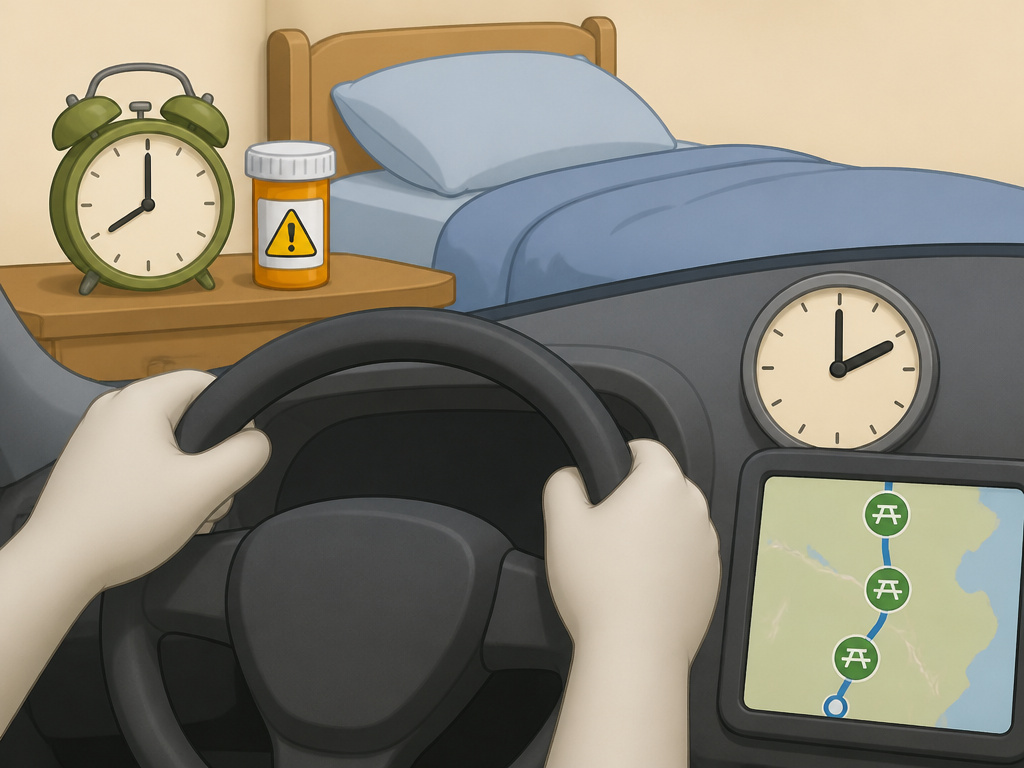
Sleep first, plan second. NHTSA’s guidance is unambiguous: getting adequate sleep on a daily basis is the only true way to protect yourself against the risks of driving drowsy, and experts urge consumers to make seven to eight hours a night a priority, though Transport for NSW puts the average at about 8 hours (with teenagers needing more), and the NTSB says older adults need 7 to 9 hours and teens 8 to 10 hours. If you’re planning a long drive, the night before is part of the trip.
Build the breaks into the itinerary. The National Sleep Foundation recommends stops every 100 miles or two hours, while RoSPA (citing UK Highway Code Rule 91) calls for a minimum 15-minute break after every two hours of driving. If you’re using a road trip preparation checklist, put the break schedule in before you put the sightseeing in. The stops are the part of the plan that keeps the rest of it intact.
Rotate drivers when you can. Transport for NSW specifically recommends sharing the driving with a friend or family member. If you’re the only licensed driver, that changes the plan: shorter days, more stops, no late-night legs.
Check your medications before you leave. NHTSA and FMCSA both flag this. FMCSA names tranquilizers, sleeping pills, allergy medicines, and cold medicines as common drowsiness-inducing categories, and advises checking warning labels. NHTSA advises checking prescription and over-the-counter medication labels and, if you take medications that could cause drowsiness, using public transportation when possible.
Know the higher-risk groups. Shift workers are twice as likely to fall asleep at the wheel compared with non-shift workers, according to National Sleep Foundation data cited by RoSPA. Professional drivers with sleep apnoea are between 6 and 15 times more likely to have a road traffic collision. Teens are a special case. NHTSA notes their biological sleep need increases during adolescence and advises delaying driving until well-rested. If you’re driving with a teen who plans to take a shift, share driving duties with clear rules about when they hand the wheel back.
What About Night Driving Specifically? Night driving stacks the risks. The midnight-to-6 a.m. Window is a peak drowsiness period, and per Transport for NSW the risk of a fatal fatigue-related crash is four times greater late at night and early in the morning.
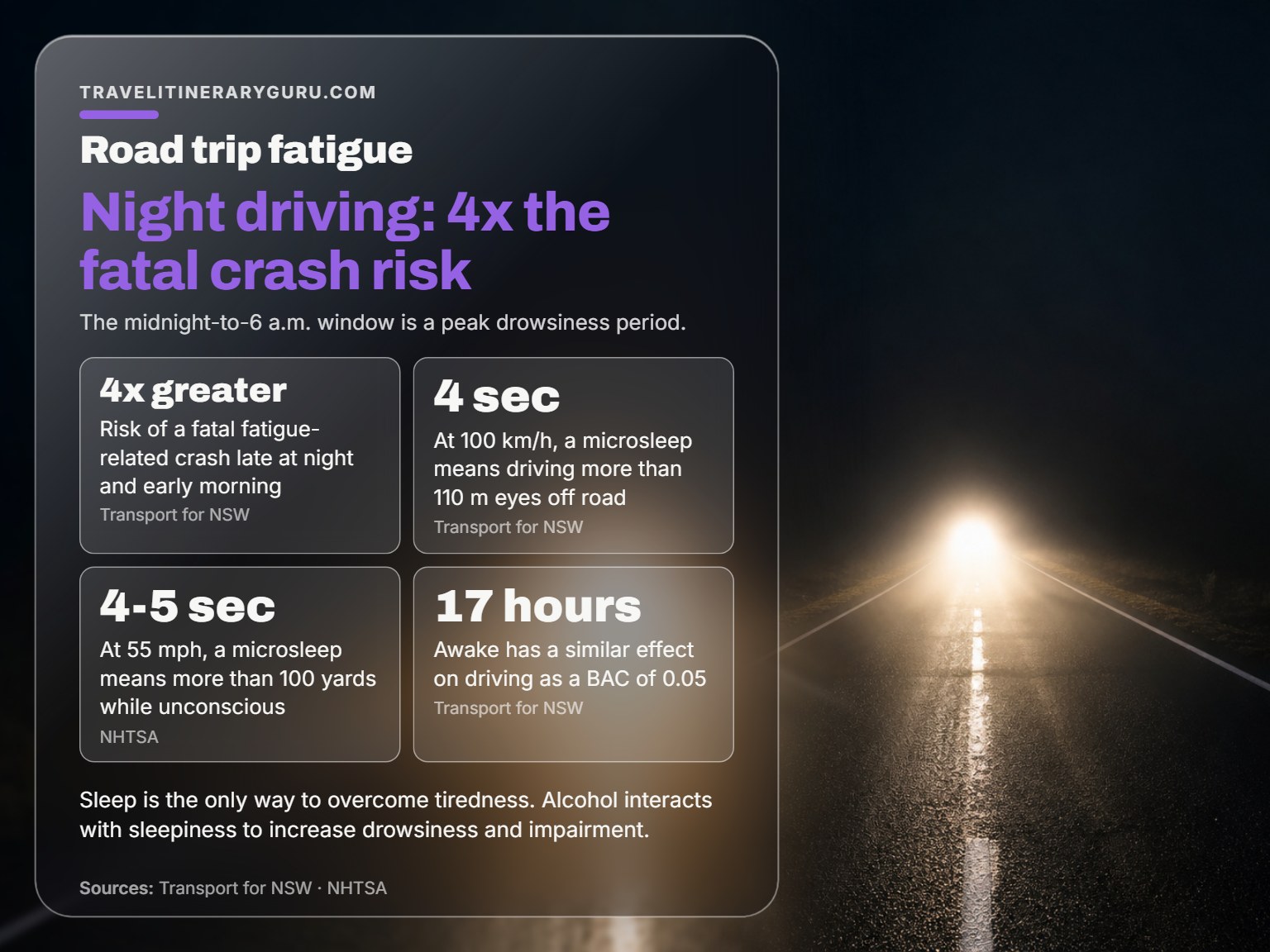
If a night leg is unavoidable, the mitigations are the same but the margins are thinner. Shorter stints. More frequent stops. No alcohol. NHTSA notes that alcohol interacts with sleepiness to increase drowsiness and impairment, which means the compounding effect is worse than the sum of the two.
I underweight food and nightlife in my own itineraries, which means I sometimes push evening drives further than I should to hit a morning start. That’s a real gap in my planning, and it’s exactly the pattern that lands drivers in the 2 to 4 p.m. Or late-night danger windows without them noticing.
For a fuller breakdown of the specific tactics, there’s a separate guide on night driving that covers headlight use, wildlife, and the specific hazards of low-light highway driving.
How many hours of sleep do you need before a long drive?
Sources differ. NHTSA urges seven to eight hours per night. The NTSB gives a range that adjusts for age: older adults need 7 to 9 hours, and teens need 8 to 10 hours for optimal health and safety. Transport for NSW says the average person needs about 8 hours, with teenagers needing more.
Does coffee actually help with driver fatigue?
It helps for a short window, and the sources disagree on how much that matters. NHTSA presents the coffee-plus-20-minute-nap combination as a positive recommendation backed by scientific studies. The National Sleep Foundation labels caffeine a secondary intervention that doesn’t target the main cause. RoSPA’s read is that caffeine reduces crash risk but only for a short time. Transport for NSW goes further still, advising against too much coffee and stating that sleep is the only way to overcome tiredness.
What is a microsleep and how dangerous is it?
A microsleep is a brief, unintended loss of consciousness lasting a few seconds to a few minutes. At 100 km/h, a four-second microsleep means driving more than 110 metres with your eyes off the road. At 55 mph, four to five seconds means more than 100 yards traveled while unconscious. Transport for NSW’s advice is direct: don’t wait for a microsleep, because by then it’s too late.
Can you drive after waking up from a nap? Transport for NSW advises waiting 30 minutes after waking before driving, because sleep inertia, the high fatigue risk immediately after waking, generally lasts 15 to 30 minutes. NHTSA doesn’t specify a post-waking wait period.
What should you avoid eating or drinking before a long drive? Transport for NSW advises avoiding alcohol, fatty foods, too much coffee, and sweet soft drinks, and drinking plenty of water instead. Dehydration can cause fatigue. FMCSA adds that skipping meals or eating at irregular times can lead to fatigue, and that going to bed on an empty stomach or immediately after a heavy meal can interfere with sleep.
Are fatigue detection devices reliable? RoSPA is explicitly concerned about this. Their position is that drivers may rely on detection and warning devices and even be tempted to drive when tired, believing the device will prevent a collision. RoSPA’s guidance is that it’s far better to avoid driving when too tired, to plan journeys safely, and to follow the advice in the Highway Code and RoSPA’s guides.
Frequently Asked Questions
Does drinking coffee help you stay awake on a long drive?
Caffeine can improve alertness for a short period, but it does not reverse the underlying sleep debt that causes fatigue. The National Sleep Foundation lists caffeine among the tactics drivers commonly rely on that do not address the root cause. Treat it as a brief delay, not a substitute for rest.
What is sleep inertia and why does it matter before you drive?
Sleep inertia is the grogginess window that follows waking, and Transport for NSW advises waiting about 30 minutes before getting behind the wheel. During this period your reaction time and judgment are still recovering even though you feel awake. NHTSA does not offer specific post-waking wait guidance, focusing instead on getting sufficient sleep before a long trip.
Are there times of day when drowsy driving risk is highest?
Yes. NHTSA identifies peak drowsiness from midnight to 6 a.m. And again in the late afternoon, with FMCSA narrowing the afternoon window to 2 to 4 p.m. Transport for NSW describes the night window more broadly as late at night and early in the morning. Scheduling drives outside these windows reduces your exposure to the body’s natural dip in alertness.
Can you build up a tolerance to driving while tired?
No. Feeling accustomed to driving tired is not the same as being safe, and the collision data shows risk rising well before a driver notices impairment. Drivers who slept five to six hours had 1.9 times the collision rate of those who slept seven, and four hours or less pushed that to 11.5 times. Experience behind the wheel does not cancel out the physiology of sleep deprivation.
The Bottom Line One rule most fatigue advice skips: the National Sleep Foundation says drivers who have slept less than five hours are generally not fit to drive safely. Not “drive carefully.” Not “take extra breaks.” Don’t start. That threshold is the least forgiving number in this entire article, and it’s the one most drivers rationalize past.
If you’re planning a long trip, the first thing to do this week is look at your departure day and ask whether you’ll actually be rested when it starts. If the answer is no, shift the departure by a day. That’s cheaper than the alternative, and it’s the only adjustment that changes the underlying risk rather than masking it.
The rest of the plan, the two-hour stops, the 15-minute minimums, the post-nap wait, the driver rotation, all of it works only on top of that first decision. Fatigue is a manageable threat, but only if you manage it before you’re behind the wheel.
