
How Many Days to Spend in Nairobi? The 3-Day Structure
This post contains affiliate links. As an Amazon Associate, we earn from qualifying purchases.
You can see Nairobi’s headline sights in two to three days according to LikeALocalGuide and Visit Nairobi, while The Kenya Guide and bestkenya.ke land on three full days. The four must-sees. Nairobi National Park, the Sheldrick elephant orphanage, the Giraffe Centre and the Karen Blixen house, fit into a single day if you start early, which is worth knowing when deciding how many days to spend in Nairobi.
That last sentence is where the arguing starts. Two days, three days, four days: the sources genuinely disagree on how many days to spend in Nairobi, and the disagreement is worth understanding before you book anything. It comes down to how much traffic you’re willing to eat.
What follows is the day-by-day structure, where the clusters sit on the map, what each stop actually costs, and the safety geography that turns a generic plan into a bad one.
Key Takeaways
- Three days is the number The Kenya Guide and bestkenya.ke recommend for wildlife, the Karen cluster, and a museum, with real meals in between, while LikeALocalGuide and Visit Nairobi say two to three days cover the highlights.
- Nairobi National Park opens at 6am and takes 2-3 hours minimum for the main game circuit. The 6am slot is the one that matters; lions and cheetahs move before the heat builds.
- Group your days geographically. Karen and Langata south, the city centre, the northern suburbs. Traffic is the single most-cited reason itineraries fail here.
- Day 3 needs a driver or a tour. You must stay in a vehicle inside Nairobi National Park, so ride-hailing alone won’t cover it.
- Kenya travel insurance is mandatory for almost every non-Kenyan visitor aged 3 and over since October 5, 2026. Your home policy doesn’t count.
How Many Days Do You Actually Need in Nairobi?
Three days is the number The Kenya Guide and bestkenya.ke recommend, but it isn’t unanimous. The Kenya Guide says three full days covers the main wildlife attractions, the Karen cluster, Nairobi Museum and Karura Forest, with time for good meals. LikeALocalGuide puts the ideal stay at two to three days, enough to enjoy the highlights at a relaxed pace. Visit Nairobi says two or three days cover the highlights, and adds that you can technically do Nairobi in one day with an early start.
Bestkenya.ke is blunter about it: three days is exactly the right amount of time to see why Nairobi isn’t a stopover. Kenyaauthority.com takes the opposite structural view, packing the four must-sees into one day and treating the national museum, KICC view and dinner at Carnivore as a second day.
Here’s the honest read. The how many days to spend in Nairobi question isn’t the real variable. Geographic clustering is.
Nairobi’s main visitor sites sit in three separate clusters: Karen and Langata in the south, the city centre, and the northern suburbs around Gigiri. Each cluster carries its own traffic penalty, and crossing between them during working hours can consume two hours of a day. Grouping by cluster matters more than total days.
That’s the whole argument in three sentences. Add days and you add clusters, not stops.
| Source | Recommended Duration | What It Covers |
|---|---|---|
| The Kenya Guide | 3 full days | Wildlife, Karen cluster, museum, Karura Forest |
| LikeALocalGuide | 2-3 days | Highlights at a relaxed pace |
| Visit Nairobi | 2-3 days, plus 2 more | Highlights plus a day trip on days 4-5 |
| bestkenya.ke | 3 days | Wildlife, culture, markets |
| kenyaauthority.com | 1 day for must-sees, 2 days total | Four must-sees day one, museum and Carnivore day two |
LikeALocalGuide and Visit Nairobi say two to three days cover the highlights, while The Kenya Guide and bestkenya.ke say three full days.
The 3-Day Structure That Actually Works
The structure below assumes you’re grouping by geography. It’s the same logic The Kenya Guide uses, and it holds up because it matches how the road network actually behaves.
Day 1: Karen and Langata
Start with the Giraffe Centre on Gogo Falls Road in Langata. Entry is USD 15 for non-resident adults as of 2026, and the Rothschild giraffe feeding platform opens at 9am. Arrive at opening to beat the tour groups. Allow 45-60 minutes.
Before you start:
Then the Sheldrick Wildlife Trust elephant orphanage, then the Karen Blixen Museum, then Kazuri Beads if you have the afternoon. Kazuri began in 1975 as Lady Susan Wood’s backyard pottery employing two local women. Today it’s a World Fair Trade Organization member employing hundreds of Kenyan women, most of them single mothers, with an on-site clinic providing free medical care to staff. The workshop tour is free.
A taxi or Bolt for the full day in Karen costs approximately KES 6,000-8,000. That’s the most efficient way to cover all four sites.
Day 2: Nairobi National Park and the City Centre
This is the day that justifies the trip. Nairobi National Park is the only national park located within a capital city, and it sits roughly 7 km from the centre by kenyaauthority.com’s measure. The Kenya Guide places the Langata Road gate differently and treats the park as a 2-3 hour minimum commitment for the main game circuit.
Entry is approximately USD 80 per non-resident adult as of 2026, with a vehicle fee of about KES 300 extra. Both figures are consistent across The Kenya Guide and bestkenya.ke.
The 6am opening is the point. Animals are most active before the heat sets in, and the park’s black rhino population is one of the better sightings in Kenya, though no sighting is guaranteed, as bestkenya.ke notes.
After the park, the Nairobi National Museum on Museum Hill Road. Entry is KES 1,500 for non-resident adults as of 2026, and you should allow 2 hours. The adjacent Snake Park adds another 30 minutes.
Day 3: Karura Forest, Markets, and Departure
If your Day 3 lands on a Friday, the Maasai Market at Village Market in Gigiri is the one The Kenya Guide rates as the best in Nairobi for genuine crafts.
Where this goes sideways:
Can You Do Nairobi National Park Without a Car?
Yes, but not on your own terms. This is one of the genuine source disagreements, and both positions are defensible.
The Kenya Guide says self-drive is possible in a saloon car on the main gravel roads. That’s true, the main circuit is graded and passable in a standard sedan.
Bestkenya.ke takes the practical view: Day 3 requires a driver or tour for Nairobi National Park since you must stay in a vehicle inside the park. Ride-hailing works for Days 1 and 2, but not the park.
Both are correct about different things. A saloon car can physically handle the main gravel roads. What it can’t do is put a licensed guide in the passenger seat who knows where the rhino were seen that morning.
Guided drives through operators like Let’s Go Travel cost approximately KES 4,000-6,000 per person on top of park fees. That’s the number to weigh against the cost of hiring a car and driving yourself.
If you’re weighing this against a longer safari later in the trip, the same logic applies, and the Kenya safari itinerary question is worth considering.
What Does Three Days in Nairobi Actually Cost?

The fixed costs are the entry fees. Hotels, meals and transport vary widely, so price those separately for your own style of travel.
| Item | Cost | Notes |
|---|---|---|
| Nairobi National Park entry | ~USD 80 per non-resident adult | Plus ~KES 300 vehicle fee |
| Giraffe Centre entry | USD 15 per non-resident adult | Opens 9am |
| Nairobi National Museum | KES 1,500 per non-resident adult | Allow 2 hours |
| Guided game drive | ~KES 4,000-6,000 per person | On top of park fees |
| Full-day taxi/Bolt in Karen | ~KES 6,000-8,000 | Covers all four Day 1 sites |
Meals are the wild card. Brew Bistro in Westlands runs approximately KES 1,800-2,500 per person. Habesha Ethiopian, for a communal injera meal, is approximately KES 1,400-2,000 per person.
For connectivity, buy a Safaricom SIM at JKIA arrivals, approximately KES 100, with data bundles from KES 500. Safaricom has the best coverage across Nairobi and the national parks.
Where the Sources Disagree on Trip Length
This is worth spelling out because the disagreement is real and it changes your booking.
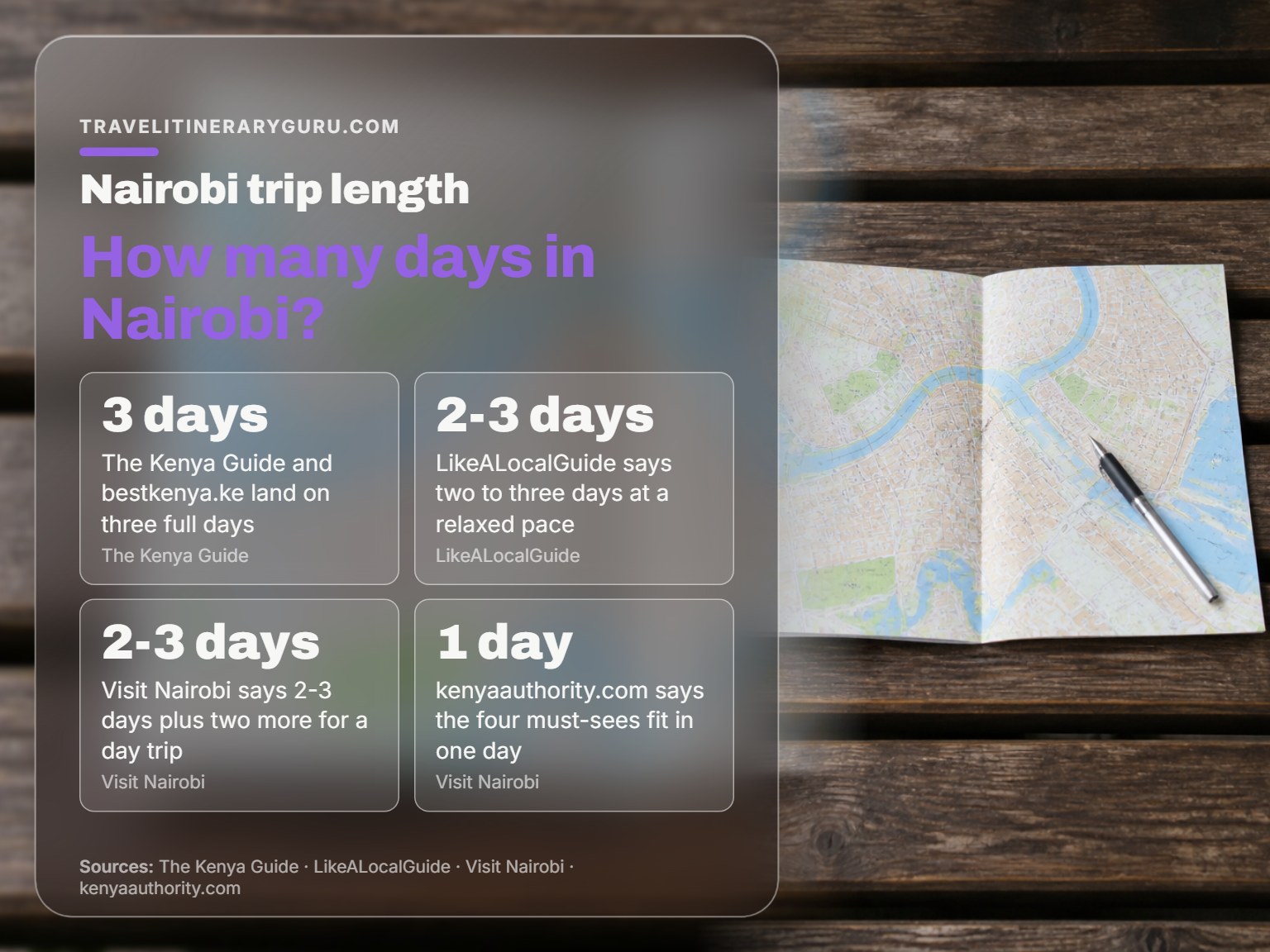
The Kenya Guide and bestkenya.ke land on three full days, while LikeALocalGuide says two to three days. Visit Nairobi says 2-3 days plus two more if you want a day trip. Kenyaauthority.com compresses the must-sees into one day and treats the second day as optional additions.
The outlier position comes from a long-term resident view: roughly 4 days, with an explicit warning that a rushed trip means losing half your trip to traffic.
Here’s how to decide. The Kenya Guide and bestkenya.ke say three days; LikeALocalGuide and Visit Nairobi say two to three days; kenyaauthority.com says the four must-sees fit in one day.
The part nobody mentions: Visit Nairobi says days four and five of a 5-day itinerary are for day trips. Visit Nairobi lists Lake Naivasha and Hell’s Gate, Mount Longonot, Ol Pejeta and the Ngong Hills as day-trip options on days four and five.
Hell’s Gate and Lake Naivasha are roughly two hours from Nairobi and combine well for a full-day Rift Valley trip. That’s a real day, not an afternoon.
If you’re extending beyond Nairobi, the same trip-length logic applies to the coast, and how many days to spend in Zanzibar is a separate calculation.
Security Geography: What Changes Your Plan
Nairobi is a large city with standard big-city precautions needed, but the specifics matter more than the general advice.
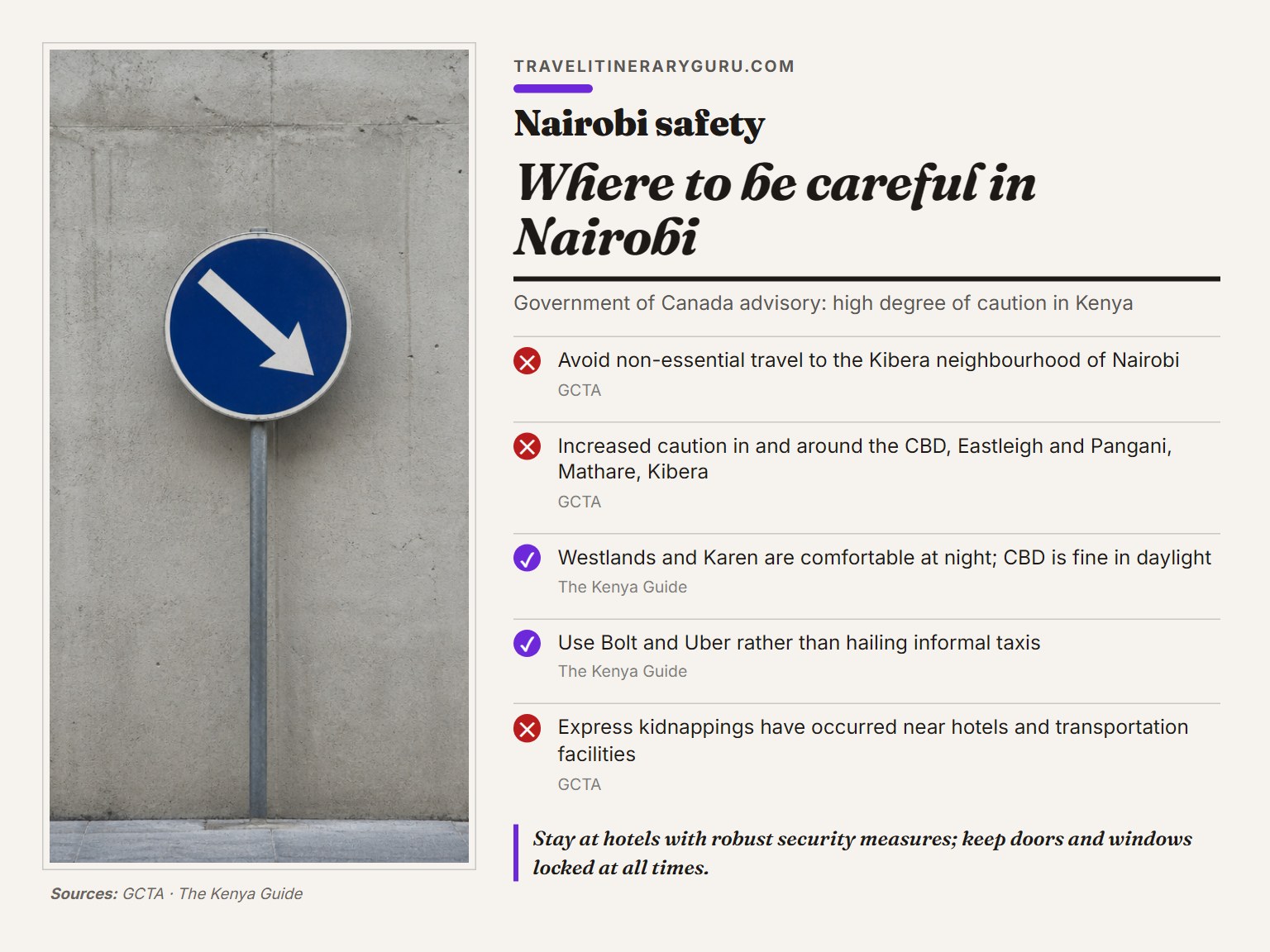
The Government of Canada advises exercising a high degree of caution in Kenya due to the threat of terrorism and a high crime rate. In Nairobi specifically, the advisory calls for increased caution in and around the Central Business District, Eastleigh and Pangani, and Mathare, Kibera, and other informal settlement communities. It advises avoiding non-essential travel to Kibera altogether.
That’s not a reason to skip Nairobi. It’s a reason to know which neighbourhoods your itinerary routes through.
Easy to miss: Express kidnappings have occurred near hotels and transportation facilities in Nairobi, where kidnappers demand small immediate ransoms. Victims are sometimes held overnight for a second ATM withdrawal. Use only reputable cab companies or ride-sharing apps, confirm the licence plate matches the app, and don’t accept rides from new acquaintances.
The Kenya Guide’s practical version: Westlands and Karen are comfortable at night. The CBD is fine in daylight but avoid unlit streets after dark. Use Bolt and Uber rather than hailing informal taxis.
The Government of Canada goes further on transport, it advises against motorcycle taxis (boda) and three-wheel taxis (tuk tuks) entirely, citing accident frequency. It also notes that public buses, including matatus, are unsafe, overcrowded and frequently involved in fatal accidents.
Where you stay shapes how much of this you deal with. LikeALocalGuide recommends staying central and walkable to the main sights for a first visit, and names South and Langata as the area. The Kenya Guide names specific properties by cluster: The Hemingways or House of Waine for Karen, Sankara Nairobi or Tribe Hotel for Westlands dining access, and Sarova Stanley for CBD access or Ole Sereni for park views at the mid-range.
The Canada advisory also has a line worth internalising for the park itself: many national parks and nature reserves are in remote areas with limited emergency services, and tourists have been victims of crime in parks and reserves as well as on safaris. Its guidance is to use only reputable and professional guides or tour operators, follow the advice of local guides and camp employees, and not walk around at night.
For wildlife observation specifically, maintain a safe distance, and only exit a vehicle when a professional guide or warden says it’s safe.
What to Pack and How to Handle the Altitude
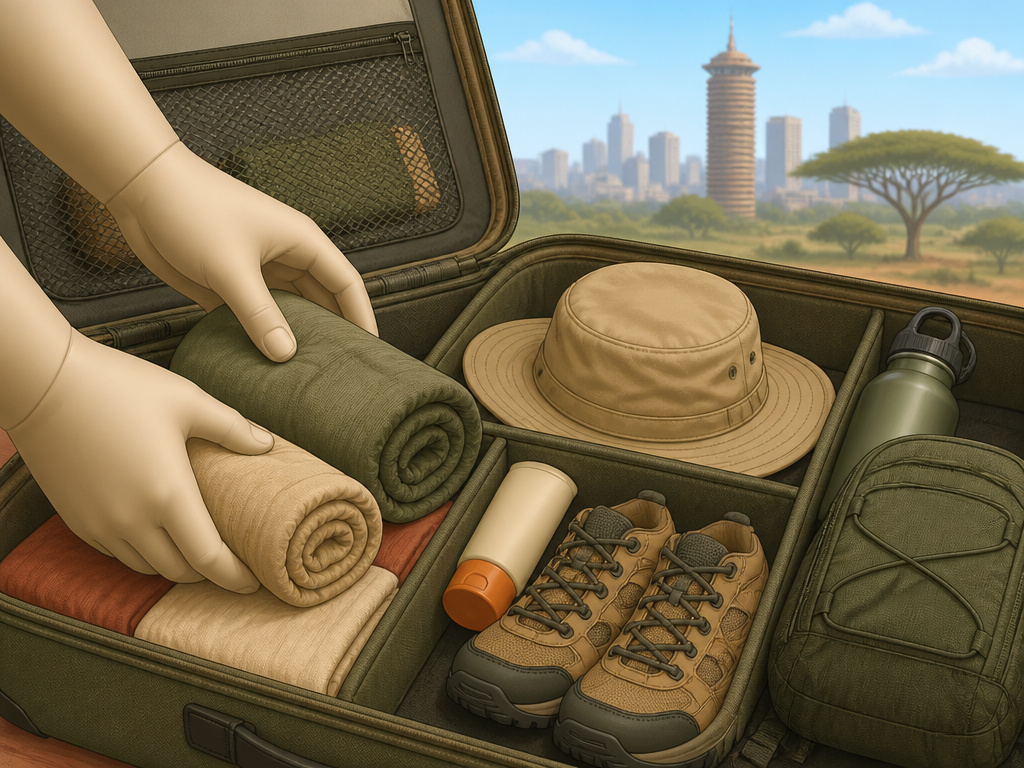
Nairobi sits at approximately 1,800m, which intensifies UV exposure. Sunscreen for Nairobi National Park isn’t optional.
Temperatures at 6am can be 12-15°C. Light layers for the early game drive, long sleeves for Karura Forest, comfortable walking shoes for the museum and Old Town.
Some visitors feel slightly breathless for the first day or two at altitude. Stay hydrated, and don’t schedule strenuous activities on arrival day. That’s the same advice whether you’re coming off a long-haul flight or a short regional hop.
If you’re carrying gear for both the city and a longer safari, the best luggage for an African safari question is worth settling before you pack.
Extending: Nairobi as Part of a Bigger Trip
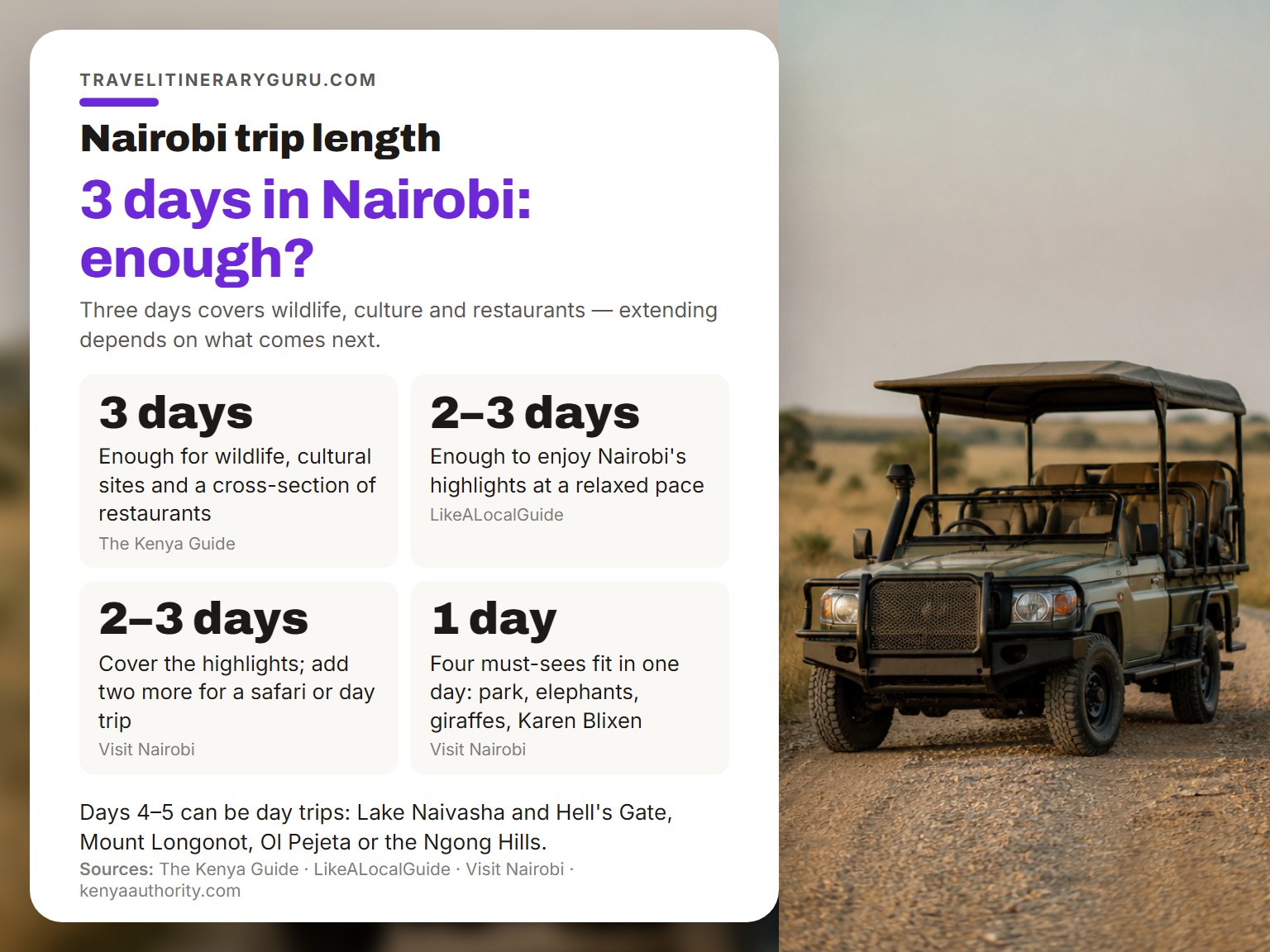
Three days in Nairobi is enough time to cover the city’s standout wildlife experiences, its main cultural sites, and a cross-section of restaurants. Whether you extend depends on what comes next.
If it’s a safari, the planning question shifts. A multi-country package that runs Nairobi to the Serengeti to Cape Town is a lot of internal flights, visa applications, and a traveler who needs a vacation from their vacation. If you’re deciding between the two big safari destinations, the Kenya vs Tanzania comparison is the place to start, and if you’ve already committed to the southern circuit, the Tanzania safari itinerary structure is a separate planning question.
One more thing that catches people out. Kenya travel insurance is mandatory since October 5, 2026 for almost every non-Kenyan visitor aged 3 and over. Your own insurance doesn’t count. That’s a pre-departure item, not something you sort at the airport.
Frequently Asked Questions
Is two days enough for Nairobi?
Two days covers the highlights if you cluster tightly. Day one for Karen and Langata. Giraffe Centre, Sheldrick, Karen Blixen, Kazuri. Day two for Nairobi National Park in the morning and the museum in the afternoon. What you lose is Karura Forest and any breathing room.
Can I do Nairobi in one day?
Yes, with an early start: the park, the giraffes, lunch in Karen and an afternoon museum. Kenyaauthority.com confirms the four must-sees fit in one day. What you won’t get is anything at a relaxed pace, and one traffic incident breaks the whole plan.
Do I need a car in Nairobi?
Not for Days 1 and 2. Ride-hailing works for the Karen and Langata cluster and for the city centre. Day 3 needs a driver or a tour for Nairobi National Park, since you must stay in a vehicle inside the park. The Kenya Guide notes self-drive is possible in a saloon car on the main gravel roads, but that assumes you’re comfortable driving Nairobi traffic.
What’s the best time of day for Nairobi National Park?
The 6am opening. Animals are most active before the heat sets in, and the park takes 2-3 hours minimum to cover the main game circuit. Arriving at 10am means you’re driving past animals that have already moved into shade.
How much does Nairobi National Park cost?
Approximately USD 80 per non-resident adult as of 2026, with a vehicle fee of about KES 300 extra. Add roughly KES 4,000-6,000 per person if you book a guided drive through an operator like Let’s Go Travel.
Is Nairobi safe for tourists?
The Government of Canada advises a high degree of caution in Kenya due to terrorism threat and a high crime rate, with increased caution in the CBD, Eastleigh, Pangani and informal settlements, and no non-essential travel to Kibera. In practice: stay in Westlands or Karen at night, use Bolt or Uber instead of street taxis, avoid boda bodas, and don’t display valuables.
The Bottom Line
If you take one number from all of this, take three days, which is what The Kenya Guide and bestkenya.ke recommend, while LikeALocalGuide and Visit Nairobi say two to three days cover the highlights.
Visit Nairobi says add two more days for a safari or day trip. Visit Nairobi says days four and five of a 5-day itinerary are for day trips, and bestkenya.ke says Hell’s Gate National Park and Lake Naivasha are roughly two hours from Nairobi.
Your first move this week, before you book anything else: check your travel insurance situation. Since October 5, 2026, Kenya requires its own policy for almost every non-Kenyan visitor aged 3 and over, and your home coverage doesn’t satisfy it. That’s the one item with a hard deadline attached, and it’s the one most itineraries forget to mention.
