
Amtrak Acela vs Northeast Regional: Which Should You Book?
This post contains affiliate links. As an Amazon Associate, we earn from qualifying purchases.
Amtrak Acela vs Northeast Regional is a time-versus-fare trade: Acela tops out at 150 mph and saves 30 to 60 minutes on most segments, while the Northeast Regional runs at 125 mph, serves 53 stations, and prices at roughly a third of the Acela fare.
Fare is where the Amtrak Acela vs Northeast Regional comparison turns slippery, because the two trains don’t price the same way. Northeast Regional fares climb steeply as the departure date closes in. Acela fares move far less. Book two to three weeks out and the Regional’s advantage is at its widest; book same-day and the gap narrows to almost nothing.
What follows is the practical version: the segment-by-segment time math, the station list that settles some trips before you ever compare fares, and the class of service most travelers walk right past.
Key Takeaways
- Acela saves 30 to 60 minutes on most Northeast Corridor segments, and only 5 to 20 minutes between New York and Philadelphia.
- The Regional serves 53 stations across all branches, including every Virginia and Springfield stop that Acela skips.
- Book two to three weeks out on the Regional; its fares scale far more steeply than Acela’s as departure approaches.
- Regional Business Class is the underrated seat on the corridor, priced well below Acela Business.
- First Class exists only on Acela, and it’s the only tier with at-seat meal service.
Where the Amtrak Acela vs Northeast Regional Time Gap Comes From
Acela and Northeast Regional share the same Northeast Corridor track, the same stations, and the same dispatching. The speed difference comes from what each train skips: Acela runs 150 mph on cleared segments and bypasses smaller stops, while the Regional runs 125 mph and calls at intermediate stations Acela passes.
The gap stays modest because of the track, not the trains. Tilt is the reason Acela can carry speed through a curve at all. The trainset leans into the bend, which keeps the lateral force off the passengers and lets the engineer hold more speed than a 125 mph Regional can.
So how much is 30 minutes worth to you on that particular morning? That’s the only question that matters here.
The Segment-by-Segment Math
| Segment | Acela | Northeast Regional | Verdict |
|---|---|---|---|
| New York to Washington | 2 hr 45 min | 3 hr 15 min to 3 hr 30 min | Acela, on a fixed schedule |
| New York to Philadelphia | 75 min | 5 to 20 min longer | Regional, every time |
| New York to Boston | About 3 hr 30 min | 4 hr to 4 hr 20 min | Acela on a day trip |
| Boston to Washington | 6 hr 38 min to 6 hr 50 min | 7 hr 30 min to 8 hr | Acela, if someone else pays |
Sources don’t agree on exactly how wide that gap is. ShopBack puts the Regional roughly 30 minutes behind Acela on New York to DC. Success Knocks calls it a 45-minute gap. A third comparison gives a 30-to-60-minute range. Which departure you pick changes the answer more than which source you read.
For best views heading from New York to Boston, grab a window seat on the left side of the train. Same view. Nobody pays a premium for it, because both trains have it.
The time math matters most when you’re stacking legs. A three-day Acela train trip from Boston to Washington only works if the schedule bends around the sightseeing, not the other way around.
Why the Northeast Regional Wins on Fare Almost Every Time
Regional tickets routinely land at a third of the Acela fare on the same city pair. That ratio holds on advance bookings. It mostly collapses on same-day ones.
The reason is that the two trains price on different curves. Northeast Regional fares scale steeply with booking timing; the same train booked two weeks ahead versus day-of can be a several-fold difference. Acela fares scale far less dramatically, so a same-day Acela isn’t wildly more expensive than an advance one. Amtrak doesn’t publish why the curves differ, so treat any explanation you read online as inference.
Acela’s scales less dramatically.
The Regional also has Saver fares, which Acela has no equivalent for. Saver tickets carry rebooking penalties (read the fine print before you commit), and they’re the cheapest option on the corridor. The Regional moved over 12 million riders in FY2025 against Acela’s roughly 3.1 million.
Ever priced the same Regional two weeks apart and watched the number move? That’s the curve doing the work.
Three fare behaviors worth knowing:
- Regional Coach is the floor price on the corridor, and the only class with a Saver tier.
- Acela Business is the entry point on Acela, since there’s no Coach at all.
- Same-day walk-up on the Regional is routinely several times the advance fare.
For a second read on the fare tiers, the NerdWallet Acela vs Northeast Regional comparison is worth a look.
So the Regional’s advantage is real on advance bookings and mostly evaporates on same-day ones.
Which Stations Does Each Train Actually Serve?
Acela and the Northeast Regional stop at the same big-city stations. Everything in between is where they split.
Acela serves 13 to 14 stations between Boston and Washington, depending on whether Back Bay and South Station get counted separately. The Regional serves 53 stations across all its branches per ShopBack’s published Amtrak timetables. One aggregator puts the number at 55, and ShopBack’s count is the closer match to 53.
The Stops Acela Skips
The Regional-only stops are the ones that decide trips:
- Newark Airport, Metropark, New Brunswick, Princeton Junction, and Trenton get Regional service only.
- Newark, Delaware and Aberdeen, Maryland are Regional-only too.
- Richmond, Williamsburg, Newport News, Norfolk, Roanoke, and Springfield sit on the Regional’s Virginia and Massachusetts branches, and the Virginia run adds another 3 to 6 hours south of DC depending on destination.
Both trains board at the same place in New York: Moynihan Train Hall, on 8th Avenue between 31st and 33rd Streets. Same building, same departure boards, same ticketing area.
The cities to visit by Amtrak from New York are largely the same list on either train, with a handful of Regional-only additions. Keystone Service, Amtrak’s Philadelphia-to-Harrisburg corridor with continuing service to New York, is a third option on part of this route.
Common mistake: Booking Acela without checking whether your station is on its route. Acela skips Newark Airport, Metropark, and every Virginia stop, so you’ll be rebooking at the counter while the Regional you could have taken pulls out.
Business Class on the Regional Is the Best Seat on the Corridor
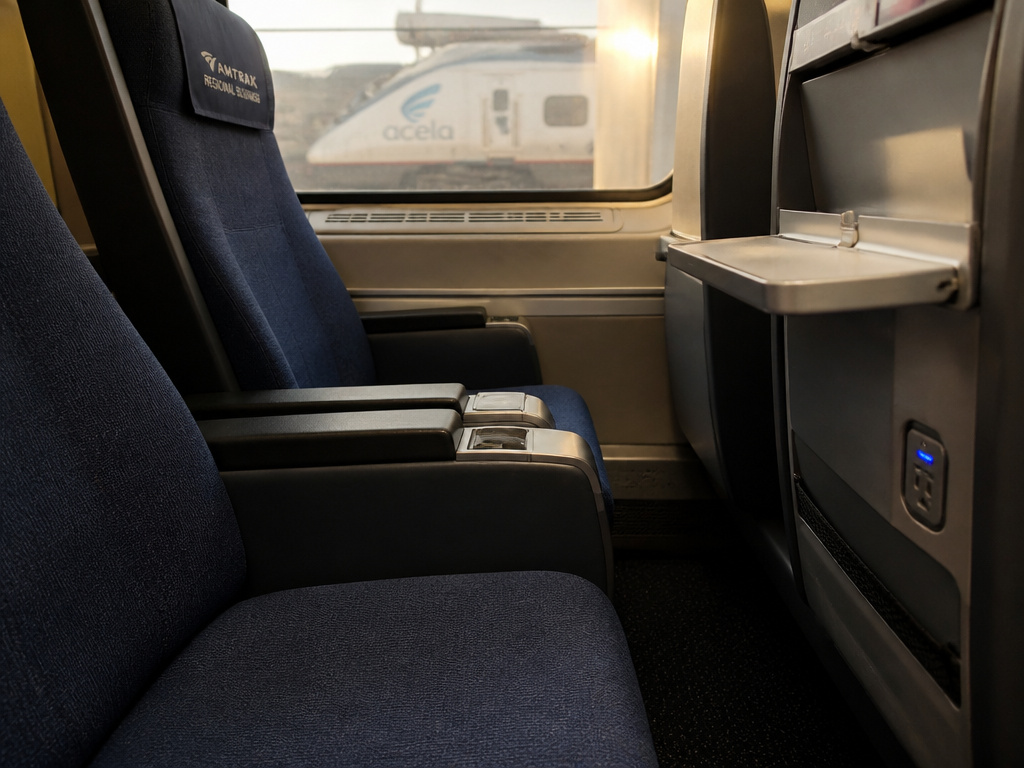
Regional Business Class is the best value seat on the Northeast Corridor, and it’s the tier most travelers skip past on their way to Acela.
The class structure is simple. Acela offers Business and First Class only, with no Coach. The Regional offers Coach and Business. First Class is exclusive to Acela; the Regional’s top tier is Business.
Acela Business vs Regional Business
The physical difference is the row layout. Acela Business runs 2-and-1, which is where the wider seats, extra pitch, and at-seat power come from. In a 2-and-1 row your armrest isn’t shared, and you notice that at hour two, not hour one.
I’d take Regional Business over Acela Business on short segments.
Acela First Class adds complimentary meal and beverage service, including alcoholic options for adult passengers, plus a dedicated attendant and a quieter cabin. It also gets lounge access at Moynihan Train Hall in New York and Union Station in Washington.
The Regional’s Business tier is a middle option, priced the way Amtrak prices coach vs sleeper on its overnight routes: you’re buying space and a guaranteed seat, not a different trip.
What the Onboard Experience Is Actually Like at 125 and 150 mph
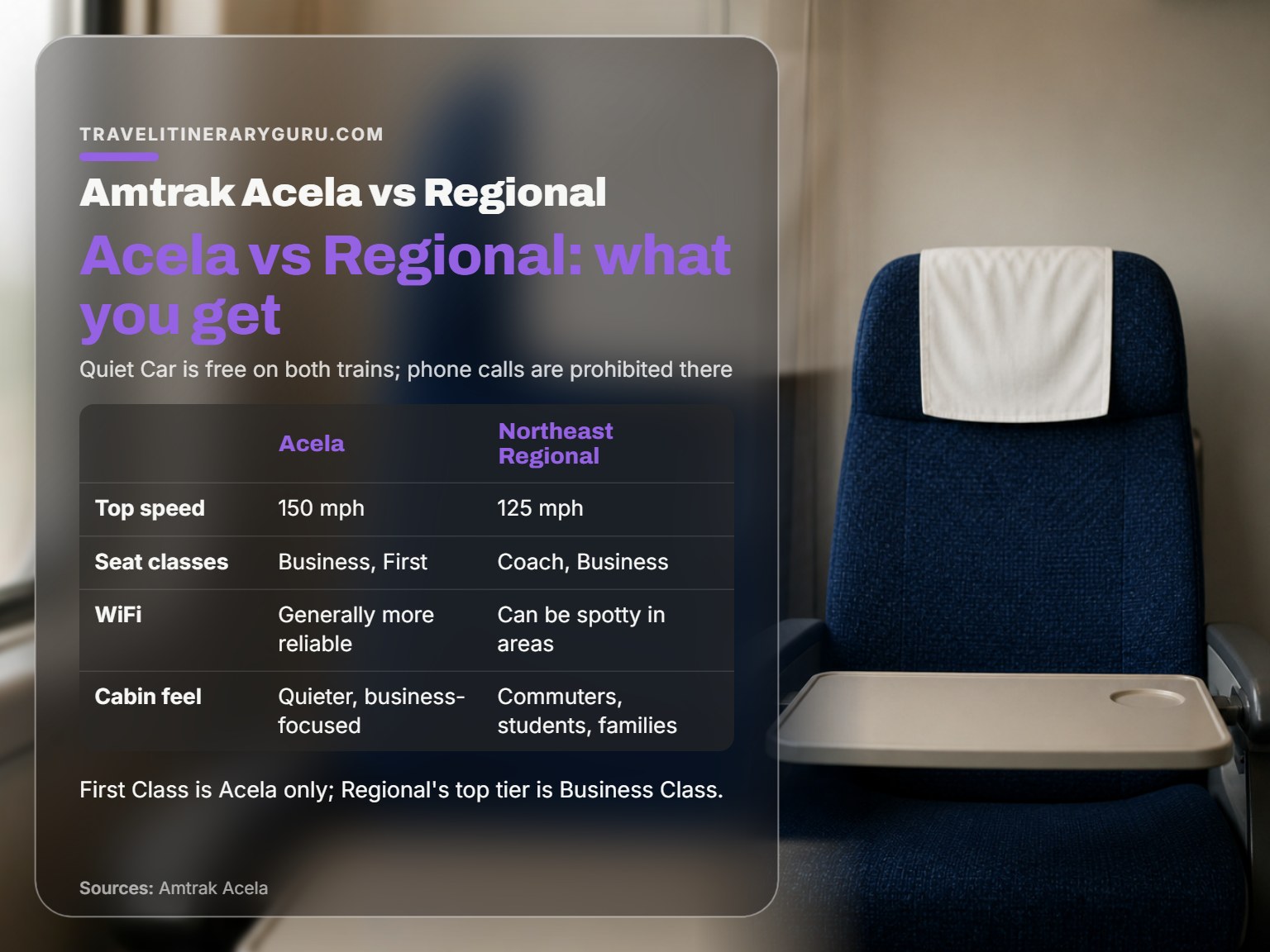
The interiors are where the premium shows up. Acela’s cabin is quieter and more business-focused; the Regional’s is a mix of commuters, students, and families. Acela’s WiFi is generally more reliable, and the Regional’s can be spotty in certain stretches.
Both trains typically carry a Quiet Car, free with any ticket. Phone calls are prohibited there, and conversations stay at a hush.
- Quiet Car: free on both trains, and phone calls are prohibited.
- Café Car: both trains have one.
- At-seat service: Ac
Frequently Asked Questions
Does Acela cost more than Northeast Regional on every route?
Not always. The two trains use separate fare buckets, so on some departures the cheapest Acela seat can land close to a Regional Business Class fare. The gap widens most on short segments where Acela saves little time, and narrows on long trips booked late.
Can I use a Northeast Regional ticket to board an Acela?
No. The trains carry separate inventories, so a Regional ticket does not transfer to Acela and vice versa. If you want to switch, you must cancel or modify the original reservation and pay whatever the new fare is at that moment.
Which train has more legroom and quieter cars?
Acela Business offers slightly wider seats and a quieter ride thanks to its tilting suspension, but the difference is modest. Regional Coach seats are comparable in pitch, and Regional Business Class cars are often quieter than expected because fewer passengers book them.
Do both trains offer Wi-Fi and power outlets at every seat?
Yes. Wi-Fi and standard outlets are available in all classes on both trains, and Acela adds a few extra amenities in First Class. Connection quality varies by segment, so do not count on either train for a critical video call.
