
7-Day San Francisco Portland and Seattle Itinerary
This post contains affiliate links. As an Amazon Associate, we earn from qualifying purchases.
A 7-day San Francisco Portland and Seattle itinerary is a one-way drive of roughly 800 miles (1,287 km) and 12 to 14 hours of road time without stops, per Winetraveler, while thetravel.com puts the direct I-5 run at 819 miles and about 12 hours 45 minutes. Portland sits about halfway, which splits the driving into 6- to 7-hour days.
That distance is the honest number, and it’s why trip length is the one figure every published itinerary argues about. Winetraveler sets seven days as the minimum, while Indie Campers calls a 7-day run a good, fast-paced option and puts the ideal at 10 to 14 days. Whether it covers it comfortably depends on how many stops you try to fold into it.
What follows is the day-by-day skeleton, the two seasonal traps that break it, and the spots where the tour operators and the National Park Service tell you different things.
Key Takeaways
- Seven days is a floor. Indie Campers puts the ideal at 10 to 14 days and calls a 7-day run a good, fast-paced option.
- Portland is the natural halfway sleep at roughly 6 to 7 hours of driving per day.
- Crater Lake’s Rim Drive is typically fully open only from about July to October per NPS. Intrepid Travel notes snow can be expected as late as July and can start again in September.
- Olympic National Park doesn’t fit in one day. NPS treats the Hoh Rainforest, Kalaloch, and Hurricane Ridge as separate destinations hours apart.
- Every operator itinerary on this route runs one-way, and none of them addresses the rental car drop fee.
The Drive-Time Math Behind a 7-Day San Francisco to Seattle Run
Twelve to fourteen hours of driving is what the direct route asks before a single stop. Two sources give slightly different numbers for the same corridor. The gap matters less than the shape of the day.
The direct Interstate 5 corridor from San Francisco to Seattle covers approximately 800 miles (1,287 km) and takes 12 to 14 hours of driving without stops. A separate figure puts the run at 819 miles and about 12 hours 45 minutes. Portland sits roughly halfway between the two cities, which splits the drive into two 6- to 7-hour days.
The 800-mile (1,287 km) figure comes from Winetraveler, along with the 12- to 14-hour window. The 819-mile, 12-hour-45-minute number comes from thetravel.com, which is an aggregator rather than a road authority. Treat the second one as a cross-check.
My rule for USA routes is to keep driving days short. This corridor breaks that rule twice, which is exactly why the itinerary below sleeps at Crescent City and again in Oregon instead of pushing straight through.
Sleep towns first. Pick where you’re stopping, then decide what you’re seeing. That’s the same order of operations as any multi-city trip planning, and it’s why the day-by-day below holds together.
Seven Days Is a Floor: What the Sources Actually Recommend
My first long coastal drive had fourteen stops on day one and a spreadsheet to match. By the third afternoon I was eating gas-station food in a parking lot, too tired to care where I was standing.
That trip taught me the thing I now build into every plan: white space earns its place. I schedule at least one free block per day, and the trip runs better for it.
Planning this route is a bit like making a stew. A few strong ingredients, low heat, and the discipline not to keep opening the lid.
| Source | Recommended length | What it assumes |
|---|---|---|
| Winetraveler | Minimum 7 days, up to 2 to 4 weeks | You stop often and linger |
| Indie Campers | 10 to 14 days ideal; 5 days possible | 5 days means highway only |
| Intrepid Travel | 9 days for this exact sequence | Fixed pace, fixed stops |
| AA Plus and TakeTours | 7 days | Long driving days, operator-led |
Read that table as a range. Indie Campers calls a 7-day run fast-paced and puts the ideal at 10 to 14 days. Winetraveler sets the floor at seven and says the trip stretches to 2, 3, or even 4 weeks. Intrepid Travel sells this exact San Francisco-to-Seattle sequence as a 9-day product, which tells you what a commercial operator thinks seven days can hold.
So seven days is a workable floor if you accept two long driving days and one park you might not get the full loop on.
Where the extra days go is a separate question. The two ends of the route absorb them best: how many days to spend in San Francisco at the start, and how many days to spend in Seattle at the finish.
The 7-Day San Francisco Portland and Seattle Itinerary, Day by Day
Three decisions shape this route: where you sleep, which parks you commit to, and how much coastline you’re willing to trade for time.
Day 1 belongs to San Francisco. A San Francisco itinerary for first-time visitors is worth borrowing from before you commit to the drive, because the city rewards a slower start than most people give it.
- Day 1: San Francisco. No driving. Intrepid Travel’s welcome meeting runs at 6 pm on day one, and the company suggests arriving a day or two early. Skip that buffer and you start day two already behind.
- Day 2: San Francisco to Crescent City. Roughly 7.5 hours of travel per Intrepid’s own itinerary, with a stop at the Avenue of the Giants. Leave after 9 am and you reach the redwoods in flat light.
- Day 3: Redwood National Park. A full day in the groves. Nobody cuts day three. Cut it and you’ve driven 7.5 hours for a photo of a tree from a car window.
- Day 4: Crater Lake National Park. About 3 hours from Crescent City. If Rim Drive is snow-closed, you get viewpoints and walks instead of the loop.
- Day 5: Willamette Valley to Portland. Roughly 4 hours. Skip the early start and you miss the gorge in good light the next morning.
- Day 6: Columbia River Gorge and Multnomah Falls. The falls run 620 ft (189 m). The bridge sits almost in the middle of them, and the spray soaks through a light jacket inside a minute.
- Day 7: Olympic Peninsula, then Seattle. About 4.5 hours to the peninsula and roughly 5 hours from the Hoh Rainforest into Seattle. This is the leg that makes seven days tight.
Notice what day seven is doing. Intrepid Travel spreads that same ground across two days inside a nine-day product, which is the clearest evidence that seven days compresses this route rather than fitting it.
Crater Lake: The Snow Problem That Isn’t on the Brochure
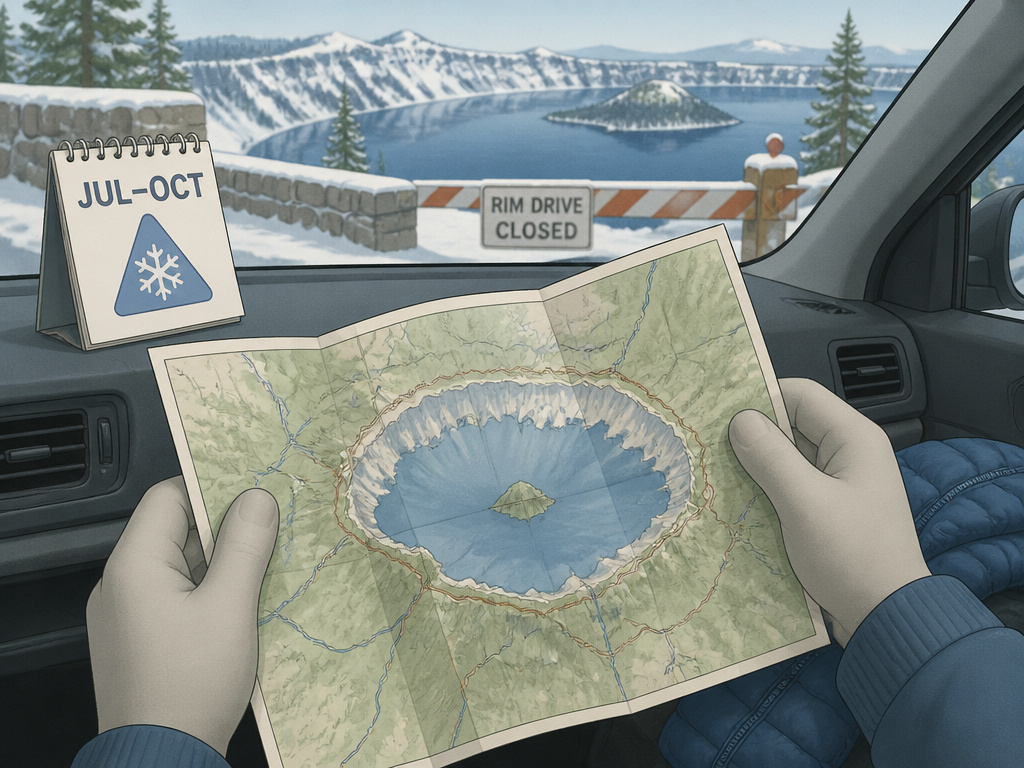
Every operator itinerary lists Crater Lake as a standard day-three or day-four stop. The agency that runs the place describes a much narrower window.
Mount Mazama erupted and collapsed roughly 7,700 years ago to form the lake. The Crater Lake Rim Drive is typically fully open only from about July to October.
Intrepid Travel is more specific about the shoulders. Snow can be expected at Crater Lake as late as July and can start again in September. When there’s snow on the ground, Rim Drive closes, though viewpoints and some walks stay open to visitors.
| Window | What the sources say | What you get |
|---|---|---|
| July to October | NPS: Rim Drive typically fully open | The full rim loop |
| Late June | Intrepid: snow still possible | Viewpoints, walks, layers |
| September | Intrepid: snow can start | Check status before committing |
| Outside that window | NPS: Rim Drive frequently snow-closed | Viewpoints and walks only |
When Rim Drive Is Closed, What Still Works
Operators handle the closure differently. Tours Limited swaps the park for Lake Shasta Caverns and the Sundial Glass Bridge when heavy snow closes Crater Lake. Intrepid Travel keeps the visit and stays on the open viewpoints and walks. Both approaches are defensible, but they promise different days.
Fair warning. Stand at an overlook in late June and the wind coming off the water hits like an open freezer door. Bring the layers Intrepid tells you to bring.
I won’t route anyone through Crater Lake between November and June without checking the Rim Drive status the morning of. The park is still worth the stop. The loop is what you’re gambling on.
The part nobody mentions: Operator itineraries sell “Crater Lake Rim Drive viewpoints” without flagging that NPS treats the full loop as a mid-summer-only road. Book the stop, but don’t build the whole day around the loop.
For the wider regional picture, the Pacific Northwest travel guide covers what else sits within a day’s drive of the park.
Olympic National Park in One Day: What Do You Actually See?

A single day at Olympic gets you a fraction of the park and a lot of driving.
TakeTours and Intrepid Travel both market the park as a single-day stop. NPS positions it as a multi-day destination, because the Hoh Rainforest, Kalaloch, and Hurricane Ridge sit hours apart from each other. Treksplorer recommends at least two days.
Here’s what a one-day visit realistically covers:
- The Hoh Rainforest, a temperate canopy of moss and ferns, and the walk most people come for.
- Kalaloch Beach and its Tree of Life, where the roots hold onto nothing but air.
- Hurricane Ridge, which is a separate drive entirely.
- The ferry crossing, if you’re coming from Seattle.
TakeTours’ Day 5 reaches the park on a Puget Sound ferry, which adds a schedule dependency to an already tight day. Washington State Ferries publishes the sailings. If they’re full or weather-cancelled, the day collapses.
Pick one thing and do it properly. A rushed loop through the park in a single day is a car ride with scenery.
The Olympic National Park pages break the park into its separate areas, which is the fastest way to see why one day doesn’t work.
How Many Nights Do Portland and Seattle Each Deserve?
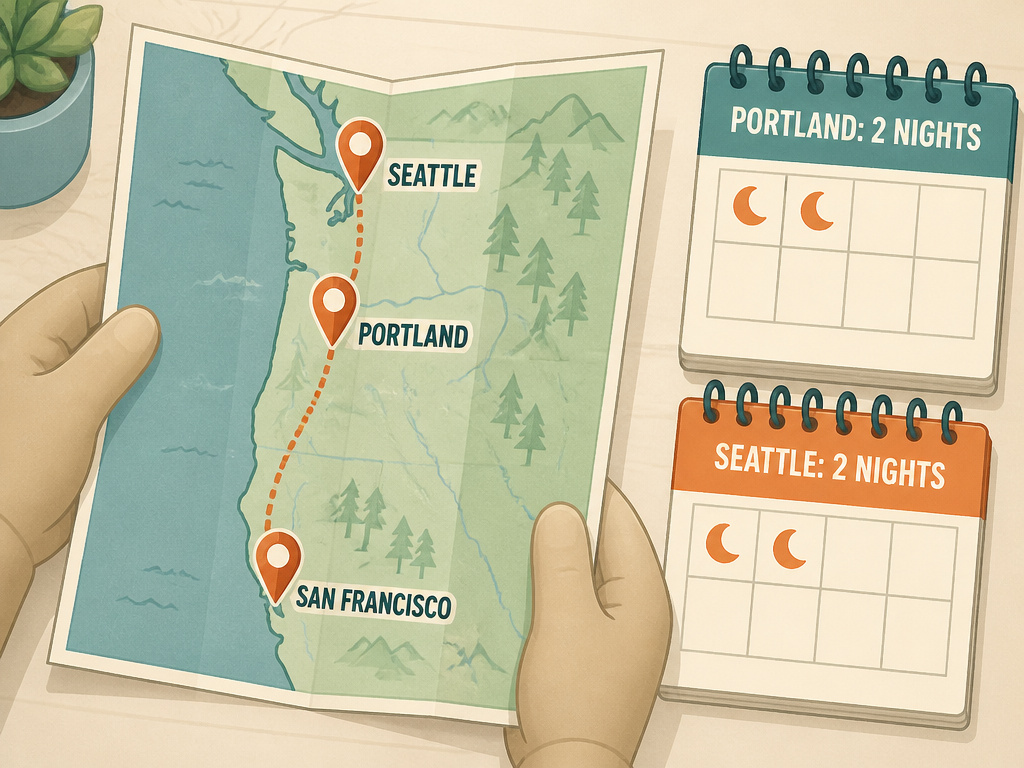
Portland and Seattle are where the itineraries disagree most, and the spread is wide enough to change your trip.
Frommer’s spends three days in Portland on its one-week Pacific Northwest plan. Treksplorer also recommends three days. Intrepid Travel spends two nights there, on days five and six. Indie Campers gives Portland a single day.
Portland: Two Nights or Three?
Two nights is the practical answer for a seven-day run. Three days in Portland is a real recommendation, but it’s a recommendation for a trip that isn’t also trying to reach Seattle in the same week.
Seattle: One Night or Two?
Treksplorer recommends at least two days in Seattle. Winetraveler allows anywhere from zero to three nights. Intrepid Travel arrives in Seattle on day eight and ends the trip on day nine, which is one evening plus a morning.
Two nights, minimum, in whichever city you’re flying out of. The last morning of a trip always disappears into packing and airport time, so a single night gives you an evening and nothing else.
Easy to miss: Booking your flight home on the same day you leave a national park. The drive from the Hoh Rainforest into Seattle runs about five hours per Intrepid Travel, and that’s before traffic.
If you want to build the city end properly, a Seattle itinerary for first-time visitors is the place to start.
One-Way Rentals, Amtrak, and What Tour Fees Actually Cover
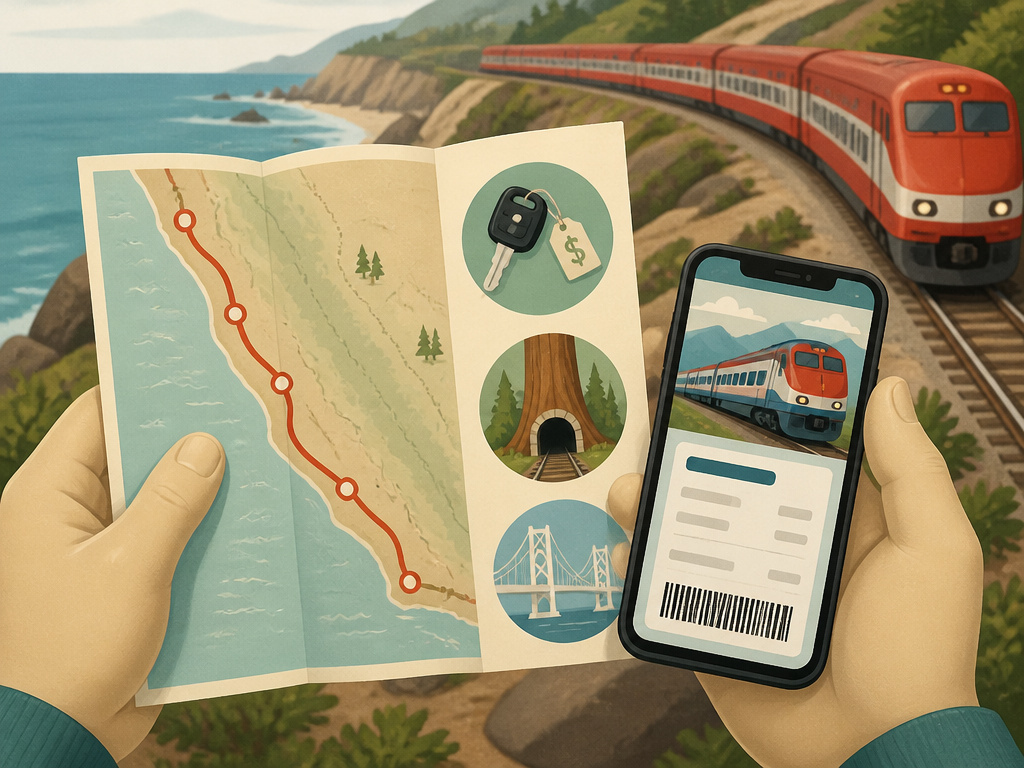
The Coast Starlight is Amtrak’s only direct rail link between the Bay Area and Seattle, and it solves a problem the drive creates.
The full run end to end takes about 20 hours or more. AA Plus Vacation uses just the Seattle-to-Portland segment, which it lists as a mandatory 4-hour ride. Those two figures describe different pieces of the same line.
The One-Way Rental Problem
Every operator itinerary on this route runs one-way, San Francisco to Seattle. Winetraveler notes the route works in reverse too. Nobody mentions the drop fee, and that’s a genuine gap in what’s published.
I’ve done San Francisco on foot and transit with zero rental car, and I’d do it again. Book lodging near a train line, not near the convention center, and the city end of this trip costs you nothing in parking.
The three operators structure their fees differently, and the difference matters more than the amounts. Tours Limited charges a minimum daily service fee per person, payable in cash to the guide and driver. TakeTours charges a higher daily rate per passenger. AA Plus Vacation bundles one mandatory fee that covers Redwood National Park, Crater Lake National Park, Mount Rainier National Park, the Napa Valley Sutter Home stop, the Coast Starlight Seattle-to-Portland ticket, and Shasta Dam.
Read the inclusions before you compare anything. AA Plus’s bundled fee is doing work the daily fees don’t.
Cancellation terms differ too. Tours Limited issues no refunds for cancellations made within 14 days of the tour start date. TakeTours scales its refund by how far ahead you cancel.
A few named pieces worth knowing about on this corridor:
- Amtrak Coast Starlight: the rail option, Seattle to Portland in about 4 hours on the AA Plus itinerary.
- The Chandelier Drive-Thru Tree in Leggett, a 2,400-year-old redwood with a 6-foot-wide, 7-foot-tall tunnel carved in 1937.
- The Museum of Flight at King County International Airport, which TakeTours describes as the largest private aerospace museum in the world, with more than 150 aircraft.
- The Sundial Bridge at Turtle Bay in Redding, designed by Santiago Calatrava.
If you’re weighing rail against driving, the Coast Starlight is worth considering both as a full run and as a single segment.
Frequently Asked Questions
Is 7 days enough for San Francisco to Seattle?
Seven days covers the route. Winetraveler sets seven days as the minimum and Indie Campers calls a 7-day run a good, fast-paced option while putting the ideal at 10 to 14 days. Intrepid Travel sells this exact sequence as a nine-day product. Plan on two long driving days and one park where you might not get the full loop.
What is the best time of year for this drive?
Winetraveler puts the best window between late spring and early fall, from May to September. Intrepid Travel adds a caveat that changes the shoulder months: snow at Crater Lake can be expected as late as July and can start again in September. If Crater Lake is the reason for the trip, aim for July through October, when NPS says Rim Drive is typically fully open.
Should I drive the coast or take I-5?
Indie Campers recommends combining them: Highway 101 for the Redwoods and the Oregon coast, I-5 for the efficient stretches. Winetraveler describes the direct I-5 route as the primary San Francisco-to-Seattle path. The operator itineraries all lean coastal, which tells you where the scenery is.
Can you do this route without a car?
Partly. Amtrak’s Coast Starlight is the only direct rail link between the Bay Area and Seattle, and the full run takes about 20 hours or more end to end. San Francisco and Seattle both work well on foot and transit. The middle section, including Crater Lake and Olympic, does not.
How long is the Amtrak Coast Starlight from San Francisco to Seattle?
The full end-to-end run takes about 20 hours or more. AA Plus Vacation uses a much shorter piece of the same line, listing the Seattle-to-Portland segment as a mandatory 4-hour ride. Both figures describe the same train.
The Bottom Line
Seven days works on this route, but only if you accept what it costs: two long driving days, one compressed park visit, and a city at each end that gets an evening instead of a stay.
One trigger should change your plan outright. If your travel dates fall outside July through October, drop Crater Lake from the loop and put that day into Olympic National Park instead. NPS says Rim Drive is typically fully open only in that window, and a snow-closed Crater Lake gives you viewpoints rather than the drive you came for.
This all shifts if you’re running the route in reverse. Winetraveler notes the trip works Seattle to San Francisco just as well, and the reverse direction puts the long coastal legs on the ocean side of the road.
One more thing worth saying plainly. The 7-day San Francisco Portland and Seattle itinerary is a fast-paced trip, and it’s a better one at nine days. If you can only spare the week, take it. Just don’t spend the whole thing in the car.
