
How Many Days to Spend in Kathmandu: The 3-Day Rule
This post contains affiliate links. As an Amazon Associate, we earn from qualifying purchases.
Plan two to three full days in Kathmandu for most first-time visitors. Two days covers all seven UNESCO monument zones at a fair pace, but three days is where the city stops being a checklist and starts being a place. If Kathmandu is a stopover before a trek, one well-planned day works.
That “seven zones” number gets repeated everywhere without the qualifier. The Kathmandu Valley is one UNESCO World Heritage property, inscribed in 1979, made up of seven monument zones rather than seven separate sites. The Durbar Squares of Kathmandu, Patan and Bhaktapur, the stupas of Swayambhu and Boudhanath, and the temples of Pashupati and Changu Narayan all sit under a single listing. Visitors often ask how many days to spend in Kathmandu to see all seven zones.
That distinction matters for the how many days to spend in Kathmandu question because it changes what “seeing all seven” actually means. You are not crossing a country. You are working within one valley where traffic, not distance, decides your day.
What follows is the honest version of the 2-vs-3-day question. The operators disagree with each other, the entry fees have a real discrepancy at one gate, and the Lukla flight buffer can blow up any itinerary you build. Here is how to plan around all of it.
Key Takeaways
- Two days covers all seven zones at a fair pace, with day one for the western sites and day two for the eastern cluster.
- Three days is the honest number if you want Bhaktapur properly, not as a half-day drive-by.
- Budget NPR 5,700 in entry fees for foreign visitors across the two-day seven-site plan, as of November 2026.
- Add 1 to 2 spare days before a Lukla flight — delays are common enough that operators build them in.
- Skip the seven-sites-in-one-day product. You get a rushed visit across a long day.
How Many Days Do You Actually Need in Kathmandu?
Start with the honest split. Six commercial operators publish day-count advice for Kathmandu, and they do not agree with each other. That disagreement is the single most useful piece of information on the page, because it tells you the answer depends on what kind of trip you are running.
Here is who says what, without the sales pitch attached.
| Source | Recommended days | What it assumes |
|---|---|---|
| Base Camp Tours | 3 days | Two days means you “see everything and absorb little” |
| Kathmandu Valley Tours | 2 to 3 full days | First-time visitor, no trek attached |
| Travel Himalaya Nepal | 2 days minimum, 3 comfortable | Essentials plus a Bhaktapur half-day |
| Uncover Nepal | 2 days for the seven zones | A third day adds hills and old towns |
| EBC Trails | 1 day if it is a stopover | Stopover before Everest Base Camp |
| Nepal Hostels | 3 days | Backpacker baseline plan |
The Kathmandu Valley is a single UNESCO World Heritage property composed of seven monument zones: the Durbar Squares of Kathmandu, Patan and Bhaktapur, the stupas of Swayambhu and Boudhanath, and the temples of Pashupati and Changu Narayan. The property was inscribed in 1979 and sat on the List of World Heritage in Danger from 2003 to 2007.
Read that table again and notice the pattern. Every single source is a commercial operator selling tours in the valley. Base Camp Tours wants three days because three-day tours are their product. EBC Trails wants one day because you are supposed to be spending money on the Everest trek, not the city. The advice is not neutral, and the 2-vs-3 split has no arbiter — UNESCO publishes no visit duration, and neither does the Nepal Tourism Board.
So the real answer depends on three things: whether a trek follows, whether Bhaktapur is a priority, and whether you count your arrival day.
The Arrival Day Question Nobody Answers Honestly
Count your arrival day only if you land before noon. That is the position Kathmandu Valley Tours takes on how many days to spend in Kathmandu, and it holds up. A late flight, immigration, and hotel check-in can eat most of a day. Base Camp Tours says the same thing from a different angle: if you land in the afternoon, treat the first evening as a rest and a walk around your hotel rather than a sight.
Here is the part nobody tells you. Kathmandu sits at 1,324 m (4,344 ft) according to the CDC Yellow Book Nepal chapter, and Pushing straight into a sightseeing circuit after a long flight is how you end up with a heavy head and a wasted morning.
I have made this mistake in other cities and it never gets cheaper. You pay for the rushed arrival day twice.
The practical move is to land, drop your bag, walk the lanes near your hotel, and eat something. That is the whole first day. Build the itinerary from the next morning.
Two Days in Kathmandu: The Western Day, Then the Eastern Day
Uncover Nepal says two days covers all seven zones if you split them geographically, while Base Camp Tours says three days is the number that works. Day one handles the western cluster: Swayambhunath, Kathmandu Durbar Square, and Patan. Day two goes east: Pashupatinath, Boudhanath, Changu Narayan, and Bhaktapur.
Uncover Nepal runs the same split but flips the order, putting Boudhanath, Pashupatinath, Kathmandu Durbar Square and Swayambhu on day one. Either order works. The point is not to cross the city twice in a day, which Base Camp Tours flags as the single biggest planning error in the valley.
Here is the day-two shape that works, with the timings from the operators who run it.
- Leave your hotel at 7:30 am. The rush hour starts around 8 am, and you want to be ahead of it. This one habit saves you an hour.
- Pashupatinath first, 8:00 to 9:00 am. Entry is NPR 1,000. The main temple is for Hindus only, but the riverside complex and the ghats are covered by the ticket.
- Boudhanath at 9:30 to 10:45 am. Entry is NPR 400. Walk the kora clockwise with everyone else.
- Changu Narayan at 11:30 am to 12:30 pm. Entry is NPR 300. Open 6 am to 6 pm.
- Bhaktapur from 1:00 to 4:00 pm. Lunch, then the square.
- Return by 5:30 pm. Budget 45 minutes to 1.5 hours depending on how the evening builds.
That is a full day. It is also the day where a car and a guide earn their money, because you have four stops and the longest drives.
What Three Days Adds That Two Cannot
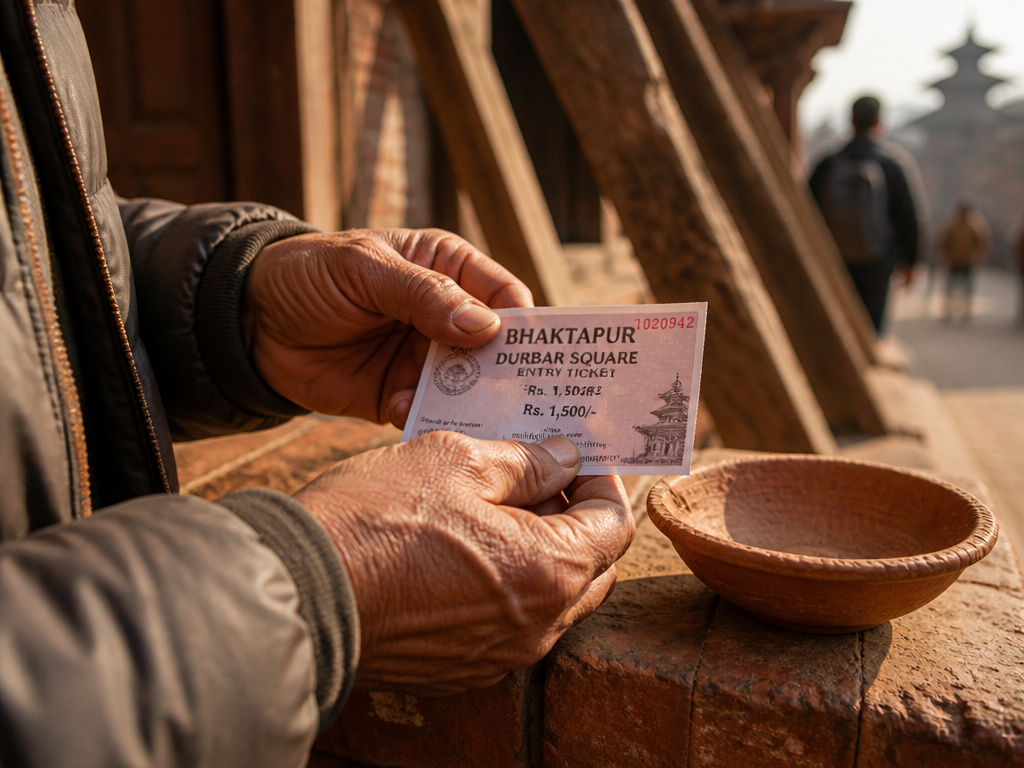
Base Camp Tours says three days is where Bhaktapur becomes a real visit instead of a stop, while Travel Himalaya Nepal treats it as a half-day add-on and Kathmandu Valley Tours folds it into day two of the two-day plan. Base Camp Tours is blunt about this: Bhaktapur is worth a full day on its own for its brick squares, pottery and quiet side streets. Travel Himalaya Nepal frames it as a half-day add-on. Kathmandu Valley Tours folds it into day two of the two-day plan.
Three sources, three different Bhaktapur answers. The reason is the drive. Bhaktapur sits 12 km east of Kathmandu on the Arniko Highway according to Uncover Nepal, and Travel Himalaya Nepal puts it at 13 km. Kathmandu Valley Tours measures the Thamel-to-Bhaktapur leg at about 15 km, which is the number that actually matters because it is the route you drive.
What most people get wrong: Treating Bhaktapur as a two-hour stop. The ticket covers the old city, not just the square, and the town covers 6.4 sq km. Rushing it means you see Nyatapola Temple and leave.
Nyatapola stands 30 m tall and is the tallest pagoda in Nepal. It is also the photograph everyone takes and leaves. The pottery squares and the side lanes are where the day actually earns itself.
Three days also lets you take one of them at a slower pace. A second visit to Boudhanath at dusk, when the circuit fills with walkers and butter lamps, tells you more than a first visit with a camera. That is a Base Camp Tours observation and it matches how the site actually works.
The Seven-Sites-In-One-Day Trap
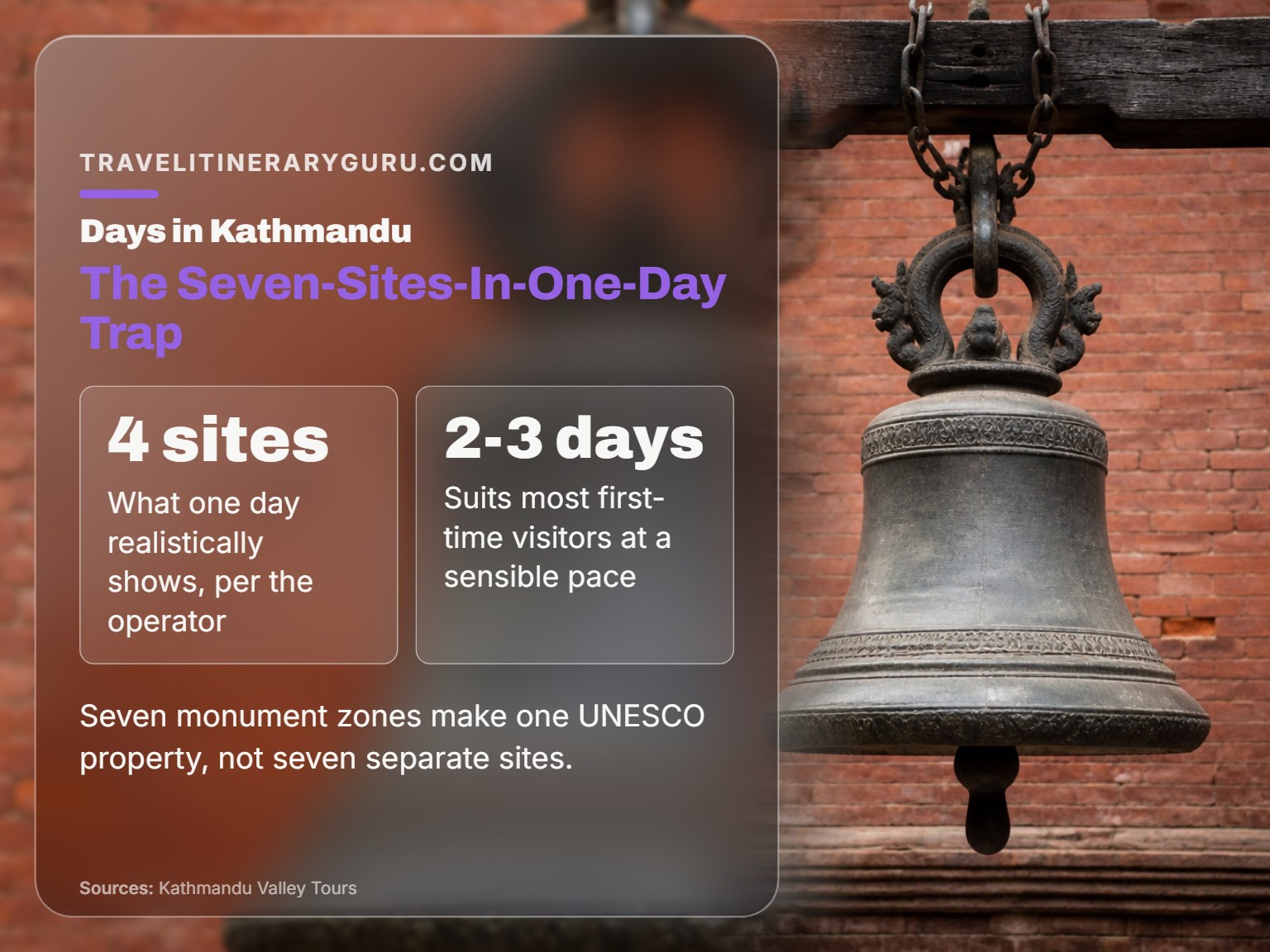
Kathmandu Valley Tours sells a seven-sites-in-one-day product. They also publish the numbers on it, which is unusually honest. You get roughly 5 hours 25 minutes on site across all seven stops, inside a 9-to-11-hour day.
Do the math on that. Five and a half hours of site time across seven monument zones, with the rest of the day spent in a vehicle. That is a forced march with a camera, not a visit.
I get it — some travelers have one day and want to squeeze everything in. But you will not remember the fifth stop. You will remember being tired.
The one-day version that actually works is narrower. Kathmandu Valley Tours says one day shows four UNESCO sites, and that is the realistic ceiling. Travel Himalaya Nepal is more direct: budget travelers often squeeze Kathmandu into one day, and you should not do this unless you have no choice.
Skip this if: Your flight out is the next morning and you have not slept. A four-site day on no sleep produces nothing but photographs you will not look at again.
How Many Days Before or After a Trek?
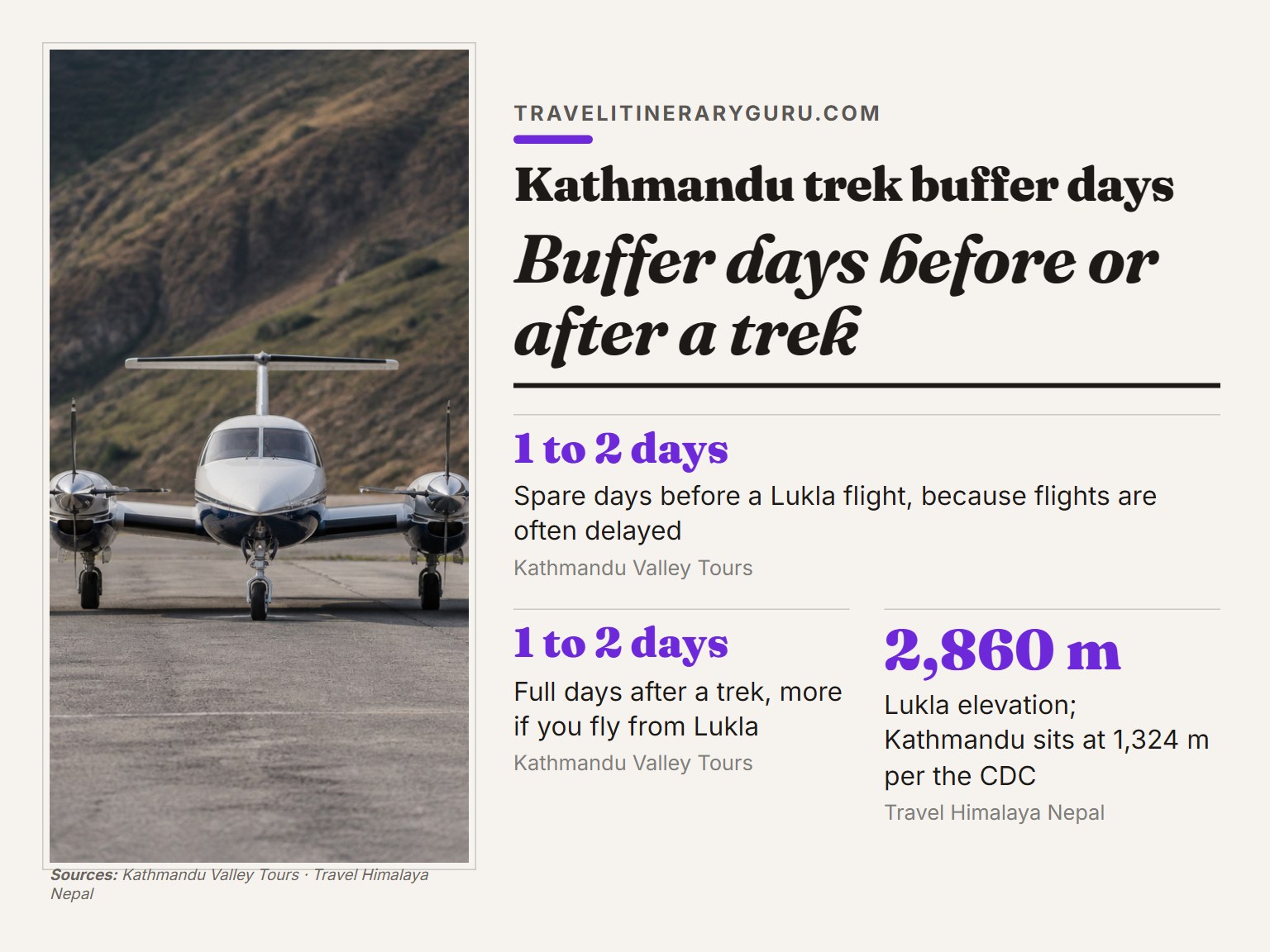
This is where the standard 2-to-3-day advice falls apart. Kathmandu Valley Tours recommends 1 to 2 spare days before a Lukla flight and 1 to 2 full days after, because Lukla flights are often delayed. They note that Lukla flights are often delayed.
That last detail is the one that breaks itineraries. When Kathmandu-Lukla flights are cancelled, trekkers get bused to Manthali, which removes them from Kathmandu entirely. Any city plan you built for those days is gone.
Travel Himalaya Nepal adds another wrinkle. Flights to Lukla depart from Manthali (Ramechhap) Airport rather than Tribhuvan for most months of the year, which adds a 4-to-5-hour drive. So the buffer day is not just for delays. It is for the reroute.
The acclimatisation claim deserves a flag. Travel Himalaya Nepal says three days in Kathmandu gives your red blood cell count a small head-start before flying to Lukla at 2,860 m. That is a physiological claim with no cited study behind it. EBC Trails says Kathmandu days are spent starting altitude acclimatization, without attaching a day count. Treat the head-start framing as unverified.
What is verified is simpler. Kathmandu sits at 1,324 m per the CDC, and Lukla sits at 2,860 m. The gap is real. Whether three days moves your red blood cells is a different question than whether three days moves your itinerary, and only one of those has a documented answer.
The Money Question: What the Fees Actually Add Up To
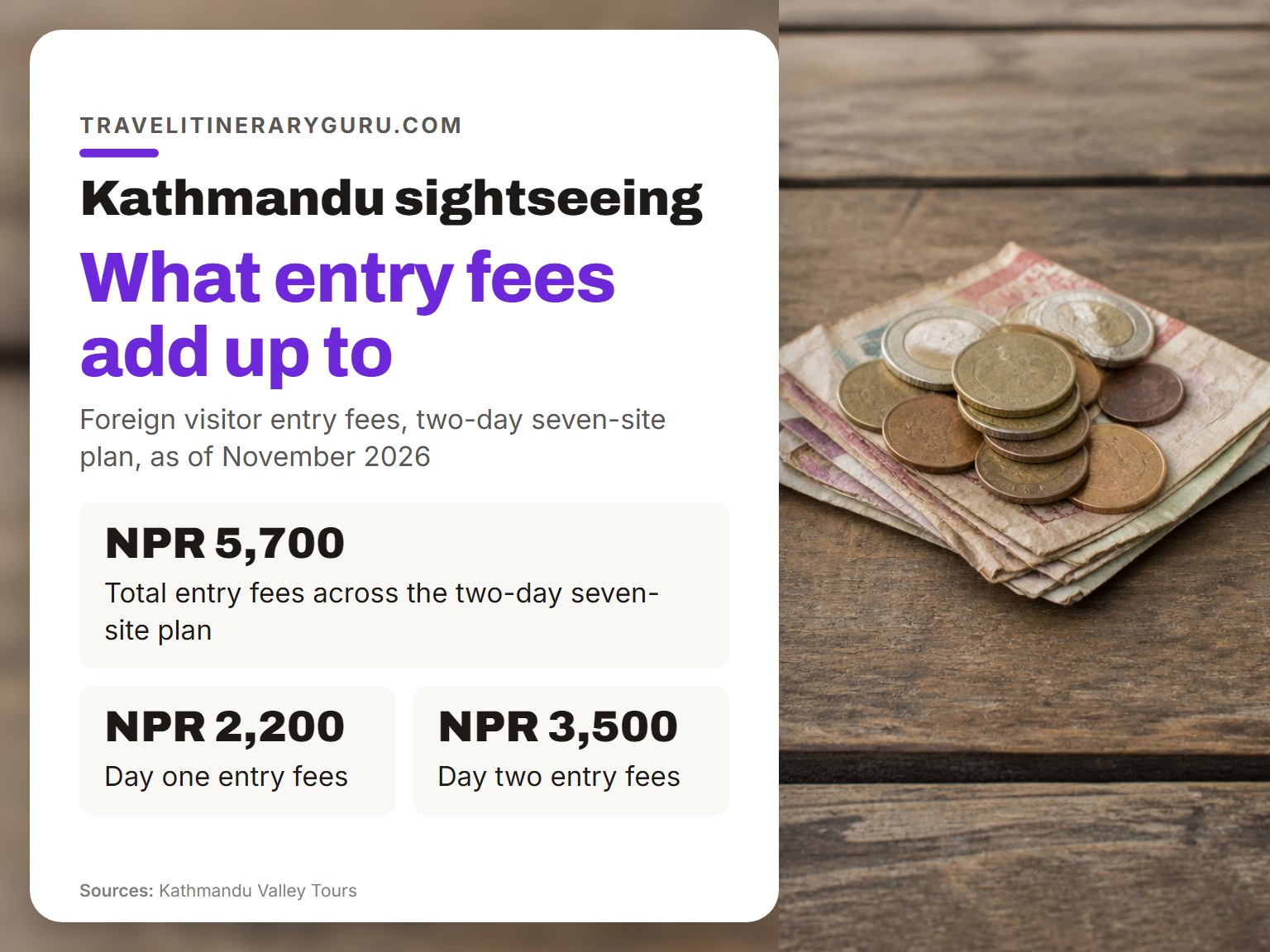
Entry fees for foreign visitors across the two-day seven-site plan total NPR 5,700 as of November 2026. Day one runs NPR 2,200 and day two runs NPR 3,500. That is the number Kathmandu Valley Tours publishes, and it is the cleanest budget figure available.
Individual fees, same source, same date:
| Site | Entry fee (foreign visitor) | Notes |
|---|---|---|
| Pashupatinath | NPR 1,000 | Main temple for Hindus only |
| Boudhanath | NPR 400 | Walk clockwise |
| Changu Narayan | NPR 300 | Open 6 am to 6 pm |
| Bhaktapur Durbar Square | NPR 1,800 | See the discrepancy below |
Bhaktapur is where the sources split. Kathmandu Valley Tours lists NPR 1,800 as of November 2026. The Nepal Tourism Board’s heritage fee list says NPR 1,800, but Bhaktapur municipality has charged NPR 2,000 since July 2025, so you may be asked for either at the gate. Uncover Nepal frames the valley-wide range as NPR 200 at Swayambhu up to NPR 2,000 at Bhaktapur.
Carry small notes. That is the practical takeaway. A gate that wants NPR 2,000 and a wallet full of NPR 1,000 notes is a slow conversation.
For a broader look at how Kathmandu fits into a longer trip, the Nepal itinerary for trekkers covers the permit and gear logistics that eat into your city days.
When the Weather Rewrites Your Plan
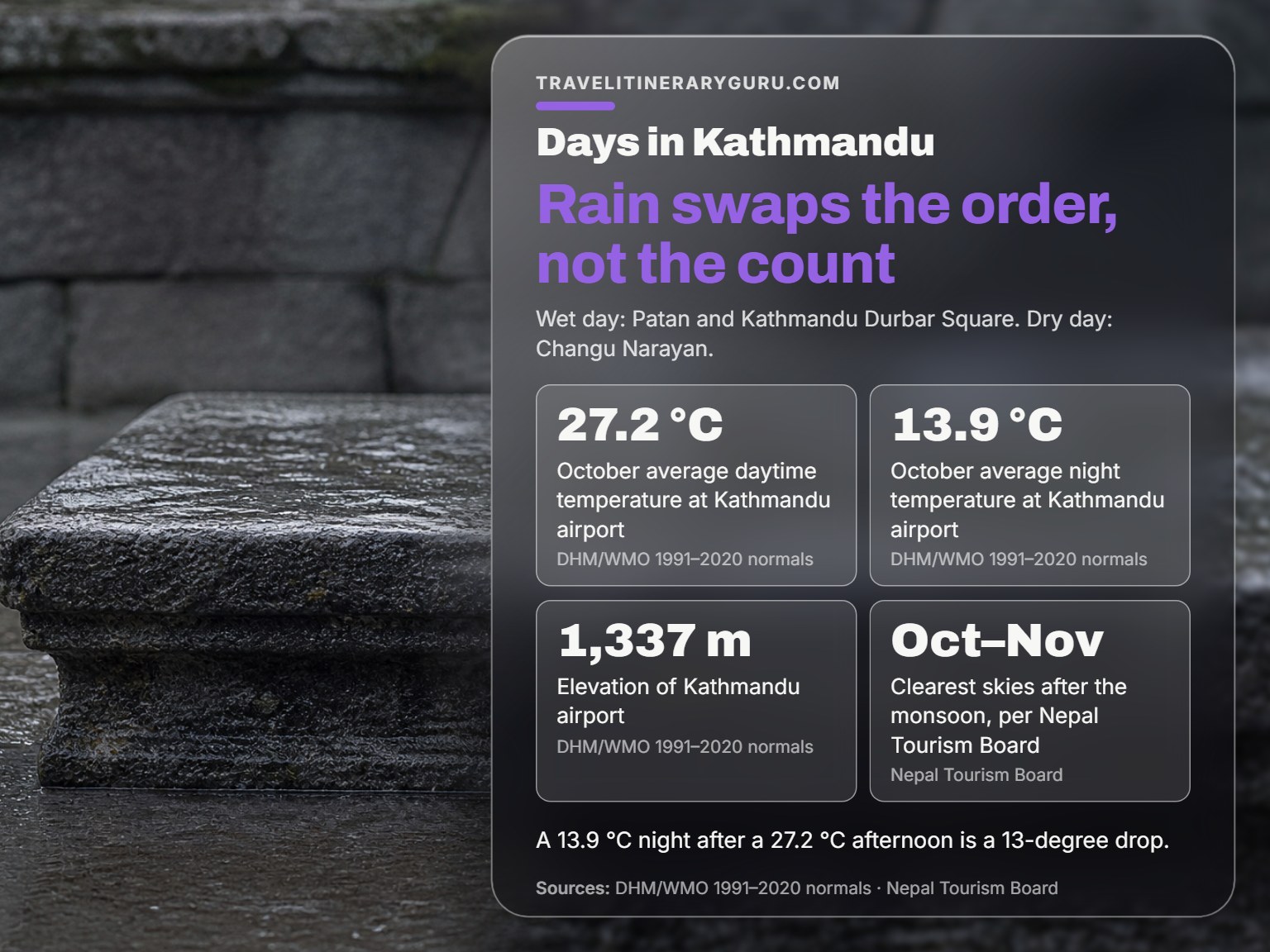
Rain changes the order, not the count. Kathmandu Valley Tours has a specific swap: if a day looks rainy, do Patan and Kathmandu Durbar Square that day because the museums are close by, and keep Changu Narayan for the drier day because it has an uphill walk.
The reasoning is mechanical. Patan Museum and Narayanhiti Palace Museum are both under a roof and work well together. Changu Narayan involves climbing, and wet stone steps on a hill are a different afternoon than wet stone steps in a courtyard.
October and November are the clearest months, according to the Nepal Tourism Board. Kathmandu airport sits at 1,337 m and October averages 27.2°C by day and 13.9°C at night, per the DHM and WMO 1991-to-2020 normals. That is a day that starts cool, gets warm, and drops fast after sunset.
Easy to miss: The temperature swing. A 13.9°C night after a 27.2°C afternoon is a 13-degree drop, and most people pack for one of those, not both.
It is accurate and useless for planning. The weather normals are the part that actually changes your packing list.
One Day, Two Days, Three Days: The Decision Rule
Here is the version I would hand a friend.
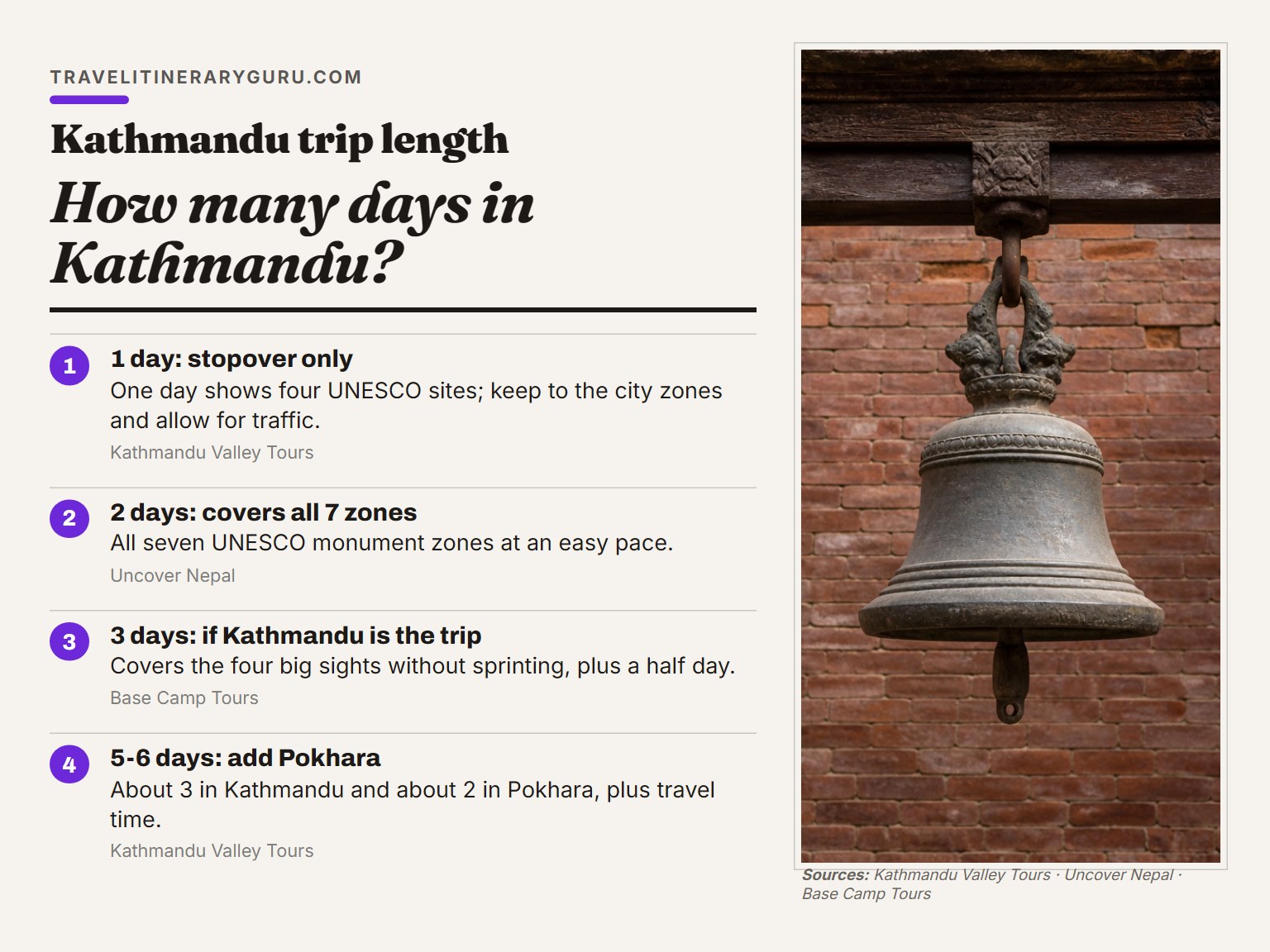
EBC Trails says if Kathmandu is a stopover before a trek, plan one well-planned day, while Travel Himalaya Nepal warns against squeezing Kathmandu into one day unless you have no choice. Four sites, no Bhaktapur, no crossing the city twice. EBC Trails is right that this covers the essentials.
If Kathmandu is the trip, plan three days. Two days works and covers all seven zones, but it does not leave room for the city to surprise you. That is the Base Camp Tours position and it holds up.
If you are adding Pokhara, budget 5 to 6 days in total — about 3 in Kathmandu and about 2 in Pokhara, plus travel time. Pokhara is about 200 km from Kathmandu, and the road is what eats your time.
The pattern is the same as how many days in Cusco or how many days in Hanoi: the city sets a floor, and your next flight sets the ceiling. Kathmandu’s floor is two days. The ceiling is whatever the Lukla buffer allows.
For a comparison point on how another dense Asian capital handles the same question, the Bangkok breakdown runs the same math and lands in a similar place.
Frequently Asked Questions
Is two days enough for Kathmandu?
Two days covers all seven UNESCO monument zones at a fair pace, according to Kathmandu Valley Tours and Uncover Nepal. You will see the sites. You will not have much unstructured time, and Bhaktapur becomes a stop rather than a visit. Base Camp Tours argues that with only two days, you see everything and absorb little.
Should I count my arrival day as a sightseeing day?
Only if you land before noon. Kathmandu Valley Tours is specific about this, and Base Camp Tours agrees from the other direction — if you land in the afternoon, treat the first evening as a rest rather than a sight. Immigration and check-in can consume most of a late arrival day.
How much should I budget for entry fees?
NPR 5,700 for foreign visitors across the two-day seven-site plan, as of November 2026, split as NPR 2,200 on day one and NPR 3,500 on day two. Individual fees run from NPR 300 at Changu Narayan to NPR 1,800 or NPR 2,000 at Bhaktapur depending on which gate you reach.
Do I need a guide to see the sites?
No. Taxis and buses reach the main sites and many people visit on their own, per Kathmandu Valley Tours. A guide helps most where the meaning is not obvious from signs. A car and guide make day two easier because it has four stops and the longest drives.
How many spare days do I need before a Lukla flight?
Kathmandu Valley Tours recommends 1 to 2 spare days before and 1 to 2 full days after, because Lukla flights are often delayed. Flights also depart from Manthali rather than Tribhuvan for most of the year, adding a 4-to-5-hour drive.
Before You Go
The 2-vs-3-day argument will not be settled by any source you find, because every source selling an answer is selling a tour. Six operators, six positions, no primary arbiter. That is the actual state of the information, and you should plan knowing it.
Here is the threshold I would use. If your next flight out of Kathmandu is a Lukla flight, stop and add two spare days to whatever you planned. That is not a rare event you can plan around after the fact.
For everyone else, the first move this week is simple. Open your calendar and block the arrival day as a rest day, not a sightseeing day. Then count your full days from the morning after. Most people discover they have one fewer day than they thought, and that discovery is much cheaper at home than at the hotel desk.
The last thing worth saying is a concession. This advice assumes you are moving through the city by taxi or on foot. If you are hiring a car and driver for the whole stay, the traffic math changes and a four-stop day becomes genuinely comfortable. I default to mid-range and budget planning, so I will not pretend to know how the high-end version of this trip runs. That is a different article, and someone else should write it.
