
7-Day Nepal Itinerary for Trekkers: 3 Routes That Fit
This post contains affiliate links. As an Amazon Associate, we earn from qualifying purchases.
To plan a 7-day Nepal itinerary for trekkers, pick a route that fits inside four or five walking days. The Ghorepani-Poon Hill circuit is the safest fit: a maximum sleeping altitude under 3,000 m, a 3,210 m sunrise at Poon Hill, and roughly 45 km of trail over four days.
Four to five walking days is the constraint everything else bends around. Everest Base Camp needs 12 to 14 days and won’t compress into seven, and the full Annapurna Circuit wants a fortnight. That leaves a short list of routes that fit, plus one hard rule about who’s allowed to walk them.
What follows is the route comparison, the guide and TIMS rule that changed on March 31, 2023, and a day-by-day Ghorepani-Poon Hill plan you can hand straight to an agency. By the last section you’ll know which 7-day Nepal trek matches your legs, your calendar, and your tolerance for 4am alarms.
Key Takeaways
- Ghorepani-Poon Hill has a maximum sleeping altitude under 3,000 m.
- Everest Base Camp needs 12 to 14 days. Any 7-day itinerary claiming otherwise is selling you a helicopter ride.
- A licensed guide and agency-issued TIMS card are mandatory on listed routes, effective March 31, 2023.
- The Ulleri climb gains about 500 m. It’s the day that sorts people out.
- Build an eighth day. The itinerary has no buffer.
What a 7-Day Nepal Itinerary for Trekkers Actually Covers
Seven days buys four or five real walking days. Everything else is transit, permits, and sleep.
Under the Revised TIMS Provision in force since March 31, 2023, listed Protected Areas of Nepal require a licensed trekking guide plus an agency-issued TIMS Card. The Nepal Tourism Board publishes the affected routes by region, and the list includes Poon Hill-ABC, Langtang, Helambu, Mardi Himal and Everest Base Camp.
The arithmetic is unforgiving. Two of your seven days go to Kathmandu and the valley, and one goes to recovery in Pokhara. That leaves four for the trail.
Everest Base Camp needs 12 to 14 days and won’t compress. The Annapurna Circuit wants a fortnight, though the CDC’s Nepal chapter notes that roads have cut the walking portion of the Around-Annapurna route from 21 days to 5 for anyone travelling by vehicle. Those are two different trips, and neither is a week.
Which is why the days in Kathmandu question matters more than it looks. Cut that leg and you buy a fifth walking day. Keep it and you get Bhaktapur and Boudhanath, which is a fair trade.
If you’re new to sequencing a trip like this, the same logic behind a build a travel itinerary process applies here. Fix the fixed points first, then fill the gaps around them.
Nepal’s tourism ministry also maintains an official Nepal trip itinerary planner alongside the TIMS rules, worth a look as a cross-check on whatever your agency sends.
I’d build the eighth day in before I’d add a second trek. Every time.
Which 7-Day Nepal Trek Fits You? Three Routes Compared
Three routes fit inside a week, and they aren’t interchangeable.
| Route | Top Altitude | Guide + TIMS | Best For |
|---|---|---|---|
| Ghorepani-Poon Hill | 3,210 m at Poon Hill | Required (route listed) | A first Himalayan trek |
| Langtang Valley from Dhunche | Higher sleeping altitude than Poon Hill | Required (route listed) | Bigger valley, fewer crowds |
| Mardi Himal | High-altitude adventure | Required (route listed) | Fit trekkers chasing altitude |
| Everest Base Camp | Not a 7-day option | Required (route listed) | Not a 7-day option |
| Annapurna Circuit | Not a 7-day option | Required (route listed) | Not a 7-day option |
Ghorepani-Poon Hill: The 3,210 m Sunrise Circuit
Poon Hill sits at 3,210 m, a 45 to 60 minute climb from Ghorepani in the dark with a head torch. The circuit’s maximum sleeping altitude stays under 3,000 m, which is why it’s the route most first-timers should book.
The hard day is Tikhedhunga to Ghorepani, five to six hours opening with the climb to Ulleri. That’s a climb gaining about 500 m. Himalaya Guide Nepal‘s Annapurna PDF names Ulleri to Ghorepani and Chhomrong to Bamboo as the two days that separate trained trekkers from untrained ones.
Langtang Valley From Dhunche: The Rerouted Week
The Langtang trailhead moved. After the Rasuwa Bhotekoshi Flood in 2026, the operator running the 7-day Langtang itinerary reports that Syaphru Bensi took a significant hit and is not likely reachable by road. The trek now starts from Dhunche.
That’s a live disagreement with older material. The CDC’s Nepal chapter still frames the Langtang region around the Syabrubesi approach, and the same operator notes the classic route used to reach Syaphru Bensi in a 5 to 6 hour drive. If you find a 7-day Langtang itinerary starting at Syaphru Bensi, it predates the flood.
The Langtang route climbs higher than the Poon Hill circuit, so expect thinner air at Kyanjin Gompa. Expect thin air at Kyanjin Gompa.
Mardi Himal: The 4,500 m Week
Mardi Himal tops out around 4,500 m at Mardi Base Camp, the highest of the three routes that fit in a week. Mountain Tiger Nepal lists its 7-day treks as ranging from 1,000 m of comfortable hill walking to that 4,500 m ceiling.
It’s a fair-weather route. Altitude symptoms can begin as low as 2,400 m, so a 4,500 m week isn’t the place to discover how your body handles thin air.
So which one? For a first Himalayan trek, Ghorepani-Poon Hill. For hill legs and a bigger valley, Langtang from Dhunche. For a fit trekker who wants altitude inside a week, Mardi Himal. I’d take Langtang over Mardi Himal unless I’d already done a 4,000 m trek. If Everest Base Camp is the dream, give it 12 to 14 days or book the Everest Panorama version, which Mountain Tiger Nepal notes builds in acclimatisation days.
The Guide Mandate, the TIMS Card, and the Enforcement Gap
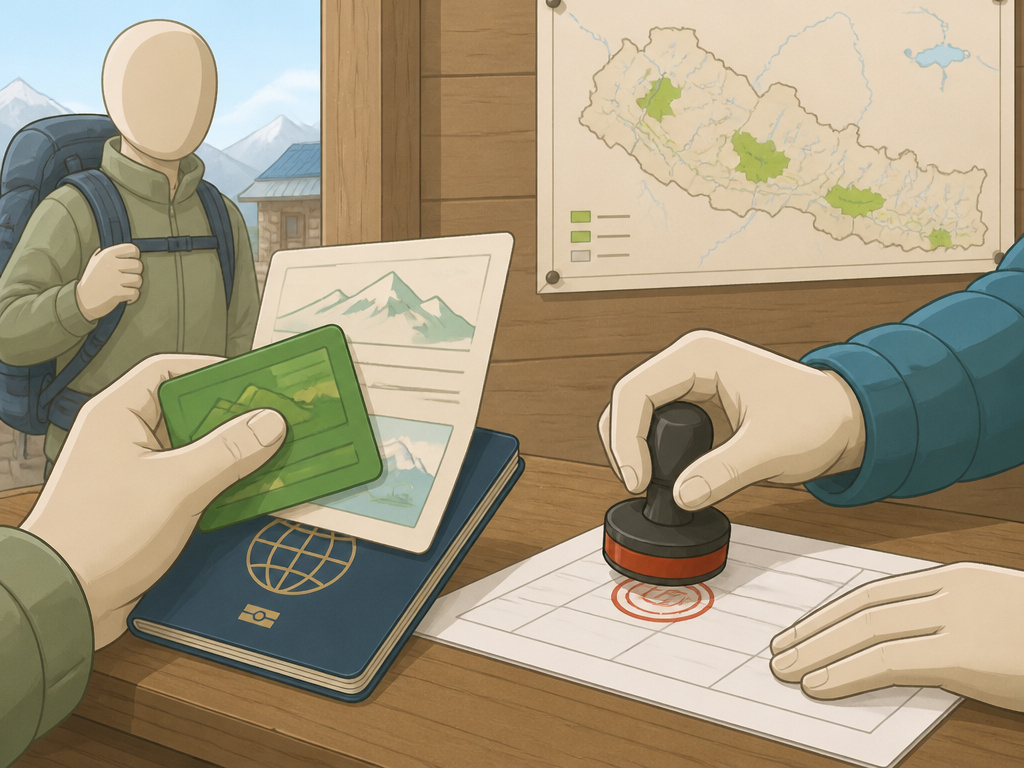
The Nepal Tourism Board’s TIMS page lists the affected routes region by region, from Kanchenjunga to Humla.
The rule itself is simple. Since March 31, 2023, listed Protected Areas require a licensed trekking guide and a TIMS card issued by a trekking agency. Agencies register the trekker, the guide and the route before the card gets generated.
Book the guide through a government-registered agency rather than a freelancer with a laminated card. The agency is the entity that buys the TIMS card; an individual guide cannot issue one.
The Nepal Tourism Board TIMS card page is the only version of this rule that counts. The fee is lower for SAARC-country applicants than for everyone else, and it’s payable online.
Here’s what the agency actually handles for you:
- The TIMS card itself, registered against your name, your guide and your route.
- The ACAP permit for Annapurna region treks, or the Sagarmatha National Park and Khumbu permits for Everest region routes.
- The guide’s licence check, which is the part you can’t verify yourself at a trailhead.
Common mistake: Assuming the guide mandate means joining a group tour. It means one licensed person walks with you, and you can still travel solo.
The official position and the on-ground reports part company here. The Nepal Tourism Board states the guide and card are mandatory on the listed routes. The Longest Way Home, an independent trekking resource updated in 2026, reports that few checkpoints are open that year, which implies the mandate goes widely unenforced on some routes.
Both things can be true. The rule is on the books and the checkpoints are uneven. Plan for the rule rather than the checkpoint.
If you’d rather sidestep the mandate entirely, Journeythroughasia notes that an overnight to Australian Camp or Dhampus sits outside the guide-mandatory zone. You still get Annapurna views. You just get them without the steps.
And if you’ve never done a guided trek before, the rhythm is different from walking alone. Your guide sets the pace, picks the teahouse, and decides when a headache means stop.
The 7-Day Ghorepani-Poon Hill Itinerary, Day by Day
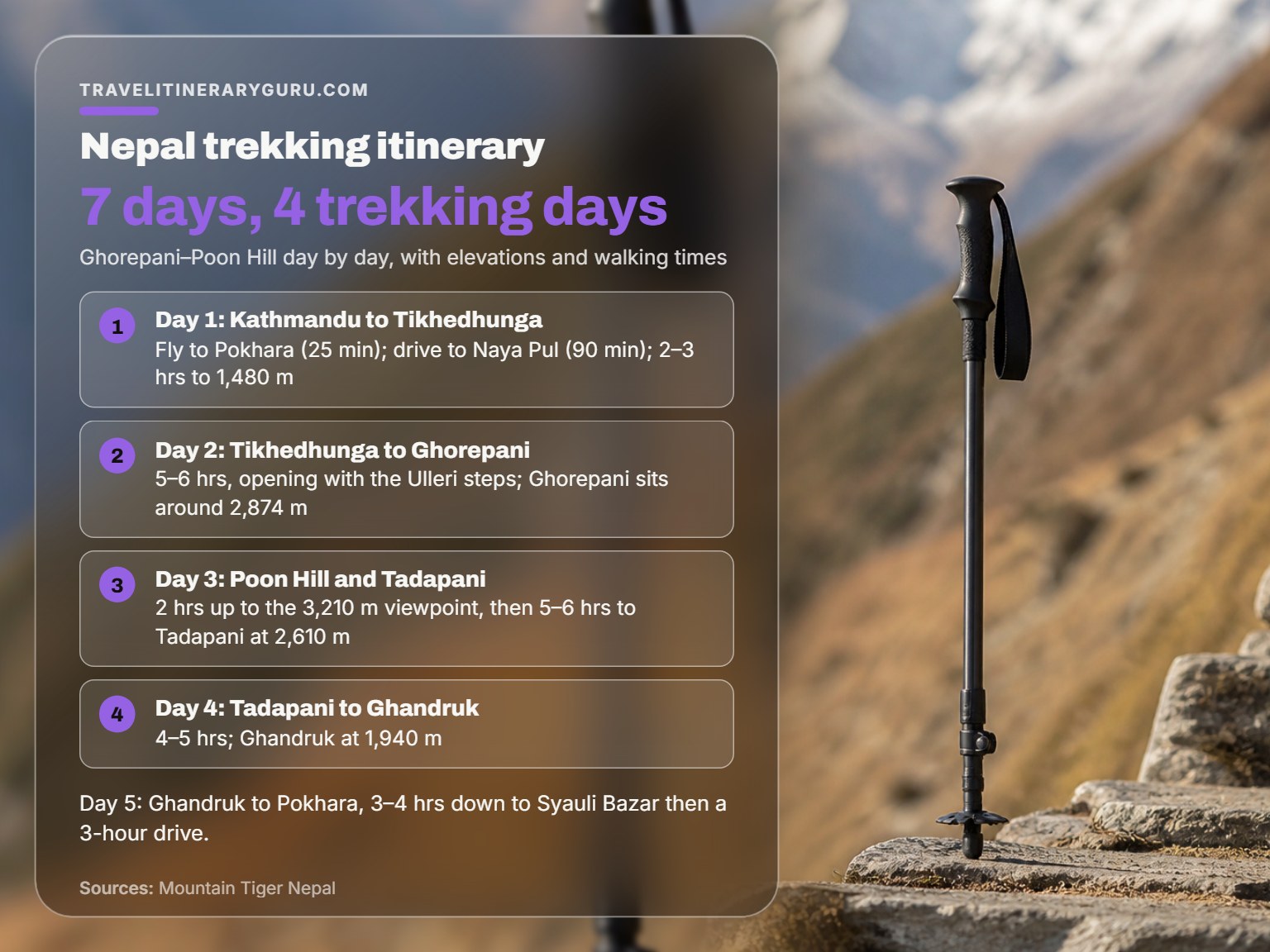
Four trekking days, one 4am alarm, and a steep climb to Ulleri.
Before you start: The Ulleri climb gains about 500 m in one push, and altitude symptoms can begin as low as 2,400 m, so walk slower than feels dignified for the first hour. Helicopter evacuation in the mountains is usually limited to morning hours because of afternoon winds, so a problem at 4pm becomes a problem at dawn. Confirm your insurance covers evacuation to your trek’s maximum altitude before you fly.
- Day 1: Kathmandu to Tikhedhunga. Fly to Pokhara (25 minutes) or take the tourist bus (7 to 8 hours on the Prithvi Highway). Nayapul is about 42 km from Pokhara, 1.5 to 2 hours by private jeep. Then two to three easy hours to Tikhedhunga at 1,480 m.
- Day 2: Tikhedhunga to Ghorepani. Five to six hours, opening with the Ulleri steps. Go absurdly slowly. Ghorepani sits around 2,874 m and the lodges fill up in October.
- Day 3: Poon Hill and Tadapani. The climb from Ghorepani to the 3,210 m viewpoint takes 45 to 60 minutes in the dark, then five to six hours on to Tadapani at 2,610 m.
- Day 4: Tadapani to Ghandruk. Four to five hours downhill through forest. Mountain Tiger Nepal puts Ghandruk at 1,940 m and Himalaya Guide Nepal at 1,950 m, which tells you how much the last digit matters.
- Day 5: Ghandruk to Pokhara. Three to four hours down to Syauli Bazar, then a three-hour drive. You’ll have walked roughly 45 km over four days, with the biggest day around 11 to 12 km.
- Day 6: Pokhara. Sarangkot for sunrise if your legs forgive you, Phewa Lake in the afternoon, and a hot shower that will feel like a medical procedure.
- Day 7: Back to Kathmandu. The drive is 7 to 8 hours. Fly if the schedule allows.
At 4am on the Poon Hill steps you hear almost nothing: breathing, trekking poles on stone, and frost crunching underfoot. Nobody talks on the way up. The talking starts when the light hits Dhaulagiri.
Pack light for this. Your trekking backpacks stay with the porter or at the teahouse, and you carry a daypack for hiking holding water, a shell and a head torch. Porters on the Langtang route carry 20 to 22 kg for two trekkers, so don’t hand over anything you’ll want at lunchtime.
Where the Altitude Numbers Disagree
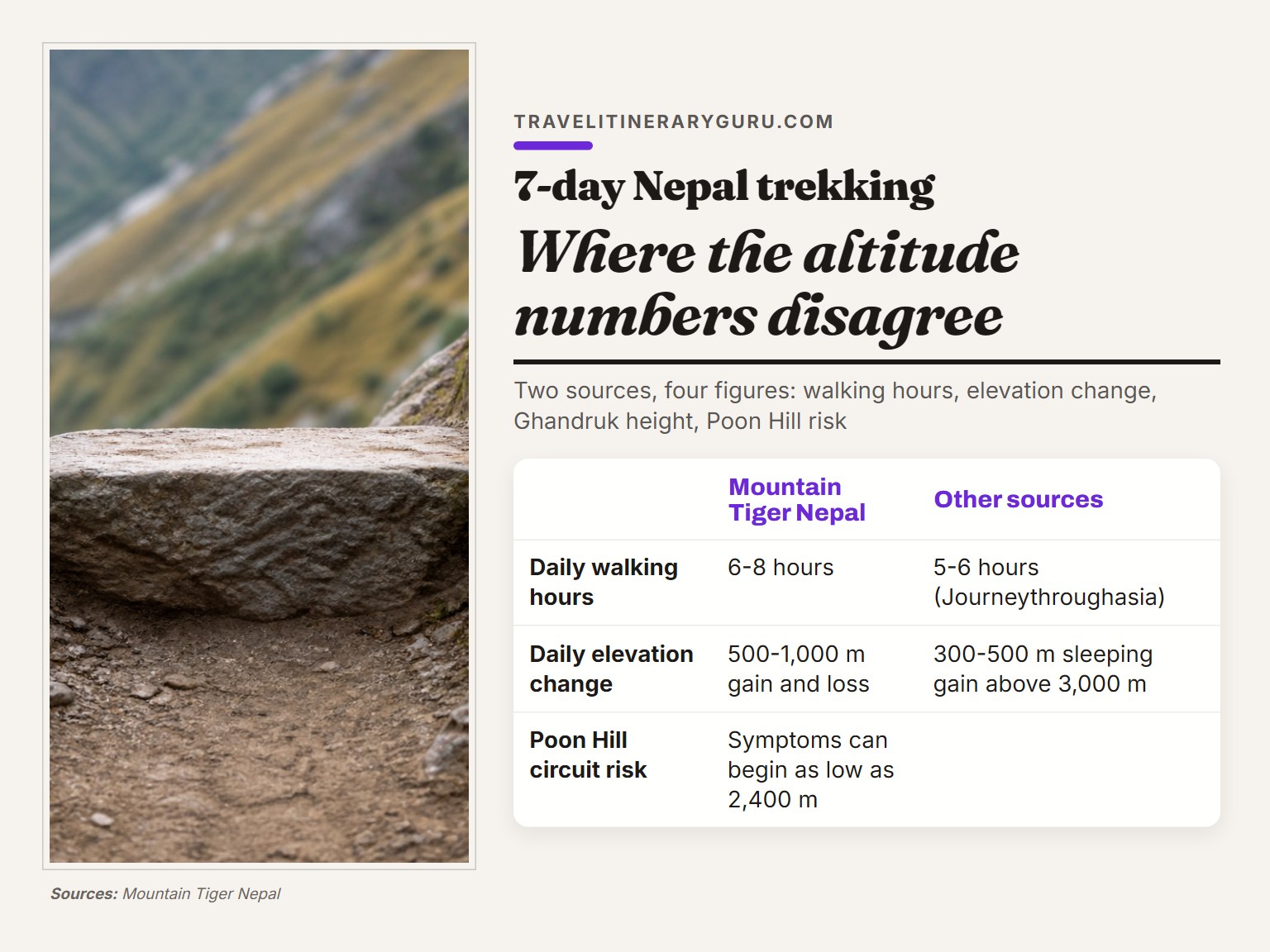
Altitude rules are written for sleeping altitude, not for how high you walk.
| Figure | One Source Says | Another Says |
|---|---|---|
| Daily walking hours | 6-8 hours (Mountain Tiger Nepal) | 5-6 hours (Journeythroughasia) |
| Daily elevation change | 500-1,000 m gain and loss (Mountain Tiger Nepal) | 300-500 m sleeping gain above 3,000 m (Himalaya Guide Nepal) |
| Ghandruk elevation | 1,940 m (Mountain Tiger Nepal) | 1,950 m (Himalaya Guide Nepal) |
| Poon Hill circuit risk | Max sleeping altitude under 3,000 m keeps risk minimal (Journeythroughasia) | Symptoms can begin as low as 2,400 m (Mountain Tiger Nepal) |
Read that table the way a planner should. The walking-hours gap is real and you should train for the higher number. The elevation gap isn’t a contradiction at all: one figure covers total up-and-down, the other covers net sleeping gain. And the altitude-risk row is the one that matters, because a route with minimal risk still isn’t a route with no risk.
The Acclimatisation Rules That Do Hold
Himalaya Guide Nepal’s Annapurna region PDF is the most specific source here, and its rules survive the disagreement:
- Above 3,000 m, keep sleeping-altitude gains to 300 to 500 m per night.
- Plan a full acclimatisation day for about every 1,000 m of altitude gained.
- Drink three to four litres of water a day, far more than feels necessary.
- No drug, oxygen bottle or rest day replaces going down. Identify descent options before you start.
The CDC adds a pharmacological option. Acetazolamide prophylaxis can substantially decrease the chances of developing acute mountain sickness, and the CDC’s Nepal chapter specifically cites Namche as the case where it helps. It’s a prescription decision, not a packing-list item.
The other rule worth stealing from the Annapurna circuit is the altitude test. The rest day in Manang includes a hike to Gangapurna Lake or higher, and it functions as a trial run before Thorong La.
I’ve come around on one thing over the years: the descent plan matters more than the ascent plan. Going down is the treatment.
A headache that sits behind your eyes and doesn’t move when you change position is the early version. So is losing your appetite at dinner when you’ve just walked six hours. Both are reasons to tell your guide that evening, not the next morning.
Most 7-day routes here are teahouse-based, so tents for trekking only matter if you’re extending into a camping section or trekking in a shoulder season when lodges close. The CDC Yellow Book Nepal chapter is the source I’d read before any of this, because it covers the health side that route PDFs skip entirely.
Why Does a 7-Day Nepal Itinerary Fall Apart?
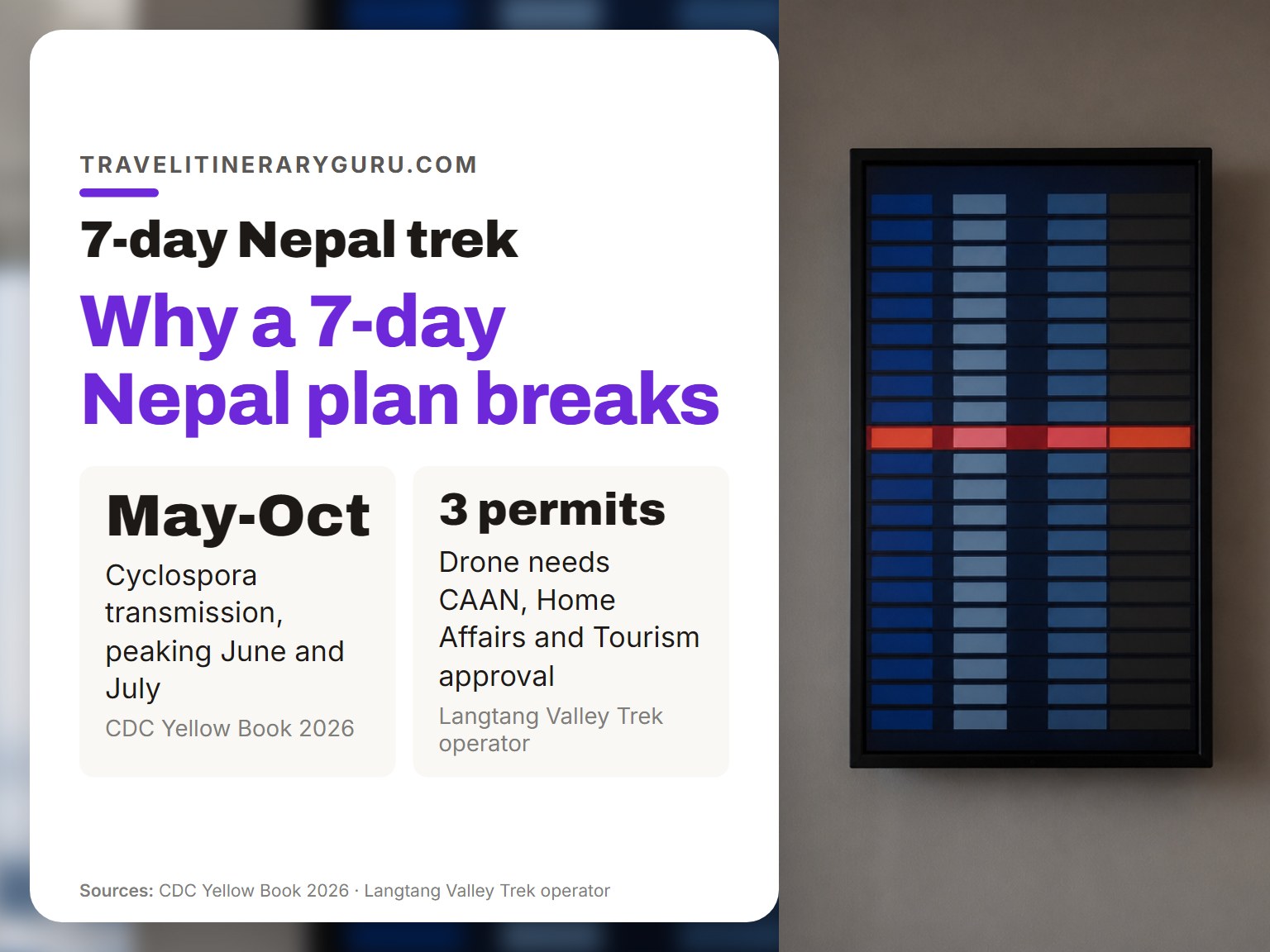
Day three, Pokhara domestic terminal, 6am. The board says cancelled.
Early in my planning career I packed days so tightly that I missed a sunset I’d been building toward for months, because I was rushing to tick off the next item. Seven days in Nepal is the same trap with higher stakes. The itinerary has no slack, and the thing you came for is the first casualty.
Here’s what actually breaks a 7-day plan:
- No buffer. Journeythroughasia is blunt about this: the itinerary has no slack. If weather closes the Pokhara flight, you lose a trekking day, not an hour.
- October bookings. Dashain runs 11 to 25 October in 2026, with Vijaya Dashami on 21 October.
- Rescue cost and insurance. The CDC notes helicopter rescue is billed at approximately USD 4,000 per hour, that evacuation policies generally require rescues arranged through the insurer, and that some international insurers no longer cover Nepal or add a surcharge.
- Drones. On the Langtang route a drone needs permits from the Civil Aviation Authority of Nepal, the Ministry of Home Affairs and the Department of Tourism. The army checkpoint at Dhunche checks bags, and unpermitted drones get confiscated.
- Health timing. Cyclospora transmission in Nepal runs almost exclusively May to October with a June and July peak. Half of all traveller exposures to a possibly rabid animal happen near Swayambunath.
Where this goes sideways: Booking the Pokhara flight on arrival during Dashain. You’ll spend a trekking day at the domestic terminal instead of on the trail.
The fix is boring. Build an eighth day. Then run a one week before a trip checklist so the permit, the insurance and the luggage arrangement are all confirmed before you land.
One more thing nobody mentions: your Kathmandu hotel will hold your extra bags while you trek, but the Langtang operator is explicit that you have to confirm the arrangement beforehand.
Frequently Asked Questions
Can you see Nepal in 7 days?
Yes, if you pick the Ghorepani-Poon Hill circuit. Two days in Kathmandu and the valley, four on the Ghorepani-Poon Hill circuit from Pokhara, and one recovery day fit comfortably. Everest Base Camp needs 12 to 14 days and won’t compress.
Is the Ghorepani-Poon Hill trek hard?
Easy to moderate, with one genuinely hard day. The climb from Tikhedhunga through Ulleri gains about 500 m. The rest is manageable if you can walk five to six hours on consecutive days.
Do you need a guide for the Poon Hill trek?
Yes. The Poon Hill-ABC route is on the Nepal Tourism Board’s list of routes requiring a licensed guide and an agency-issued TIMS card, effective March 31, 2023. Enforcement varies by checkpoint, but the rule is the rule.
Can you do Everest Base Camp in 7 days?
No. Everest Base Camp needs 12 to 14 days. The Everest Panorama trek reaches significant heights and builds in acclimatisation days, but it still isn’t a seven-day route.
What is the best month for a 7-day Nepal trek?
October has the clearest air and the longest daylight, and it’s also the busiest. Dashain runs 11 to 25 October in 2026, and domestic flights sell out weeks ahead. November keeps most of the clarity with fewer people and colder mornings.
How fit do you need to be?
Mountain Tiger Nepal says comfortable walking six to eight hours a day on uneven ground with a light pack, though one operator’s 7-day plan assumes five to six. Build six to eight weeks of cardio before you go.
The Bottom Line
If your maximum sleeping altitude is under 3,000 m, you can book a 7-day Nepal itinerary for trekkers with almost no acclimatisation planning. Above 3,000 m the arithmetic changes: add a rest day for roughly every 1,000 m of gain, and write the descent options into the plan before you leave home.
The threshold I’d actually use is simpler. If you can’t walk five hours on back-to-back days right now, don’t book Langtang or Mardi Himal. Book Ghorepani-Poon Hill and spend the six to eight weeks before departure on cardio.
One concession: if you’re travelling in the lighter monsoon window, the Helambu trek stays at moderate altitudes throughout, and Mountain Tiger Nepal rates it feasible during lighter monsoon periods. Different trip, different packing list.
And one last thing. Build the eighth day.
