
How to Plan a Multi-Stop Road Trip With Kids: Step-by-Step
This post contains affiliate links. As an Amazon Associate, we earn from qualifying purchases.
Those two numbers measure different things, and no source reconciles them. The four-to-six-hour figure caps the whole day. The two-to-three-hour figure caps a single stretch behind the wheel. Read them as one limit and you plan six hours of driving with no room left for the stops that were supposed to be the point. Knowing how to plan a multi-stop road trip with kids means treating the daily cap and the per-stretch cap as separate limits.
What follows: the sourced break intervals, a six-step planning sequence, a way to sort stops by what they’re actually worth, and the three places this plan breaks.
Key Takeaways
- Four to six hours is the daily driving ceiling for one driver, per NRMA and Travel with Rimon.
- Break every two to three hours in daylight with a baby in a car seat, and every four to six at night.
- Add 15 to 25 percent to every app drive time before you book a single night of lodging.
- Never breastfeed in a moving car. Both Penn State 5210 and the AAP say stop the vehicle.
How Many Hours a Day Should You Drive with Kids?
Federal and pediatric guidance converges on two break intervals: every two to three hours of daytime driving with a baby in a car seat, and every four to six hours at night. NHTSA directs parents to install each car seat per the manufacturer’s instructions and the vehicle owner’s manual.
Here’s how the four sources line up:
| Source | What it says | What it limits |
|---|---|---|
| NRMA | 4-6 hours of driving per day | The whole day |
| Penn State 5210 | Stop every 2-3 hours by day, 4-6 by night | A single leg |
| AAP, cited via SIXT | Break every 2-3 hours by day, 4-6 by night | A single leg |
| Travel with Rimon | 250-300 miles, or 4-6 hours, per day | The whole day |
Before you start: A child’s body temperature rises three to five times faster than an adult’s, so never leave a child in a parked vehicle and check the back seat before you lock the door. Install every car seat per its own instructions and your vehicle’s owner’s manual, then have it checked free at an NHTSA child car seat inspection station. Check tire pressure cold, at least three hours after driving, and inspect tread and sidewalls for cuts, bulges, and cracks before a long trip.
The 6-Step Sequence to Plan a Multi-Stop Road Trip with Kids
Six decisions shape the whole itinerary when you compare a how to plan a multi-stop road trip with kids, and they go in this order.
- Set the daily ceiling first. Pick four to six hours of driving per day and hold it. Skip this and you’ll sketch a ten-hour day that looks fine on paper and falls apart by hour seven.
- Choose the route shape. A loop when you’re bringing your own car home, a linear route when geographic coverage matters more, hub-and-spoke when convenience wins, out-and-back when one destination is the whole point. Pick wrong and you’ll spend the trip re-driving the same highway.
- Place at least two stops with a purpose. A multi-stop trip connects your start and finish through at least two intentional intermediate stops. Each one needs a reason: sightseeing, an overnight, a meal, a charge, a family visit, or weather cover.
- Sort the stops by weight. Anchors, staging stops, and flex stops. The next section covers how to tell them apart.
- Add the buffer. Add 15 to 25 percent to every long leg, then add one flexible buffer block for every three to four travel days.
- Book the flexible option. One cancellation-friendly booking keeps a weather day from becoming a sunk cost.
The same sequence scales to a multi-city trip route with flights between legs, except the ceiling only applies to the days you’re actually driving. Packing comes last for a reason, and packing for a family trip with kids goes faster once the route is locked.
The road trips with young children guidance from Penn State 5210 sets the daytime interval at two to three hours and the night interval at four to six. It also recommends identifying gas stations, charging stations, and rest stops before you leave home, which is step three done properly.
Anchor, Staging, and Flex: Sorting Stops by What They’re Worth
Three stop classes do all the work in a how to plan a multi-stop road trip with kids: anchors, staging stops, and flex stops. A fuel station and a national park don’t deserve the same planning weight, and treating them the same is how itineraries get bloated.
How to Tell an Anchor from a Staging Stop
Anchors are the destinations you’d be disappointed to miss. Staging stops are ordinary overnight towns that exist to break a drive. Flex stops are the optional attractions you’d like to see but could drop without ruining the trip.
The test is simple. Pull an optional stop out of the plan and see whether the route still works. If it doesn’t, that stop is an anchor wearing a flex-stop label.
What most people get wrong: Treating every overnight town as an anchor. You end up with a route that has five must-sees and no slack, and the first weather day collapses the rest of the week.
A backtracking ratio above roughly 15 percent deserves a review, which is the practical argument behind avoiding backtracking on a road trip. Staging stops are also where planning fuel stops on a road trip earns its keep, because a fuel stop placed badly turns into a detour you never budgeted for.
Anchor stops carry most of the weight on a family national park trip, where permits and lodging book out long before anything else.
Why Your GPS Drive Time Is 15-25% Too Optimistic
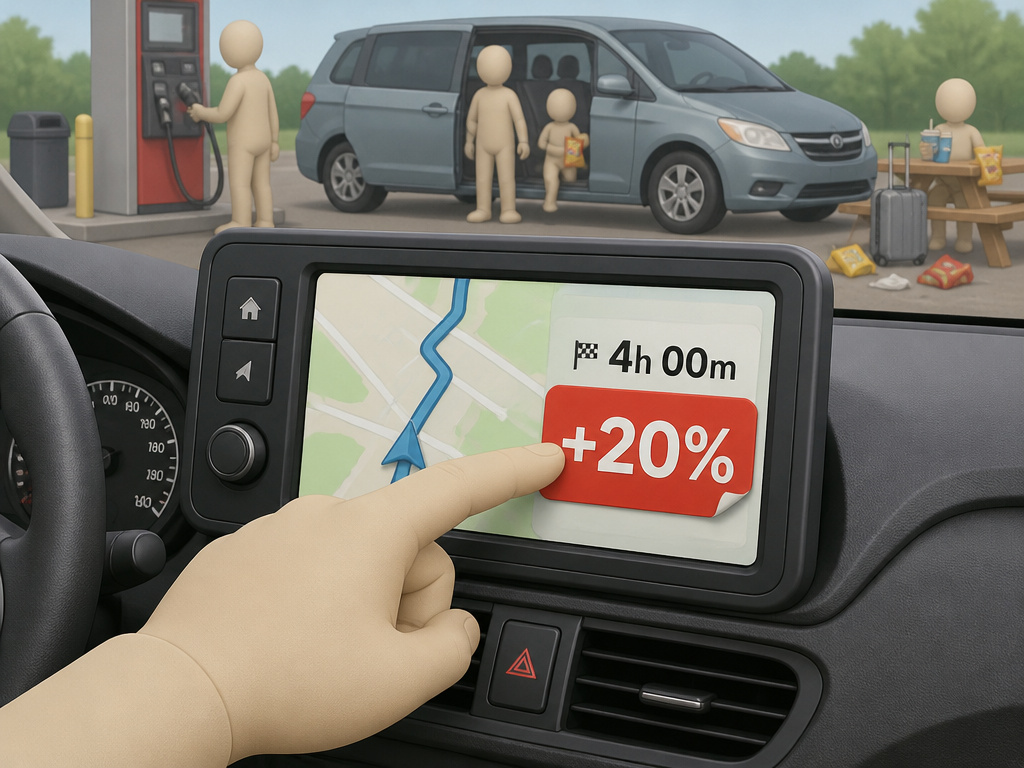
Add 15 to 25 percent to every long leg before you book a single night of lodging. GPS drive times exclude delays, so the number on your screen is a floor, not the plan.
The buffer covers real time. Meal stops, parking, charging, hotel check-in, and a fuel stop that lands at the wrong exit all eat into the estimate. On flat interstate, 250 to 300 miles is the more comfortable target.
Rule of thumb: A four-hour estimate rarely equals a four-hour experience. If a leg runs past six hours between meaningful stops, it needs an overnight staging point rather than a longer day.
The road trip preparation checklist I use starts with the transponder, not the suitcase.
What Actually Breaks the Plan
Heat kills first. A child’s body temperature rises three to five times faster than an adult’s, according to the NHTSA summer driving tips guidance, and no itinerary field absorbs that.
The buckle tells you before anything else does. Metal that’s too hot to hold for more than a second means the cabin has been sitting in full sun. Check the back seat before you lock the door, every time.
The 3-Hour Cold Tire Reading vs. Your 2-Hour Break
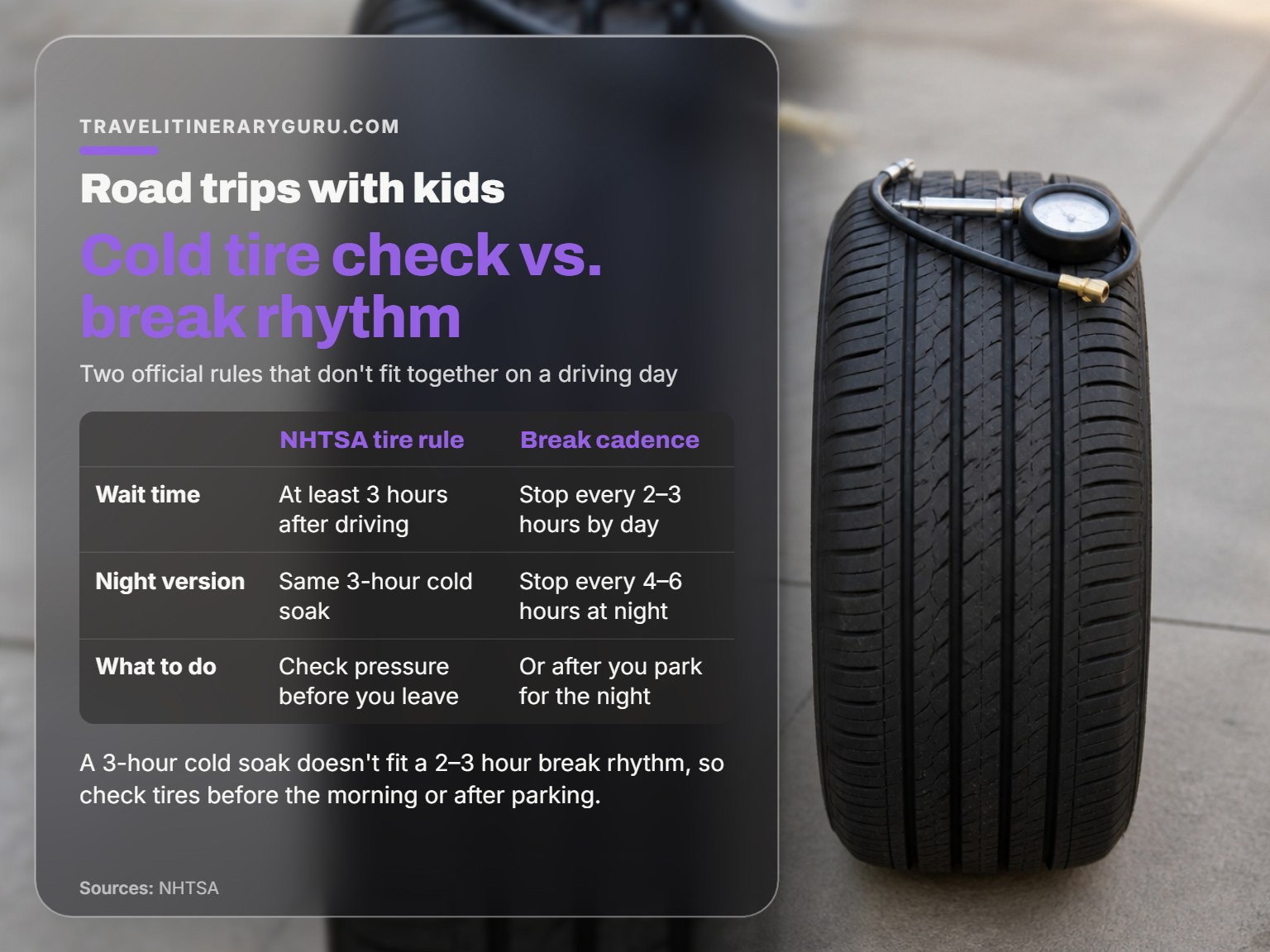
Two pieces of official guidance don’t fit together. NHTSA says check tire pressure when the tires are cold, which means at least three hours after driving. Penn State 5210 says stop every two to three hours on a daytime trip. A three-hour cold soak doesn’t fit a two-to-three-hour break rhythm, so the pressure check has to happen before you leave in the morning or after you park for the night.
Here’s what to run through before a long trip:
- Tires: check tread and sidewalls for cuts, punctures, bulges, scrapes, cracks, and bumps at least once a month and before any long drive.
- Tread depth: use the penny test. Put a penny in the tread with Lincoln’s head upside down, and if you can see the top of his head, you need new tires.
- Belts and hoses: summer heat degrades rubber, so look for bulges, blisters, cracks, or cuts, and check that every hose connection is secure.
- Spare and jack. Make sure both are in the vehicle and that you know where they live.
- Emergency kit: a cell phone tops the list, and NHTSA recommends building a roadside kit around it.
I check tires the night before, not the morning of, because a cold reading needs three hours.
Car Seats, Back Seats, and the Rules That Change at the State Line
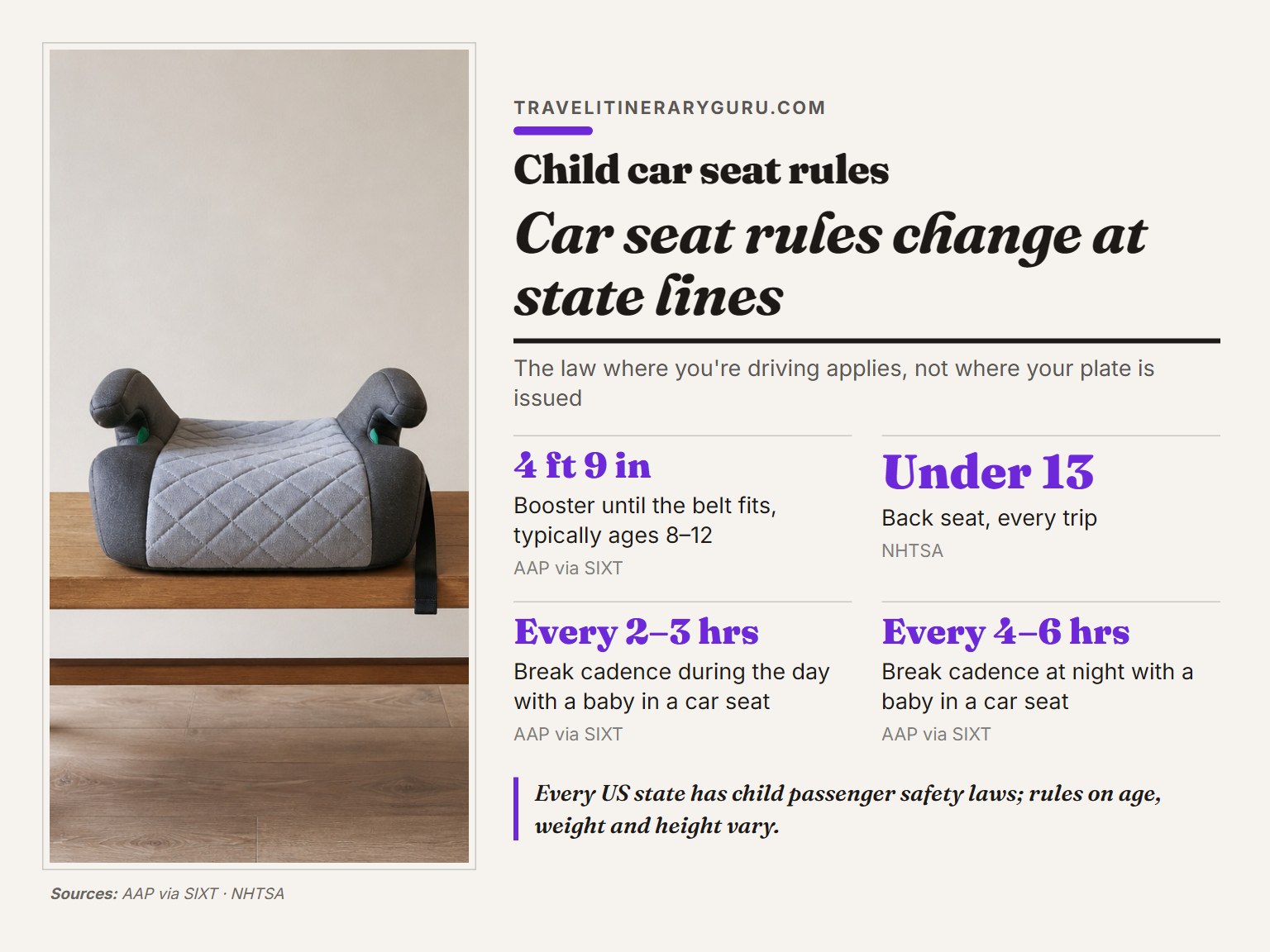
Child passenger rules are set by the state you’re driving in, not the state that issued your license plate. Every US state has child passenger safety laws, but the rules on age, weight, and height vary, so a route that crosses state lines needs a check for each one.
| Child | Seat or position | Source |
|---|---|---|
| Toddler still within rear-facing limits | Stay rear-facing; check the seat’s own limits | NHTSA |
| Around 4 ft 9 in, ages 8-12 | Booster until the belt fits properly | AAP |
| Under 13 | Back seat, every trip | AAP and NHTSA |
| Any age | Install per the seat instructions and owner’s manual | NHTSA |
Booster Seat: Size Decides
The AAP ties the switch out of a booster to the seat belt fitting properly: the lap belt across the upper thighs and the shoulder belt across the shoulder and chest. That lands around 4 feet 9 inches and ages 8 to 12. A birthday is not the trigger.
Why 13 Is the Front-Seat Number
Both the AAP and NHTSA put children younger than 13 in the back seat, and NHTSA’s wording is to keep a child there at least through age 12. It applies on every trip, including the short one to the trailhead.
The part nobody mentions: The law that applies is the one where you’re driving. A seat that’s legal at home can be illegal three states over, and you’ll find that out at a roadside stop with the kids already unbuckled.
If you want a second set of eyes, NHTSA’s Child Car Seat Inspection Station Locator lists free inspection stations and virtual options.
How Do You Keep Kids Occupied Past Hour Two?
Why Audiobooks Beat Tablets
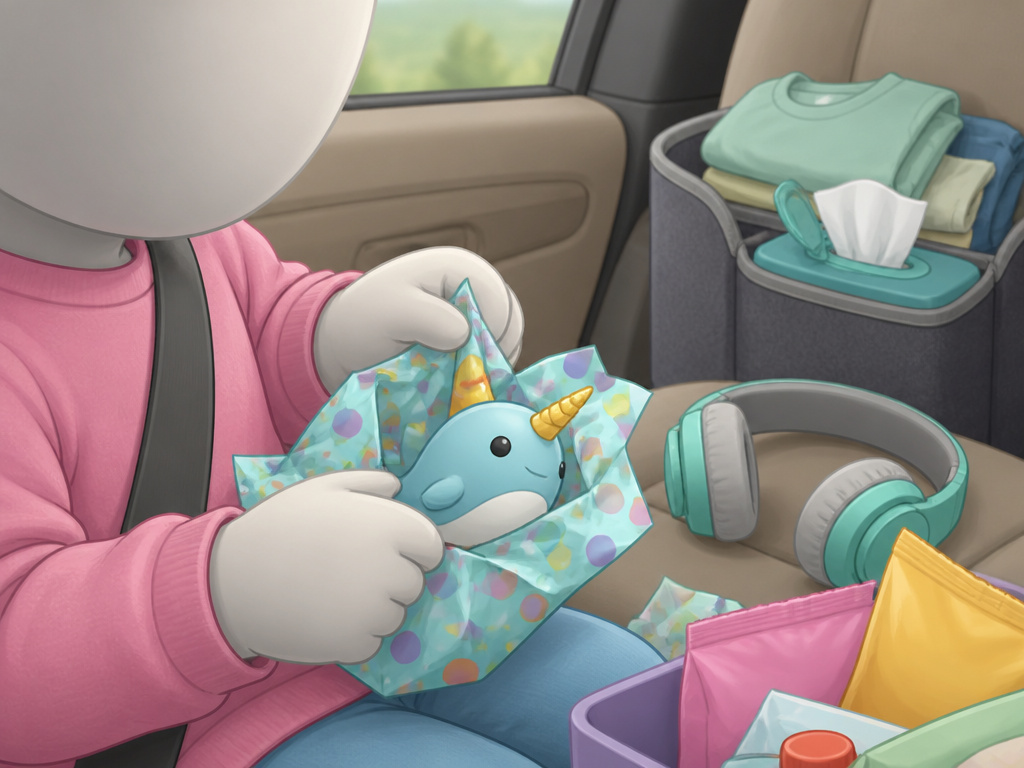
Novelty is the whole mechanism. A tablet is the same tablet it was yesterday, so it stops working as a distraction around the same time it stops being interesting. A new thing is new.
Here’s the kit that does the work:
- Wrapped novelty toys. Cheap ones, handed out one per hour, because the novelty is the mechanism.
- Headphones. So one kid’s choice doesn’t become the whole car’s choice.
- Wipes and a change of clothes within arm’s reach of the back seat, not buried in the trunk.
If you’d rather buy than improvise, the best car travel toys for kids are the ones that survive a full day in a seat.
Frequently Asked Questions
How many hours a day can you drive with a toddler?
Four to six hours is the working ceiling for one driver, based on NRMA’s daily guide and Travel with Rimon’s 250-to-300-mile target. That assumes a break every two to three hours during the day. Anything past six hours of wheels turning tends to cost you the next morning.
How often should you stop on a road trip with a baby?
Every two to three hours during the day and every four to six hours at night, per the AAP guidance cited by SIXT and corroborated by Penn State 5210. Those stops are for diapering, feeding, and movement. Never breastfeed while the car is moving; stop the vehicle.
Can a child sleep in a car seat overnight?
No. A car seat is for travel. Once you arrive, move your baby to a safe sleep space, and don’t let them sleep in the seat after you’ve stopped for the night.
Do child car seat laws change when you cross state lines?
Yes. Every US state has child passenger safety laws, and the age, weight, and height rules differ. The law where you’re driving is the one that applies, so check each state on your route before you leave.
What should you pack for a multi-stop road trip with kids?
Car seats, snacks, water, games, headphones, a change of clothes, wipes, a first aid kit, and any medication. Add a spare tire and jack kit, an emergency roadside kit with a charged phone, and a toll transponder if your route crosses a toll road.
