
How to Choose Travel Insurance for a Cruise: Key Checks
This post contains affiliate links. As an Amazon Associate, we earn from qualifying purchases.
To choose travel insurance for a cruise, match four things to your actual sailing: medical evacuation cover for a ship at sea, a policy that includes cruises rather than assumes them, trip interruption that names missed ports, and a declared list of every destination including transit stops. A helicopter evacuation from a cruise ship can cost in the $100,000s, and some lines won’t let you board without cruise-specific cover at all.
Regular travel insurance assumes you’ll get sick on land, near a hospital, in a country where someone will bill somebody. A cruise breaks every one of those assumptions at once. You’re in international waters, the doctor on board isn’t in your health system, and the nearest intensive care unit might be a helicopter ride away. That is why it helps to know how to choose travel insurance for a cruise.
That gap is where the money goes. What follows is the how to choose travel insurance for a cruise order I’d check things in, the two clauses that quietly cost people the most, and where the official sources don’t agree with each other.
Key Takeaways
- Cruise cover isn’t automatic. Policies don’t include cruising by default, so you have to tell your insurer you’re sailing.
- Medical evacuation at sea is the line item that matters most. Smartraveller warns helicopter evacuation from a ship can cost in the $100,000s.
- “Missed port” and “trip interruption” are different clauses. A weather diversion that costs you an excursion usually falls outside a standard interruption benefit.
- Declare conditions under investigation, not just diagnosed ones. GOV.UK says pending tests count, and an undeclared condition can void the whole policy.
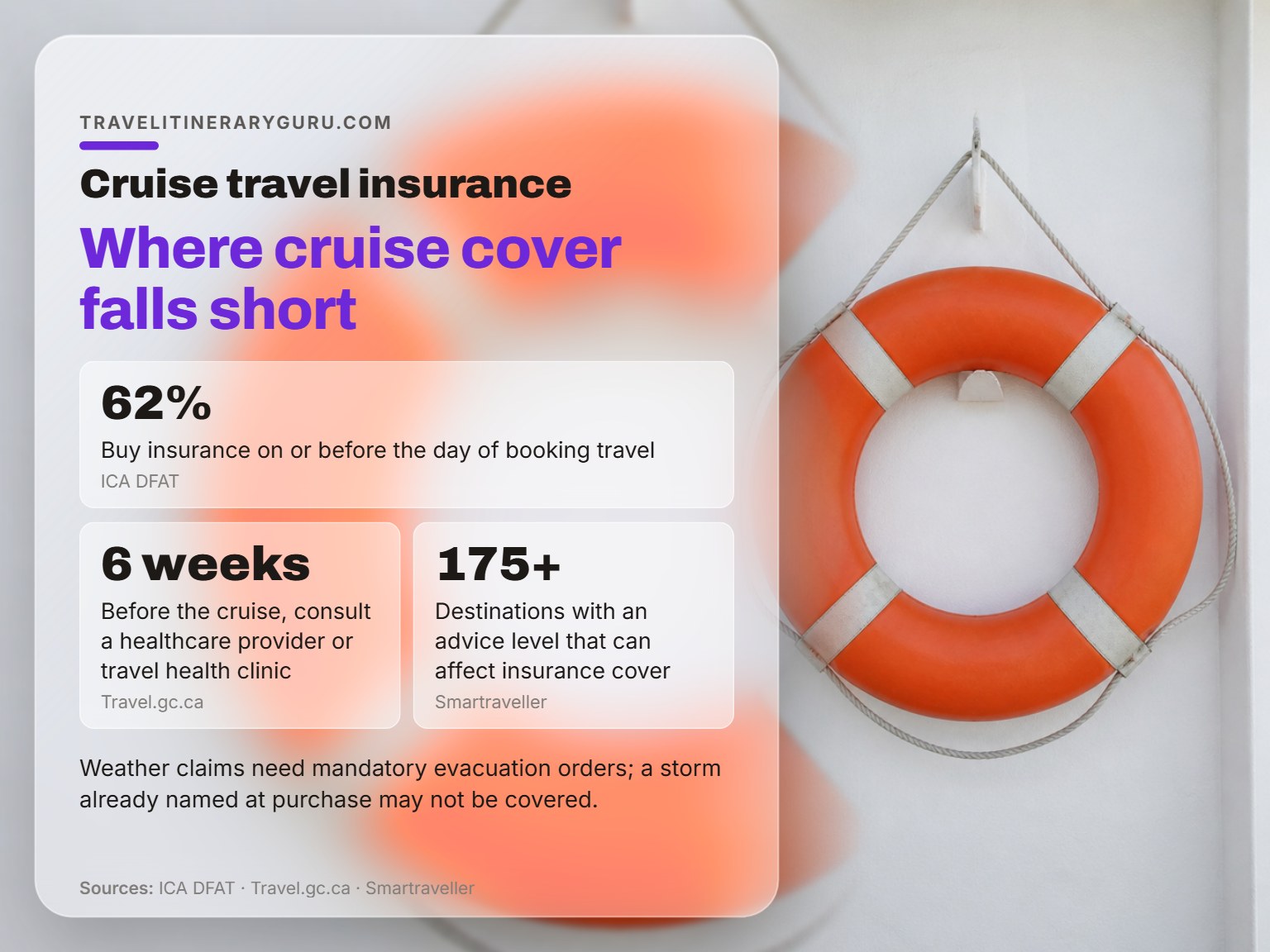
- Buy it the day you book. The ICA and DFAT survey cited by Smartraveller found 62% of insured overseas travellers buy on or before booking day.
Why a Standard Policy Isn’t Enough for a Cruise
Cruise ships sit outside the systems your normal cover relies on. That’s the whole how to choose travel insurance for a cruise problem in one sentence.
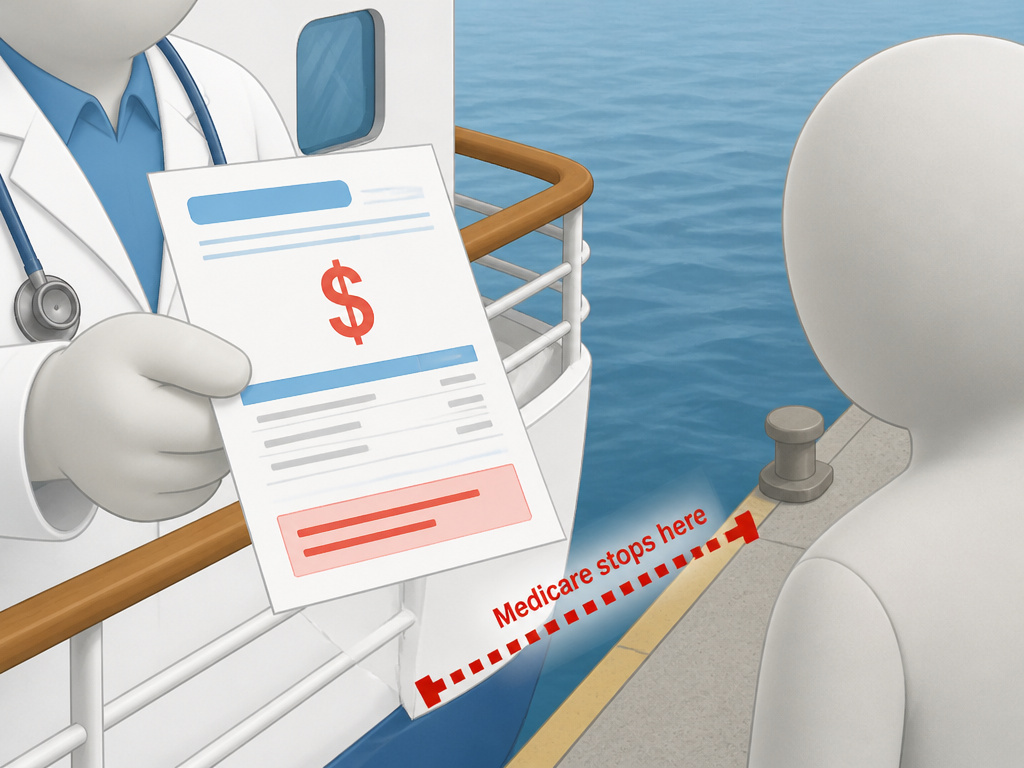
Start with the doctor. Cruise ship doctors aren’t required to hold Medicare provider numbers, so you can’t claim a Medicare or private health rebate on board. That rule applies even on a cruise that never leaves Australian waters. Smartraveller spells this out directly, and it’s the single most misunderstood point in this whole category.
Then there’s the boarding gate. Some cruise ships won’t allow passengers to board without cruise-specific insurance. Not “recommend.” Won’t allow. If you turn up with a general policy that excludes cruising, you can be standing at the terminal with a suitcase and no way on.
Cruise travel insurance must cover medical evacuation from a vessel at sea, treatment in a ship’s medical centre that sits outside national health systems, and the full set of destinations on the itinerary including ports entered only in transit. Standard single-trip policies frequently exclude one or more of these.
The Australian Government won’t pay your medical bills or your evacuation costs overseas. Neither will most national health systems once you’re on a foreign-flagged vessel. If you need medical help on a cruise, you may need to pay immediately, which means you need access to emergency funds even with a policy in hand.
What Does Cruise Travel Insurance Actually Need to Cover?
Four benefits do the real work. Everything else is nice to have.
Medical evacuation from the ship is the one that decides whether a policy is serious. The Smartraveller international cruise guidance states the cost of medically evacuating a patient from a cruise ship by helicopter can be in the $100,000s. Read your evacuation limit against that number, not against a domestic ambulance bill.
Emergency medical treatment on board matters because the ship’s infirmary is a private provider. The CHOICE travel insurance coverage guide notes that domestic travel insurance doesn’t cover medical costs at all, so an Australian domestic cruise needs either international travel insurance confirmed to cover domestic cruises or a dedicated domestic cruise policy.
Trip cancellation and interruption should cover your full prepaid cost, not just the fare. Allianz Partners points out that insurance bought from the cruise line may cover the cost of the cruise but not your flights, hotels and other associated expenses.
Here’s the part nobody tells you: the destination list matters as much as the benefits list. Smartraveller assigns an overall advice level to more than 175 destinations, and if your port sits at level 3 or 4, the policy may exclude that destination entirely.
| Cover Element | What to Check | Consequence If Missing |
|---|---|---|
| Medical evacuation | Limit vs helicopter medevac cost | You fund the flight yourself |
| Onboard treatment | Private provider cover, no rebate | Pay at the infirmary, claim later |
| Trip interruption | Covers flights and hotels, not just fare | Cruise-line policy leaves the rest exposed |
| Destination list | Every port, including transit stops | Advisory-level port excluded from cover |
The Missed Port Clause That Costs People Money
A client of mine missed Cozumel because of weather. The ship rerouted, the excursion was gone, and they assumed the insurance would pick up the tab.
It didn’t. The policy covered trip interruption, not missed ports. That distinction cost them the excursion fee and taught me to read the itinerary change clause on every policy I compare. Weather diversions are routine on a cruise, and a standard interruption benefit doesn’t treat a skipped port as an interruption at all.
Cruise lines usually have processes for severe weather, such as rerouting ships if conditions are dangerous, so the diversion itself is normal operation. Your policy has to be written to match.
What most people get wrong: Assuming a skipped port is a covered loss. Unless the policy names missed ports as a benefit, a weather diversion leaves you paying for the excursion you never took.
Cruise-Line Insurance vs Third-Party Insurance
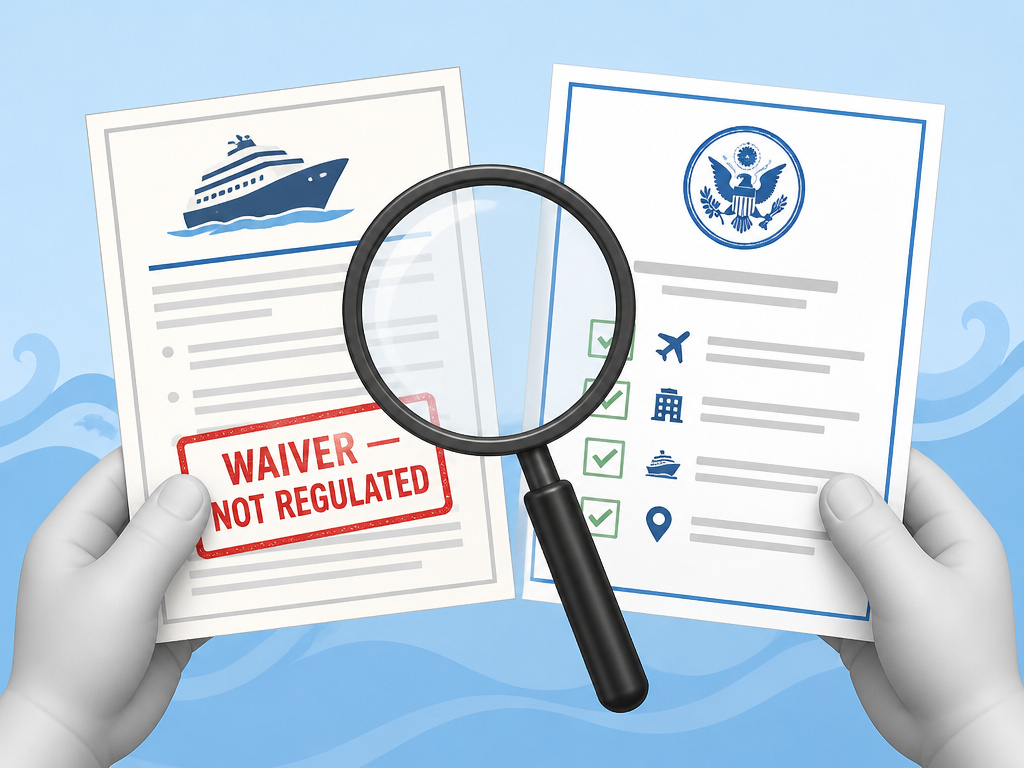
The two are not the same product, and the regulators don’t treat them the same way.
Allianz Partners frames the difference as a coverage gap: buy from the cruise line and it may cover the cost of the cruise but not your flights, hotels and other associated expenses. The North Carolina travel insurance guide frames it as something sharper. Cruise and tour operators sometimes sell cancellation waivers, which are not insurance and are not regulated by the Department of Insurance. If you buy a waiver and later have a complaint, the regulator may not be able to help you.
Both positions are correct. They’re just answering different questions. One is about what’s covered; the other is about who you can appeal to when it isn’t.
Skip this if: You’re booking a cheap domestic cruise and your only real exposure is a lost deposit. A waiver can be adequate there. For anything with a flight attached or a foreign port on the itinerary, a regulated policy is the safer structure.
Which Policy Type Fits Your Sailing?
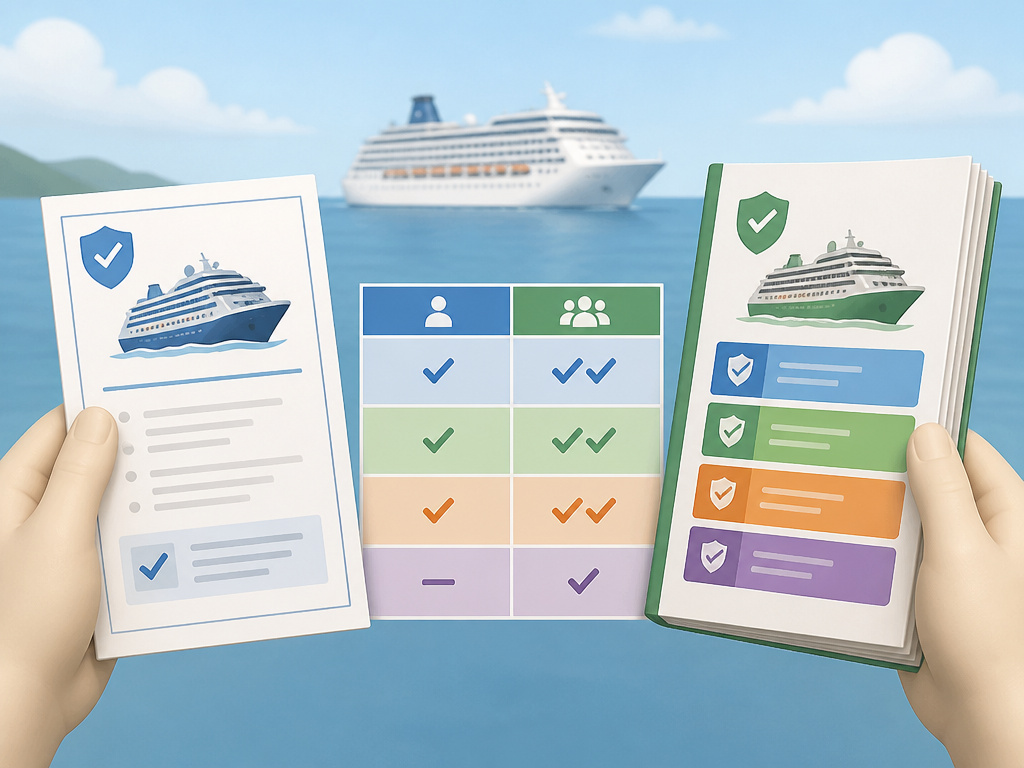
Policy type follows trip count, not trip length. That’s the rule I use.
If you’re taking one cruise this year, a single-trip policy with cruise cover added is the straightforward answer. If you’re planning two or more cruises or other vacations in the next 365 days, Allianz Partners suggests an annual plan may be the most affordable option. For annual plans, the trip cancellation and interruption limit is per insured person, per year, so the limit has to be sized against your most expensive trip, not your average one.
The family travel insurance comparison is where this gets practical, so compare family plans specifically on evacuation limits and missed port cover.
| Plan Type | Trip Cancellation Limit | Emergency Medical / Transport |
|---|---|---|
| AllTrips Basic | Not included | $20,000 / $100,000 |
| AllTrips Prime | $3,000 | $20,000 / $100,000 |
| AllTrips Executive | $5,000–$10,000 tiered | $50,000 / $250,000 |
| AllTrips Premier | $2,000–$15,000 tiered | $50,000 / $500,000 |
Those figures come from Allianz Partners’ own annual plan comparison. Read them as an illustration of how wildly the tiers differ, not as a recommendation. The Basic tier has no cancellation benefit at all, which tells you how much the entry level assumes you won’t need it.
For a single cruise, the Cancel Anytime upgrade reimburses up to 80% of trip costs in cash when you cancel for almost any reason not covered in the plan. That upgrade is the closest thing to a genuine “changed my mind” benefit in the market.
Where Cruise Policies Quietly Fall Short
Exclusions do more damage on a cruise than on any other trip type, because the exposure is concentrated.
Pandemic and influenza cover is the first one to check. Smartraveller warns that some travel insurance policies exclude pandemic or influenza cover, and infectious diseases like COVID-19, influenza and gastroenteritis are common on cruise ships given how many passengers live and socialise in close quarters over a long period.
Alcohol is the second. GOV.UK states most travel insurance policies do not cover events that happen after drinking excessive alcohol or taking recreational drugs or other substances. On a cruise with a drinks package, that clause is doing more work than you’d think.
The third is the one that catches people at the worst moment. That’s a regulator’s rule, not an insurer’s preference, and it means your first phone call isn’t to the insurer.
Easy to miss: Weather claims are contingent on mandatory evacuation orders, and a storm already named at the time you bought the policy may not be covered. Buy before the forecast has a name in it.
When Cruise Insurance Won’t Save You
Three situations where the policy does nothing, no matter how good it is.
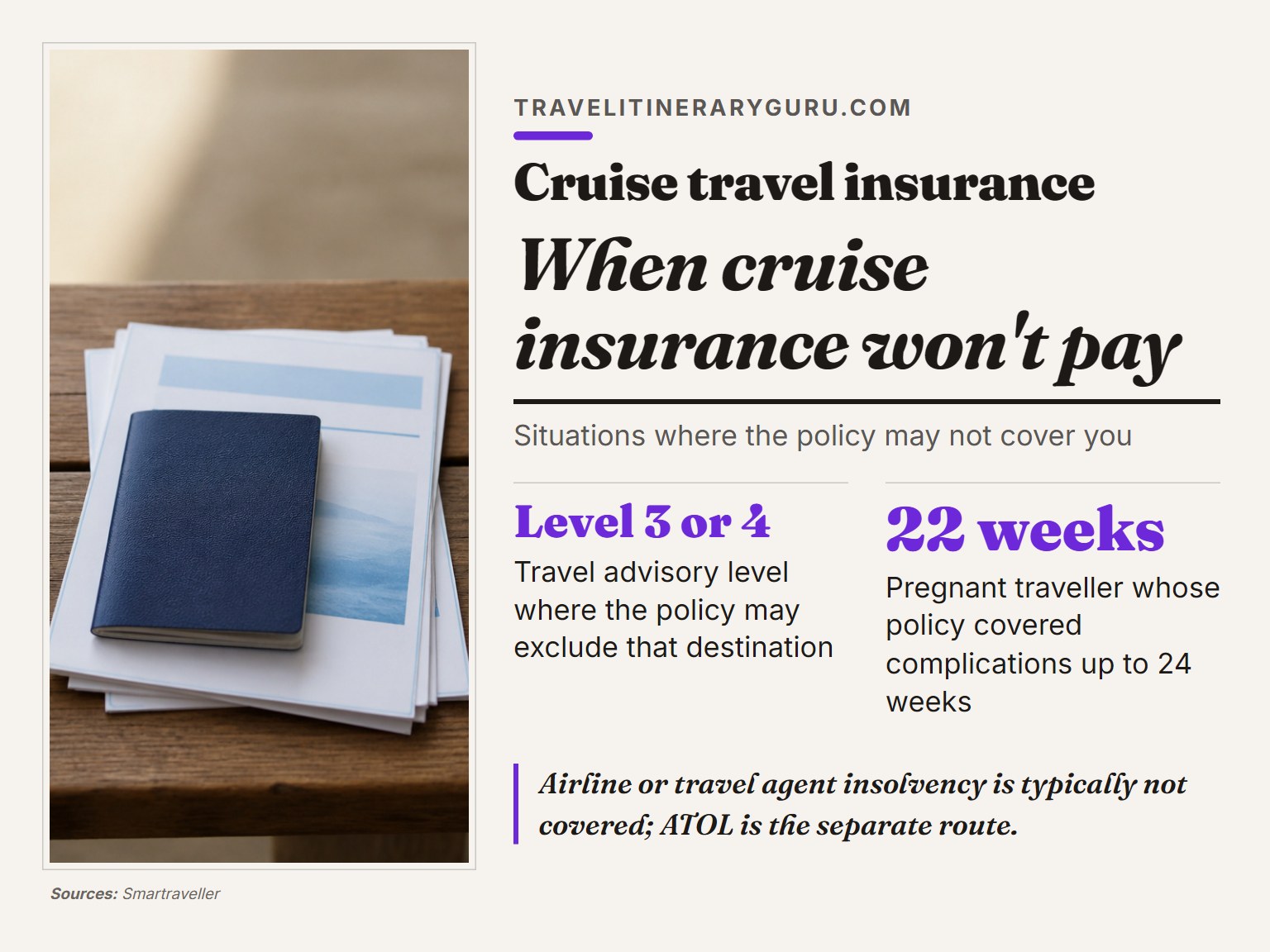
If you travel to a destination where the FCDO advises against all but essential travel or all travel, your insurance may be invalidated. Smartraveller’s version of the same rule is the advisory-level threshold: level 3 or 4 and the policy may exclude that destination. Check the advisory before you book the port, not after.
If the airline or travel agent goes bust, that’s typically not covered. ATOL protection, managed by the Civil Aviation Authority, is the separate route for air holidays and flights. A cruise policy won’t fill that hole.
If you’re pregnant, the covered gestation window is the whole game. One case in the Smartraveller buying guide involved a traveller at 22 weeks whose policy covered pregnancy complications up to 24 weeks. Two weeks later, the same trip would have been uncovered.
Before you start: Declare every condition, including ones still under investigation and pending tests, because GOV.UK states failing to declare something may invalidate the policy. Check the trip-length cap, since many policies set a maximum trip duration or an annual limit on days outside the country. Read the free-look period before the deadline passes, because that’s your only clean exit if you bought the wrong policy.
Age changes the maths too. Insurers often charge older travellers more, and in some cases “older” can be as young as 50. Travellers as young as 60, but more commonly over 80, can face a higher excess: the normal excess of around $100 to $200 is often increased to $2,000 to $3,000 for travellers 80 and over on injury or illness claims. Restricted conditions like reduced medical cover limits or a policy that must be purchased six months in advance can apply to travellers over a certain age.
Do You Need Travel Insurance for a Domestic Cruise?
Yes, and this is the answer that surprises people most.
Domestic travel insurance doesn’t cover medical costs. So an Australian domestic cruise needs either international travel insurance that’s confirmed to cover domestic cruises, or a dedicated domestic cruise policy. There’s no third option where your ordinary domestic cover picks it up.
The reason is the Medicare provider number rule. Because ship doctors aren’t required to hold one, no Medicare or private health rebate applies on board, including in Australian waters. One case in the Smartraveller guide involved a traveller on a multi-night cruise that departed and returned to Sydney with no stops in other ports. She fell ill, paid for treatment on board, and was reimbursed because she’d bought a policy that covered domestic cruises.
Worth knowing before you start: A domestic cruise is not a domestic trip for insurance purposes. The vessel is a private medical provider in international waters, and your health cover stops at the gangway.
Frequently Asked Questions
Is cruise travel insurance different from normal travel insurance?
Yes. Cruises aren’t automatically included in all travel insurance policies, so you have to inform your insurer to get cruise cover. A standard policy may also exclude the two things a cruise most needs: medical evacuation from a vessel at sea and treatment in a ship’s medical centre that sits outside any national health system.
How much medical evacuation cover do I need for a cruise?
Smartraveller states the cost of medically evacuating a patient from a cruise ship by helicopter can be in the $100,000s. Size your evacuation limit against that figure rather than against a domestic ambulance or a short-haul air ambulance. Size your evacuation limit against the fact-sheet figure of a helicopter evacuation costing in the $100,000s rather than against a domestic ambulance or a short-haul air ambulance.
Does Medicare cover me on a cruise in Australian waters?
No. Cruise ship doctors aren’t required to hold Medicare provider numbers, so you can’t claim a Medicare or private health rebate on board, even on a cruise that never leaves Australian waters. You may be asked to pay for treatment at the time and claim it back from your travel insurer.
What happens if my cruise misses a port because of weather?
Unless your policy names missed ports as a covered benefit, a weather diversion usually falls outside a standard trip interruption clause. The diversion itself is normal operation, since cruise lines routinely reroute ships when conditions are dangerous. Check the itinerary change clause before you sail, and keep the paperwork from any excursion you paid for.
Can I buy cruise insurance from the cruise line instead?
You can, but understand what you’re buying. Allianz Partners notes that cruise-line insurance may cover the cost of the cruise but not your flights, hotels and other associated expenses. The North Carolina Department of Insurance goes further, noting that cruise and tour operators sometimes sell cancellation waivers that aren’t insurance and aren’t regulated by the Department of Insurance.
Should I buy travel insurance before or after booking the cruise?
As soon as possible after booking. GOV.UK advises buying travel insurance as soon as possible after booking the trip, and the ICA and DFAT survey cited by Smartraveller found 62% of overseas travellers who buy insurance do so on or before the day of booking. Buying early also gets you in before any storm has a name.
The Bottom Line
One rule I’ll keep repeating: if you can’t afford the insurance, you can’t afford the cruise.
Here’s the specific trigger to watch for. If any port on your itinerary sits at advisory level 3 or 4, stop and check the policy before you book the cruise, not after. That single check catches more people than any other line on the page.
The first thing to do this week: pull up your itinerary, list every port including transit stops, and read the destination exclusions against that list. It’s the difference between a policy that responds and a policy that turns out to have been pointing somewhere else the whole time.
