
How to Choose a Family-Friendly Hotel: The 50-Point Test
This post contains affiliate links. As an Amazon Associate, we earn from qualifying purchases.
To choose a family-friendly hotel, check the safety basics against a published rubric instead of the marketing photos. Dubai’s 2026 ACCOLADES manual requires 50 mandatory points out of 100 for its Family-Friendly badge, covering supervised pools, child-safety locks, cots on request, and monitored exits.
That 50-point floor covers the things a photo gallery can’t show: lifeguard certification, staff-monitored exits, slow-closing doors, and cots that actually turn up. Miss enough of them and the badge never happens. Knowing how to choose a family-friendly hotel matters. You find out on arrival day, with a tired toddler and no plan B.
What follows is the rubric itself, the failure rates researchers measured across 84 hotels, the three booking shortcuts that don’t hold up, and the two decisions that matter more than any star rating.
Key Takeaways
- Ask for the crib at booking, not at check-in. The AAP says to confirm cribs and playards are available when you book, and to reject any crib with broken parts, loose hardware, or extra padding.
- Supervised pools are a certification, not a vibe. A real family-friendly rubric ties pool supervision to lifeguards certified by a national sports authority or an equivalent body.
- Brand names don’t predict amenities. A peer-reviewed study of 88 Kraków hotels found no significant difference in family provision by hotel category or chain membership.
- Age beats everything else. The same hotel serves a 2-year-old and a 9-year-old completely differently, and operators tend to treat children as one group.
- A kitchen changes the trip. Apartment stays with a kitchen kill the morning restaurant scramble and the daily food spend.
The 50 Mandatory Points Behind a Family-Friendly Hotel Rating
Fifty of the hundred points on Abu Dhabi’s Family-Friendly rubric are mandatory. A nicer lobby doesn’t move them.
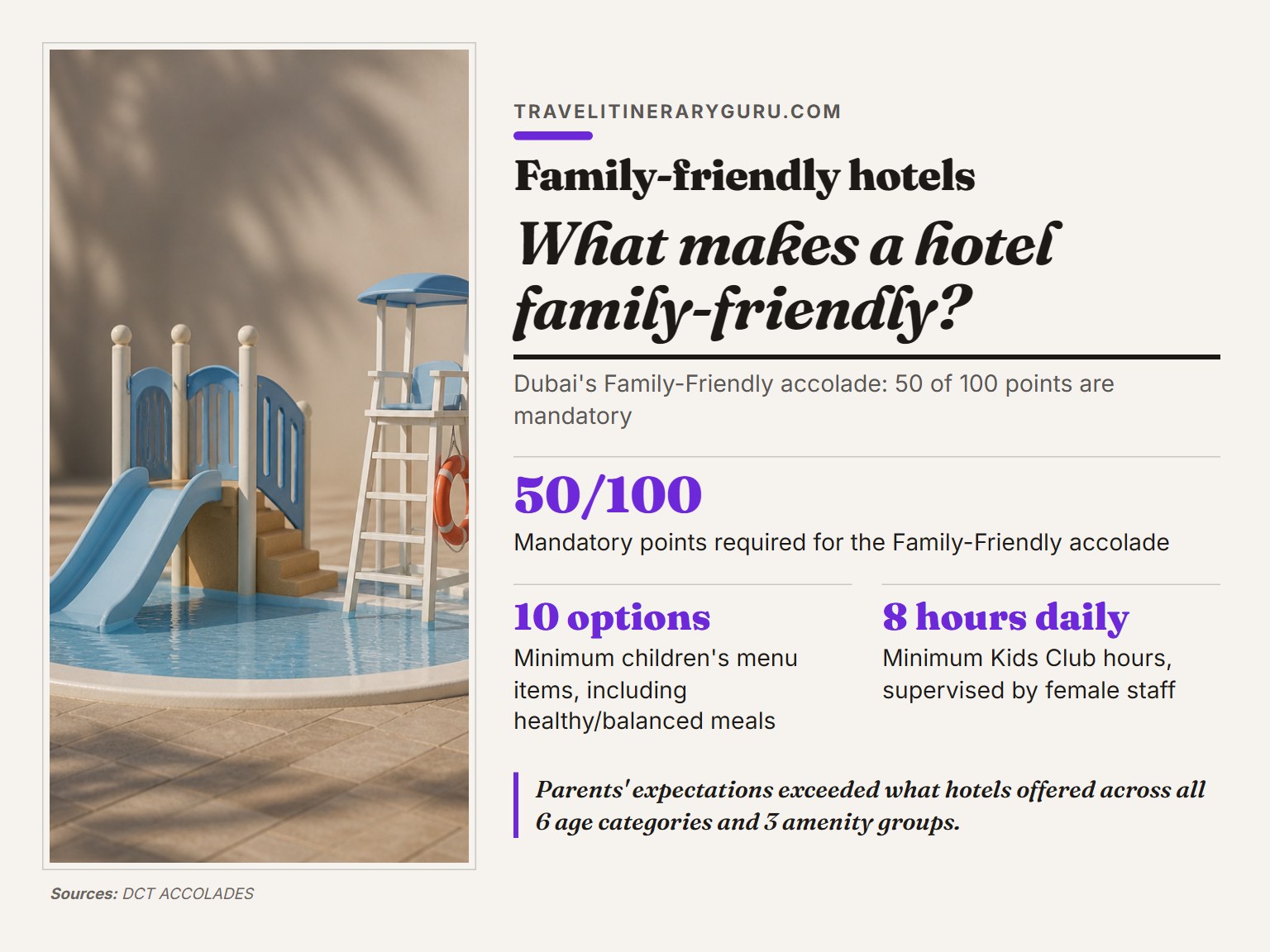
The Family-Friendly accolade requires a minimum of 50 mandatory points out of 100. Mandatory criteria cover safety and accessibility, children’s services, family accommodation, and food and beverage. Points are awarded per criterion, with the highest single weights assigned to child-safety measures, lifeguard supervision, cots and safe bedding, and access security.
The Dubai ACCOLADES hotel manual publishes every criterion and its point value, which makes the badge auditable rather than aspirational. It’s also Gulf-specific, and that matters. The UAE version requires a Kids Club supervised by female staff, a criterion you won’t find on a European or American rating sheet.
A sample of the mandatory criteria and the weights the manual assigns:
- Supervised pools and play areas. Lifeguards must hold a valid certification from the UAE General Authority of Sports or an equivalent internationally recognized body, covering operating hours. At 8 points, it’s the heaviest single safety item.
- At least two of three family spaces: a dedicated outdoor play area, a dedicated indoor play area, or a children’s pool (8 points).
- Child-safety measures across all public areas, including signage, locks, and safety film on glass surfaces (8 points).
- Cots, cribs, and safe bedding on request (8 points).
- Stroller accessibility through barrier-free routes and suitable ramp access across common areas (6 points).
- Access security, with staff monitoring all main exits so a child can’t leave unsupervised (6 points).
- Flexible family dining hours, including early and late seating to fit family schedules (6 points).
Two more mandatory items round the sheet out. A children’s menu must offer at least ten options including healthy and balanced meals (5 points), and all child-care and entertainment staff must be First Aid trained specifically for children (4 points).
The optional half is where the useful detail lives. A hotel can claim a minimum 30% of guest rooms are suitable for families, accommodating 3 to 4 people through larger rooms or interconnecting configurations. It can also run a daytime Kids Club for a minimum of eight hours daily. Neither is guaranteed by the badge, so ask about both by name.
One caveat before you apply this to a European or American booking: it doesn’t port. The point values, the certification bodies, and the staffing rule are all UAE-specific. Use it as a template for the questions, not as a standard the hotel down the road has somehow failed.
Which Safety Features Do Hotels Actually Fail On?
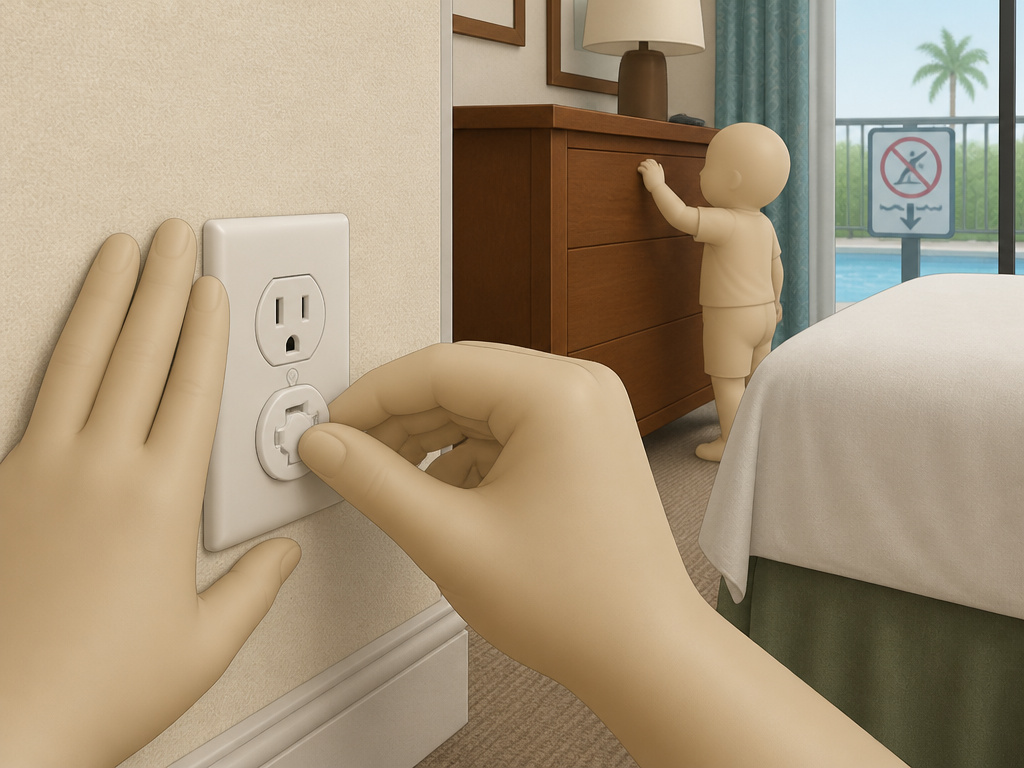
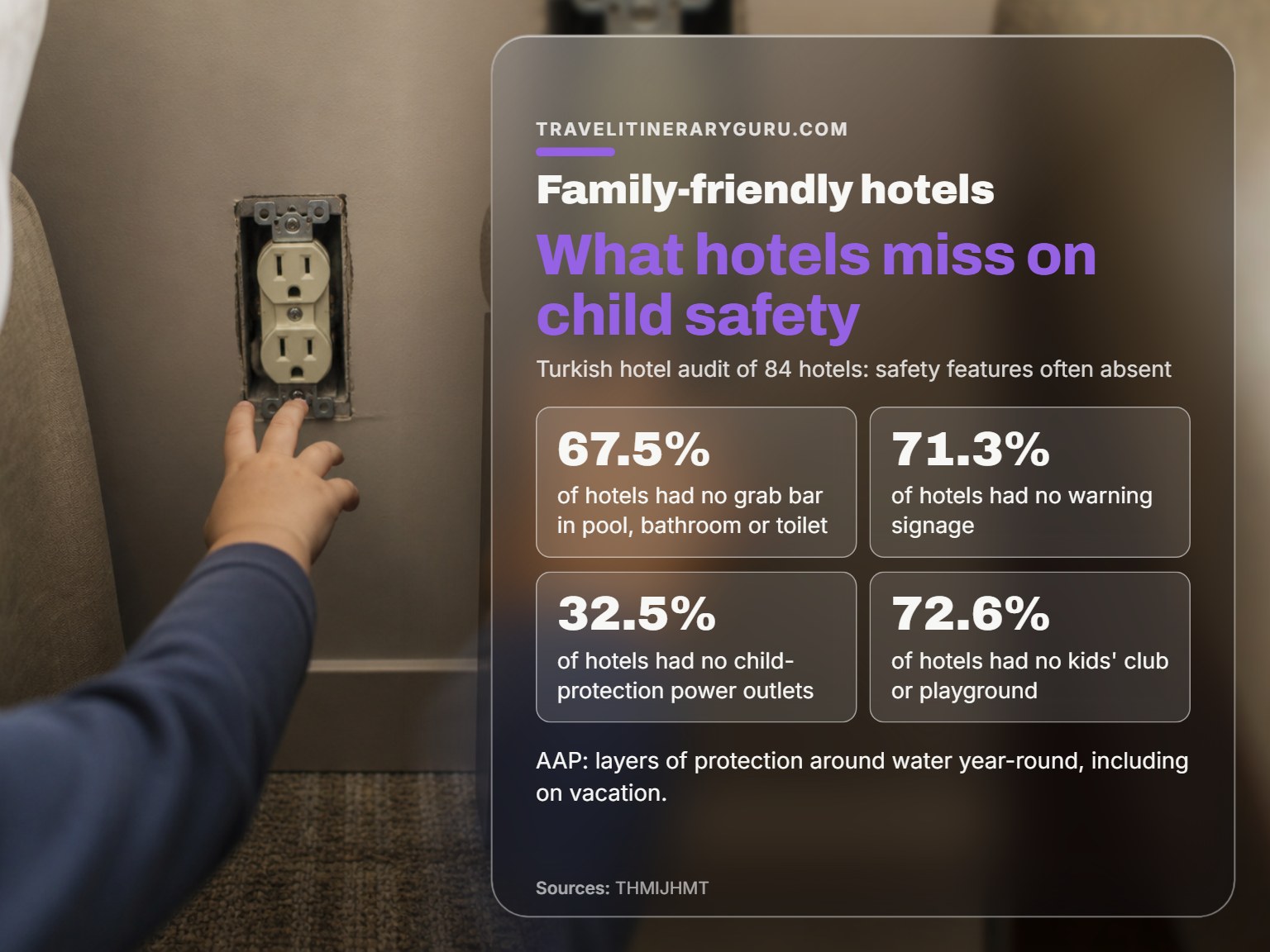
Eighty-four hotels across Sivas, Kayseri, and Ankara were checked for child-safety basics, and the gaps clustered around the cheapest fixes.
| Safety feature | Hotels without it (n=84) | What to check at the door |
|---|---|---|
| Grab bar in pool, bathroom, or toilet | 67.5% | Look behind the toilet before you unpack |
| Warning signage | 71.3% | Pool depth and depth-change markers |
| Child-protection power outlets | 32.5% | Pack your own covers anyway |
| Furniture incompatible with child safety | 32.5% | Sharp corners, tip-over risk on dressers |
| Break-resistant glassware | 43.8% | Ask housekeeping to swap it |
| Kids’ club or playground | 72.6% | Confirm it exists before you book |
The Turkish hotel survey also found 60.0% of hotels had easy-open faucet handles and 38.7% offered no health service at all. This sample covers city hotels in three provinces, so it isn’t a global benchmark. What it does show is that features you’d assume are standard are frequently absent.
Walk past the pool during operating hours. Still water and an empty lifeguard chair tell you more than any supervision claim on the website.
If you’re travelling with a grandparent, book accessible hotel rooms by name rather than hoping the front desk upgrades you at check-in.
Common mistake: Reading “lifeguard on duty” as “lifeguard on duty all day.” Supervision is tied to operating hours, so ask what those hours are and whether they shrink on weekdays.
Three Shortcuts That Fail: Brand, Size, and the Map
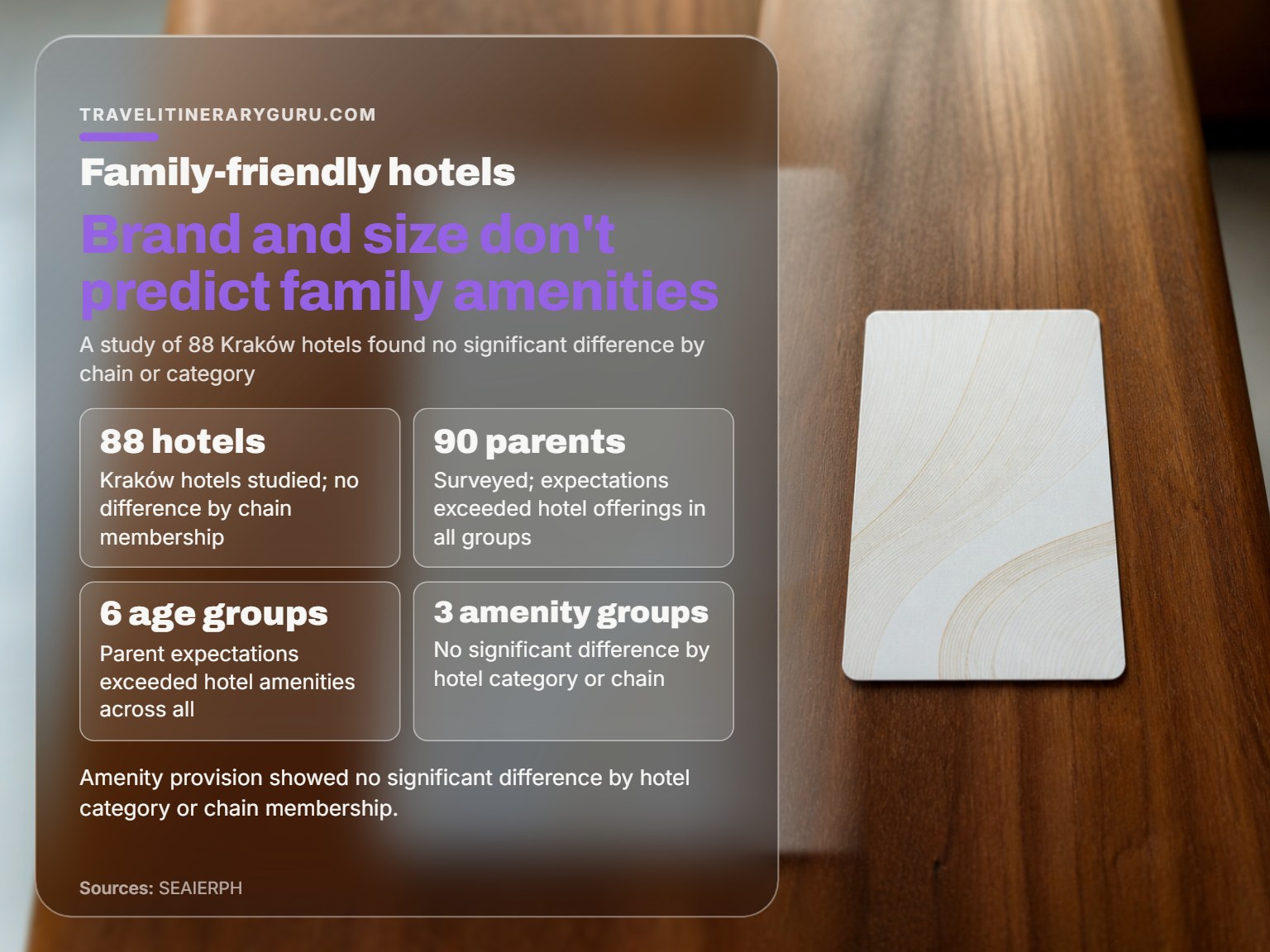
Three shortcuts get repeated constantly: book the brand you know, book the biggest hotel in town, and book whatever sits closest to the sights. The research on the first two is thinner than the advice suggests.
| The claim | Who makes it | What the evidence shows |
|---|---|---|
| Family features are brand-linked | Marriott Bonvoy markets them that way | A study of 88 Kraków hotels found no significant difference by chain membership |
| Big hotels have the best amenities | Michelin Guide inspectors | The same study found no effect by hotel category |
| Children are one audience | How surveyed hoteliers framed it | Parent data shows age is the key differentiator |
Marriott Bonvoy markets its family-friendly features as brand-linked and designed to make travelling with children easier. That’s a marketing position, and a defensible one for a company running a single set of standards across hundreds of properties.
The peer-reviewed hotel amenity analysis of 88 Kraków hotels and 90 parents found something different. Amenity provision showed no significant difference by hotel category or chain membership, which means the brand on the door didn’t predict what families actually received.
Michelin Guide inspectors take the opposite line on size. Their position is that the largest hotels carry the deepest amenity set and suit families who need multiple restaurants in multiple styles, a kids club with a babysitter, or a pool open to children as well as adults. The same inspectors note the biggest hotels are frequently the quietest city hotels, especially on the highest floors.
When you compare a how to choose a family-friendly hotel, booking on brand alone is like picking a restaurant because the chain has a good location in another city. The standards are shared. The kitchen isn’t.
The map shortcut is the one that holds up, with a correction. I booked a hotel once because it looked perfect on a map and spent the week commuting. Location still matters, and the walk to transit decides it more than the pin does. Michelin’s inspectors draw the same line: for short stays, prioritise a central location near the sights or your main reason for the visit.
Booking with free cancellation is the cheapest insurance in this whole decision, because it lets you walk if the pool turns out to be a puddle.
Ask for the quietest room when you book, not when you arrive. Hoteliers know which rooms those are, and the special-request box is where the answer actually gets actioned.
The Family-Friendly Hotel Room Features Worth Asking For by Name
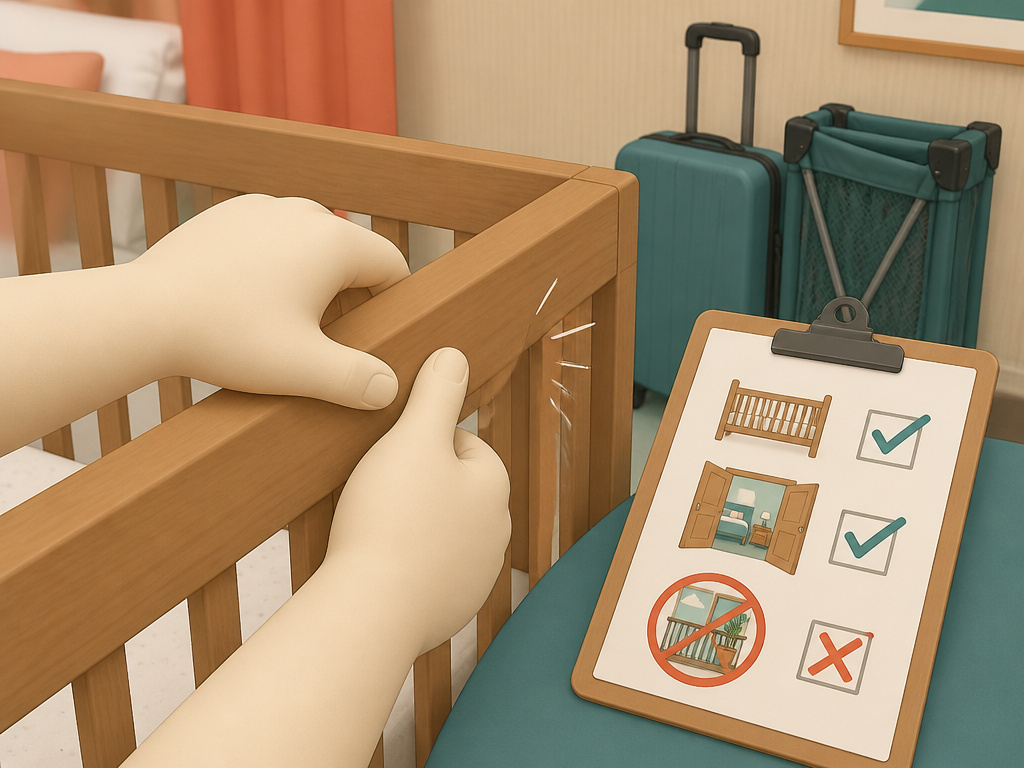
Room configuration decides more of the trip than the lobby does. A hotel can score well on pool supervision and still hand you a room where the cot doesn’t fit.
Crib Checks the AAP Says to Make
The AAP’s guidance is specific. Ask when you’re booking whether cribs or playards are available on request, then inspect the one you’re given. A crib with broken or missing parts, loose hardware, or padding beyond the manufacturer’s original mattress fails the check.
Push the side rail. A crib in good repair stays rigid; a loose one may rock or have loose hardware.
The AAP also advises against putting a baby in bed with you, recommending a portable crib or packable playard instead. If you’d rather not gamble on the hotel’s stock, a travel crib that meets current safety standards packs into a suitcase. A travel crib that meets current safety standards packs into a suitcase.
On childcare, the AAP notes most hotels keep a list of local babysitting agencies, and that sitters arranged through the hotel are expected to stay in the room with your children.
The 30% Room Rule
The optional room criterion asks for a minimum 30% of guest rooms suitable for families, accommodating 3 to 4 people through larger rooms or interconnecting configurations. Ask which one you’re getting. A bigger room and two interconnecting rooms solve completely different problems, and only one of them lets you put a toddler down at 7pm while the rest of the family stays up.
If grandparents are coming, a multi-generational family trip needs interconnecting rooms rather than one big suite.
What to request by name, in order of how often it matters:
- Cots and cribs, confirmed at booking.
- Interconnecting rooms if you need separate sleeping spaces.
- A room away from the lift lobby and the pool deck. Those are often the loudest spots on a floor.
- Break-resistant glassware, requested from housekeeping.
- A balcony-free room if you have a curious or climbing child.
The rubric also requires slow-closing doors and safety locks as part of child-safety design, which is the kind of detail you only notice when it’s missing.
The part nobody mentions: A childproof lock on a balcony door may still open from the inside. If your child climbs, avoid rooms with balconies.
I carry a small power strip.
Apartment Rental or Family Resort: Pick the Right One
I stopped booking all-inclusive family resorts, and I haven’t missed them.
The how to choose a family-friendly hotel switch happened because of breakfast. Making it in the apartment instead of buying it downstairs cuts a real slice out of the daily food spend for a family of four, and it removes the 7am restaurant meltdown before anyone is properly caffeinated.
The bigger problem with all-inclusive is what it insulates you from. You fly a full travel day and spend the week eating chicken fingers at a buffet that could be anywhere. The kids come home knowing the resort pool better than the destination.
When the Resort Wins
- A theme park trip where the resort sits on the shuttle loop.
- A short break where you want zero logistics and no grocery run.
- A multi-generational trip where everyone wants a pool and a bar within a short walk.
When the Apartment Wins
- Anything longer than a long weekend.
- Cities where you’d rather eat breakfast in than hunt for a cafe before 8am.
- Families with a toddler who wakes before the hotel restaurant opens.
For most families on anything longer than a long weekend, an Airbnb apartment with a kitchen beats the resort on both cost and sanity. Book the resort when the property itself is the destination.
Cooking in the apartment is a lever to save money on a family vacation. Book the one big activity in advance so you’re not negotiating at a desk with three tired children.
What Do Parents Want That Hotels Keep Missing?
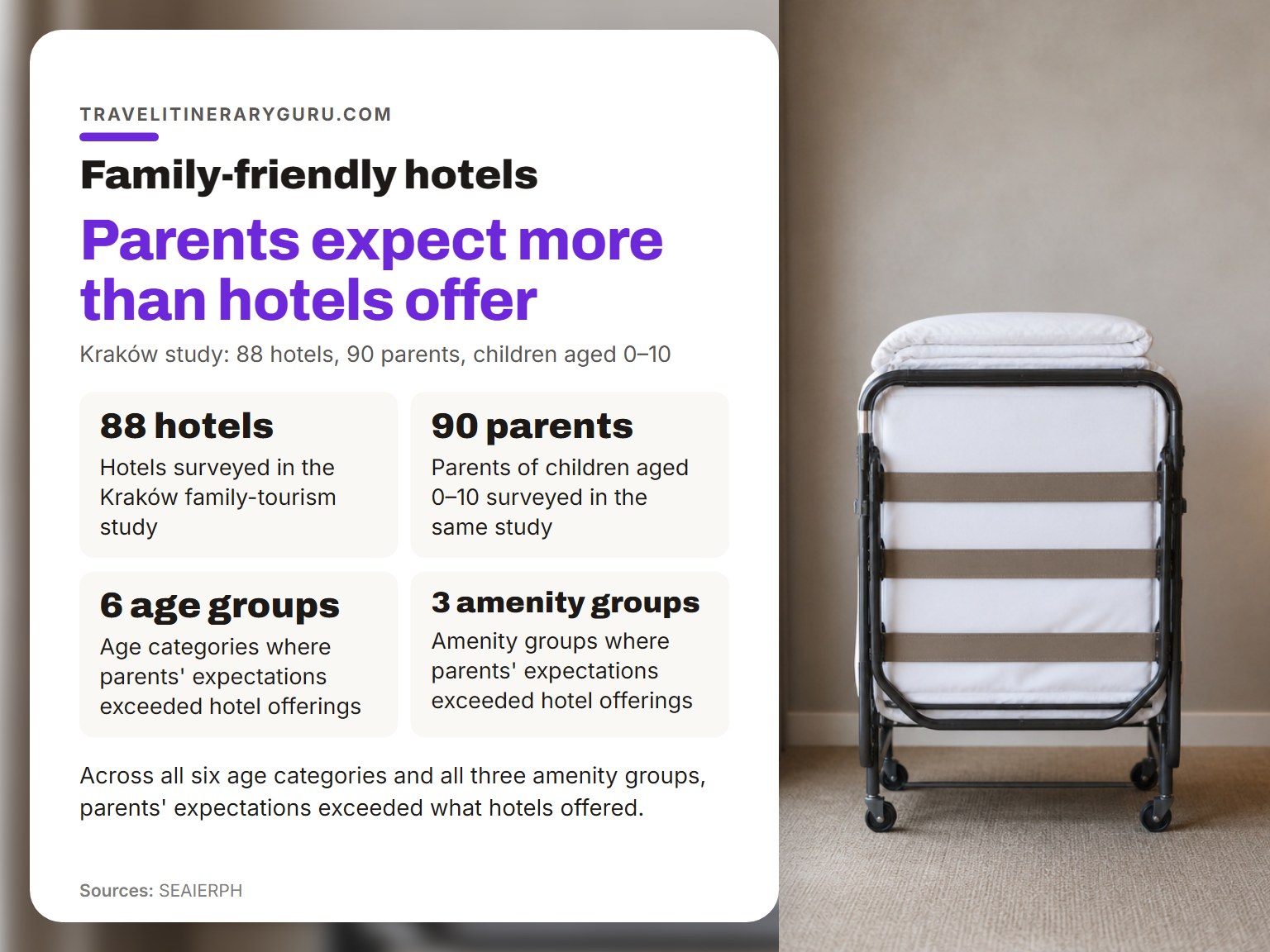
A parent with a 2-year-old walks into the lobby and looks for the cot. A parent with a 9-year-old looks for the pool slide and the activity board. Same booking, two different hotels.
The family tourism satisfaction study makes that gap measurable. It surveyed 88 hotels and 90 parents of children aged 0 to 10, and found that across all six age categories and all three amenity groups, parents’ expectations exceeded what hotels offered.
The mismatch runs deeper than a missing item. The hoteliers in that study perceived children as a homogeneous group, while the parent data shows age is the key differentiating factor. An operator can tick every box on a checklist and still miss the family standing in front of them.
Here’s my unpopular take: the kids’ club matters less than the walk to breakfast. A club you use twice doesn’t fix a hotel where every meal means a stroller ride through three lobbies.
Two limits on that research are worth knowing. It collected data in winter only, so pool and outdoor-play findings may not reflect summer operations. The authors also note that most published work covers holiday hotels rather than city hotels, so the findings transfer imperfectly to a downtown booking.
If your youngest is under three, planning a family trip with young children is a different exercise from planning around a nine-year-old.
What Should You Check in the First Hour After Check-In?
The first hour in the room is when you do the work the hotel didn’t. The hotel hazards for young children guidance from the American Academy of Pediatrics reads like a checklist because that’s what it is.
The AAP’s core position is layers of protection around bathtubs, toilets, pools, and hot tubs, year-round and including on vacation. That guidance puts the verification burden on you rather than on the hotel, which is a different posture from the UAE rubric’s third-party lifeguard certification.
Before you start: Two hazards cause most hotel-room incidents with small children. Water: bathtubs, toilets, and pools need layers of protection year-round, including on vacation, and drowning happens fast and without noise. Doors: an unlocked deadbolt or a balcony door is an exit, and a wandering toddler can reach a lift lobby quickly. Use the deadbolt, keep the bathroom door closed, and take a toilet lock with you.
- Get on the floor. Crawl the room at your child’s eye level and you’ll spot the pen under the dresser, the lamp cord, and the low drawer that pulls all the way out.
- Tape the cords. Blind cords and window cords are strangulation hazards, and a roll of painter’s tape takes ten seconds to solve it.
- Cover the outlets. Plastic outlet covers weigh almost nothing in a suitcase and beat hoping the hotel fitted them.
- Check the crib before bedtime. Broken or missing parts, loose hardware, or extra padding all disqualify it.
- Walk the exits. Find the stairs, then pick a meeting place outside the hotel in case of fire.
- Look at the pool. Know where it is, and use touch supervision in the water at all times.
Get on the floor and look under the bed. You’ll find a pen, a coin, and a phone cord coiled where a crawling baby can reach it.
The same walk is when you decide where to keep valuables safe in a hotel room.
Some hotels offer childproofing services for guests who ask. Call the hotel directly in advance rather than raising it at check-in, when the front desk is at its busiest.
Bottom line: the room scan takes less time than unpacking, and it’s the only part of this decision you fully control.
Frequently Asked Questions
How do I know if a hotel is genuinely family-friendly or just marketing itself that way?
Look for a named certifying body and a published rubric. Dubai’s ACCOLADES manual scores hotels on 50 mandatory points out of 100, with each criterion carrying a stated value. If a family-friendly claim arrives with no certifier, no criteria, and no point score, you’re reading an adjective.
What should I ask the hotel before I book?
Ask three things: whether cribs and playards are available on request, which rooms suit a family of three or four, and what hours the pool is supervised. The AAP recommends confirming crib availability at booking rather than on arrival. Get the answers through the booking system so you have them in writing.
Are chain hotels better for families than independent ones?
The evidence doesn’t support the assumption. A peer-reviewed study of 88 Kraków hotels found no significant difference in family amenity provision by hotel category or chain membership. Marriott Bonvoy markets its family features as brand-linked, which is a real commitment, but brand affiliation didn’t predict what parents received in that dataset.
Is an apartment rental better than a family resort?
For stays longer than a long weekend, the apartment wins on both cost and sanity. A kitchen removes the morning restaurant scramble and cuts the daily food spend for a family of four. Resorts win when the property itself is the destination, or when you’re on a theme park shuttle loop and want zero logistics.
What age range are hotel kids’ clubs designed for?
That varies by property, and it’s the question parents forget to ask. The Kraków research found hoteliers tend to treat children as a single group, while parents’ needs differ sharply by age. Ask the age band before you count on it, because a club that suits one child may exclude the other.
Do I need to bring my own childproofing gear?
Yes, at minimum a toilet lock, a few plastic outlet covers, and a roll of painter’s tape. The AAP advises bringing your own toilet lock and using tape to cover outlets and secure blind and window cords. A folded washcloth taped over a sharp table corner solves the problem.
Before You Go
One threshold worth keeping: if a family-friendly hotel can’t name the body that certifies its lifeguards, treat the claim as decoration. The rubric language ties supervision to a recognised certification, and a property that holds one will know it off the top of its head.
Before you book anything this week, write down two things: your youngest child’s age and whether you’ll cook breakfast in the room. Those two answers eliminate most of a shortlist faster than any review score.
This all shifts if you’re booking two nights in a city centre with a nine-year-old. Then the rubric matters less than the walk to the metro, and a hotel that scores badly on kids’ clubs can still be exactly right.
And I’ll defend this one to the end: a family trip with one anchor activity a day beats a trip with one attraction a day. Kids remember the gelato walk. They don’t remember the second museum.
