
How to Get a Better Currency Exchange Rate: Step-by-Step
This post contains affiliate links. As an Amazon Associate, we earn from qualifying purchases.
To get a better currency exchange rate, compare the total cost as a percentage mark-up over the European Central Bank reference rate, decline the conversion prompt at foreign ATMs and card terminals, and avoid converting large amounts at an airport. The mark-up number is the one figure that lets you compare a bank, a bureau, and a card terminal on equal terms.
That mark-up figure exists because of a specific rule. Since 19 April 2020, providers offering currency conversion at ATMs or points of sale must tell you the exchange rate and fees before you pay, and they must express the total cost as a percentage mark-up over the latest ECB euro foreign exchange reference rate. One number. Comparable across providers. Knowing how to get a better currency exchange rate starts with asking for it. Most travelers never ask for it.
What follows is how to use that number, where the posted rate list lies to you, and the two card habits that quietly cost more than any exchange counter.
Key Takeaways
- Compare the mark-up, not the rate. A percentage over the ECB reference rate is the only apples-to-apples figure, and providers are required to give it to you before payment.
- Decline the conversion prompt. At a foreign ATM or terminal, choose to pay in the local currency and let your own bank convert under your contract terms.
- Above €1,000, demand the paperwork. A bureau must hand you written pre-transaction information covering rate, fees, and your right to cancel.
- The posted rate is the worst rate.
- Fee-free is a marketing word. A service can advertise no fees and still be the most expensive option, because the money is made in the mark-up.
Why the Posted Exchange Rate Tells You Almost Nothing
The number on the board is a spread, not a price. A bureau de change buys foreign currency from you at one rate and sells it to you at another, and the gap between those two numbers is where the profit lives. The Czech National Bank’s consumer rules put the how to get a better currency exchange rate question plainly: if the buy and sell rates differ by several korunas, consider whether to proceed at all.
That gap is invisible if you only look at one side of the board.
Currency conversion providers at ATMs and points of sale must disclose the applicable exchange rate and fees before payment initiation, and must express the total cost of the conversion as a percentage mark-up over the latest ECB euro foreign exchange reference rate. The requirement has applied since 19 April 2020.
I see this advice a lot, and here’s why it falls apart on the ground: people compare the big number on the left of the board and ignore the smaller number on the right. The right-hand number is the one you actually get.
Here’s the part nobody tells you. Bureaux are allowed to publish their least favourable rate. If they offer a better rate to some customers, they may advertise only that the option exists, not the number itself. So the board you’re comparing against may already be the worst deal in the shop. You have to ask.
How Do You Compare Two Currency Exchange Offers Fairly?
Ask for the mark-up percentage. That’s the whole method. A provider that quotes you a mark-up over the ECB reference rate has given you a number you can hold next to any other provider’s number, on the same day, in the same currency, when you compare a how to get a better currency exchange rate.
Without it, you’re comparing a rate against a rate and hoping the fees are similar. They usually aren’t.
The Banco de España frames this as the reason the rule exists: users need to be able to compare the charges applied by different providers and choose the best option. A mark-up percentage does that. A headline rate does not.
The mechanics matter here. A “fee-free” transfer and a “fee-free” card terminal can both be more expensive than a competitor charging a visible fee, because the revenue is earned in the retail exchange-rate mark-up. The ACCC made that point directly: a service advertised as fee free is not necessarily the cheapest option.
So when you compare, you’re comparing two things at once: the mark-up, and any separate commission. That’s a rule worth knowing even if you never exchange a koruna, because it tells you what a clean transaction looks like: one rate, no add-on fee.
The ATM Prompt That Costs You More
The screen asks a simple question and the wrong answer is the default-feeling one. At a foreign ATM or card terminal, you’re usually offered a choice: pay in your home currency, or pay in the local currency of the outlet or machine. Choosing your home currency means the machine’s operator does the conversion, at their rate.
Choosing the local currency means your own bank does the conversion later, under the terms of your contract.
The difference is not small. I hit the decline button on an ATM in Lisbon that wanted to convert a €200 withdrawal to dollars at a rate worse than the interbank rate. My bank gave me the real rate instead. I’ve also done the opposite: jet-lagged, I accepted the prompt once and paid extra on a single withdrawal. That’s the most expensive tap of a button I’ve ever made.
Common mistake: Accepting the ATM’s “convert to your home currency” offer. The operator sets that rate, and it is consistently worse than what your own bank applies under your contract.
If you want the mechanics of this in more depth, the choice between cash or cards abroad changes which conversion path you’re on for most of your spending, so it’s worth deciding before you fly rather than at the machine.
What the ATM Fee Actually Is
The conversion mark-up and the ATM fee are two separate charges, and people conflate them. That’s the access charge. The mark-up is the pricing of the currency itself.
Two charges, two places to look.
Where the Sources Genuinely Disagree on Banks
This is the part most guides smooth over, and it matters because it changes what you should actually do.
NerdWallet states that your bank or credit union will almost always be the cheapest place to exchange currency, while the ACCC’s 2019 inquiry found Australia’s big four banks were consistently more expensive than many other suppliers. The ACCC found the opposite for Australia’s big four banks: they were consistently more expensive than many other suppliers for both foreign cash and international money transfers, and rarely the cheapest option for USD or GBP.
Both can be true at once. The ACCC finding is specific to four named Australian banks, in one market, for two currency pairs. NerdWallet is making a general claim about US institutions. Neither is a universal rule, and any guide that tells you “banks are always cheapest” is repeating one side of a live disagreement.
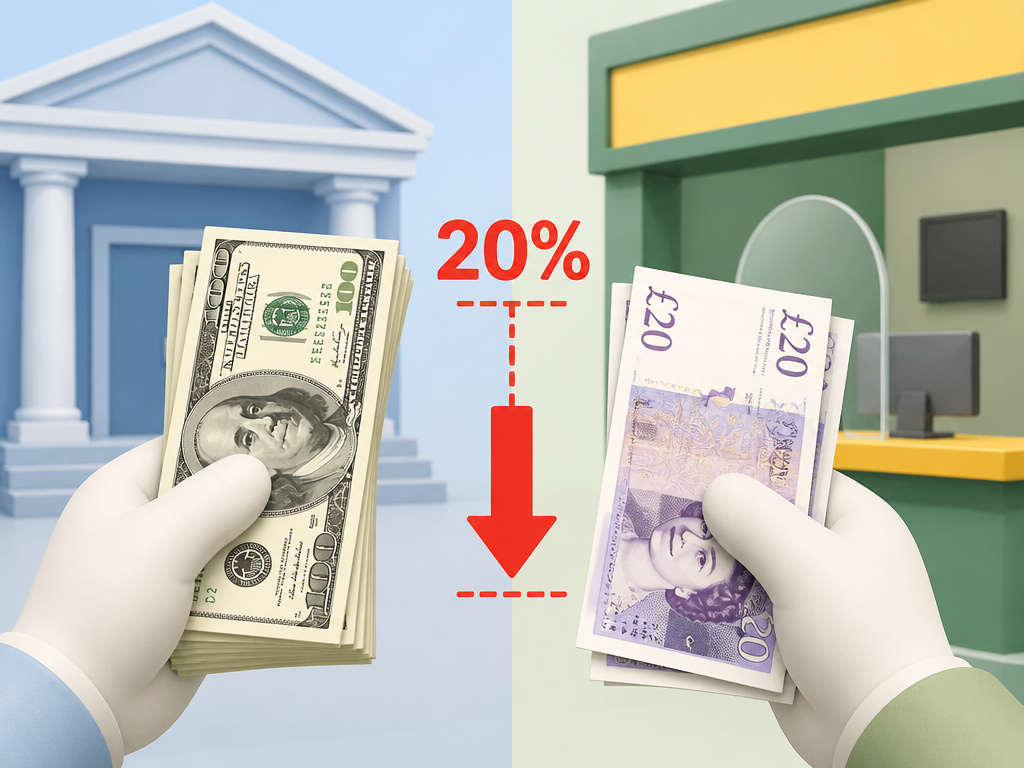
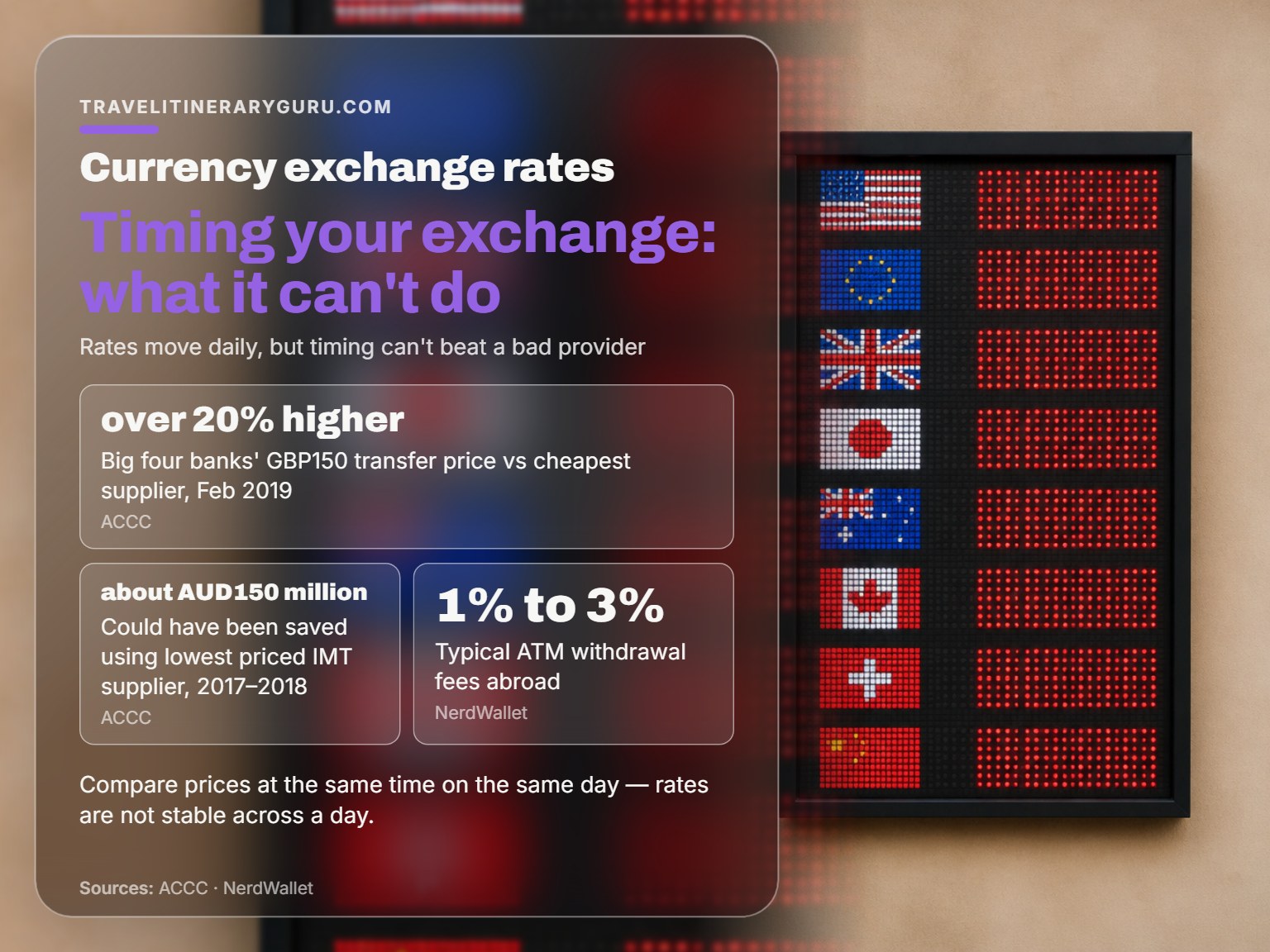
The ACCC also found that customers of the big four banks sending an international money transfer of GBP150 to the UK in February 2019 could have paid a price over 20 per cent higher than the cheapest IMT supplier’s price.
That’s the scale of the gap when you pick the wrong provider on a single transfer.
| Provider type | Where the cost hides | What to check |
|---|---|---|
| Bureau de change | Buy/sell spread | Mark-up over ECB reference rate |
| Bank branch | Rate plus possible fee | Whether it beats a specialist |
| ATM abroad | Conversion prompt | Decline it; pay in local currency |
| Airport counter | Everything at once | Avoid for anything but small amounts |
| Card terminal | Dynamic conversion | Always choose local currency |
The airport row is the one place the sources agree without hedging. The ACCC states flatly that foreign cash is more expensive at airport locations than at other locations. NerdWallet calls airport kiosks a last resort, with poor rates and high fees. Three independent sources, one conclusion.
The €1,000 Threshold That Gives You Leverage
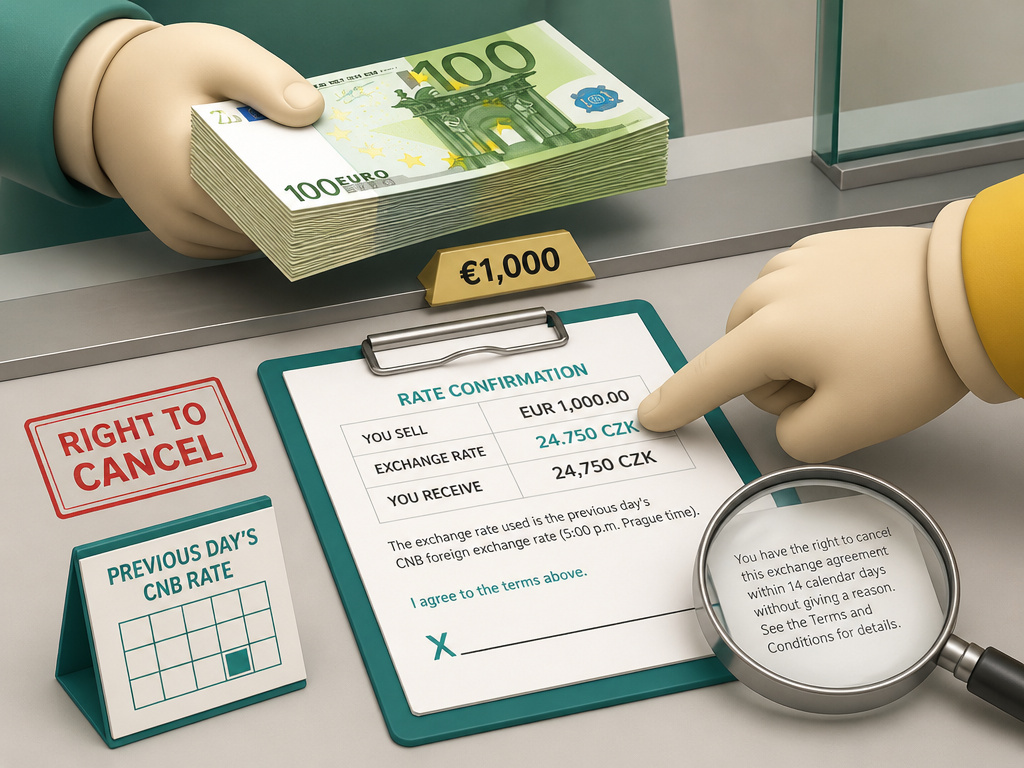
Exchanges above the equivalent of €1,000 trigger a different set of obligations, and most travelers don’t know they exist.
That document cannot be worse than the posted rate list. It may differ only if the difference is more favourable to you.
Read it before you hand over cash. If your signature is required on a copy, sign only if you agree with the conditions, and keep a copy for any later complaint.
Worth knowing before you start: On any exchange over €1,000, you have a documented right to cancel. The bureau must accept the funds back and settle at the previous day’s CNB rate.
Insist on the confirmation slip, too. The bureau is obliged to issue one, and without it your ability to exercise the cancellation right gets significantly harder.
The Right to Cancel Is Not a Free Option
It’s a right to unwind at a stated rate, not a right to profit from a rate move in your favour. The reimbursement uses the previous day’s declared CNB rate, so you’re settling at a known reference, not at whatever the market did overnight.
Know that going in.
Does Timing Your Exchange Actually Work?
Partly, and less than the apps suggest. Rates move daily, so checking again before each transfer is sensible.
What timing cannot do is beat a bad provider. The ACCC’s advice is to compare prices at the same time on the same day, because rates are not stable across a day. A quote you got this morning is not the quote you’ll get this afternoon.
So the discipline is not “wait for a good rate.” It’s “compare like with like, right now.”
If you’re building a trip budget, daily travel costs are where the exchange rate actually shows up in your planning, and it’s easier to model a mark-up than to predict a currency move.
The Two Cards That Do Most of the Work
A no-foreign-transaction-fee card is a high-value item in your wallet for this problem, and the logic is simple: it removes one of the two charges entirely, though NerdWallet instead calls your financial institution’s ATM network the best option abroad for minimal fees. Western Union notes that a credit card with no foreign transaction fee helps you make purchases abroad without hefty fees, and that credit cards often have better exchange rates than foreign exchange houses.
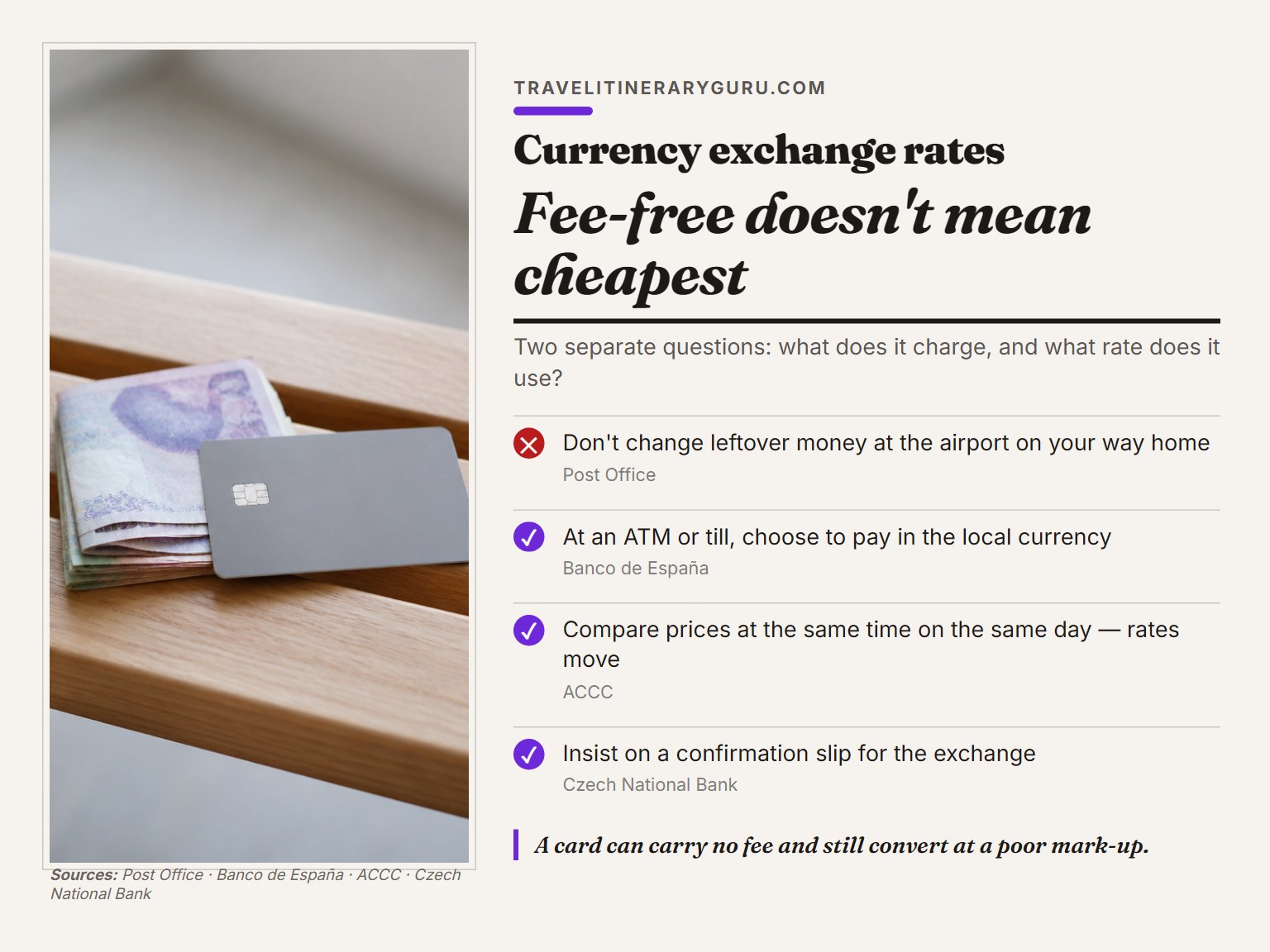
The ACCC’s finding on “fee free” services is the reason to check the rate anyway. A card can carry no fee and still convert at a poor mark-up. The two questions are separate: what does it charge, and what rate does it use.
For cash access, NerdWallet calls your financial institution’s ATM network the best option abroad for minimal fees, while the Post Office warns that ATMs may charge high fees or be prone to tampering. NerdWallet calls your financial institution’s ATM network the best option abroad for minimal fees. The rate is good; the machine is not always trustworthy.
That’s where using ATMs abroad stops being a rate question and becomes a security one. Card skimming at a foreign ATM costs you more than any mark-up.
Easy to miss: A fee-free card and a good exchange rate are two different features. Check the mark-up separately, or you’ll optimise the wrong half.
What About Leftover Currency?
Your bank may buy back foreign currency when you return, though it may not accept every currency type. If it won’t take what you’ve got, a currency exchange store or airport kiosk will, at a rate you likely won’t like.
The Post Office’s advice is blunt: don’t change leftover money at the airport on your way home. Same logic as the outbound leg, just with less room to negotiate because you’re not shopping around.
When to Skip the Comparison Entirely
There are cases where the standard advice doesn’t apply, and pretending otherwise wastes your time.
Closed currencies. Some countries use currencies you cannot buy before you travel. Cuba and North Korea are the named examples. If you’re going to either, exchanging on arrival isn’t a bad habit you should break; it’s your only option.
Coins and cheques. The commission prohibition that protects a straight exchange in the Czech Republic does not cover coins or cheques. If you’re converting a jar of coins, expect a fee and don’t be surprised by it.
Small amounts. A few hundred in local cash for the first day is not worth an hour of provider comparison. The Post Office’s framing is to avoid exchanging large amounts at the airport, which leaves room for a small, expensive, convenient transaction when you land.
VIP rates. If a bureau advertises a better rate as an option without publishing the number, you have to ask for it. The published rate is the least favourable one they offer, so the board is a floor, not a ceiling.
That last point is the one I’d tattoo on a luggage tag. The number you can see is the number they’re least worried about giving you.
Frequently Asked Questions
Is it cheaper to exchange currency before I travel or when I arrive?
Before, for most destinations. The Post Office recommends ordering or collecting foreign currency before you travel so you have time to compare rates, though for closed currencies like Cuba’s and North Korea’s you can’t buy in advance, so exchanging on arrival is your only route. The exception is closed currencies like Cuba’s and North Korea’s, which you can’t buy in advance, so exchanging on arrival is your only route.
Should I choose to pay in my home currency at a foreign card terminal?
No. Choose the local currency of the outlet or the ATM. That leaves the conversion to your own bank under your contract terms, rather than letting the terminal operator set the rate. The operator’s rate is consistently worse, and the gap is large enough to notice on a single withdrawal.
Why is the exchange rate on the board different from the rate I’m offered?
Because bureaux may publish only their least favourable rate. A better rate may exist as a VIP option, but the rules allow them to advertise that the option exists without publishing the number. Ask directly what the best available rate is before you commit.
Do banks really give the best exchange rates?
It depends where you are. NerdWallet states your bank or credit union is almost always the cheapest place to exchange currency. The ACCC found Australia’s big four banks were consistently more expensive than many other suppliers. Treat “banks are cheapest” as a claim to test, not a rule.
How do I compare a bank, a bureau, and a card on the same basis?
Ask each for the total cost as a percentage mark-up over the ECB reference rate. Providers at ATMs and points of sale are required to disclose it before payment. That single number lets you compare providers that structure their pricing completely differently.
Are commercial comparison sites reliable?
Not always. If a comparison site doesn’t tell you how it’s funded, treat its rankings with suspicion.
The Bottom Line
One rule decides most of this: if a provider won’t give you a mark-up percentage over the ECB reference rate, you’re not comparing prices, you’re comparing marketing. Ask for the number. The provider that gives it to you cleanly is usually the one with the least to hide.
Start this week with two things. Decline the conversion prompt on your next foreign withdrawal, and check whether your main card charges a foreign transaction fee. Those two moves cost nothing and cover the majority of the money you’ll lose on a typical trip.
The concession worth stating plainly: none of this helps if your destination uses a closed currency, and it helps less if you’re only converting a small amount for the first day. In those cases, take the convenient option and move on. The math doesn’t justify the effort.
The best exchange rate is rarely the one you find by hunting. It’s the one you get by refusing the default.
