
How to Travel With Food Allergies: A Calm Pre-Trip Plan
This post contains affiliate links. As an Amazon Associate, we earn from qualifying purchases.
I’ll be honest with you: I’ve planned hundreds of trips, and the one that taught me the most about how to travel with food allergies was a hike I had no business scheduling. I flew into a mountain town on a red-eye, slept four hours, and started up a trail the next morning. We turned back before lunch. That failure wasn’t about fitness. It was about giving my body zero buffer after long travel, and it’s the same lesson that applies here.
To travel with food allergies, book a pre-travel appointment at least one month before departure, carry your adrenaline auto-injectors in the cabin rather than checked luggage, and clean your seating area before you sit down. Over half the world’s countries lack easily available injectable epinephrine, so plan as if you cannot refill abroad.
That one-month window isn’t arbitrary. It’s the gap between “I have a plan” and “I have a plan that survives contact with a foreign pharmacy.” And the countries where you can’t easily replace a device are concentrated in Africa, Central America, South America, and Asia, which happens to overlap with a lot of the how to travel with food allergies itineraries people ask me to build.
So what does a workable plan actually look like? It splits into three jobs: what you sort out before you leave, what you carry on the plane, and what you do when you’re standing in a restaurant in a country where you don’t speak the language. The rest of this walks through all three, with the parts most guides skip.
Key Takeaways
- Book your pre-travel appointment at least one month out; that’s the CDC’s window, and it exists so vaccines and prescriptions have time to work.
- Carry two adrenaline devices in the cabin, never in checked bags, and keep them within reach rather than in the overhead bin.
- Clean the tray table, screen, and seatbelt before you eat; allergen proteins transfer easily from surfaces to hands to mouth.
- Buy your over-the-counter medications before you leave the US, because names, availability, and quality vary sharply abroad.
- Declare your allergy to your travel insurer the same way you’d declare any other medical condition, or the coverage may not apply.
How Far Ahead Should You Book a Pre-Travel Appointment?
One month minimum, per CDC Travelers’ Health guidance. The CDC’s consumer guidance says to see your healthcare provider or a travel health specialist at least one month before you leave, and the reason is mechanical: destination-specific vaccines and medication adjustments need lead time to take effect.
I see this advice a lot, and here’s why it falls apart on the ground. People book the appointment, get the prescriptions, and then treat the visit as a box ticked. The CDC’s clinical guidance for severely allergic travelers describes what that visit should actually contain: a review of your current allergens and medication regimen, prescriptions sufficient for the whole trip, and a walkthrough of how to use your injectable epinephrine device.
Pre-travel care for a traveler at risk of anaphylaxis covers three things: a review of current allergens and medications, prescriptions sufficient for the duration of the trip, and an updated anaphylaxis action plan with a hands-on review of proper injectable epinephrine technique. The device’s expiration date must extend beyond the travel period.
That last clause is the one people miss. If your device expires three days into a two-week trip, you’ve built a plan with a hole in it. Check the date before you book anything, because getting a replacement prescription takes time you won’t have if you notice it at the gate.
There’s also the question of how much medication to bring. The CDC’s consumer page recommends taking enough to last your entire trip plus extra in case of travel delays. Allergy UK makes the same point from a different angle: consider the length of your trip and how far from medical help you may be, which helps you plan how much to take.
What Goes in the Bag Before You Leave Home
The how to travel with food allergies medication list is short and specific. Prescriptions for the full trip. Over-the-counter medications purchased in the US before departure. Spare devices if there’s any doubt about supply at your destination.
The CDC is direct about why you buy the over-the-counter stuff at home: medications available in the US may not be available in other countries, may have different names, may be confused or mistaken in translation, and may be of uncertain quality. That’s four separate failure modes in one sentence, and I’ve watched people hit at least two of them.
For the prescription medication side of this, the same logic holds: bring the original packaging with identifying information linking you to the device, per the CDC’s clinical guidance. A loose auto-injector with no label is a customs conversation you don’t want.
The documentation question, and where sources split
Here’s a genuine disagreement in the guidance, and I’d rather show it than pick a side for you.
The CDC advises a physician’s note outlining your medical condition and requirement for injectable epinephrine. It’s explicit that this is not required by TSA or airlines, but says it’s worth having to prevent concerns arising at security or customs abroad. The UK Civil Aviation Authority, by contrast, states that in the UK and most other countries, no doctor’s letter is needed to take adrenaline pens through airport security, and no airline permission is required either.
Both can be true. The CDC is optimizing for the worst-case customs officer in a country you’ve never visited. The CAA is describing the actual regulatory requirement. My read: carry the note. It costs you one appointment and it’s the difference between a two-minute conversation and a forty-minute one.
| Document | Required? | Why carry it anyway |
|---|---|---|
| Physician’s note for epinephrine | Not by TSA or airlines (CDC) | Preempts security or customs questions abroad |
| Copy of prescription or action plan | Recommended (Allergy UK) | Documentary proof may be requested for devices |
| Translated allergy cards | Recommended (CDC) | Restaurant and kitchen staff need the local language |
| ASCIA Travel Plan | Recommended (A&AA) | Signed medical document covering device and food |
The dietary restrictions conversation starts here, not at the restaurant. If you’re doing a food tour allergies plan, the translated card is the single most useful item in your bag.
How Many Adrenaline Devices Should You Actually Carry?
Two is the standard recommended by the CAA and MHRA guidance cited by Allergy UK, while the CDC adds a qualifier that matters more than the number. Current MHRA guidance in the UK recommends two adrenaline devices be prescribed to people at risk of anaphylaxis, and the CAA says the same: two self-administered devices. Allergy UK adds that they should always be kept nearby.
The CDC’s clinical guidance goes further. It recommends prescribing extra injectable epinephrine devices if there’s uncertainty about the availability of injectable epinephrine, the availability of medical care, or language barriers that might limit access, while the CAA and MHRA guidance cited by Allergy UK recommend two devices be prescribed to people at risk of anaphylaxis. That’s not a general recommendation to hoard devices. It’s a conditional one, and the condition is your specific itinerary.
Skip this if: You’re traveling to a major city in North America, Europe, or Australia, where injectable epinephrine is generally available by prescription or over the counter. The extra-device advice is aimed at itineraries where a refill isn’t a pharmacy trip away.
Over half the world’s countries lack easily available injectable epinephrine, concentrated in Africa, Central America, South America, and Asia. If your trip touches those regions, the math changes. Two devices is the floor, not the ceiling.
The travel with a chronic illness playbook runs on the same principle: assume the local supply chain won’t save you, and pack accordingly.
Where Do You Store Epinephrine on a Plane?
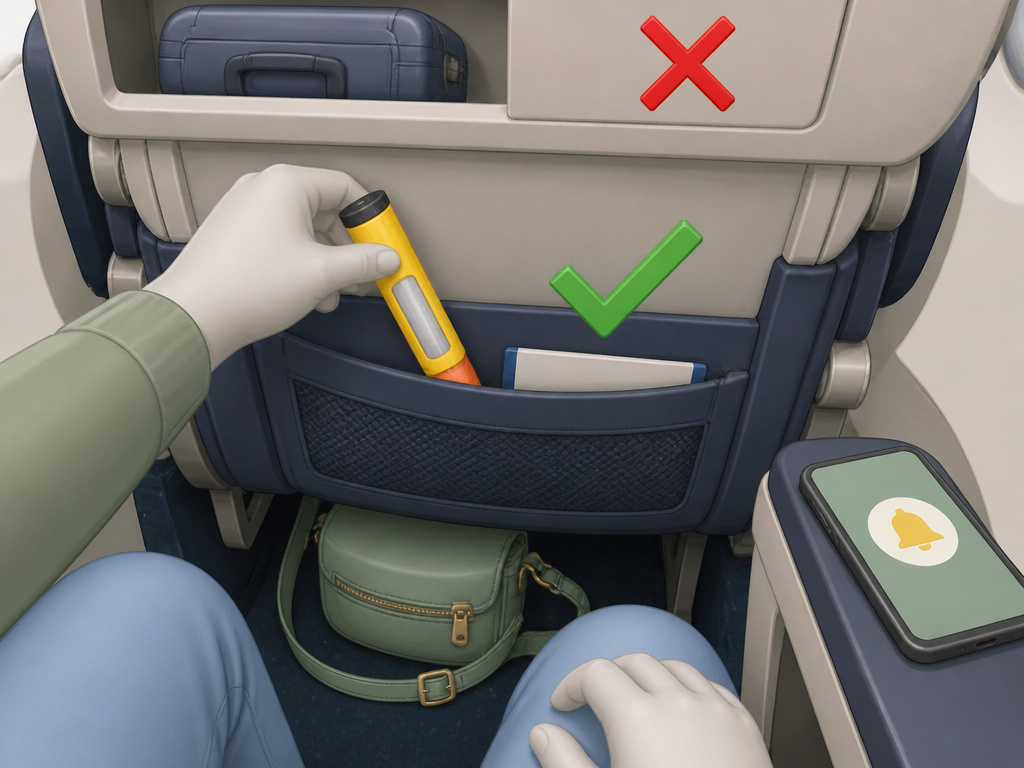
In the cabin, on your person or within arm’s reach. Never in the hold. Allergy UK is blunt about why: the aircraft hold is inaccessible during flight and may be subject to temperature extremes that aren’t advised for medication storage.
Overhead bins are also out, per Allergy UK, because items can move, become damaged, or be difficult to reach. The seat pocket or a bag under the seat in front of you is the recommended spot, provided it’s genuinely accessible in an emergency, while the CAA advises keeping adrenaline devices with you in the cabin and taking them out if you’re not sitting close to your cabin bag.
The CAA frames it slightly differently: keep your adrenaline devices with you in the cabin, don’t check them, and if you’re not sitting close to your cabin bag, take the devices out so they’re close by.
The part nobody mentions: You will forget one. Allergy UK flags this directly, and it happens constantly. Set a phone reminder for landing, because a device left in a seat pocket is a device you no longer have for the return leg.
If you’re carrying liquid antihistamine, there’s one piece of good news. Allergy UK notes the 100ml liquid rule for hand luggage doesn’t apply to medication in liquid form. That’s a real exception, not a myth, though you should still expect to declare it at security.
A travel pill case won’t solve the accessibility problem on its own, but it does keep the small stuff from migrating to the bottom of a carry-on. For anything temperature-sensitive, the medication cooler question is worth thinking through before you fly, since Allergy UK advises avoiding extreme temperatures and storing medication per the manufacturer’s guidance.
| Storage location | Verdict | Reason |
|---|---|---|
| Seat pocket or bag under seat | Best option | Accessible in an emergency (Allergy UK) |
| On your person | Fine | Meets the “kept nearby” standard |
| Overhead bin | Avoid | Items move, get damaged, hard to reach |
| Checked hold luggage | Never | Inaccessible in flight, temperature extremes |
Do You Need to Clean Your Seat Area?
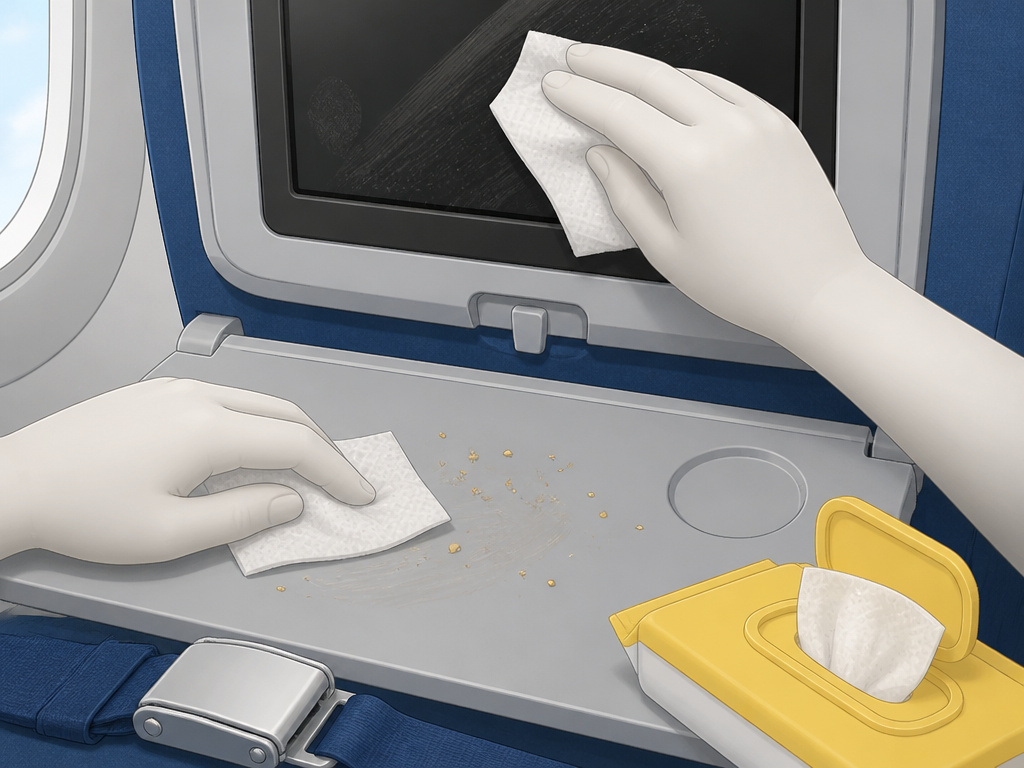
Yes, and this is where two credible sources genuinely disagree about the risk. I’d rather lay out both positions than pretend there’s a consensus.
The CDC’s Yellow Book states that reassuring data from controlled research indicate inhalation-only or incidental cutaneous-only exposures, without ingestion of food allergens, are unlikely to result in significant allergic reactions, while the CAA takes the precautionary position that food allergens are sticky and easily transferred to surfaces.
The CAA takes the precautionary position. It describes food allergens as “sticky,” easily transferred to tray tables, seat-back video screens, and toilet door handles. The mechanism it names is specific: allergen ends up on your hands, then on something you eat. Cleaning the seating area is the key risk-reduction step in that chain.
Allergy & Anaphylaxis Australia cites research showing allergen particles, including peanut, can be found on seats, trays, entertainment systems, and seatbelts, and notes that cleaning surfaces with detergent removes them, and that wet wipes and soap-based cleansers work better than plain water, while Allergy UK advises taking a pack of wipes to clean down the seating area and the CAA states that cleaning the seating area is key to reduce risk.
So the honest answer is: surface contact alone probably won’t cause a severe reaction, but it’s a link in a chain that ends in ingestion, and breaking the chain is cheap. Take the wipes.
The airborne question
Modern aircraft handle this better than most people assume. And the air passes through HEPA filters that remove over 99.97% of any food allergen particles that could be in the air.
That’s a strong number, and it’s the reason the CAA’s own findings note that allergic reactions to food are less common when flying, probably because of the steps people with food allergies take to keep themselves safe.
Worth knowing before you start: A passenger announcement asking people not to eat nuts isn’t a legal requirement and doesn’t guarantee anyone heard it, understood it, or will comply. Allergy UK is explicit about this. Treat the announcement as helpful, not as protection.
What Actually Happens With Buffer Zones and Airline Policy?
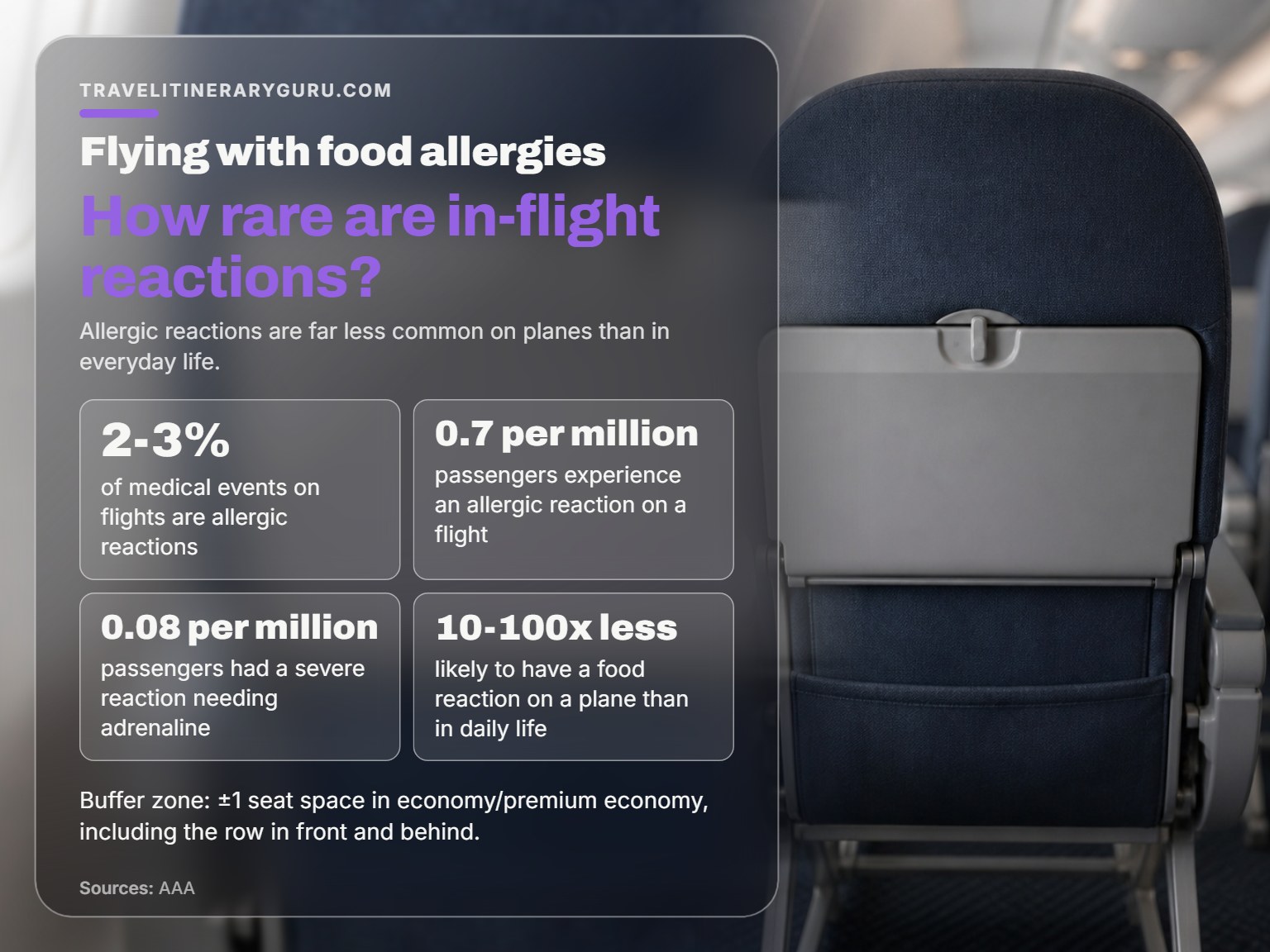
Policies vary significantly between airlines, and that’s not a hedge, it’s the documented reality. Allergy UK notes policies differ depending on the provider, while the peer-reviewed literature finds that all major airlines have policies for allergic passengers but the policies can vary quite significantly.
The restriction applies to snack food and food brought on board, not to drinks or in-flight meals, with the exception of fish and seafood.
The vicinity is defined as plus or minus one seat space in economy or premium economy, including the row in front and behind. Airlines choose between static zones, where a specific seating area is used, and dynamic zones, which shift depending on where the food-allergic passenger is sitting.
| Policy element | How it works | What it doesn’t cover |
|---|---|---|
| Buffer zone | ± 1 seat space, row in front and behind | Drinks and in-flight meals (except fish/seafood) |
| Crew announcement | Names the allergen, asks cooperation | Not a legal requirement; compliance isn’t guaranteed |
| Pre-boarding | Lets you clean surfaces first | Airline-dependent, not universal |
| Backup autoinjectors | Airlines should carry them | Who may administer them varies |
That last row is where the real gap lives. The CAA says airlines should have their own supply of back-up adrenaline autoinjectors on board for an anaphylaxis emergency, while the CDC warns not to rely on the airline as the only source, noting there may be a delay in having it available and that some airlines restrict use to trained medical personnel who may not be on every flight.
So the airline’s supply is a backup to your supply, not a substitute for it. Plan accordingly.
Can You Bring Your Own Food on the Plane?
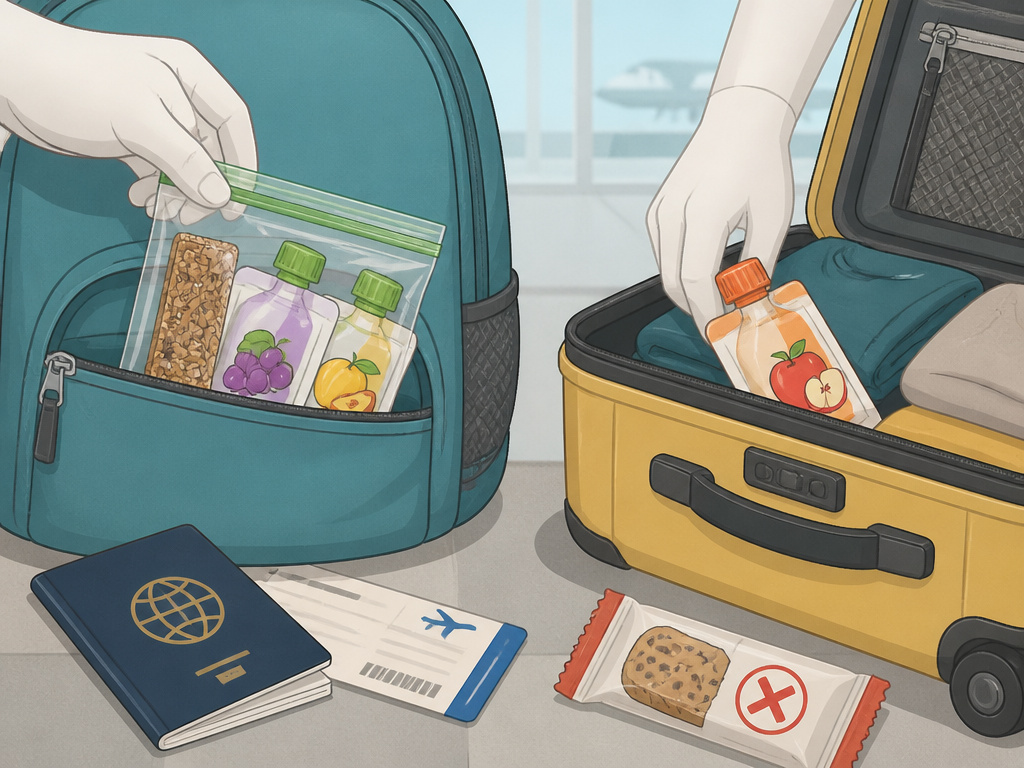
You can, and multiple authorities recommend it. Allergy & Anaphylaxis Australia strongly recommends passengers with food allergies take their own food from home to eat on the plane, calling it the safest way to reduce reaction risk, while Allergy UK advises that if meals are unsuitable, taking safe snacks is advisable, with the caveat that you should check the food can be taken onto the flight and discuss storage with the provider if needed.
The practical wrinkle is checked luggage. If you’re packing extra food for your destination, don’t put it all in one bag. Allergy & Anaphylaxis Australia recommends spreading it across every checked bag, so a single lost bag doesn’t take your entire food supply with it.
For the travel snacks you’ll eat in the air, the constraint is different from the one for your destination stash. You want things that clear security, survive a pressurized cabin, and don’t require reheating.
The labeling problem in the air
Here’s a gap most guides skip entirely. Precautionary Allergen Labelling statements, the “may contain” lines, are not regulated in Australia or most other countries and are not enforceable under law.
Its advice for air travel is stricter than its everyday advice: don’t eat any food with a PAL statement during a flight, even if you normally eat those foods, because getting medical help on a plane is hard.
The CDC’s consumer guidance takes a different angle: avoid eating foods with no ingredient labels during travel, and ask at airport restaurants about ingredients before ordering.
Where this goes sideways: You eat a “may contain” snack at hour two of an eight-hour flight because you’ve eaten it safely a hundred times at home. The label isn’t a warning system you can calibrate in the air. It’s an unregulated statement, and
What About Food Once You Land?
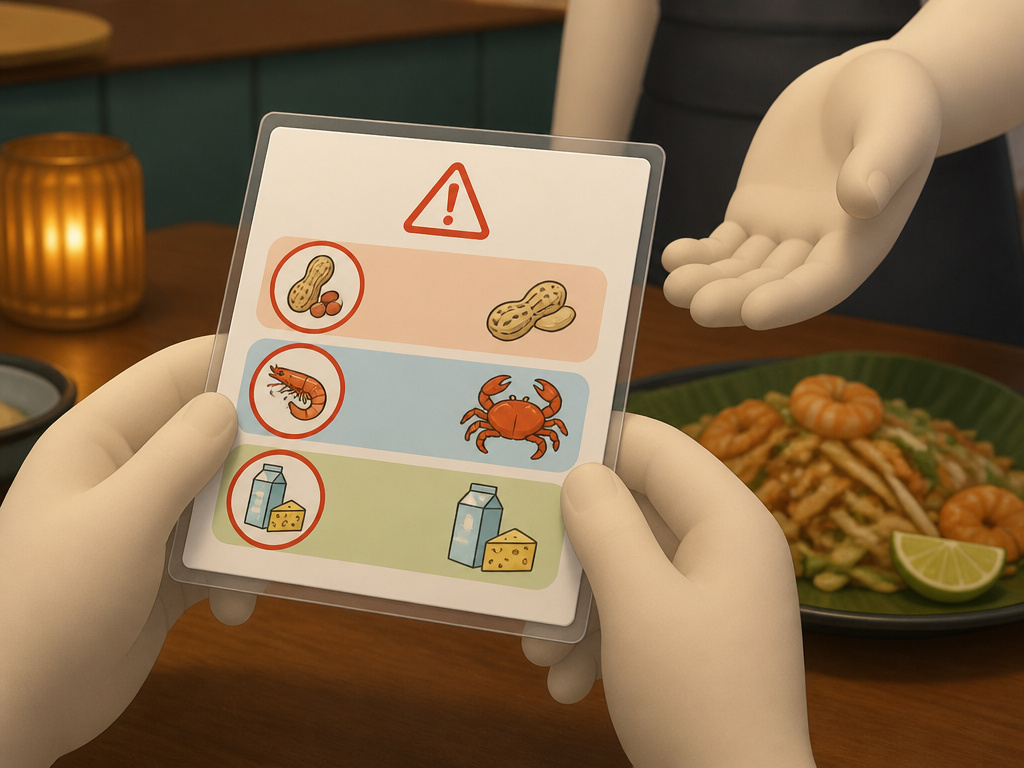
The same rules, applied with more caution. The CDC’s guidance is to always ask about ingredients and check labels, and when in doubt, don’t eat it. It specifically advises avoiding street food, since there’s often no reliable way to check ingredients.
The translated card does the heavy lifting here. The CDC recommends providing anyone who might be making your meals, including restaurant staff, with a card listing all your food allergies, translated into the local language. Allergy & Anaphylaxis Australia suggests asking your doctor to complete an ASCIA Travel Plan, which is used alongside the ASCIA Action Plan for Anaphylaxis and is a signed medical document stating you need to carry an adrenaline device and your own food, while Allergy UK advises that further information can be found on the airline’s website or by contacting its customer services helpline.
If you’re dealing with broader food poisoning risk on top of allergy risk, the calculus gets tighter, not looser. Both problems push you toward the same behavior: eat where you can ask questions and get answers you trust.
Does Travel Insurance Actually Cover This?
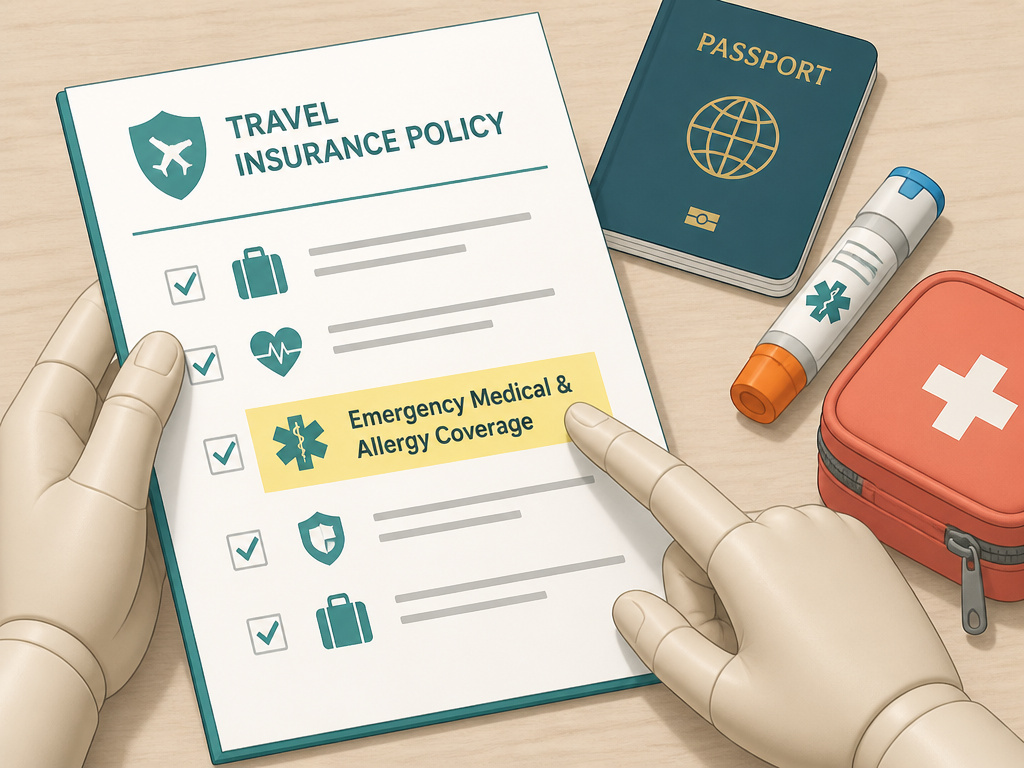
Only if you tell them. Allergy UK is specific: declare your food allergy the same way you’d declare any other medical condition, so the right cover can be provided. A policy with full coverage is recommended because the severity of a reaction can’t be predicted, and declaring means a reaction tied to that allergy will be covered, while the CDC advises finding out whether your existing health insurance covers medical care abroad and considering additional insurance covering health care and emergency evacuation.
Check that the policy includes emergency treatment, ambulance transfers, hospital admissions, and replacement allergy medications. That last one matters more than people expect, since replacing a device abroad may not be straightforward.
The CDC’s consumer guidance adds a second layer: find out whether your existing health insurance covers medical care abroad, and consider additional insurance covering health care and emergency evacuation, especially for remote destinations, while Allergy UK recommends a policy with full coverage as the severity of an allergic reaction cannot be predicted.
I’ll be honest about my own blind spot here. Budgeting for luxury travel isn’t my strength, and I’ve referred readers elsewhere for that. But insurance isn’t a luxury line item.
Frequently Asked Questions
How far in advance should I book a pre-travel appointment?
At least one month before departure, per CDC Travelers’ Health guidance. The window exists so destination-specific vaccines and medication adjustments have time to take effect. If your itinerary involves multiple countries or you need new prescriptions, booking earlier gives you more room.
Do I need a doctor’s letter to carry epinephrine through airport security?
The CDC says a physician’s note isn’t required by TSA or airlines but is advised to prevent concerns at security or customs abroad. The UK CAA states that in the UK and most other countries, no doctor’s letter or airline permission is needed. Carrying one anyway costs little and can save time.
How many epinephrine auto-injectors should I bring?
Two is the standard recommended by both the CAA and MHRA guidance cited by Allergy UK. The CDC goes further, recommending extra devices when there’s uncertainty about epinephrine availability, medical care, or language barriers. Over half the world’s countries lack easily available injectable epinephrine.
Can I bring liquid medication over the 100ml limit?
Yes. Allergy UK notes the 100ml liquid rule for hand luggage doesn’t apply to medication in liquid form, such as antihistamine solution. Expect to declare it at security, and keep a copy of your prescription or action plan with it.
Where should I keep my epinephrine on the plane?
In the seat pocket or a bag under the seat in front of you, if that’s safely accessible, per Allergy UK. Overhead bins are unsuitable because items move and become hard to reach. Never put devices in checked luggage, since the hold is inaccessible and subject to temperature extremes.
Are airline buffer zones guaranteed?
No. Policies vary significantly between airlines. The CAA describes buffer zones as covering snack food and food brought on board, within plus or minus one seat space, excluding drinks and in-flight meals except fish and seafood. Allergy UK notes that a passenger announcement isn’t a legal requirement and compliance isn’t guaranteed.
The Bottom Line
One rule most guides skip: if your epinephrine expires before your return date, everything else here is decoration. Check that date first, then build the rest of the plan around it.
Here’s a specific first step for this week. Open your calendar, count back one month from your departure date, and book the pre-travel appointment in that slot. Then check your device expiry against your return date while you’re still on the phone with the pharmacy.
This all changes if you’re heading somewhere epinephrine isn’t easily available. In Africa, Central America, South America, and much of Asia, the calculus flips from “bring your prescription” to “bring enough devices that you never need a local supply.” That’s the CDC’s conditional advice, and it’s conditional for a reason.
I know that sounds like overkill for a beach trip. But I’ve built spreadsheets detailed enough to have a tab for backup tabs, and the one thing I’ve never regretted overplanning is medical prep. A great itinerary breathes. A medical plan shouldn’t have any slack in it at all.
