
Hop-On Hop-Off Bus Tour Pros and Cons: Is It Worth It?
This post contains affiliate links. As an Amazon Associate, we earn from qualifying purchases.
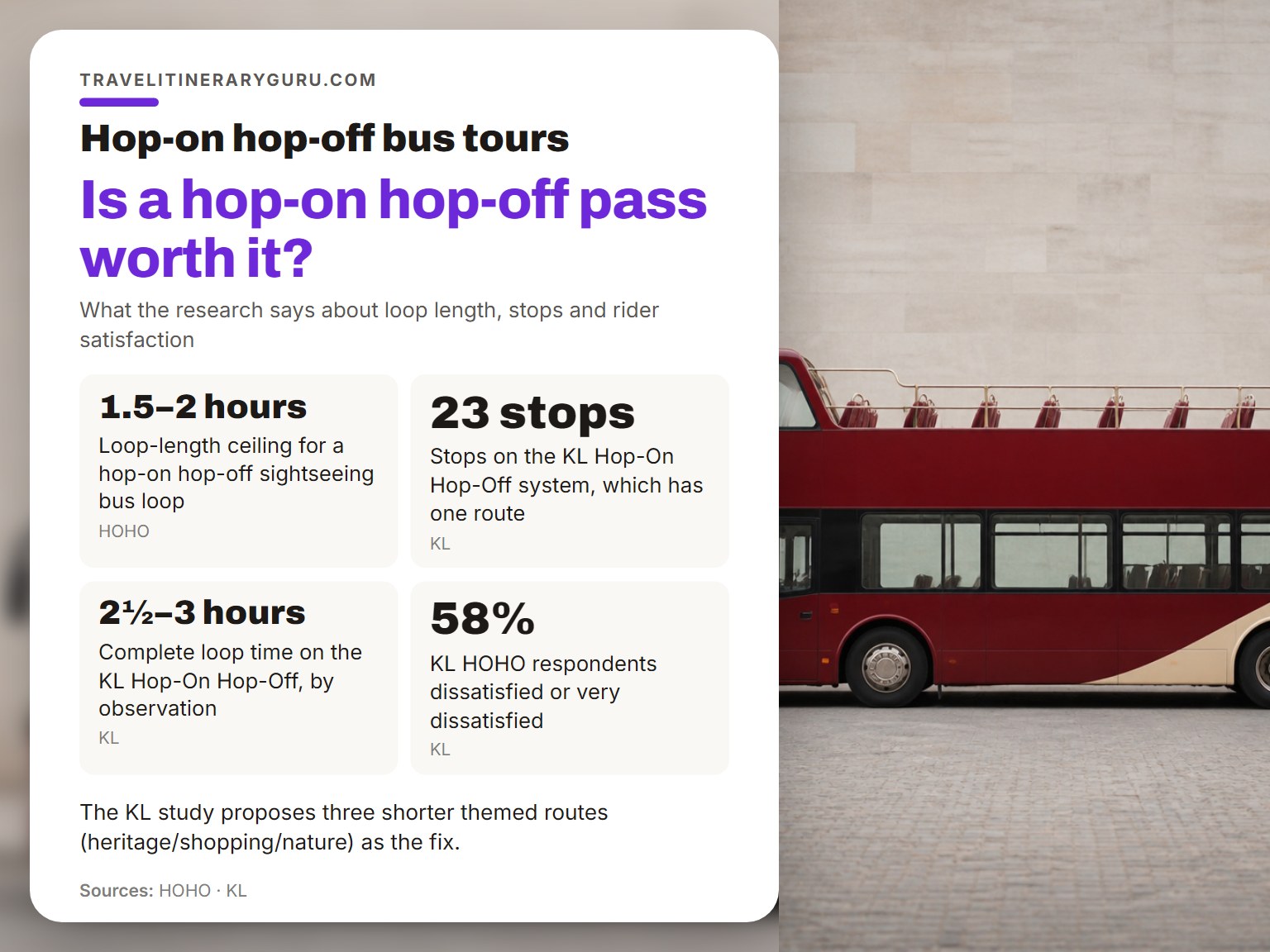
A hop-on hop-off bus tour buys you unlimited re-boarding for a day on a fixed circular route, which suits a first-day city orientation and fails when the loop runs long. The Taipei study’s design ceiling is a 1.5–2 hour loop with a capped stop count, while KL’s actual deployed system runs 2½–3 hours, and any route that runs past 2.5 hours starts costing you the day you paid to save.
That loop-length figure isn’t a marketing line. It comes from a route-optimization study of Taipei’s sightseeing bus, published in Current Issues in Tourism in 2022. The study also tied stop count to the same ceiling, one of the hop-on hop-off bus tour pros and cons. Once a route runs past that window, riders stop hopping off.
The rest of this piece digs into where the model actually breaks: the single-route trap, the curb-space problem nobody mentions in the brochure, and the documented case of a city that shut its sightseeing bus down entirely.
Key Takeaways
- Cap your expectations at a 1.5–2 hour loop. The Taipei study treats that as the ceiling, not a target, and stop count is capped alongside it, while KL’s actual deployed system runs 2½–3 hours.
- A single-route system is a red flag. KL’s one-route, 23-stop setup drew 58% dissatisfaction, and the researchers proposed three shorter themed routes as the fix, though KL respondents reported satisfaction with punctuality and frequency while the paper’s own framing lists ‘problems of punctuality and long waiting periods’ as a motivation for the study.
- Stated intent is not ridership. In Bangkok, 85% of Thai and 88% of foreign tourists said they’d use a future sightseeing bus, but only 38% and 30% had used the prior one.
- The curb is the constraint, not the bus. The 2003 DC Tour Bus Management Report found parking space “at a premium” at high-density destinations, which throttles how close any loop can actually get you.
- The pass only pays off if you’ll re-board three or more times. Below that, a day pass is a slow taxi with worse views and a fixed schedule.
What Is the Maximum Loop Length a Hop-On Hop-Off Route Should Run?
The Taipei study’s published ceiling is 1.5 to 2 hours per loop, with the number of stops capped at the same time, while KL’s actual deployed system runs 2½–3 hours. That figure comes from the Taipei route-optimization study.
A hop-on hop-off loop is a fixed circular route with unlimited re-boarding for a set period. Design benchmarks cap the loop at 1.5–2 hours and limit the stop count, because a longer loop converts the pass into a single-seat tour and removes the re-boarding that defines the product.
The mechanism matters more than the number. Every extra stop adds travel time between stops and dwell time at each one. Once the loop crosses roughly two hours, riders stop treating it as transport and start treating it as a sightseeing seat, which is the hop-on hop-off bus tour pros and cons question in miniature. That’s when the value proposition inverts.
I’ve watched this play out from the wrong end. On an early trip, I booked a sunrise tour without checking the meeting point distance from my hotel, and I spent an hour lost before dawn. Same mistake, different vehicle: the loop length and the first leg both decide whether the day works.
Where the Single-Route Model Falls Apart
KL Hop-On Hop-Off runs one route with 23 stops, and a full loop took 2.5 to 3 hours based on observation conducted on the 13th, 15th, and 17th of January, 2016. Service frequency was 20 to 30 minutes. That’s a system running past the Taipei ceiling by a full hour.
The satisfaction split tells the rest of the story. In the Planning Malaysia evaluation, 58% of respondents were dissatisfied or very dissatisfied, 19% were neutral, and 23% were satisfied. KL respondents reported satisfaction with punctuality and frequency, though the paper’s own framing lists ‘problems of punctuality and long waiting periods’ as a motivation for the study, which points the finger at route design rather than operations.
Here’s the part nobody tells you. The 23 stops covered 48 tourist spots and 17 shopping places within the city centre, and only 11 tourist spots sat outside walking distance from a stop. The coverage was fine. The problem was that riders felt they were paying more than their ability to use the service.
The study’s own fix was three shorter themed routes: heritage, shopping, and nature. That’s the loop-length ceiling showing up again, this time as a hop-on hop-off bus tour pros and cons redesign recommendation.
An evaluation of the Kuala Lumpur tour bus route makes the same case with a different dataset. Multi-route isn’t an upgrade to a hop-on hop-off system. It’s a precondition.
The Bangkok Shutdown: When the Bus Dies on Legal Grounds
Bangkok’s Rattanakosin sightseeing bus was closed down by the Bangkok government before the 2011 study was even published. The cited causes were unpopularity and legal issues. That’s a full service failure, not a ridership dip, and it’s the kind of edge case no rider-facing pros-and-cons list captures.
The survey data underneath the shutdown is where it gets interesting. Only 38% of Thai tourists and 30% of foreign tourists had used the prior Rattanakosin tram service. When asked whether they’d use a future service, 85% of Thai tourists and 88% of foreign tourists said yes.
That gap between stated intent and revealed behaviour is the single most useful number in this whole category. The study also found that more than half of tourists, Thai and foreign, had never heard of the service at all. Low advertising, not low demand, killed the awareness.
Then there’s the terminal problem. Tourists reported difficulty accessing the service terminal, with most having to walk a long distance or take a public bus just to buy a ticket. A peer-reviewed study of Boracay public transport found the same class of failure in a completely different market: information dissemination scored 3.46 out of 5, the weakest area alongside peak-hour frequency at 3.44 and digital connectivity at 3.51.
Common mistake: Booking a hop-on hop-off pass based on the route map alone. The map shows coverage; it doesn’t show whether the terminal is reachable or whether the service has been advertised well enough that buses actually run on schedule.
Why One Product Can’t Serve Two Tourist Groups
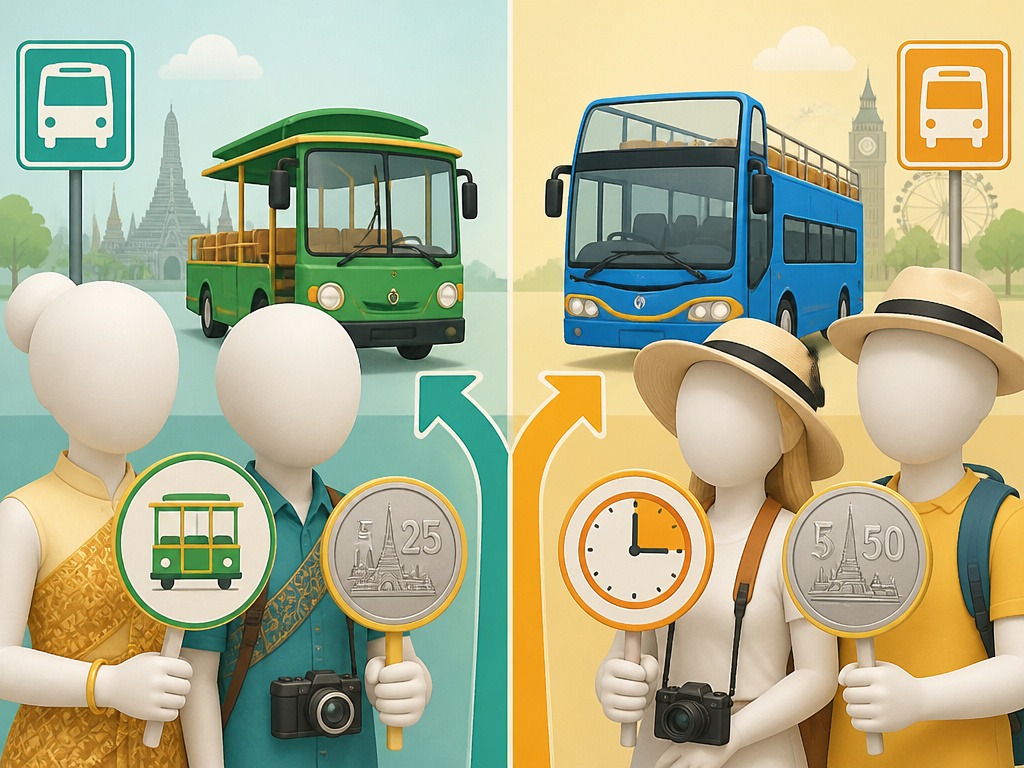
The Bangkok study ran the numbers on vehicle preference and found a clean split. Thai tourists preferred a tram-like vehicle at 45%, an air-conditioned bus at 35%, and a tuk-tuk at 21%. Foreign tourists split evenly between tram and AC bus at 27% each.
Trip length diverged the same way. Thai tourists preferred a 30-minute trip at 30% or a 45-minute trip at 27%. Foreign tourists preferred a 60-minute trip at 39% or a 30-minute trip at 23%.
Fare preference followed. Thai tourists picked 25 Baht at 41% or 15 Baht at 27%. Foreign tourists picked 50 Baht at 35% or 25 Baht at 31%. The study’s conclusion was blunt: one service arrangement could not satisfy both groups, and two distinct service types would be needed.
| Preference | Thai tourists | Foreign tourists |
|---|---|---|
| Preferred vehicle | Tram (45%) | Tram or AC bus (27% each) |
| Preferred trip time | 30 min (30%) | 60 min (39%) |
| Preferred fare | 25 Baht (41%) | 50 Baht (35%) |
| Preferred service type | Hop-on hop-off (58%) | Hop-on hop-off (50%) |
That table is the strongest argument against the “one pass fits all” pitch. If a single city with a single tourist district can’t reconcile its two largest visitor segments, a generic hop-on hop-off product sold to a mixed ridership is going to disappoint one of them.
If you’re weighing this against the alternative, a walking tour vs bus tour comparison is worth ten minutes before you commit. Walking tours win on dense historic cores; bus tours win when the sights are spread across a metro area.
The Curb-Space Problem That Caps Every Route
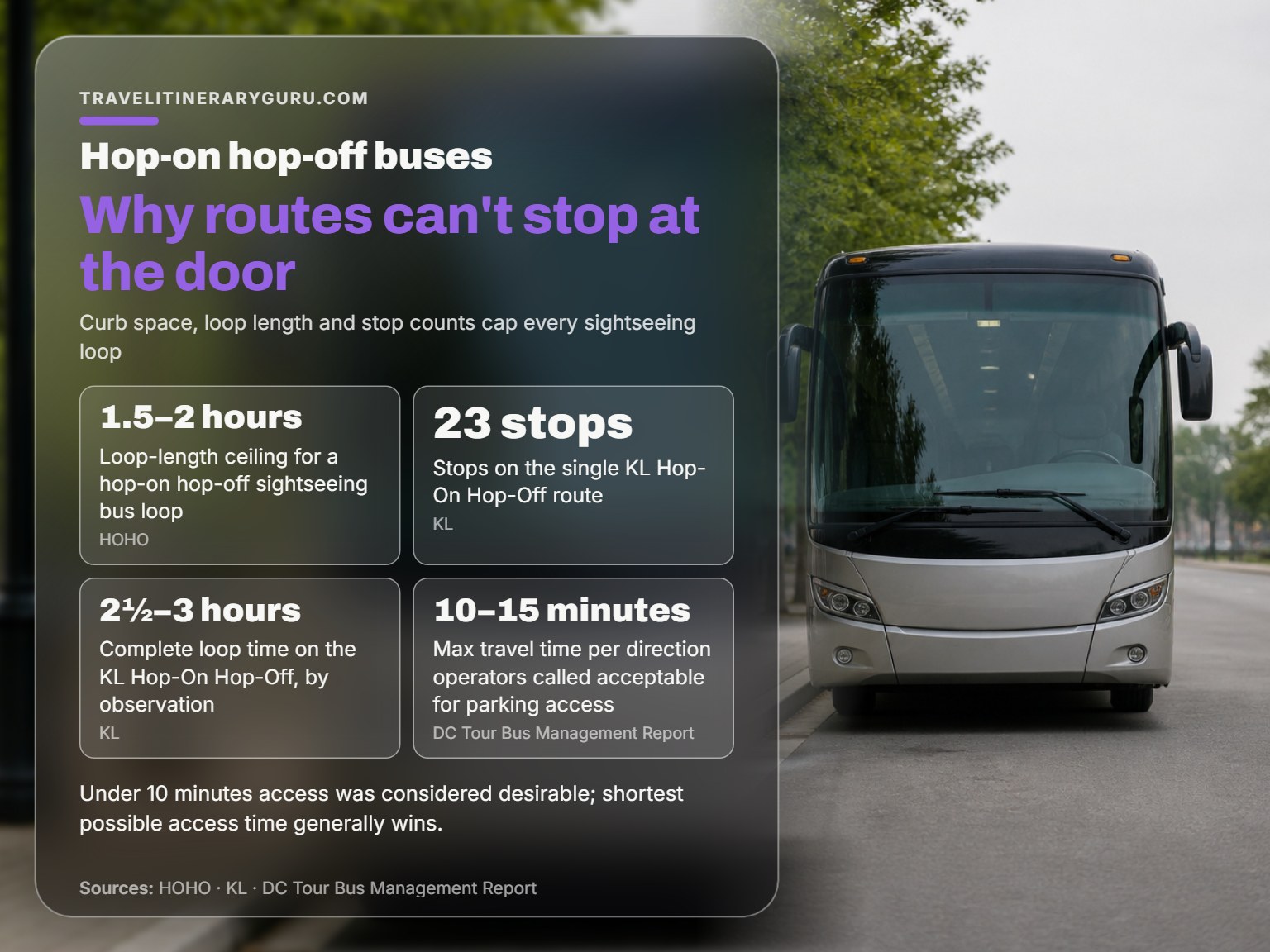
The 2003 DC Tour Bus Management Report, produced for the U.S. National Capital Planning Commission, found tour-bus parking supply failure at high-density destinations. Loading and unloading conflicts pile up wherever parking space is “at a premium.”
Tour bus operators interviewed for that study said maximum travel times of 10 to 15 minutes per direction would be acceptable for access to longer-term parking. Access times under 10 minutes were considered desirable. Shortest possible access time generally wins.
That’s the constraint that quietly reshapes every hop-on hop-off route. The bus can’t stop where the attraction is. It stops where the curb allows, and the walk from the stop to the entrance eats into the time the pass was supposed to save.
The DC report also flagged a second issue. Keeping a typical-size tour bus group together on a circulator would be difficult, because individual tour groups would frequently need an entire vehicle or exceed the capacity of a single one. The same physics applies to a hop-on hop-off bus at peak hours, just with independent riders instead of a group.
Worth knowing before you start: Short-term parking needs in the DC study ranged from under half an hour for photo stops to up to an hour for fast-food lunch breaks. A hop-on hop-off route that tries to serve all of those needs on one loop runs into the same curb-space wall.
What the Boracay Ratings Actually Measure
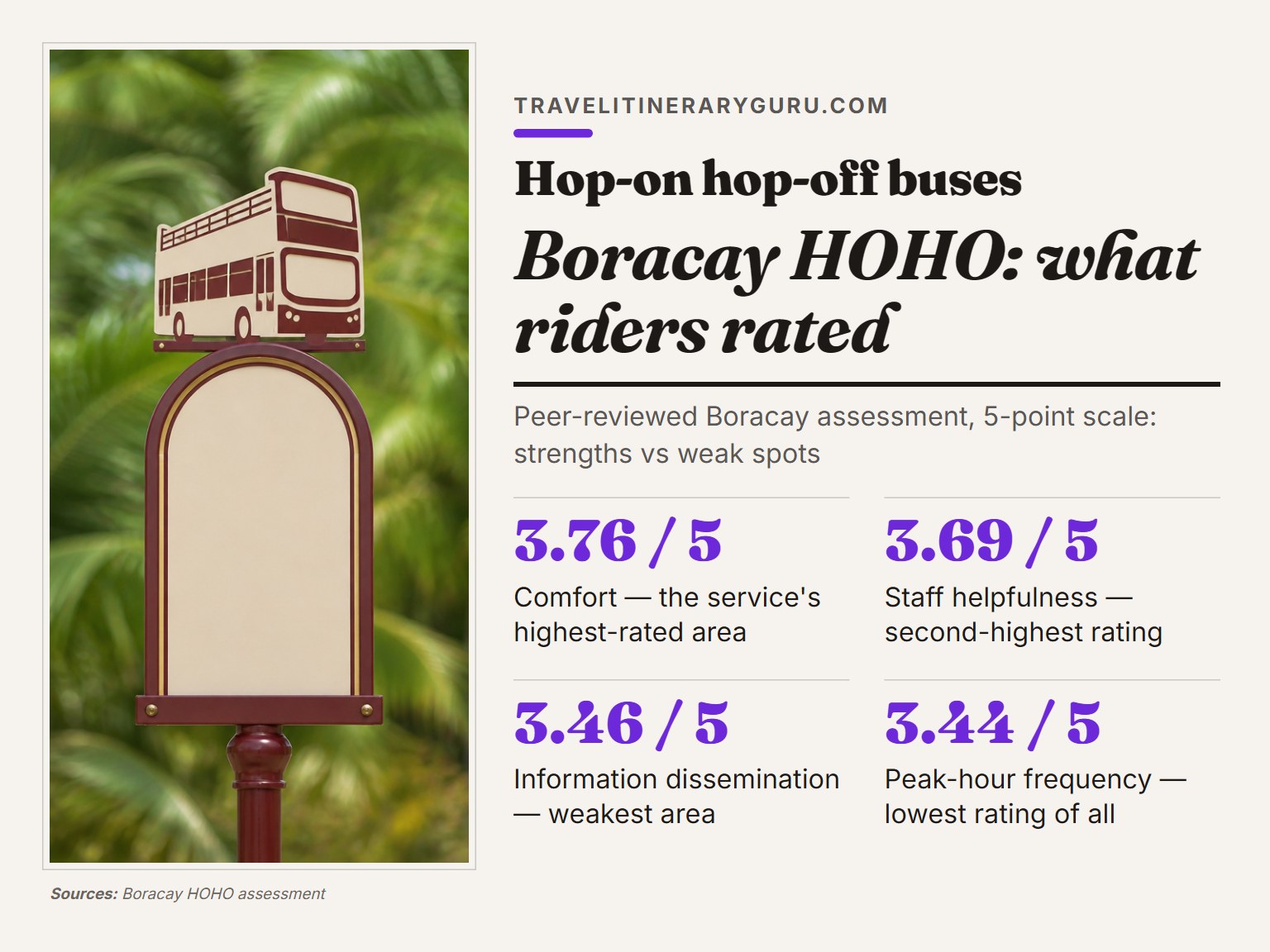
Boracay’s hop-on hop-off service, operated by Southwest Group Inc., was assessed in a peer-reviewed study. Comfort scored 3.76 out of 5, staff helpfulness 3.69, and cleanliness 3.66. Those are the areas where the service worked.
The weak spots were information dissemination at 3.46, peak-hour frequency at 3.44, and digital connectivity at 3.51. The study recommended Southwest Tours optimize routes, add vehicles to reduce waiting times, improve accessibility for persons with disabilities, adopt sustainable practices, and improve visible information through signage and announcements.
Read that list again. Every recommendation is an operational fix, not a product redesign. The bus was comfortable and the staff were helpful. Riders just couldn’t figure out when it was coming or where it was going.
That’s the pattern across every study in this category. The hardware is fine. The information layer and the route design are what break.
Read the numbers as relative rankings between categories, not as absolute quality scores.
What a Well-Run Shuttle Gets Right
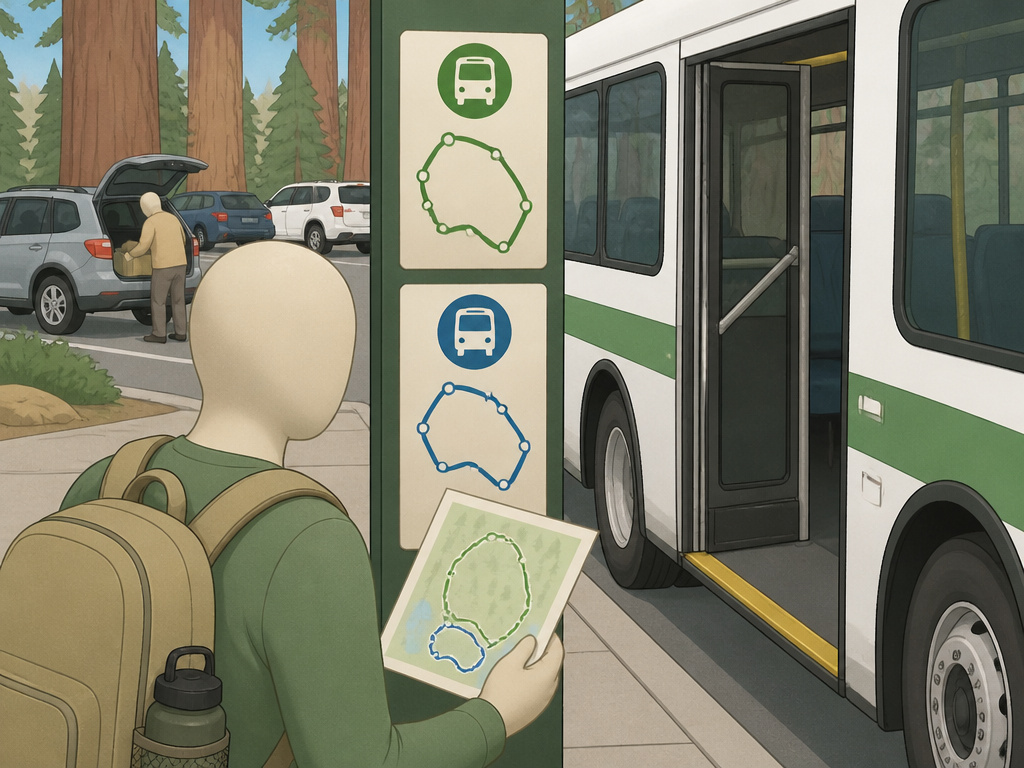
The FTA’s first-year operations evaluation of the Sequoia Shuttle is the cleanest positive case in this category. Route 1, running from Giant Forest Museum to Wuksachi Lodge, had some difficulty with schedule adherence: actual travel times were sometimes too long for buses to keep to their 15-minute schedule.
Everything else held. Travel time variations stayed generally within an acceptable range, and no passenger loads exceeded bus capacity. The evaluation sampled 25% of bus runs at random across weekday and weekend day time periods, using one-week on/off counts by stop to build load profiles.
The reason it worked is structural. The shuttle reduces parking demand and congestion at General Sherman Tree, Giant Forest Museum, Moro Rock, and Crescent Meadow. Visitors leave their cars at a hub and ride. A visitor who parks at Giant Forest Museum might take three trips on Route 2 and three on Route 1, a total of six trips.
That’s the hop-on hop-off model working as designed: a short-loop shuttle feeding a hub, not a city-wide tour product. If you want to see how that fits into a broader day, balancing sightseeing and travel is the skill that decides whether the shuttle saves you time or burns it.
So Is a Hop-On Hop-Off Pass Worth It?
For a first-day orientation in a city with multiple routes and a loop under two hours, yes. The pass lets you see the shape of the place, mark two or three stops to return to on foot, and skip the taxi math. That’s the hop-on hop-off bus use case the model was designed for.
For a single-route city, a loop over 2.5 hours, or a trip where you’ll re-board fewer than three times, no. The pass turns into an expensive seat on a slow bus. You’d get more out of a self-guided travel approach with a transit card and a map.
If you’re comparing tour products more broadly, the guided tour decision comes down to the same question: does the structure save you more time than it costs? For a hop-on hop-off bus, that math depends almost entirely on loop length and stop count.
Skip this if: You’re traveling with a group that wants to stay together. The DC report found that keeping a typical tour bus group intact on a circulator was difficult, because groups frequently need an entire vehicle or exceed its capacity. Independent riders on a hop-on hop-off pass have the same crowding problem at peak hours, just without a guide to manage it.
Frequently Asked Questions
How long should a hop-on hop-off bus loop take?
The Taipei study’s published design ceiling is 1.5 to 2 hours per loop, with stop count capped alongside it, while KL’s actual deployed system runs 2½–3 hours. That figure comes from the Taipei route-optimization study. Loops running past 2.5 hours tend to convert the pass into a single-seat sightseeing tour.
Why do some hop-on hop-off systems fail?
Bangkok’s Rattanakosin sightseeing bus was shut down before 2011, with unpopularity and legal issues cited as the causes. The survey data showed the deeper problem: more than half of tourists had never heard of the service, and terminal access required a long walk or a public bus ride just to buy a ticket.
Is a single-route hop-on hop-off system a problem?
Yes, based on the KL evidence. The system ran one route with 23 stops, and 58% of surveyed riders were dissatisfied or very dissatisfied. The study proposed three shorter themed routes as the fix. Multi-route is a precondition for the pass to make economic sense.
What do the Boracay hop-on hop-off ratings show?
The peer-reviewed assessment of the Southwest Group Inc. Service gave comfort 3.76 out of 5, staff helpfulness 3.69, and cleanliness 3.66. The weakest areas were information dissemination at 3.46, peak-hour frequency at 3.44, and digital connectivity at 3.51. All the recommended fixes were operational.
Do people actually use hop-on hop-off buses when they say they will?
Often not. In the Bangkok survey, only 38% of Thai tourists and 30% of foreign tourists had used the prior service, but 85% and 88% respectively said they would use a future one. Stated intent and revealed behaviour diverged sharply.
What’s the biggest hidden constraint on a hop-on hop-off route?
Curb space. The 2003 DC Tour Bus Management Report found parking space “at a premium” at high-density destinations, with loading and unloading conflicts piling up. Operators said 10 to 15 minutes of access time per direction was acceptable, and under 10 minutes was desirable.
The Bottom Line
Here’s the rule I’d hand you: if the route map shows one loop and the published loop time runs past 2.5 hours, close the tab. That’s the KL pattern, and 58% dissatisfaction is the documented outcome. A multi-route system with a 1.5 to 2 hour loop (the Taipei study’s ceiling, while KL’s actual deployed system runs 2½–3 hours) is the one worth your money.
Your first move this week: pull up the operator’s route page and count two things. How many routes, and how long is one full loop. If the answer is “one” and “three hours,” you’ve saved yourself a wasted day. If it’s “four” and “90 minutes,” buy the pass and use it as a scouting mission on day one.
Fair warning, though: even a well-designed pass assumes you’ll actually re-board. If your trip only has one anchor per day and you like walking, the pass is a luxury you don’t need. I’ve made that mistake. I’ve also had the good version, where a short loop dropped me at a neighbourhood I’d never have found on my own and I spent the afternoon there instead of at the museum I’d planned. That’s the version worth chasing.
