
Food Tour vs Cooking Class Pros and Cons: How to Choose
This post contains affiliate links. As an Amazon Associate, we earn from qualifying purchases.
Food tour vs cooking class pros and cons split along one line: a tour sells breadth across several stops, and a class sells hands-on skill in one kitchen. Rick Steves puts a food tour at about three hours and four to eight stops. Book the tour early in a trip, then the class later.
The breadth-versus-skill split is the part that holds up. It also explains why the two rarely compete for the same slot. A tour earns its place on day one, when you still don’t know what to order, and a class pays off once you’ve eaten enough to know which dish you want to make at home.
What follows: the head-to-head on time, hands-on work, and group size; the four sources that quote four different durations; and the dietary checks that end more bookings than weather ever does.
Key Takeaways
- Book the food tour first. Lima Food Tour and Crete Cooking Classes both put the tour early, because it teaches you what to order for the rest of the stay.
- A class eats more of the day than you expect. Crete Cooking Classes describes a substantial class as half a day, and Lima’s market class is listed from $67.
- Check group size before anything else. Rick Steves caps the best tours at eight or ten people; Tokyo Food Tours notes that some sushi classes fill a large room.
- Dietary limits end more bookings than rain. Tokyo Food Tours reports that several tours rule out vegetarian, halal, and gluten-free diets entirely.
- Read the inclusions before the ticket. Tokyo Food Tours warns that a low ticket often means you pay for everything you eat on the night.
Food Tour vs Cooking Class Pros and Cons: The Core Trade-Off
A food tour and a cooking class are built to produce different things, and the gap shows up in the first half hour. A tour starts moving almost immediately. A class starts with an apron and a briefing.
A food tour moves a group through several venues on foot, with prepared food served at each stop and a guide supplying context along the route. A cooking class keeps the group at one venue, where guests prepare a small number of dishes and then eat the finished plates at a shared table.
Everything else follows from that structure. A tour is a logistics product. The operator’s real skill is route design, timing, and knowing which shops still have stock late in the day. A class is a teaching product.
Here’s the head-to-head on the things that actually change your day.
| Dimension | Food Tour | Cooking Class |
|---|---|---|
| Time in one place | Moves between stops | One kitchen, whole session |
| Hands-on work | Little; tasting and listening | Chopping, mixing, plating |
| Dishes covered | Many small tastings | Lima Food Tour: two or three, in depth |
| What you take home | Local context | Recipes and technique |
| Group size | Rick Steves: best tours max out at 8 to 10 | Lima Food Tour: classes up to 8 or 10 |
| Best for | A first day in a city | Later in the trip or a wet day |
The table hides one thing. A tour’s value decays fast. Book it late in the trip and you’ve already eaten at the wrong places.
The food tour format rewards a look at the stop list before you book. If every stop sits close to a major square, you’re paying for a walk you could take yourself.
Why Does Every Source Quote a Different Duration?
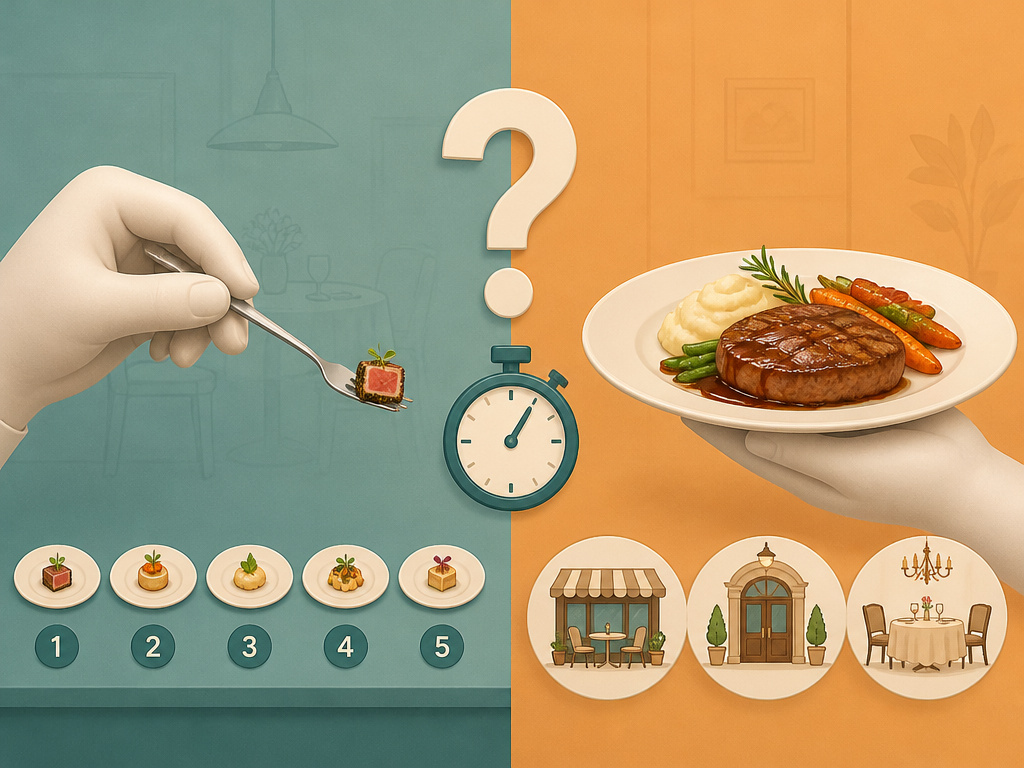
Rick Steves puts a food tour at about three hours and four to eight stops. Lima Food Tour’s own guide says two to four hours and ten to fifteen tastings. Both are describing the same product category, and the numbers don’t line up.
Here’s the part nobody tells you. Stops and tastings are different units, and operators quote whichever one sounds bigger. So which number do you trust?
Research on tourist experiences of guided food tours treats a tour as a bundle of separate attributes rather than one experience. That’s the right way to read an operator’s page too. I now write the stop count and the tasting count in my notes separately, because they answer different questions.
Stops and Tastings Are Not the Same Number
A stop is a venue. A tasting is a bite. Lima Food Tour serves ten to fifteen tastings across a neighborhood, which might mean several counters and a lot of small plates. Rick Steves counts four to eight stops, which might mean several proper servings.
| Question | Source A | Source B |
|---|---|---|
| How long is a tour? | Rick Steves: about three hours | Lima Food Tour: two to four hours |
| How many stops? | Rick Steves: four to eight | Lima Food Tour: ten to fifteen tastings |
| Is a tour a full meal? | Rick Steves: it fills you up | Gastronomic Arts Barcelona: small tastings only |
| Group size ceiling? | Rick Steves: eight or ten people | Tokyo Food Tours: some classes fill a room |
| Market visit in a class? | Rick Steves: many include one | Crete Cooking Classes: not standard |
Where this goes sideways: Treating ten to fifteen tastings and four to eight stops as the same measurement. They measure different things, and a tour with eight real servings can leave you fuller than one with fifteen bites.
The meal question is the one that costs you money. Rick Steves states plainly that a food tour should count as a meal and a tour wrapped together. Gastronomic Arts Barcelona sells its tours as small tastings and rates skill development as low. Experiences.link splits the difference and warns that if a tour offers only small samples, you may still need to budget for a separate meal.
Both positions are defensible, and the listing tells you which one you’re buying.
Which One Should You Book First?
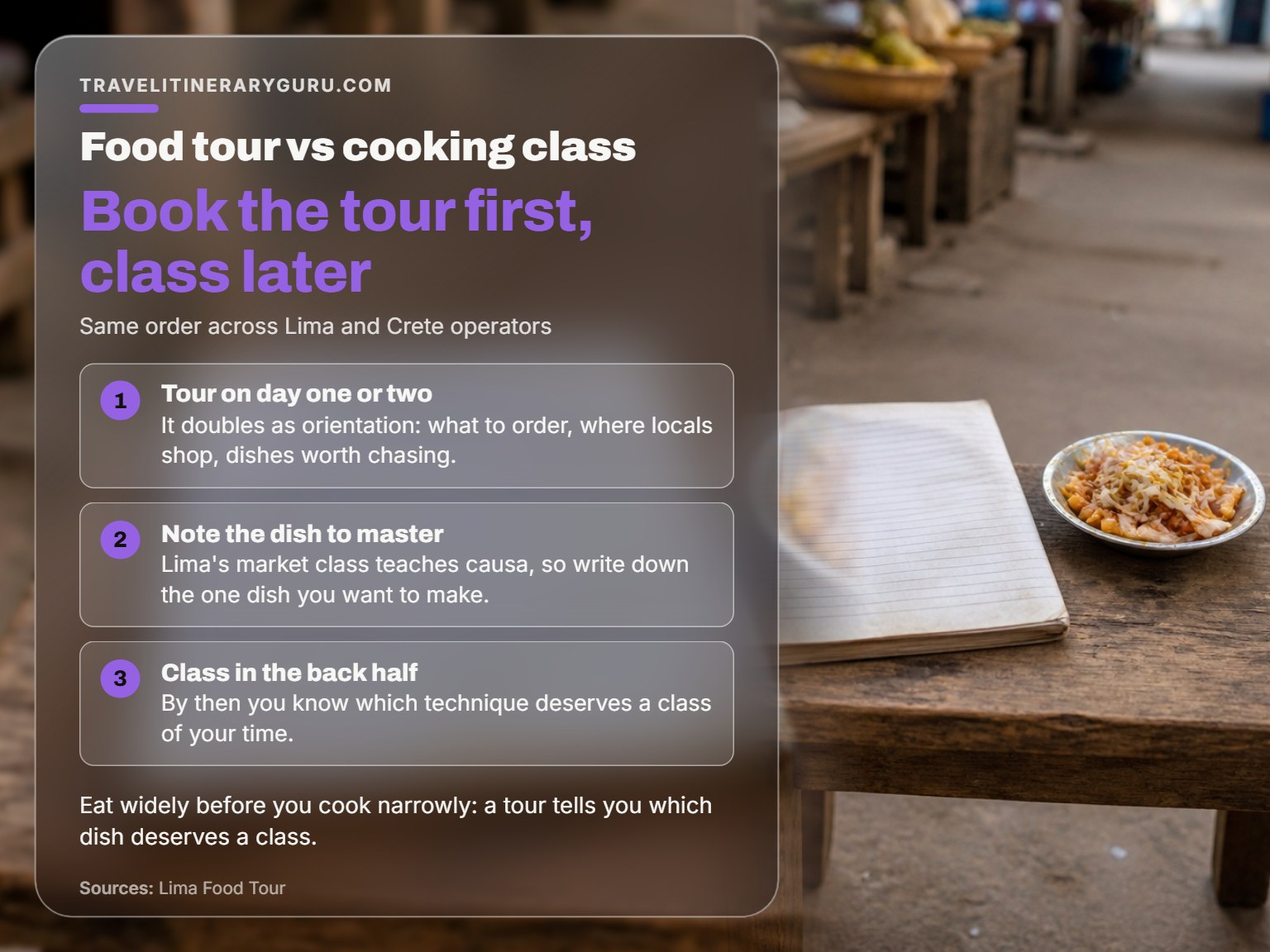
Book the tour first, if you’re only booking one early. Lima Food Tour, Crete Cooking Classes, and the Saigon operator Kiss Tour all land on the same order. They land there for the same reason.
- Put the food tour on day one or two. It doubles as orientation: you learn what to order, where locals shop, and which dishes are worth chasing.
- Write down the one dish you want to make yourself. Lima’s market class teaches causa.
- Book the class for the back half of the trip. By then you know which technique deserves a class of your time.
Eat widely before you cook narrowly. A tour tells you which dish deserves a class, and a class booked cold is a class booked on someone else’s recommendation.
One scheduling rule I’d defend hard: don’t put both on the same day. A tour and a class back to back is two major activities. Skip the pairing.
If you’d rather skip the operator entirely, a self-guided food tour covers the same ground on your own schedule.
Where a Food Tour Wins: Volume, Orientation, and Sore Feet
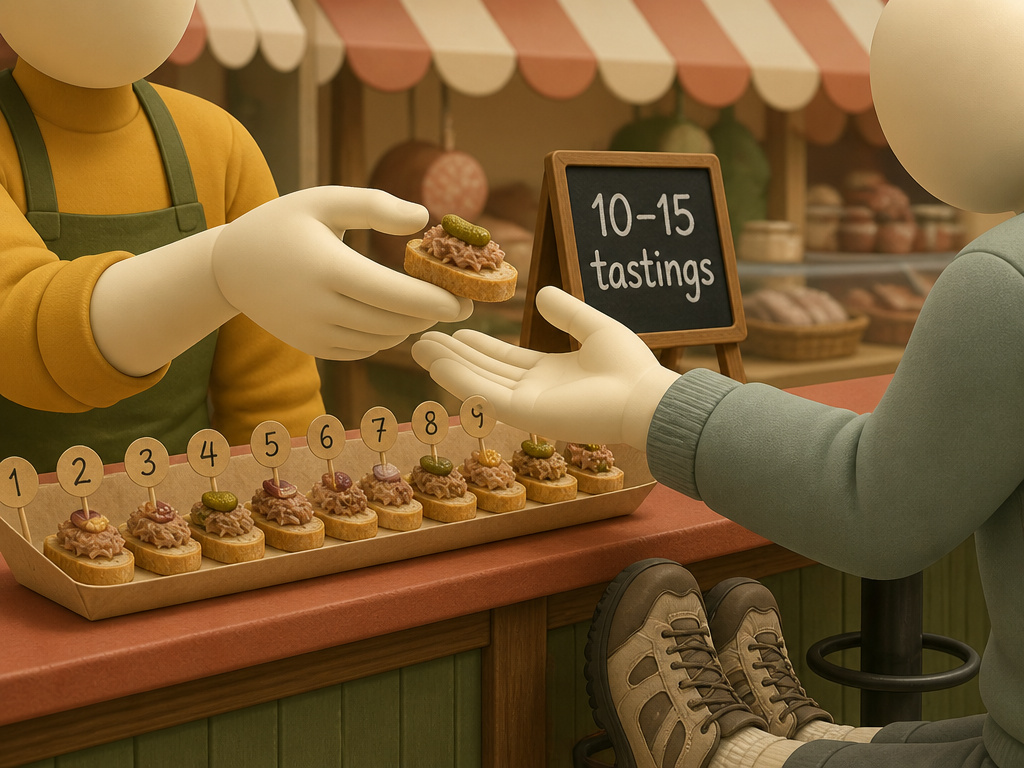
It’s 11 a.m., the group is standing at a deli counter, and the guide is passing around duck rillette on bread while explaining why the shop exists. Nobody is cooking. Everybody is eating.
That’s the format’s whole argument, and it’s a good one on a first trip. Choose a tour when:
- You want volume. Lima Food Tour serves ten to fifteen tastings across a neighborhood in one afternoon.
- You’re travelling with someone who doesn’t cook and has no plans to start.
- You want a restaurant shortlist for the rest of the stay, not a recipe.
- You’d rather see four neighborhoods badly than one kitchen properly.
Standing is the part nobody prices in. Hours on your feet at bar counters and market stalls, and by the last stop the group is leaning on whatever surface is free.
I used to treat street food as a gamble. Then I ate at a stall with a queue out the door and one cook on a single griddle. It was the best meal of the week. Crowd size and a clean counter are what I judge by now.
A street food tour leans on the same logic: the good ones stop where locals are already queuing, not where the commission is highest.
Academic work has gone into this. A gastronomic tourism experience attributes study set out to measure which parts of a culinary experience actually register with travelers.
I book a food tour on day one, and I’d push back on anyone who calls that a wasted afternoon. You come out of it knowing which three restaurants to skip and which one dish to chase all week.
Where a Cooking Class Wins: Skill, One Kitchen, and Bad Weather
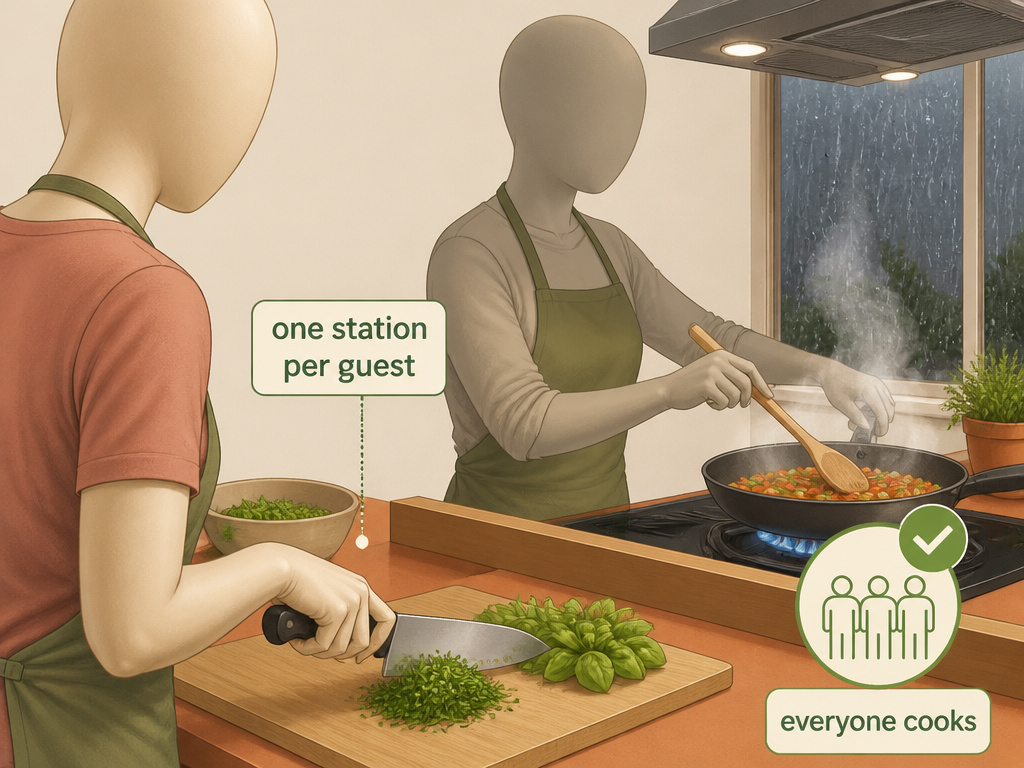
A class kitchen holds a fixed number of stations, and that number shapes the entire session. A small group around one bench gets real instruction. A large room gets a demonstration with aprons.
Choose a class when:
- You want a skill you can repeat. A Saigon class sends you home knowing how to make three or four dishes.
- You want the meal to be the event.
- The weather is against you. Crete Cooking Classes gives the class the edge whenever the venue is indoors or mostly covered.
- You’re travelling as a couple and want something to do together rather than something to watch.
A working kitchen tells you where you are before you look: hot oil, garlic hitting a pan, and an extractor fan you have to talk over.
Before you start: Class kitchens run hot and sharp. A pan handle on a shared range can stay hot. Knives at a shared station can get moved. Claim a bench spot early.
What to Verify Before You Book a Class
Ask whether every guest cooks or observes part of the session. Experiences.link flags this as the biggest variable in the category, and it’s the difference between a class and a cooking show.
Ask what the group size actually is. Lima Food Tour caps its classes at eight or ten. Tokyo Food Tours notes that some sushi classes fill a large room while others stay under ten.
There’s a cooking classes versus demonstrations study on this, and the direction of the result favors doing over watching.
Dietary Restrictions Break More Bookings Than Bad Weather
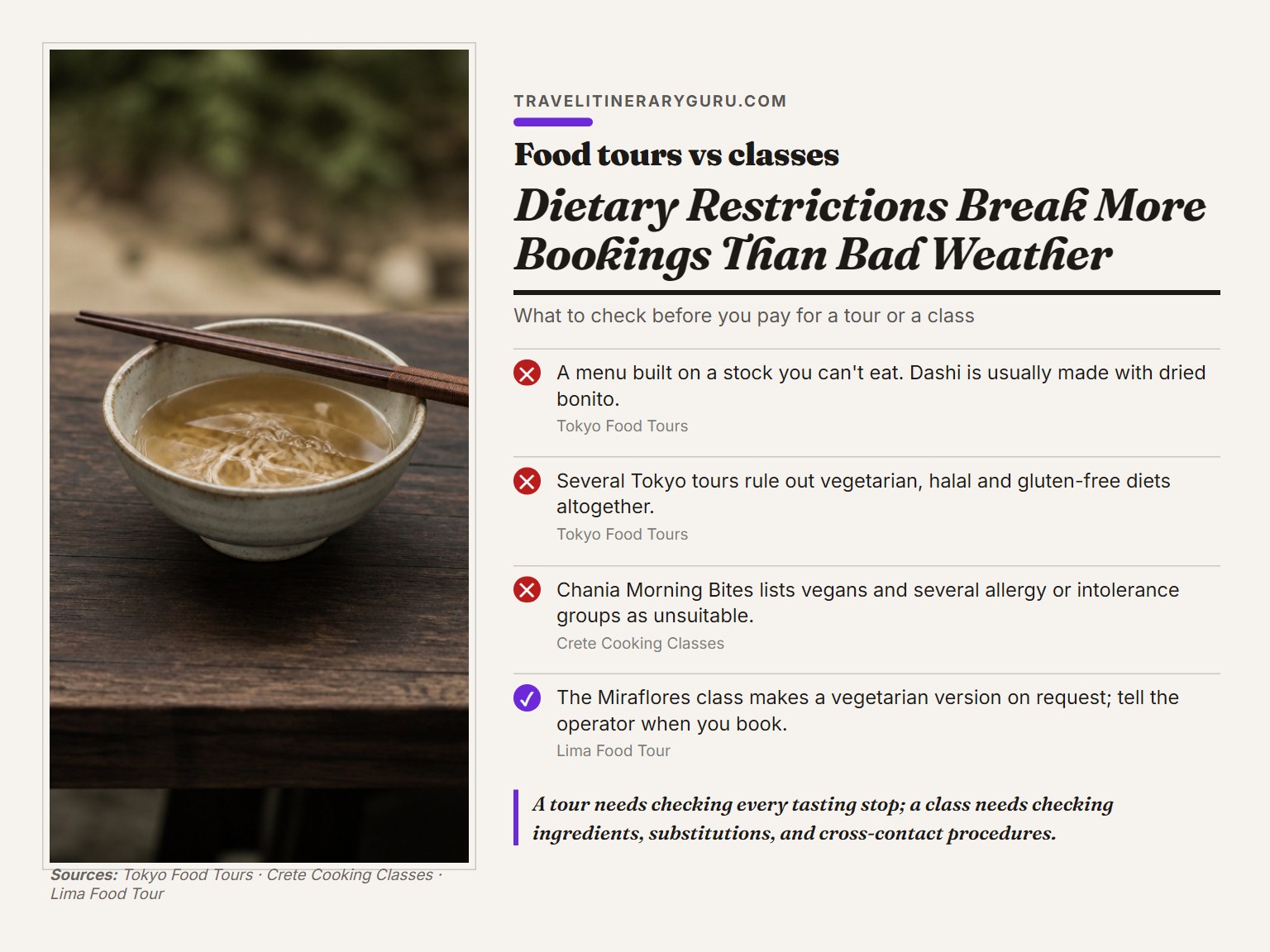
I booked a cooking class for a group once without asking a single question about what anyone ate. One guest couldn’t take part in some of the dishes and spent the session watching. Now I collect dietary notes before I collect a deposit.
Weather gets all the attention. Food is what actually wrecks an afternoon.
Tokyo Food Tours is blunt about it. Most food tours are hard going for vegetarians, because dashi is made with dried bonito and soy sauce contains wheat. Several Tokyo tours rule out vegetarian, halal, and gluten-free diets altogether. The ramen tasting tour uses chicken, pork, and fish in every broth.
Crete Cooking Classes lists its Chania Morning Bites tour as unsuitable for vegans and several allergy or intolerance groups. Lima Food Tour goes the other way: the Miraflores class makes a vegetarian version on request, but you have to tell the operator when you book.
The structural difference matters here. A tour is a chain of independent kitchens, so every stop is a separate negotiation. A class is one kitchen, one menu, and one set of ingredients.
What most people get wrong: Raising dietary needs at the door. On a tour, that leaves the guide renegotiating with multiple kitchens mid-route.
How to Check Dietary Terms Before You Pay
- A tour that won’t name its stops. Every stop is a separate kitchen with its own ingredients and its own cross-contact risk.
- A menu built on a stock you can’t eat. Dashi is the classic case, and it hides in dishes that look vegetarian.
- A listing that says “we can accommodate” without naming a single substitution.
Handling dietary restrictions on a tour is a stop-by-stop conversation, not one email. The food tour with allergies checklist is worth reading before you pay. And a vegetarian food tour is a real category now, so the good ones publish their substitutions up front.
Which Format Suits Couples, Solo Travelers, and Families
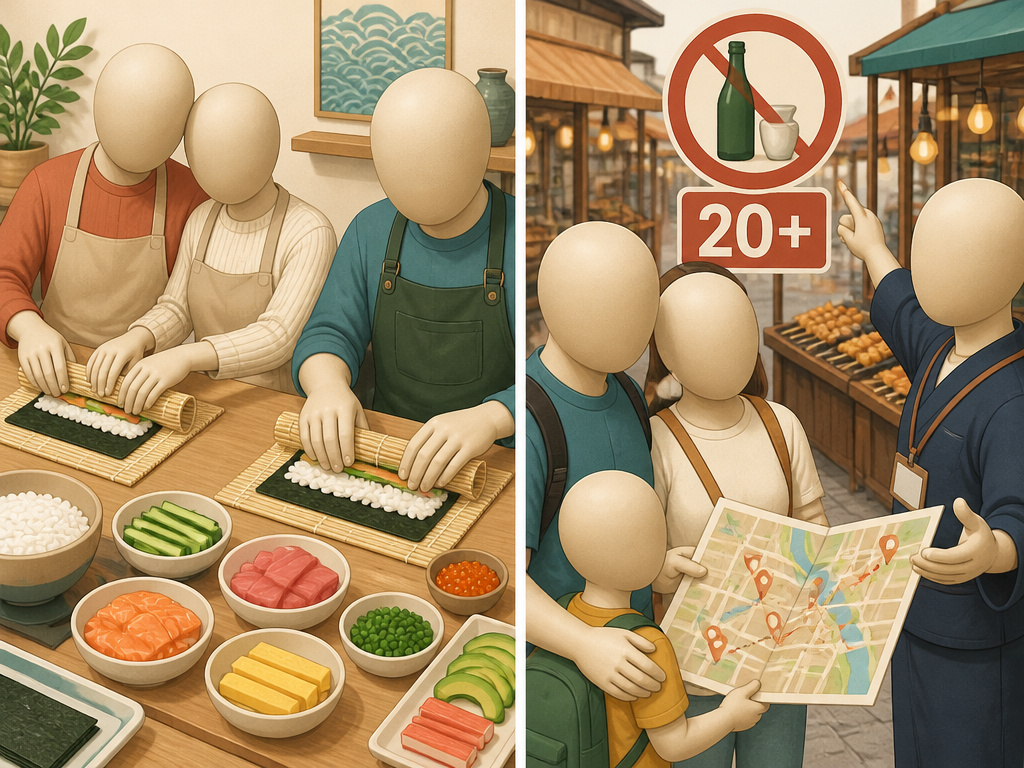
Five traveler types, five different answers, and the pattern holds.
- Couples: Crete Cooking Classes leans class for most couples, because it gives you something to do together.
- Solo travelers who want company: also the class, since you spend longer with the same group.
- Experienced home cooks: the class, but choose carefully. A basic tourist class teaches an experienced cook almost nothing.
- Families with young children: the class is the simpler evening, and Tokyo Food Tours notes that the SUSHI GARYU class sells child tickets from age 4.
- First-timers with three days or less: the tour, for the orientation alone.
The Age Rule That Catches Families Out
Japan’s legal drinking age is 20, and the Tokyo operators apply it. The izakaya crawl and the bar-hopping tour with free-flow drinks take guests aged 20 and over only, even with a parent present. The Japan Guide Star tour in Shinjuku takes under-20s and serves them soft drinks instead.
Don’t book the izakaya crawl for a seventeen-year-old. You’ll find out at the meeting point, with the tour leaving without you.
Classes that pour sake, such as the Asakusa class with unlimited sake, don’t state their age rule on the listing. Ask before you book with anyone under 20.
Frequently Asked Questions
Is a food tour or a cooking class better for a first trip?
The food tour, for most people. Lima Food Tour and Crete Cooking Classes both argue that a tour early in a trip teaches you what to order and where to return. A class works better once you know which dish you want to master.
How long does a food tour last?
Rick Steves puts it at about three hours. Gastronomic Arts Barcelona lists three to four hours, and Crete Cooking Classes lists its Morning Bites and Market Delights tour at four. Lima Food Tour gives a range of two to four hours, so the honest answer is that it varies by operator.
Do cooking classes include a market visit?
Not automatically. Rick Steves writes that many classes include a trip to local markets, and Gastronomic Arts Barcelona says most Barcelona classes include one. Crete Cooking Classes states the opposite for its area: a market visit has to be explicitly included.
Is a food tour enough for a full meal?
It depends on the operator, and the sources disagree. Rick Steves treats a tour as a meal in itself. Gastronomic Arts Barcelona sells its tours as small tastings. Experiences.link advises checking portion sizes and whether a full meal is included before you assume.
Can vegetarians do a food tour?
Yes, and Tokyo is the hard case. Tokyo Food Tours reports that most tours there are difficult for vegetarians because dashi and soy sauce both carry hidden ingredients. Several Tokyo tours exclude vegetarian, halal, and gluten-free diets entirely. Larger sushi classes offer alternative menus if you ask in advance.
Which is better in bad weather?
The cooking class, if the venue is indoors. Crete Cooking Classes gives the class the edge when the weather turns. Tokyo Food Tours adds that most food tours run in the evening and partly indoors, so light rain doesn’t stop them.
Before You Go
One threshold worth carrying: Lima Food Tour says three days or more in a city means you should do one of each. Gastronomic Arts Barcelona sets the bar higher, at five days or more. Both are talking about their own city, so treat the three-day version as the floor and the five-day version as the comfortable version.
If you’re travelling with someone who can’t eat from a shared menu, the whole calculus changes. In that case the class wins by default, because one kitchen is easier to negotiate with than six.
Your first move this week is boring and it works: open the listing and read the inclusions before you read the ticket. Tokyo Food Tours makes the point that the cheapest tickets are the ones where you still pay for everything you eat on the night. That single habit will save you more than any booking trick.
Weigh the food tour vs cooking class pros and cons against the shape of your trip, not against each other. The magic is in the mix, and neither format is the compromise choice.
