
How to Choose a Photography Group Tour: 4 Questions
This post contains affiliate links. As an Amazon Associate, we earn from qualifying purchases.
To choose a photography group tour, check five things before you pay a deposit: the group size cap, the instructor-to-participant ratio, how much of the day is scheduled, whether the named leader actually leads, and whether the operator holds permits for protected land. Get those five right and the rest of the decision mostly takes care of itself.
An itinerary is a recipe. A traveler learns the technique, including how to choose a photography group tour. You don’t need to follow the recipe exactly; you need to know why the recipe works so you can improvise when the light dies early and the group wants dinner.
That’s the whole problem with how most people shop for a photography tour. They compare destinations and price tiers. The details that actually decide whether you come home with good frames or a stiff neck are buried in the operator’s answers to five specific questions.
What follows: group size thresholds, the ratio dispute nobody will settle for you, the free-time test I run on every day-by-day, and the permit question that can end a tour on day two.
Key Takeaways
- Cap the group at 8 to 12. AARP’s Susan Portnoy books 3 to 8 guests; Outdoor Photographer cites tours of 12 to 14; The Raw Society warns large groups hit 20.
- Ask for the ratio in writing. McKay Photography Academy recommends 1 instructor per 5 participants. Outdoor Photographer’s workshops run 3 to 4 participants per instructor.
- Count the unscheduled hours. If the day-by-day doesn’t block out free time, it doesn’t exist — and a 7am-to-9pm schedule is what turns small annoyances into group blowups.
- Never assume the named photographer leads. Operators subcontract other experts, and a big name on the door doesn’t guarantee a big name in the van.
- Permits are the operator’s job. If the leader skipped them, rangers can pull the whole group off protected land mid-tour.
What Group Size Should You Actually Pay For?
Group size decides everything downstream: whether you ride in a van or a bus, how long meals take, and how much one-on-one time you get with whoever’s teaching.
Christelle Enquist, cofounder of The Raw Society, told AARP that large groups run “sometimes as many as 20 guests,” and that at that size the transport mode changes and meals stretch. Susan Portnoy, writing for the same outlet, books the smallest group her budget allows, usually three to eight guests. She’s candid about the trade-off: smaller is better for instruction, and Enquist concedes it’s “probably going to be more expensive.”
Josh Miller, writing in Outdoor Photographer, puts tours at 12 to 14 participants and notes that larger group tours “can be perfectly adequate for experienced photographers not seeking instruction.” Transitions Abroad frames the same fact without a verdict: a bus with 50 people is a different experience from a van with five.
Both are true. The question is which one you’re buying.
What most people get wrong: Booking on destination and price, then discovering the group is 20 people and the “instruction” is a laminated card of camera settings. At that size you’re paying for logistics, not teaching.
Here’s the practical split.
| Group Size | What It Gets You | Watch For |
|---|---|---|
| 3 to 8 guests | Real one-on-one time with the leader | Higher per-person cost |
| 12 to 14 guests | Logistics handled, light instruction | Fewer questions answered in the field |
| 15 to 20 guests | Lowest price per seat | Van becomes a bus; meals run long |
The 15-to-20 band isn’t automatically bad. It’s a different product, and the operator should say so plainly. When they don’t, that’s your first signal.
What Instructor-to-Participant Ratio Should You Expect?
This is the number operators are least eager to quote, and the one that predicts your experience better than any other.
Ally McKay, co-owner of McKay Photography Academy, told the LA Times her company takes one instructor for every five participants. She also said she’s heard of companies running one instructor for 20 participants. That’s not a ratio, that’s a lecture hall.
Outdoor Photographer’s Josh Miller runs his workshops at three to four participants per instructor, which is tighter still. So the two most specific published figures in this category are 1:5 and roughly 1:3.5. They don’t agree, and nobody has published a standard that settles it.
Where this goes sideways: A 20-person group with one leader. You’ll get an intro briefing, a few shouted pointers, and then a leader who’s answering the fastest question, not yours. By day three you stop asking.
The LA Times makes the sane recommendation here: companies should disclose the number of instructors and participants up front. Ask for both numbers in writing before you book, and ask what happens if the second instructor cancels.
If you need more attention than a group can give, Langell Photography’s own booking page says it directly: explore a bespoke guide instead. A private arrangement costs more, and if you’re the kind of photographer who needs someone standing next to you for an hour, it’s the honest choice. That trade-off between a private tour and a shared one is worth pricing out before you commit either way.
The 4 Questions That Expose a Weak Operator

I’ve booked enough of these that I now run the same four questions past every operator before a deposit moves. They take ten minutes to send and they’ve saved me from two bad trips.
- “Is it the same guide every day?” If they hesitate, it’s a rotating cast of contractors reading from a laminated script. One local guide who’s been in the region for years beats five freelancers with headsets every time. No script replicates that.
- “Will the leader be shooting their own images?” Ask this one flatly. Photography Life warns that a leader too busy making their own frames won’t have time for your questions. Langell Photography phrases the ideal answer as a leader who prioritizes participant success over their own photography.
- “Does the itinerary have built-in down time?” Photography Life recommends picking a tour with mid-day downtime, when the light is worst anyway. A dawn-to-dusk schedule looks productive on paper. By day three it’s a grind.
- “Who holds the permits for the protected areas on this route?” More on this below, because it’s the one that can end your trip early.
There’s a longer version of this list if you want the full set of questions to ask before booking a tour, but those four catch most of the problems.
Skip this if: You’re an experienced photographer who just wants the logistics handled and doesn’t care who’s leading. A larger, cheaper tour is a fine fit — and Miller says as much.
Why the Named Photographer Might Not Be Your Guide
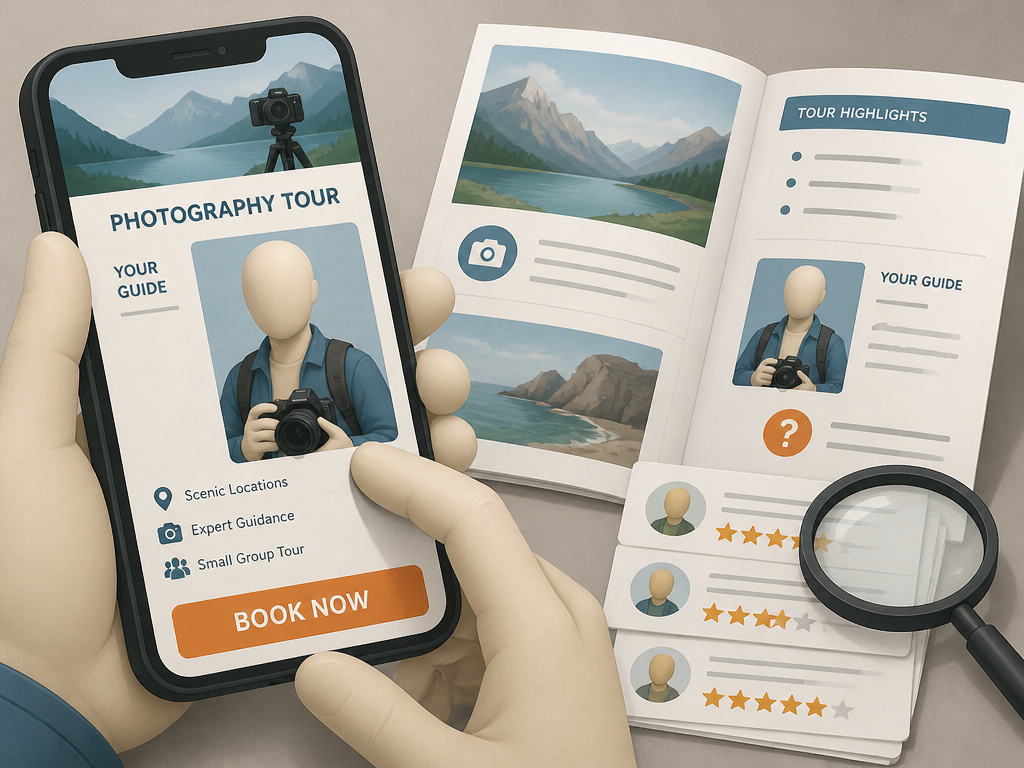
Marketing implies the name on the door leads the trip. It frequently doesn’t.
AARP reports that a big-name photographer doesn’t necessarily lead every journey an operator sells, and that companies sometimes subcontract other experts to run the departure. You book because of a portfolio, and you get someone you’ve never heard of.
That’s not automatically a bad outcome. AARP notes that many big-name photographers collaborate with academic organizations like Santa Fe Workshops, Maine Media, or the Los Angeles Center of Photography, and those organizations tend to book artists who can actually teach. General operators like National Geographic Expeditions, Natural Habitat Adventures, and Exodus Travels hire guest photographers onto especially photogenic departures.
The problem is the mismatch between the promise and the delivery. Colby Brown, who has worked as a guest photographer for a large travel company, told AARP that on a cruise where every passenger has access to the artist, one-on-one conversations are “fewer and far between.” You still get them. You just don’t get the attention a small workshop gives you.
Miller’s take is blunter: being a great photographer doesn’t automatically make someone a great teacher, and he argues that strong interpersonal skills and a genuine desire to help matter more than photographic talent for leading a workshop.
So ask the direct question. Will the person named in the marketing be in the field with you, and if not, who will? Then research whoever that is. Photography Life suggests checking how long they’ve been running the tour, whether they have a portfolio and past tour images, and what past clients say in reviews.
Does the Tour Have Real Free Time, or Just Unscheduled Gaps?
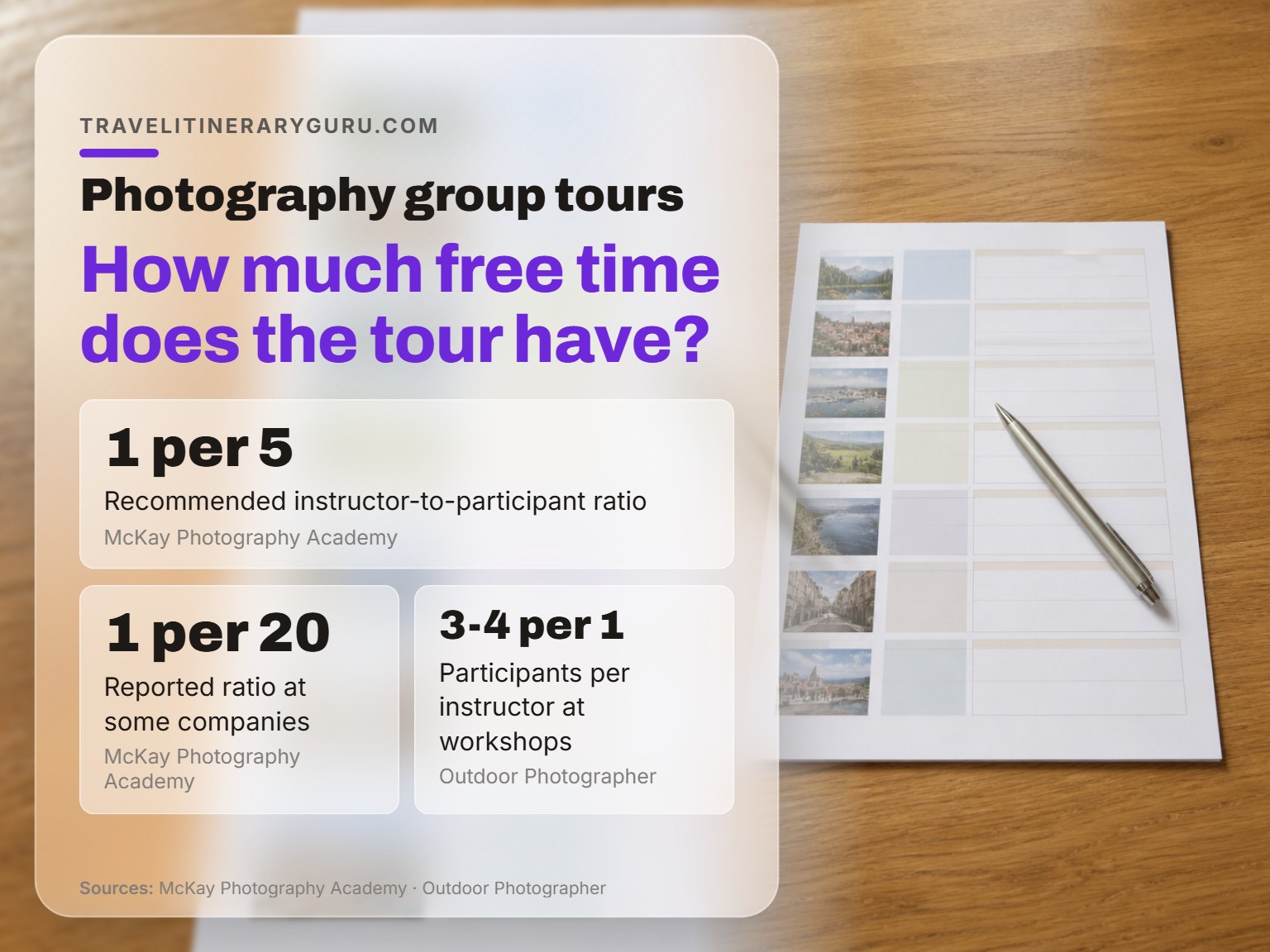
I scan every day-by-day and count the unscheduled hours before I book. If there are none, I know exactly what I’m signing up for.
This is the detail that separates a tour I’d recommend from one I’d warn you off. When everyone is exhausted and herded from 7am to 9pm, minor annoyances become major ones. Built-in free time is the pressure valve.
AARP documents the split honestly. Some operators leave guests on their own during the day and meet later to share meals and answer questions. Others stay with the group the whole time, demonstrating how to capture a scene. Some do a bit of both, and the destination usually decides which. In a city like Paris, guests can wander independently. In a remote location, it’s better to stay together.
Neither model is wrong. What’s wrong is not knowing which one you bought.
Easy to miss: A day-by-day with no blocked free time. The schedule looks packed with value on the PDF, and by day four the group is snapping at each other over a van seat.
There’s a second free-time issue worth checking, and it’s about the group itself. Langell Photography warns to ask whether your group might merge with another photography group, or with the general public. That’s not a photography tour anymore. That’s a boat ride with a camera.
| Itinerary Signal | What It Usually Means | Action |
|---|---|---|
| Mid-day gap blocked out | Operator has done this before | Book with confidence |
| Dawn-to-dusk, no gaps | Exhaustion by day three | Ask for the actual hour count |
| “Free time in the afternoon” | Vague; may not be real | Request the day-by-day in writing |
| Group may merge with public | You’re one of 100 on a boat | Ask for the cap in writing |
When the Permit Question Decides Your Trip
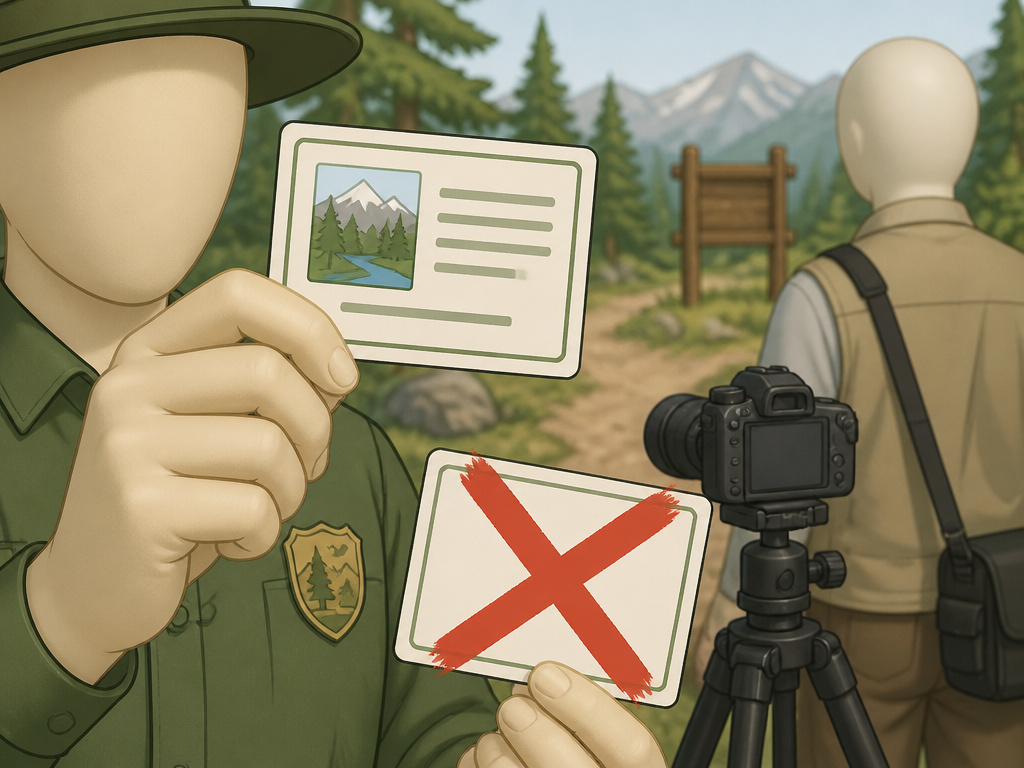
This is the one that ends tours, and almost nobody asks about it before booking.
Permits are essential when photographing in protected areas. Langell Photography’s booking page is unusually candid about the mechanics: permits can cost hundreds to thousands of dollars per excursion.
That cost is baked into a legitimate operator’s price. It’s also the first thing a cut-rate operator skips.
If the leader doesn’t hold the proper permits, rangers commonly approach the group in the field, ask everyone to leave immediately, and typically ban the group for the duration of the tour. You paid for a week in a national park and you got a morning.
Before you start: Ask which permits the operator holds for each protected site on the route, and who holds them. A vague answer here is the single strongest red flag in this category. If the leader can’t name the permit, assume it doesn’t exist.
The same logic applies to physical demands. AARP notes that locations may require a lot of walking, involve stairs, or demand long travel days. The LA Times is direct: disclose your physical limitations in advance so you can be sure you’ll participate fully. Nobody wants to discover on day two that the “short walk to the viewpoint” is a mile of switchbacks with a tripod on your shoulder.
What Should You Pack and Prepare Before You Go?
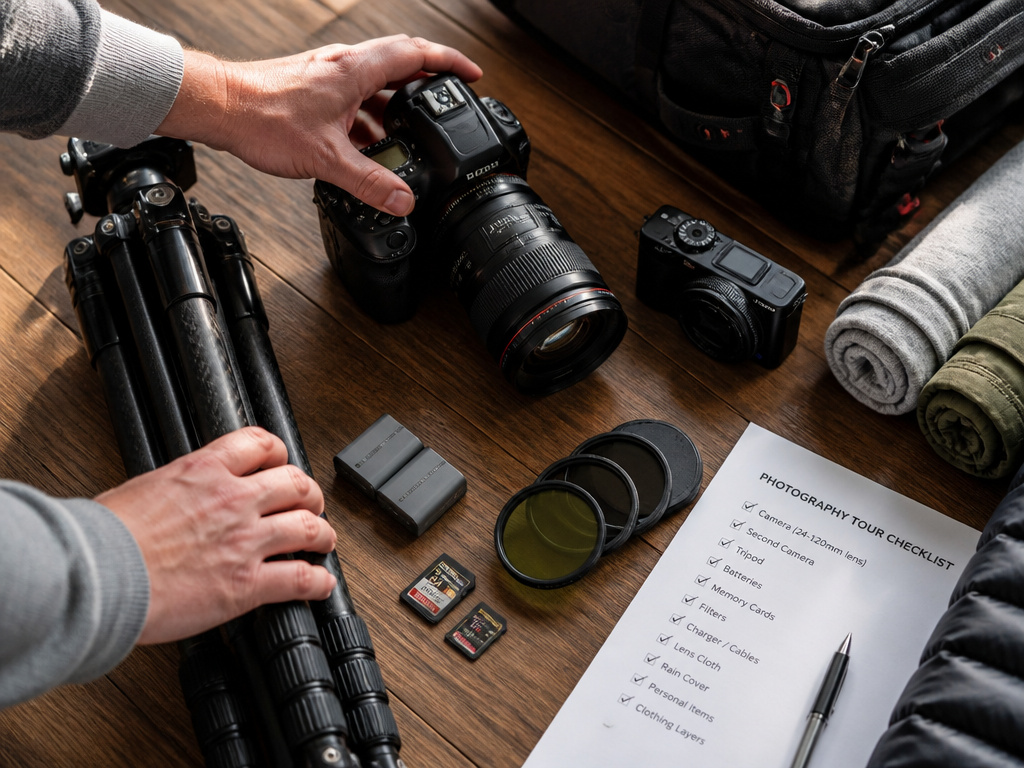
Gear choices on a photography tour are a balancing act between what you’ll shoot and what you can carry up a hill.
Photography Life recommends choosing lenses based on the shots you actually plan to take rather than trying to cover everything. If weight and space are tight, a versatile all-purpose zoom such as a 24-120mm or 18-300mm replaces several lenses. The same source recommends two camera bodies, noting that even a point-and-shoot can serve as the second one, and suggests renting a second body for once-in-a-lifetime trips.
The LA Times takes a lighter line: at minimum a basic SLR and a sturdy, lightweight tripod, plus enough familiarity with shutter speed, aperture, and ISO to control them yourself. Several companies offer affordable rental options if you aren’t ready to buy.
On the packing question, the sources split. Photography Life says never check camera gear, with the exception of a tripod and head. Transitions Abroad says to always check your gear and bring the owner’s manual plus spare parts and batteries. The reconciliation is straightforward: check the tripod, carry the camera. My own habit is to pack a travel photography gear checklist the week before and lay everything out on the floor, because the item I forget is always the one I can’t buy at the destination.
Two more prep items that get skipped. Transitions Abroad notes that some instructors require a tripod, filters, and flashes, so ask rather than assume. And if you might sell your photographs later, bring model and property releases. If your instructor doesn’t provide a pre-trip checklist, ask them to put one together.
Worth knowing before you start: Andrew Beck of Wild Eye Destinations warns that not every operator arranges weight overages for heavy camera equipment, which produces costly charges in some countries. Ask about baggage allowances on any internal flights before you pack the long lens.
Frequently Asked Questions
Is a photography tour the same as a photography workshop?
No, and the industry blurs the line anyway. Photography Life describes workshops as combining shooting time with classroom lectures, post-processing instruction, and critiques. Langell Photography says workshops involve structured lessons and feedback while tours rely mostly on your own skills with little instruction. AARP’s reporting is the honest summary: operators blur the lines, and many trips carry elements of both.
Should I avoid a photo-only tour with no instruction?
Photography Life says yes, flatly, calling photo-only tours something to be avoided. Langell Photography treats a low-instruction tour as a legitimate option for photographers who don’t want teaching. The split comes down to what you’re buying. If you want instruction, a photo-only tour is the wrong product. If you just want the logistics handled, it may be exactly right.
How do I know if the group size is too big for me?
Ask what vehicle you’ll be in. The Raw Society’s Christelle Enquist notes that groups of up to 20 change the transport from a van to a bus and stretch meal times.
What happens if the tour operator doesn’t have permits?
Rangers can approach the group in the field and ask everyone to leave immediately, and the group is typically banned for the duration of the tour, according to Langell Photography. Permits must usually be secured three to 12 months before the event, so this isn’t something an operator can fix on the day. Ask before you book.
Do I need travel insurance for a photography tour?
The LA Times recommends it to cover costs in case of an emergency or unforeseen incident, and separately advises reading the cancellation policy closely, because cancelling may cost you the deposit or the full tour price. Given that permit issues or weather can end a trip early, insurance is the cheaper side of that bet.
Can I bring a non-photographer spouse or partner?
Many tours offer a non-photographer rate for spouses and companions who want to tag along, according to the LA Times. Children usually aren’t allowed, though a serious teen photographer may be approved if you contact the company first.
The Bottom Line
One threshold decides most of this. That’s fine if logistics is what you wanted. It’s a bad deal if you signed up to learn.
Here’s the first step, this week: send the operator four questions in one email. Ask for the group size cap, the instructor-to-participant ratio, the name of the person who will actually be in the field with you, and which permits they hold for each protected site on the route. If any of the four comes back vague, that’s your answer.
I’ll concede the limits of this advice. There’s no industry standard here, and Andrew Beck of Wild Eye Destinations says so plainly. You’re not comparing a product against a spec sheet; you’re reading the honesty of an operator’s answers. Which is why the vague reply matters more than the wrong one — a wrong answer can be negotiated, and a vague one usually means there’s nothing behind it.
