
How to Travel Between US Cities by Bus: Step-by-Step
This post contains affiliate links. As an Amazon Associate, we earn from qualifying purchases.
To travel between US cities by bus, book with a carrier that holds a USDOT number and FMCSA operating authority, verify its safety record through FMCSA’s Bus Safety Search before you pay, and wear the passenger safety belt whenever the bus is moving. Large buses built after November 2016 must provide them.
That safety belt line is the one people skip. I’ve watched passengers board a motorcoach and never once look down at the buckle. Knowing how to travel between US cities by bus does not change this. The bus pulled out of the terminal and that belt sat there, unused, for the whole trip.
The rest of this covers what actually changes your trip: how to read a carrier’s safety record quickly, what federal rules guarantee you once you’ve bought a ticket, how boarding actually works at different terminals, and where the standard “book early, arrive early” advice breaks down.
Key Takeaways
- Check the USDOT number first. A carrier running interstate trips must hold one and be authorized by FMCSA, and the number is the fastest way to find its real safety history.
- Wear the belt whenever the bus is moving. Buses manufactured after November 2016 are required to provide passenger safety belts.
- Unused tickets are refundable within 30 days of your request under 49 CFR 374.305(d) — but only on regular-route service.
- A bus seating more than 14 passengers needs a restroom unless it makes reasonable rest stops, per 49 CFR 374.313(b).
- Skip the overnight bus if you’re trying to save a hotel night. You’ll arrive tired, and the sleep you lost may cost more than the room.
Why the Carrier You Book Matters More Than the Route
Route selection is the easy part. Any trip planner app will show you three carriers running the same corridor. What those apps won’t show you is whether the company behind the schedule has a clean safety record or a stack of hours-of-service violations, and that gap is exactly where the how to travel between US cities by bus question gets decided.
FMCSA publishes a free lookup tool that makes this quick. You can pull up any carrier’s history, and the agency’s own guidance is blunt about what to look for: an “Unsatisfactory” safety rating, an out-of-service order, or missing operating authority means the company should not be running across state lines at all.
Here’s the part that trips people up. A carrier can hold valid operating authority and still show as “Not Rated” in the system. Legal authority and evaluated safety are two separate statuses. Seeing “Not Rated” isn’t a red flag by itself, but it does mean the agency hasn’t completed an evaluation, so you’re working with less information than you’d have on a rated carrier.
What most people get wrong: Booking on price alone. A carrier with a clean record and a slightly higher fare is worth the difference. An out-of-service order is not a paperwork problem. It means the agency pulled the company’s operating authority for cause.
When you compare operators, compare three things: authorization status, safety rating, and the specific violation categories on their record. That third one is where the real story lives.
What Does FMCSA’s Bus Safety Search Actually Show You?
The Bus Safety Search returns a carrier’s record broken into five inspection categories. Each one maps to a specific failure mode, and some matter more to a passenger than others.
Bus Safety Search returns a carrier’s record across five categories: Unsafe Driving, Hours of Service Compliance, Vehicle Maintenance, Controlled Substances and Alcohol, and Driver Fitness. Each category reflects violations found during roadside inspections, not self-reported data. A clean record in all five is the strongest available signal that a carrier runs a disciplined operation.
Read those categories in order of what can hurt you. Unsafe Driving covers speeding, reckless driving, improper lane changes, inattention, and no seatbelts. Vehicle Maintenance covers braking, lights, and defects, including failure to make required repairs. Driver Fitness covers invalid licenses and drivers medically unfit to operate.
Hours of Service Compliance is the one most passengers never think about. It tracks drivers who log too many hours behind the wheel, plus violations involving how those hours get recorded. A fatigued driver is a specific emergency category, not a vague worry.
The Categories That Should Change Your Booking
If you’re choosing between two carriers with similar schedules, the violation distribution tells you more than the overall rating.
| Category | What It Covers | Why It Matters to You |
|---|---|---|
| Unsafe Driving | Speeding, reckless driving, inattention | Direct crash risk on your trip |
| Hours of Service | Driving too many hours, logging violations | Driver fatigue behind your wheel |
| Vehicle Maintenance | Braking, lights, defects, missed repairs | Mechanical failure mid-route |
| Driver Fitness | Invalid license, medically unfit | Unqualified operator at the wheel |
A carrier with a clean Unsafe Driving record but repeated Vehicle Maintenance findings is a different risk than one with the reverse. Both are worth knowing before you hand over a card.
When a Carrier Has No USDOT Number
Not every bus company operates interstate. A company with no USDOT number may be running entirely within a single state, and in that case FMCSA’s tool won’t have a record for it. Contact the state oversight agency instead, usually the state Department of Transportation.
That’s not a loophole. It’s just a different regulatory lane, and the state agency holds the safety information you’d otherwise pull from the federal system.
Booking: Timing, Tickets, and the One Deadline That Bites

I book almost all my intercity buses the day before, sometimes the morning of, and I’d rather pay a few extra dollars for the flexibility than lock myself into a 5 a.m. Bus three weeks out, which is the habit that shapes my whole how to travel between US cities by bus answer.
That strategy has one failure mode. I once tried to book an intercity bus the day before Thanksgiving. By the time I opened the app, the only seats left were on a 6 a.m. Departure, and mine was next to the bathroom. Holiday weekends in the US are the exception to the day-before rule, and they’re not a small exception.
Here’s the practical version: book day-before for ordinary travel, book weeks out for Thanksgiving, Christmas, and the Friday before a long weekend.
The Refund Window Nobody Uses
Federal rules give you more protection than most passengers realize. Under 49 CFR 374.305(d), a carrier must refund unused tickets within 30 days of your request, at each place tickets are sold.
Read that again. Thirty days, and the request goes to any ticket-selling location, not just the one you bought from. If your plans change and you’re holding a regular-route ticket you never used, you have a documented path to get the money back.
Skip this if: You bought a commuter ticket, a charter seat, or an irregular-route fare. Subpart C applies only to regular-route operations. Charter and irregular-route services fall outside these protections entirely.
How Baggage Timing Actually Works
Baggage rules are where federal regulation gets surprisingly specific. If a carrier doesn’t offer side-of-bus baggage checking, anything you check at a counter between 30 minutes and 1 hour before departure has to ride on your same schedule.
If the carrier does offer side-of-bus checking, and you check a bag at the counter less than 30 minutes before departure, the agent is supposed to warn you that your bag may not travel with you.
Build the buffer in.
Boarding: What Changes at Different Terminals
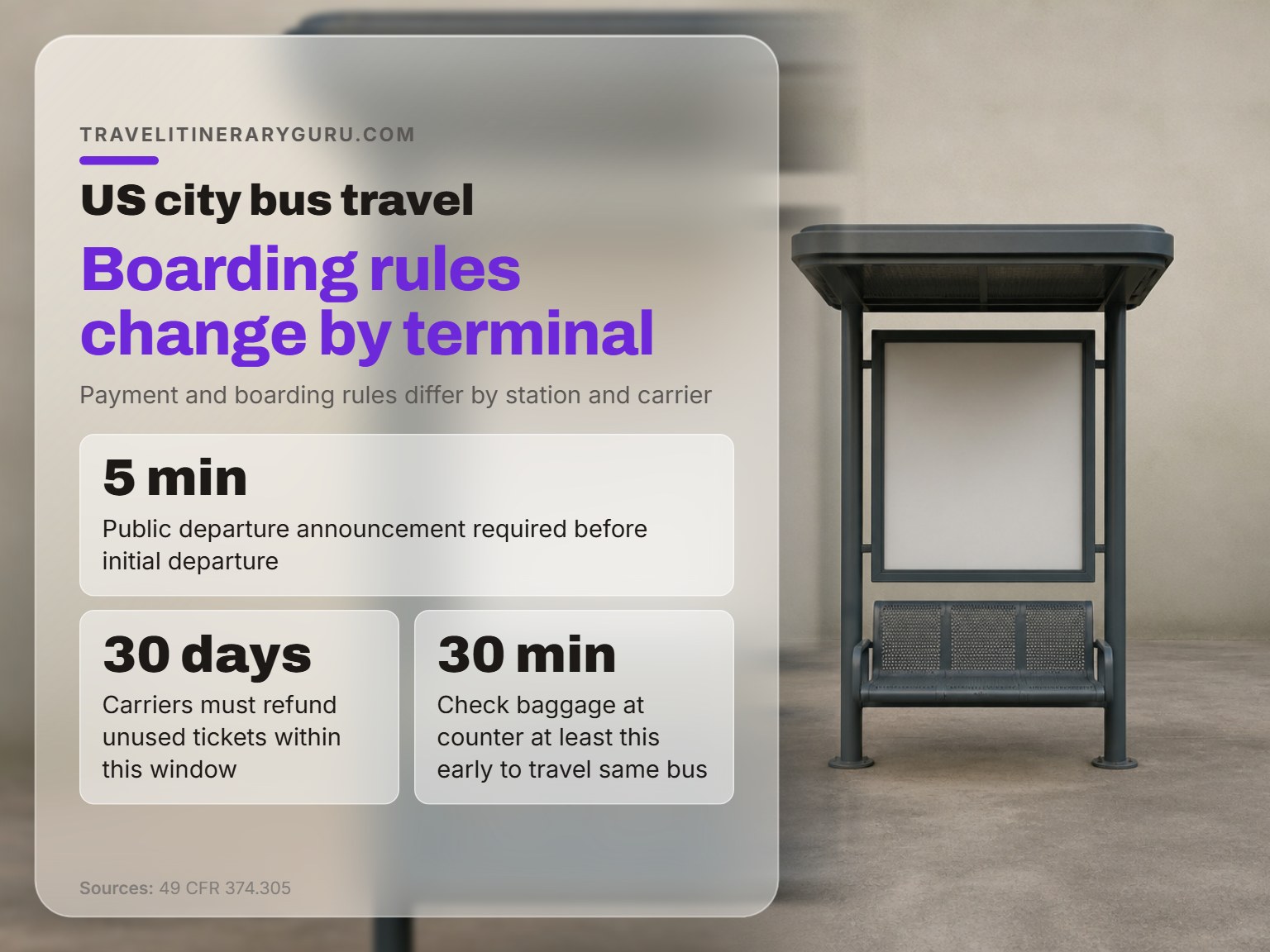
Boarding procedure is not universal. The rules shift depending on which terminal you’re standing in, and getting it wrong means watching your bus pull away.
Greyhound tells passengers to be ready to board 15 minutes before departure. That’s the carrier’s instruction, not a federal rule, but it’s a reasonable default.
NJ TRANSIT runs a different system. Drivers do not stop automatically unless someone is getting off, so you have to stand near the stop sign and wave when you see your route number approaching. If you’re used to a bus that stops for anyone at the curb, this may catch you off guard.
Paying at the Terminal vs. Paying Onboard
Fare payment rules are the sharpest disagreement in the sources, and it’s worth laying out plainly.
| Boarding Location | Payment Rule | Source |
|---|---|---|
| Port Authority Bus Terminal, NYC | Pre-purchased ticket required; no cash onboard | NJ TRANSIT |
| George Washington Bridge Bus Station | Pre-purchased ticket required; no cash onboard | NJ TRANSIT |
| New Jersey and Philadelphia boardings | Exact cash accepted; drivers carry no change | NJ TRANSIT |
If your trip starts at Port Authority or the George Washington Bridge station, buy your ticket before you get to the gate.
Zone Fares and the Key Stop Problem
NJ TRANSIT fares are distance-based, and the fare increases each time your bus crosses a zone boundary. A rider paying a single-zone fare for a multi-zone trip is underpaying.
The scheduling side has its own trap. Paper and online timetables list only major “Key Stops.” If your stop sits between two Key Stops, the published times don’t cover it. Arrive a few minutes early and treat the timetable as an approximation for your stop, not a schedule.
What Federal Rules Guarantee You Once You’re Onboard
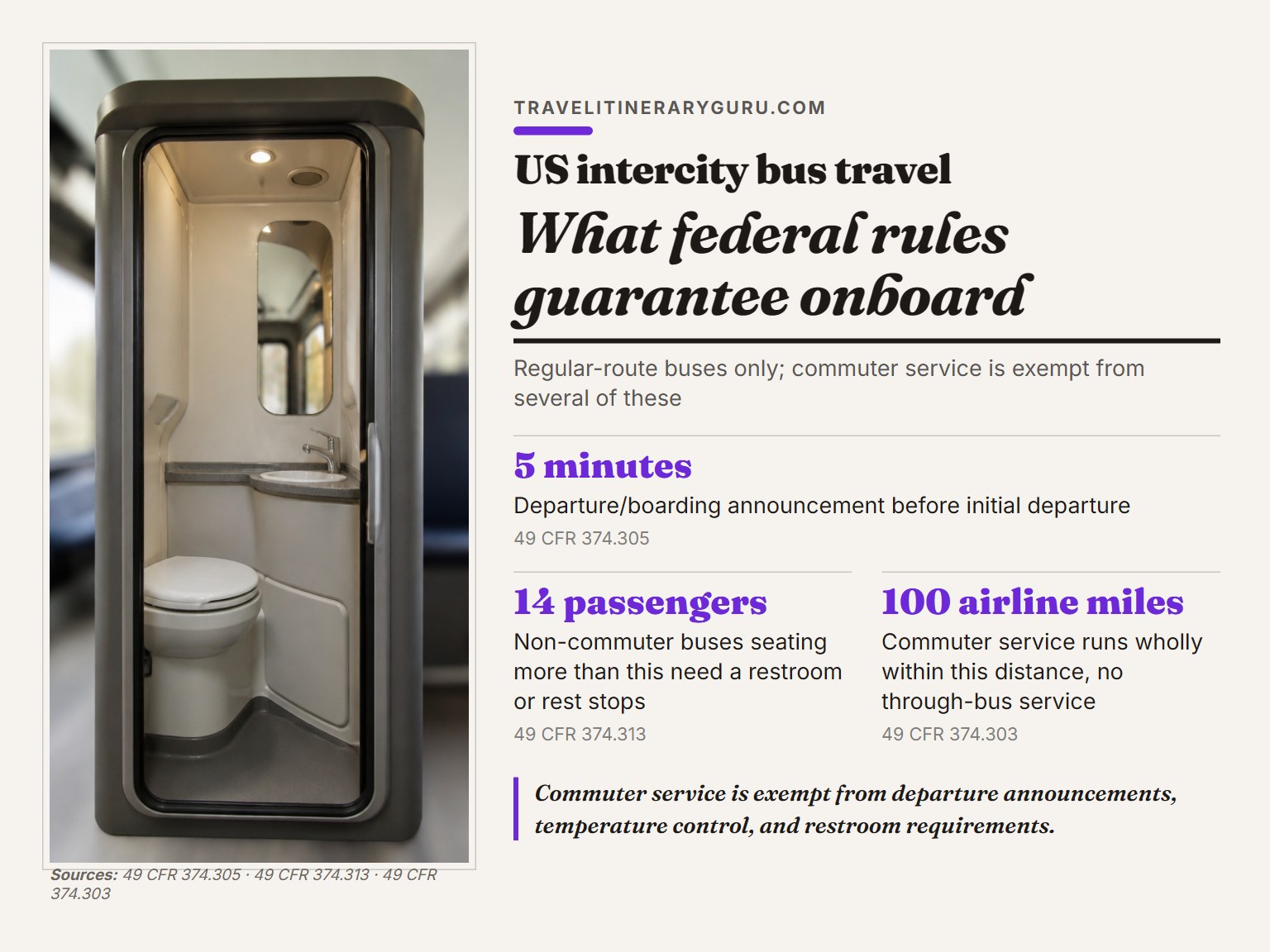
Once the bus is moving on a regular route, federal regulation backs several things you’d otherwise just hope for.
Departure announcements are the first. Under 49 CFR 374.305(e), a scheduled bus must give a public announcement of the departure and boarding point at least 5 minutes before initial departure, and before departures from points where the bus stops more than 5 minutes.
Restrooms are the second. Under 49 CFR 374.313(b), any non-commuter bus seating more than 14 passengers excluding the driver must have a clean, regularly maintained restroom, unless it makes reasonable rest stops.
Easy to miss: The restroom rule and the restroom reality diverge by route type. The federal standard allows a carrier to run a large bus without a restroom if it makes reasonable rest stops. Local buses may have no onboard restroom at all, so the rest stop is the bathroom.
The Commuter Exemption That Catches Riders Out
Commuter service is carved out of several of these protections. Under 49 CFR 374.305(e) and 374.313(a)/(b), commuter service is explicitly exempt from departure announcements, temperature control, and restroom requirements.
The definition matters here. Commuter service means passenger transportation wholly between points not more than 100 airline miles apart, with no through-bus, connecting, or interline service to points beyond that range. Its usual characteristics include reduced fares, multiple-ride and commutation tickets, and peak morning and evening operations.
If you’re on a short-haul commuter route, don’t expect the intercity rulebook to apply.
Safety Onboard: What to Do When Something Feels Wrong
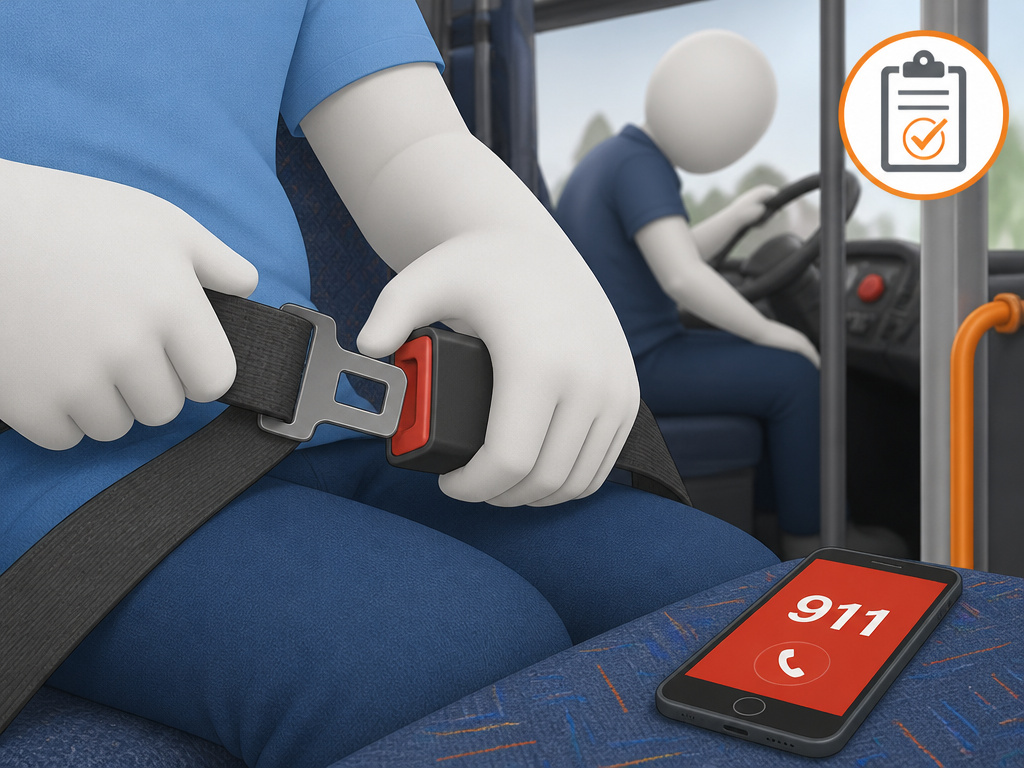
The belt is the first thing. FMCSA’s guidance is direct: wear passenger safety belts, if available, whenever the bus is moving.
The second thing is knowing the emergency threshold. If you believe you are in danger while aboard a bus, call 911. FMCSA lists a driver who seems incapacitated, fatigued, intoxicated, or otherwise impaired, including by medical conditions, as a specific emergency category.
If the driver can’t safely operate the vehicle, call 911.
Reporting a Problem After the Fact
For non-emergency issues, FMCSA runs a reporting channel. If you observe an ADA compliance problem or a safety issue with the bus or driver, or experience a service issue, report it to FMCSA.
Passengers with disabilities hold specific civil rights for acquiring accessible over-the-road bus transportation, and an ADA compliance problem is a reportable issue, not something to shrug off.
Where this goes sideways: Letting a genuine safety complaint die in your notes app. A carrier with an Unsatisfactory rating, an out-of-service status, or no operating authority should not be operating across state lines. If it’s booking passenger trips anyway, report it to FMCSA by phone or online.
Frequently Asked Questions
Do I need to print my bus ticket?
It depends on the carrier. Greyhound lets you board by showing a valid ID to the driver, or by showing a photo ID if the ticket is in your name. But if you are traveling on another carrier, you must have a printed ticket. Check your specific operator’s policy before you leave.
How early should I arrive for an intercity bus?
Greyhound instructs passengers to be ready to board 15 minutes before departure. That’s a carrier rule, not a federal one, but it’s a safe default. At terminals with baggage counters, arrive earlier if you’re checking a bag, since bags checked less than 30 minutes before departure may not travel with you.
Can I get a refund if I don’t use my bus ticket?
Under 49 CFR 374.305(d), carriers must refund unused tickets within 30 days of your request, at each place tickets are sold. This applies to regular-route service. Charter, irregular-route, and commuter tickets fall outside these protections.
Do intercity buses have restrooms?
Under 49 CFR 374.313(b), a non-commuter bus seating more than 14 passengers excluding the driver must have a clean, regularly maintained restroom, unless it makes reasonable rest stops. So a large intercity coach should have one. Local and commuter buses often don’t.
What if my bus company has no USDOT number?
Company with no USDOT number may operate entirely within a single state. In that case, contact the state oversight agency, usually the state Department of Transportation, for safety information. FMCSA’s federal lookup won’t have a record for a purely intrastate carrier.
Is it safe to take an overnight bus?
Safety isn’t the main issue with overnight buses; recovery time is. You’ll arrive at your destination having slept badly, if at all, and the day you planned to spend sightseeing gets spent recovering. If the overnight bus is the only option, build in a slow morning at the other end.
The Bottom Line
One rule most bus-travel guides skip: if a carrier’s safety record shows an Unsatisfactory rating, an out-of-service order, or no operating authority, don’t book it, no matter how cheap the fare looks. That’s not a preference. It’s a company that shouldn’t be running across state lines.
Your first concrete step this week, if you have a trip coming up: pull the carrier’s USDOT number and run it through FMCSA’s Bus Safety Search. It tells you more than any review site will.
If a bus gets cancelled mid-trip, the next bus is the answer, not a new spreadsheet. The plan is a tool. When the plan breaks, the next bus is the answer, not a new spreadsheet.
And the day-before booking habit? It works right up until it doesn’t. Holiday weekends flip the whole calculus, and that’s the lesson I paid for with an early-morning seat next to the bathroom.
