
How to Choose a Bus Company for Intercity Travel
This post contains affiliate links. As an Amazon Associate, we earn from qualifying purchases.
To choose a bus company for intercity travel, verify five things before you pay: a USDOT number plus operating authority, at least $5 million in liability insurance, a current safety rating, a driver who holds a CDL with a passenger endorsement, and a published hours-of-service policy. More than 4,000 registered, for-hire motorcoach companies operate in the United States, and the difference between them shows up in public records you can pull yourself.
That check is the whole game, and it’s one many travelers skip when they learn how to choose a bus company for intercity travel. The record that matters lives in the Federal Motor Carrier Safety Administration’s Safety Measurement System.
I’ve spent years building itineraries where the bus leg is the hinge the rest of the day swings on. When that leg is with a carrier I haven’t vetted, the whole plan is a gamble. So I check. Every time.
What follows is the sequence I actually run: the federal lookup, the insurance figure, the rating categories, the driver rules, and the two places the official guidance contradicts itself.
Key Takeaways
- A USDOT number and operating authority are the floor. No registration, no legal interstate passenger service.
- $5 million is the federal minimum liability coverage for-hire interstate motorcoach companies.
- “Not Rated” is not a clean bill of health. It means FMCSA has never evaluated the company.
- Intrastate-only carriers won’t appear in the federal search. You have to call the state DOT instead.
What the USDOT Number Actually Tells You
Start with the number, not the name. FMCSA says to search by USDOT number when you can, because company names are often similar or a carrier may not operate under its legal business name.
That single habit kills most of the confusion. Many company names are similar or may not operate under their legal business name, so searching by USDOT number is easiest.
A USDOT number plus operating authority registration means the carrier is on the federal radar. For-hire passenger carriers running trips for compensation across state lines have to register, and to keep that registration they must keep proof of financial responsibility on file with FMCSA.
A for-hire interstate motorcoach carrier must hold both a USDOT number and operating authority registration from the Federal Motor Carrier Safety Administration, and must maintain evidence of financial responsibility on file to keep that authority active. Registration status and insurance details are published on the carrier’s safety webpage.
That’s the baseline. It confirms the company exists and is allowed to sell you a seat across state lines. It says nothing yet about how they drive.
Here’s where I’d start if you’re weighing intercity bus tickets against a flight or a train: pull the number first, then price the route. A fare from a carrier without operating authority isn’t a safe bargain.
The $5 Million Insurance Rule and Where to Find It
For-hire interstate motorcoach companies must carry at least $5 million in liability coverage. That figure comes straight from FMCSA, and it’s the number I’d hold any carrier to.
Finding it takes a few clicks. On the company’s safety webpage, look for the “L&I” link under the Licensing and Insurance header. That opens a report you can view as HTML or PDF.
The section you want is called “Insurance on File” in the HTML version. In the PDF version, the same information sits under “Insurance Requirements.” Same data, two labels.
While you’re in there, check the “Active For-Hire Authority” header. You want a “Yes” displayed next to “Passenger.” If a company isn’t licensed to carry passengers but is booking them anyway, FMCSA wants that reported.
| Check | Where It Lives | What You Want to See |
|---|---|---|
| Operating authority | Active For-Hire Authority header | “Yes” next to “Passenger” |
| Insurance | L&I report, “Insurance on File” | Active policy, at least $5 million |
| Registration | Company safety webpage | Current USDOT registration |
| Rating | SMS safety information page | Satisfactory, or a reviewed Conditional |
This is the part many travelers skip. The L&I report is easy to overlook. But it’s the only place the insurance figure is published, and it’s the difference between a licensed operator and a company selling seats it isn’t authorized to sell.
Satisfactory, Conditional, or Unsatisfactory: Reading the Rating
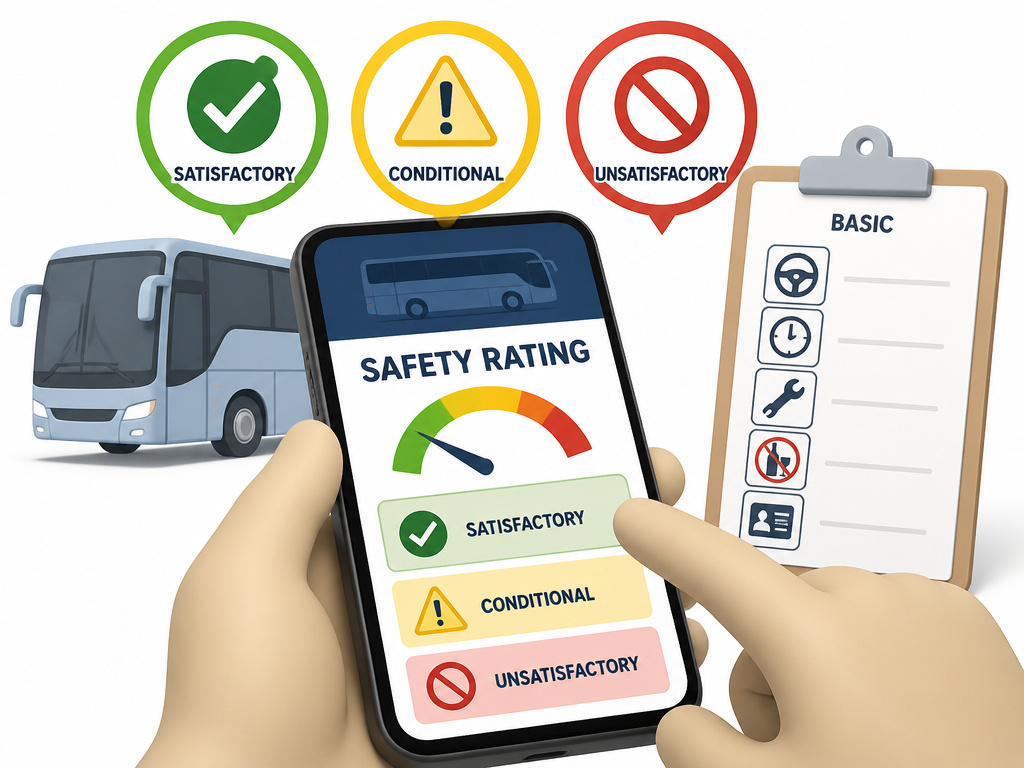
FMCSA issues three safety ratings, and the hierarchy is simple. Satisfactory is the best rating. It means the company has adequate safety management.
Unsatisfactory is the other end. Companies with that rating should not be operating at all, and an Unsatisfactory carrier that’s booking passenger trips should be reported to FMCSA. If you see a red out-of-service notification, that company isn’t currently authorized to move passengers from one state to another.
Conditional sits in the middle, and this is where the federal guidance splits. FMCSA’s trip-planning page says a Conditional rating “may pose a higher safety risk.” The agency’s Look Before You Book page describes Conditional as a company with some violations that may still operate, and advises reviewing the safety information in more detail.
Same agency. Two framings. FMCSA’s trip-planning page says a Conditional rating may pose a higher safety risk, while FMCSA’s Look Before You Book page says the company has some violations but may still operate; read the actual violation categories before deciding.
What most people get wrong: Treating “Not Rated” as a pass. FMCSA is explicit that a company without a rating has not had its operations evaluated against federal safety fitness standards. A carrier can hold valid operating authority and never have been assessed.
The Five Categories Worth Reading
The Safety Measurement System sorts a carrier’s record into Behavior Analysis and Safety Improvement Categories, or BASICs. A symbol in a category means the company has fallen below a safety threshold and may get prioritized for closer monitoring.
The categories FMCSA tells travel planners to review are:
- Unsafe Driving, speeding, reckless driving, improper lane changes, inattention, no seatbelts.
- Hours of Service Compliance, drivers running too many hours, or violations in how hours get recorded.
- Vehicle Maintenance, braking, lights, defects, and failures to make required repairs.
- Controlled Substances and Alcohol, drug or alcohol use and possession, plus a carrier’s failure to run a random testing program.
- Driver Fitness, invalid licenses and drivers who are medically unfit.
A symbol in a BASIC indicates the company has fallen below a safety threshold and may be prioritized for further monitoring.
Can You Check a Company That Only Operates Inside One State?
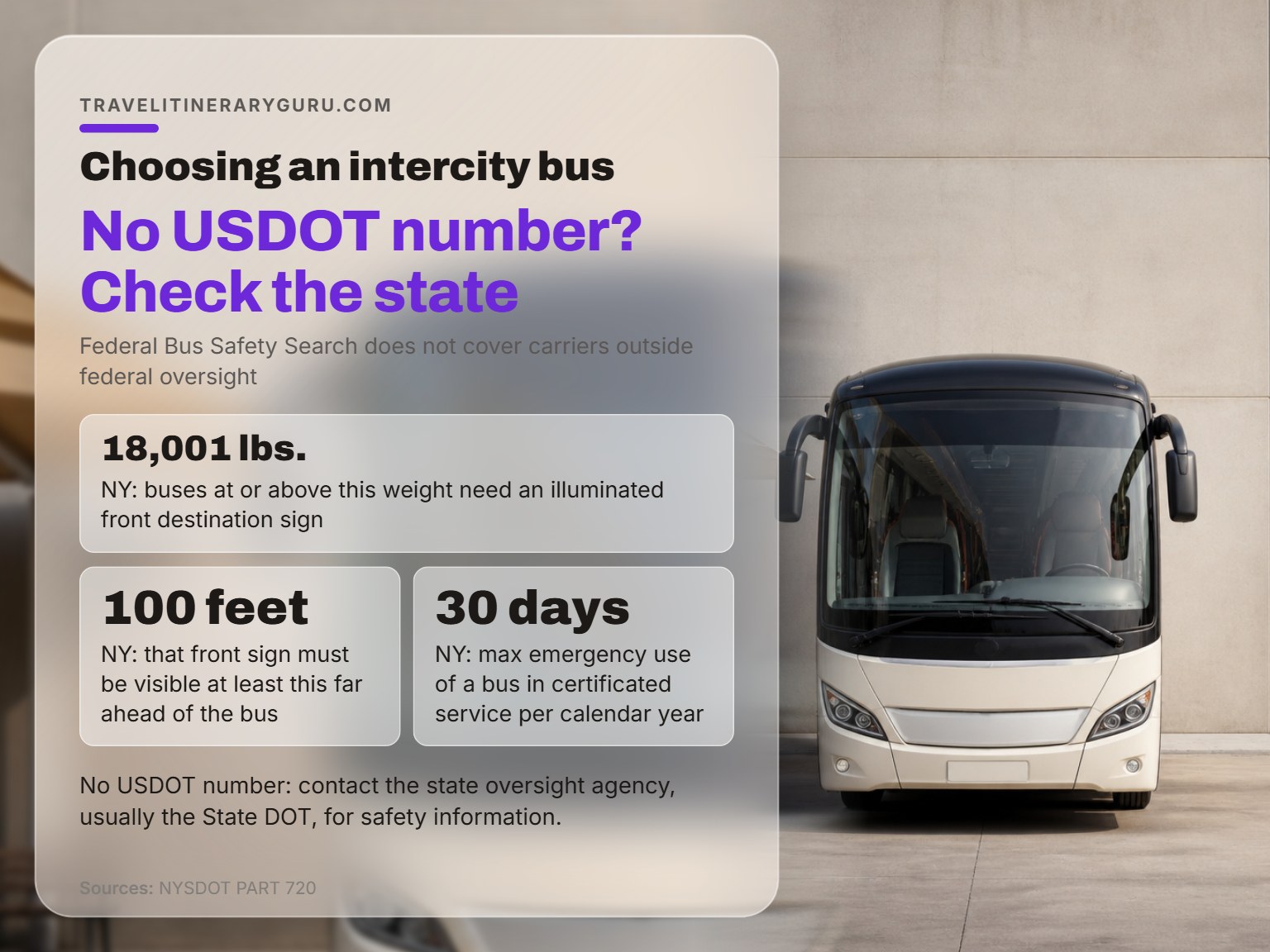
No, and that’s the honest answer. The federal Bus Safety Search does not cover carriers outside federal regulatory oversight.
A company with no USDOT number may be operating legally within a single state. FMCSA’s instruction for that case is direct: contact the state oversight agency, usually the state Department of Transportation, for safety information.
State rules can be specific too. New York’s Part 720 requires, among other things, that a bus with a maximum gross vehicle weight rating of 18,001 lbs. Or more used in city or intercity service carry an illuminated front sign showing its destination, visible at least 100 feet forward from the front of the bus.
A company with no USDOT number may operate within a single state and may not appear in the federal Bus Safety Search. In that case, contact the state oversight agency, usually the State Department of Transportation, for safety information.
If your route is domestic, the same logic applies to traveling between US cities by coach, check the federal record where it exists, and the state record where it doesn’t.
The Driver Rules That Decide Whether You Arrive Rested
The company can have a clean record and the trip can still go wrong if the driver violates hours-of-service rules. Federal hours-of-service rules exist to prevent exactly that.
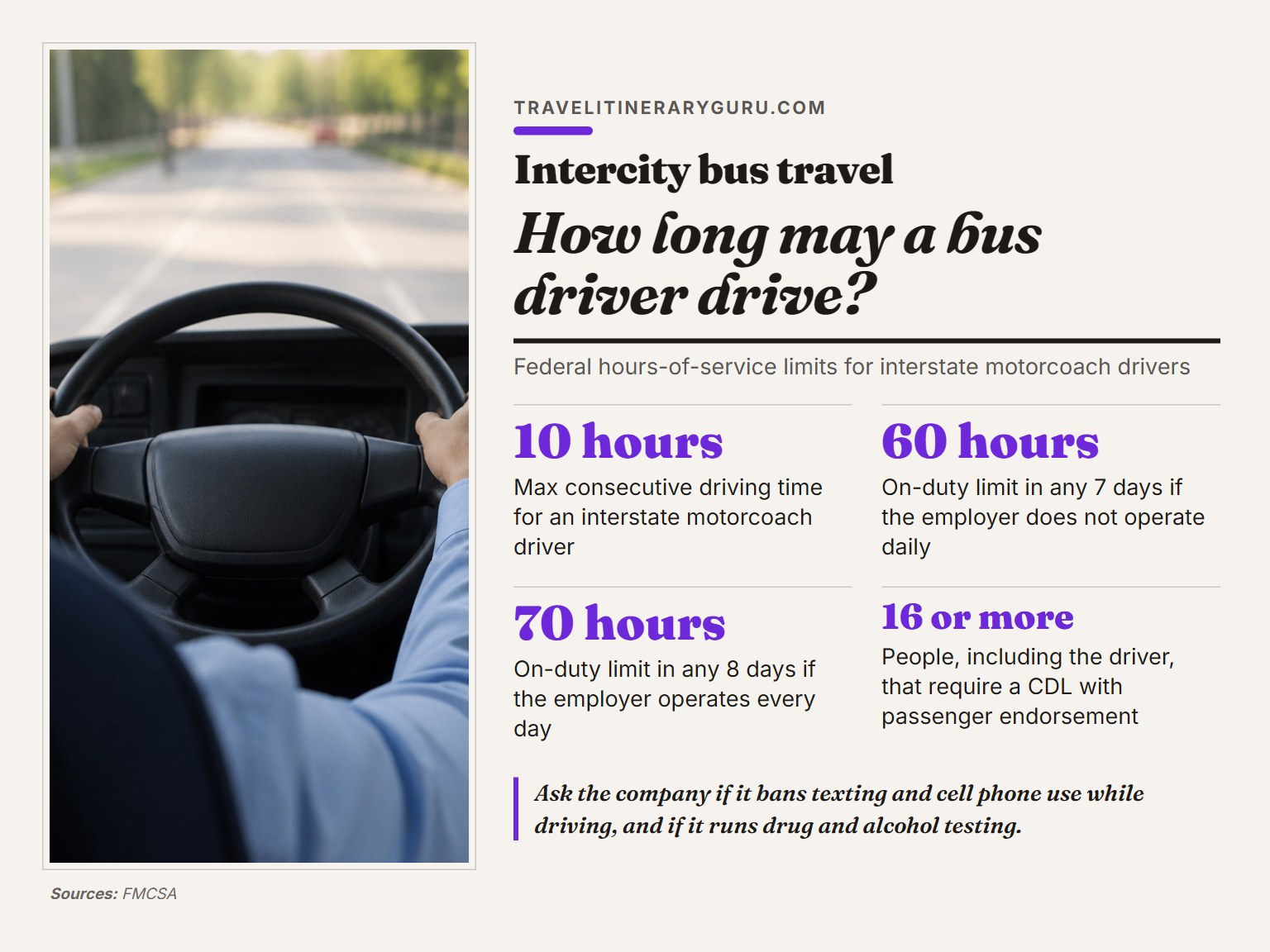
No interstate motorcoach driver may drive more than 10 consecutive hours. That’s the hard ceiling.
There are also cumulative limits, and they depend on the employer’s schedule:
- If the employer does not operate every day of the week, no driver may drive after being on duty for 60 hours in any 7 consecutive days.
- If the employer does operate every day, the limit is 70 hours in any 8 consecutive days.
Two questions FMCSA suggests asking the company directly: does it prohibit drivers from texting or using a cell phone while driving, and does it run a drug and alcohol testing program?
And the credential itself. A driver operating a vehicle designed to carry 16 or more people, including the driver, must hold a Commercial Driver’s License with a passenger endorsement. They also need a valid medical examiner’s certificate confirming they meet the physical qualification requirements.
Skip this if: You’re booking a short regional hop on a familiar carrier you’ve used before. The hours math matters most on long-haul and overnight routes, where a tired driver has the most road left to cover.
This is the section to review closely. If you’re doing long-distance bus travel overnight, the driver’s clock is the single biggest variable in whether you sleep or white-knuckle it.
Two Official Sources That Don’t Quite Agree
Here’s where I have to be straight with you, because the sources genuinely conflict and pretending otherwise would be dishonest.
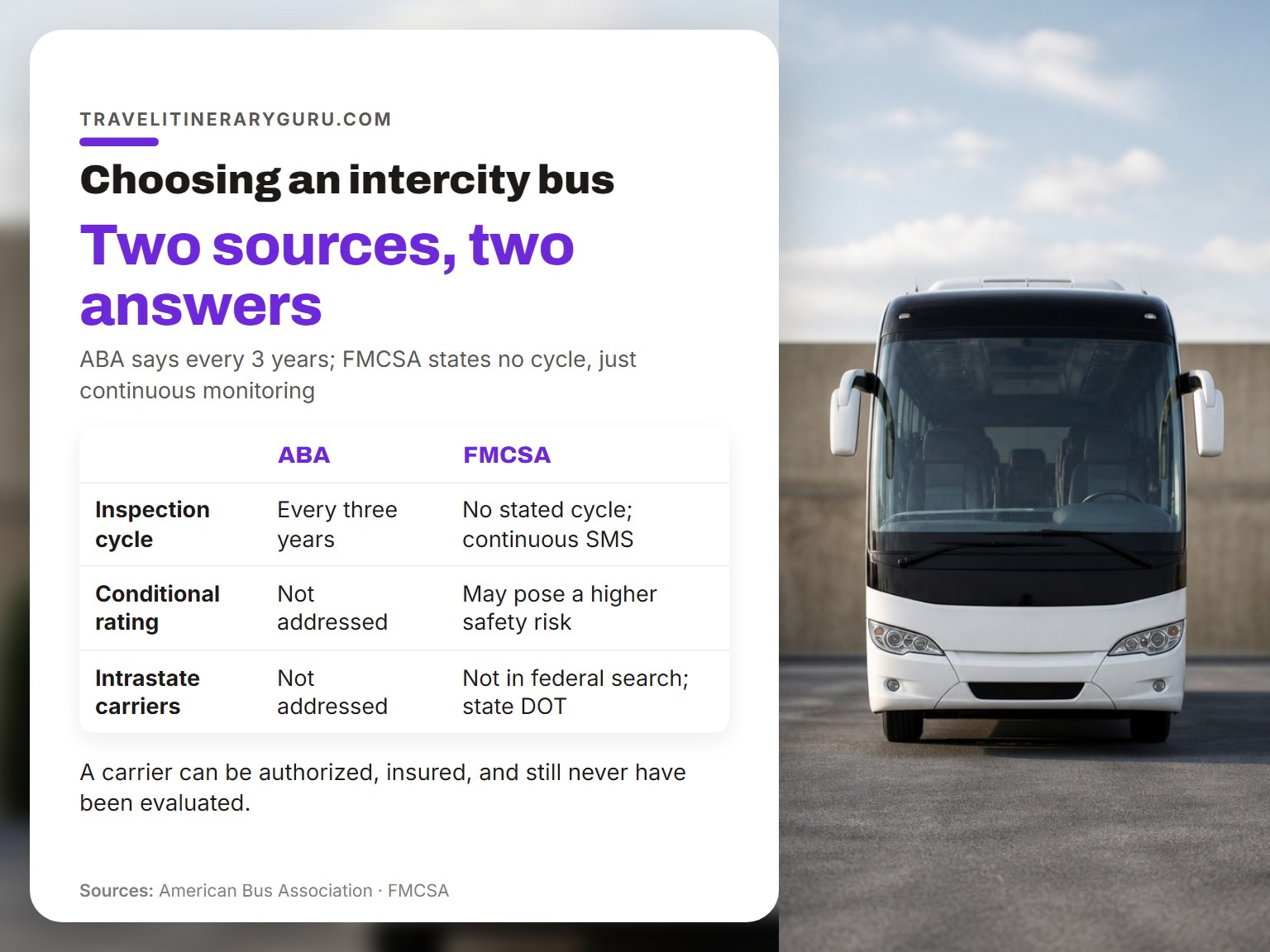
The American Bus Association states that all U.S.-based motorcoach companies must be inspected every three years, while FMCSA’s own pages do not state a three-year inspection cycle; they describe continuous Safety Measurement System monitoring and roadside inspection data instead.
| Question | ABA Position | FMCSA Position |
|---|---|---|
| Inspection cycle | ABA: every three years | FMCSA: no stated cycle; continuous SMS monitoring |
| Conditional rating | (not addressed) | FMCSA trip-planning page: may pose a higher safety risk; FMCSA Look Before You Book page: some violations but may still operate |
| Intrastate carriers | (not addressed) | Not in federal search; contact state DOT |
The ABA is a source for this claim, so weigh it accordingly. It’s useful context.
The ABA does offer something practical though: call the individual company and ask about inspection, maintenance, and repair directly. And check whether the carrier complies with FMCSA pre-trip passenger safety messaging, ask if they show the ABA safety video, play the audio CD, or carry the seatback safety cards.
Easy to miss: A carrier can be authorized, insured, and still have never been evaluated. “Not Rated” and “Satisfactory” are not the same status, and the difference matters most on routes where you have no alternative carrier.
What to Do When the Trip Goes Wrong
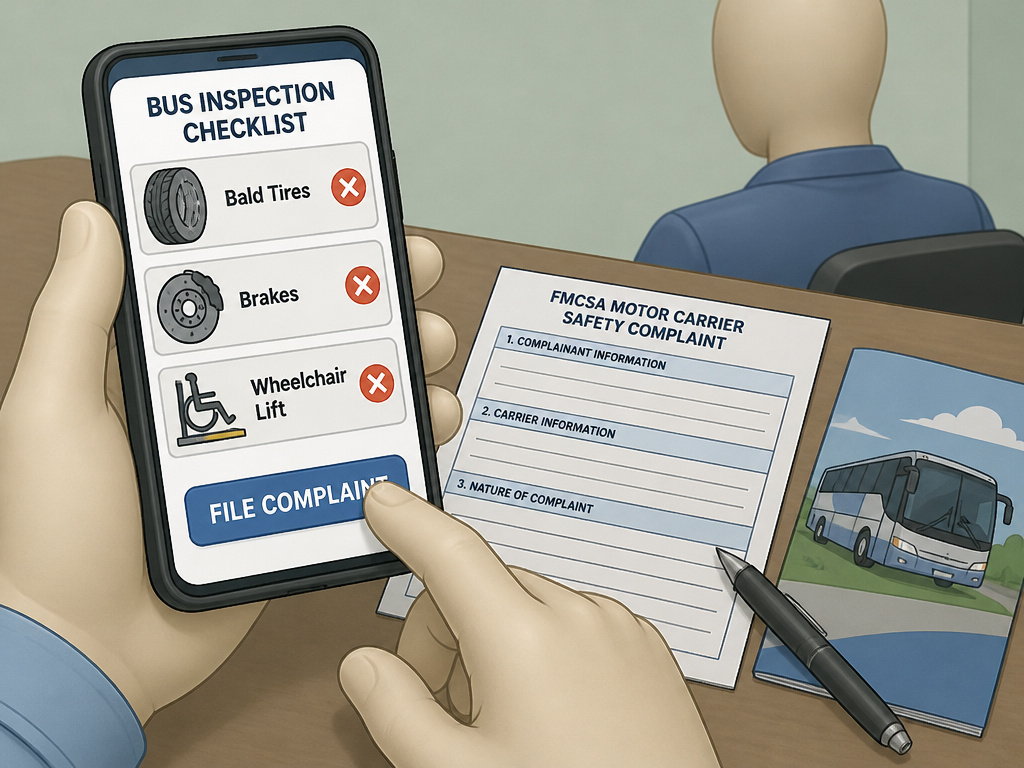
FMCSA asks you to report as soon as possible, but no later than 60 days from when you observed the issue.
What counts as a complaint is broader than most people assume. It covers the mechanical condition of the bus, bald tires, brakes that might be faulty, lights not operating properly. It also covers the driver’s actions or physical condition during the trip: texting while driving, nodding off, speeding, or driving past the legal hours.
There’s a separate channel for accessibility failures. You can file a complaint about any bus company violation of the Americans with Disabilities Act, including a broken wheelchair lift or a driver who doesn’t offer required assistance to a passenger with a disability.
That last one isn’t a courtesy issue. Accessible motorcoach service, with wheelchair lifts and securement areas, is a federal requirement under the ADA and U.S. DOT regulations. It’s a compliance obligation, not an amenity.
If you’re planning a longer haul and want the operator’s own recommendations on lodging and stops along the way, ask. Motorcoach and tour professionals deal with those suppliers daily and can often negotiate group rates. Motorcoach and tour professionals can often negotiate favorable group rates and provide extras.
Frequently Asked Questions
How do I look up a bus company’s safety record?
Use FMCSA’s Bus Safety Search. Enter the company name or USDOT number, pick the vehicle type and origin, then click the Safety Information link next to the result. That opens the Safety Measurement System record with the rating and violation categories.
What does a Conditional safety rating mean?
It means the company has some violations but may still operate, according to FMCSA’s Look Before You Book guidance. FMCSA’s trip-planning page frames the same rating as a possible higher safety risk. Read the underlying violation categories before you decide.
Is a bus company without a safety rating safe?
Not necessarily, and not necessarily unsafe. FMCSA states that a company without a rating has not had its operations evaluated against federal safety fitness standards. A carrier can hold valid operating authority and never have been assessed.
What insurance must a bus company carry?
For-hire interstate motorcoach companies must maintain at least $5 million in liability coverage. You can verify the active policy on the company’s safety webpage through the L&I link, under “Insurance on File” in the HTML report.
How long can a bus driver legally drive?
No more than 10 consecutive hours on an interstate route. Cumulative limits also apply: 60 hours on duty in any 7 consecutive days if the employer doesn’t operate daily, or 70 hours in any 8 consecutive days if it does.
How long do I have to file a bus safety complaint?
FMCSA asks you to report as soon as possible, but at least within 60 days of observing the issue. Complaints can cover mechanical problems or driver behavior, and ADA violations go through a separate filing channel.
Before You Go
If a carrier shows an Unsatisfactory rating, a red out-of-service notification, or no operating authority, it should not be running across state lines. If it’s still selling passenger trips, that’s worth a report to FMCSA, not just a pass on your part.
The concession I owe you: this entire checklist assumes an interstate carrier. If you’re booking a route that never crosses a state line, the federal database may not show your operator at all, and you’ll be calling a state DOT instead. Different office, same principle.
So here’s the first step, this week. Pick the route you’re actually planning and pull the USDOT number for the carrier you’re considering. Ten minutes on the FMCSA lookup, one L&I report, one glance at the rating. If the number comes back clean, book with confidence. If it doesn’t, you just saved yourself a very long ride.
