
How to Travel by Night Bus: Step-by-Step
This post contains affiliate links. As an Amazon Associate, we earn from qualifying purchases.
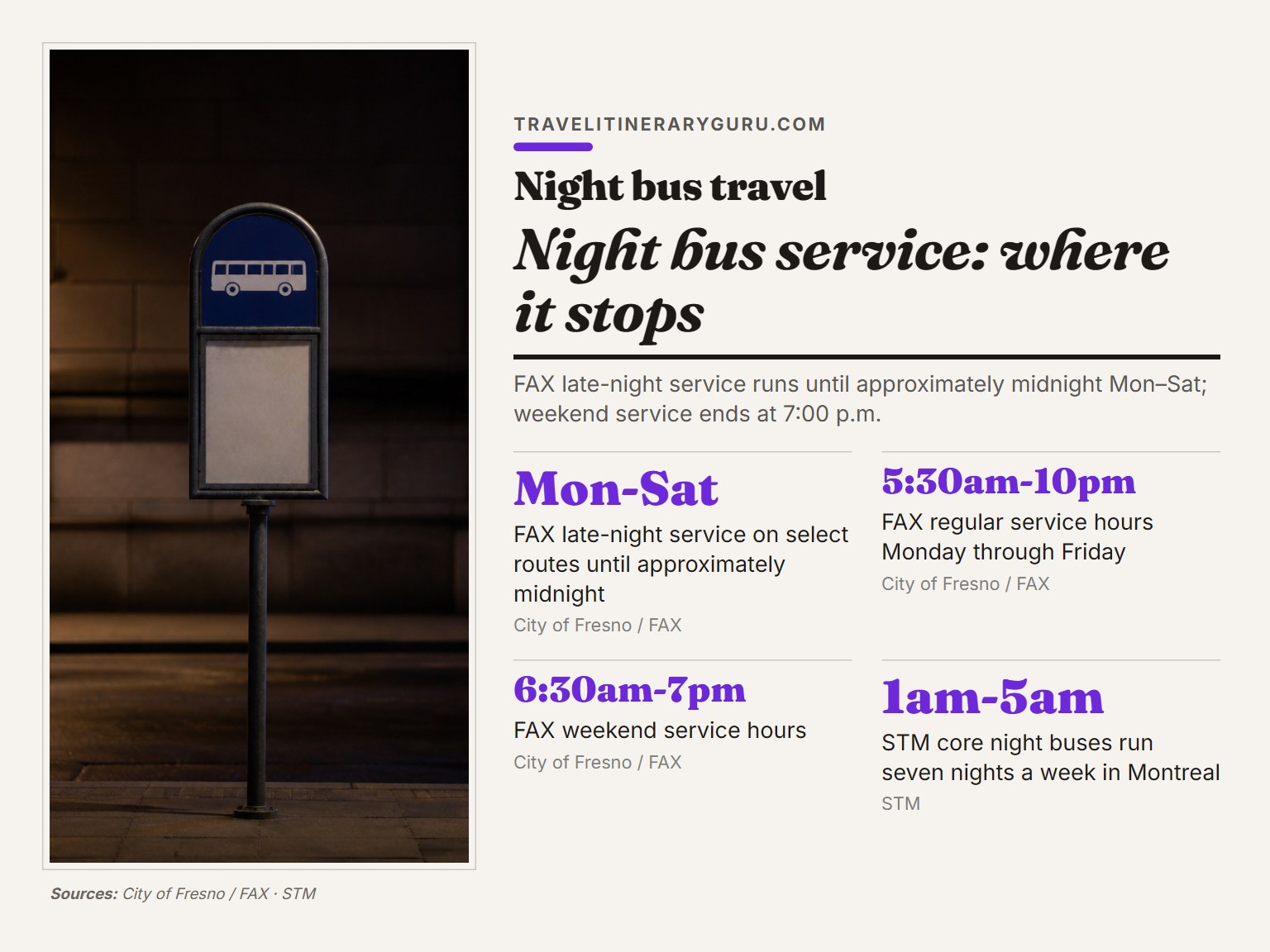
To travel by night bus, book the route before you book the sleep: check the arrival time, confirm the night window your city actually runs, and know whether you can get off between stops. Core night service in Montreal runs 1 a.m. To 5 a.m. Seven nights a week, but Fresno runs no overnight service at all.
The night window is the part that catches travellers out, because the phrase means three different things depending on which agency you ask, and knowing how to travel by night bus starts with learning each agency’s definition. Montreal’s transit authority treats 1 a.m. To 5 a.m. As its core overnight service, seven nights a week. Boston runs most buses from 5 a.m. To 1 a.m. And layers a thinner overnight service on top. Fresno has no overnight service at all.
What follows: how to pick a departure that doesn’t strand you at 4:50 a.m., what each operator actually says about arriving early, and the two rules that decide whether you can step off between stops.
Key Takeaways
- Check the arrival time before the departure time.
- Night service windows differ by city. Montreal runs core night buses 1 a.m. To 5 a.m. Seven nights a week. Fresno runs none, and nothing on Sunday.
- Boarding buffers aren’t standardized. FlixBus asks for 15 minutes, Busbud suggests 20 to 30, and Fresno and Transport for NSW set no fixed number at all.
- Between Stops is conditional. Montreal allows it from 7:30 p.m. To 5:30 a.m., but not on shuttles, express buses, or the Pie-IX BRT.
What Counts as a Night Bus Depends on the City
Three transit agencies, three different definitions, and the same two-word phrase on all three websites.
Montreal’s night network assigns route numbers in the 300s and prints the numbers in black on stop signage and schedules. Core service operates between 1 a.m. And 5 a.m. Seven nights a week, with headways running 4 to 45 minutes depending on the area served. Night routes run longer, which cuts the number of transfers.
Boston frames its overnight layer differently. Most MBTA bus routes run between 5 a.m. And 1 a.m., and some routes also run between 1 a.m. And 5 a.m. The MBTA bus guide treats that as an exception rather than the base service, and the agency adjusts its bus schedules every 3 months to account for demand.
Fresno takes the third position. FAX regular service runs Monday through Friday from 5:30 a.m. To 10:00 p.m. And on weekends from 6:30 a.m. To 7:00 p.m. Late-night service exists on select routes until about midnight Monday through Saturday, and there’s nothing at all on Sunday.
| City and operator | Overnight window | What it means for you |
|---|---|---|
| Montreal (STM) | 1 a.m. To 5 a.m., seven nights | Core night network covers most of the island |
| Boston (MBTA) | 5 a.m. To 1 a.m. Base, some routes 1 a.m. To 5 a.m. | Overnight is the exception layer, not the default |
| Fresno (FAX) | No true overnight, select routes to about midnight | Nothing runs on Sunday night |
Montreal publishes the whole night bus network schedule on the STM site, including the 4-to-45-minute headway range and the 300-series numbering. That headway range is the number that matters most, because it tells you how long you might stand on a kerb.
The part nobody mentions: A night network can look complete on a map and still leave you stranded. Montreal’s covers most of the island, not all of it, and coverage thins as you move outward from the centre.
The Arrival Time Matters More Than the Departure Time
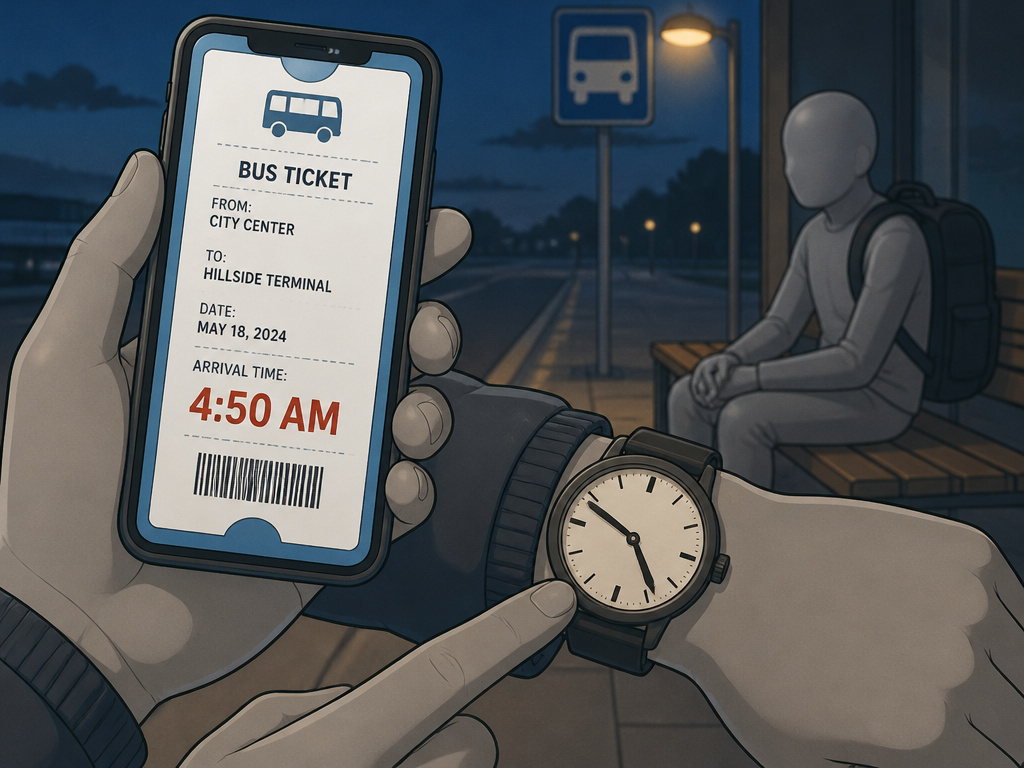
Now I check the arrival time before I check the departure time.
The bus did its job. The problem is what’s waiting at the other end.
The arrival-time problem hits hardest in bus travel in Europe, where Longer night routes exist partly to reduce transfers, which matters at 2 a.m. When you compare a how to travel by night bus and a missed connection means an hour outdoors.
What a Pre-Dawn Arrival Actually Costs You
- Look at the arrival time first. A 4:50 a.m. Arrival does not, and it’s the one you’ll remember.
- Confirm whether the arrival point is a station or a kerb. FlixBus notes that many of its stops sit at street level rather than at traditional bus stations, so a waiting room and staff aren’t guaranteed.
- Check what opens when.
- Decide before you book whether to reserve the night you won’t sleep in.
I’ve stopped treating a night bus as a way to skip a hotel night. The sleep you lose on a reclining seat is real, and the two hours you spend waiting for a city to wake up is the part that never makes it into the plan.
How Early Should You Actually Get to the Stop?
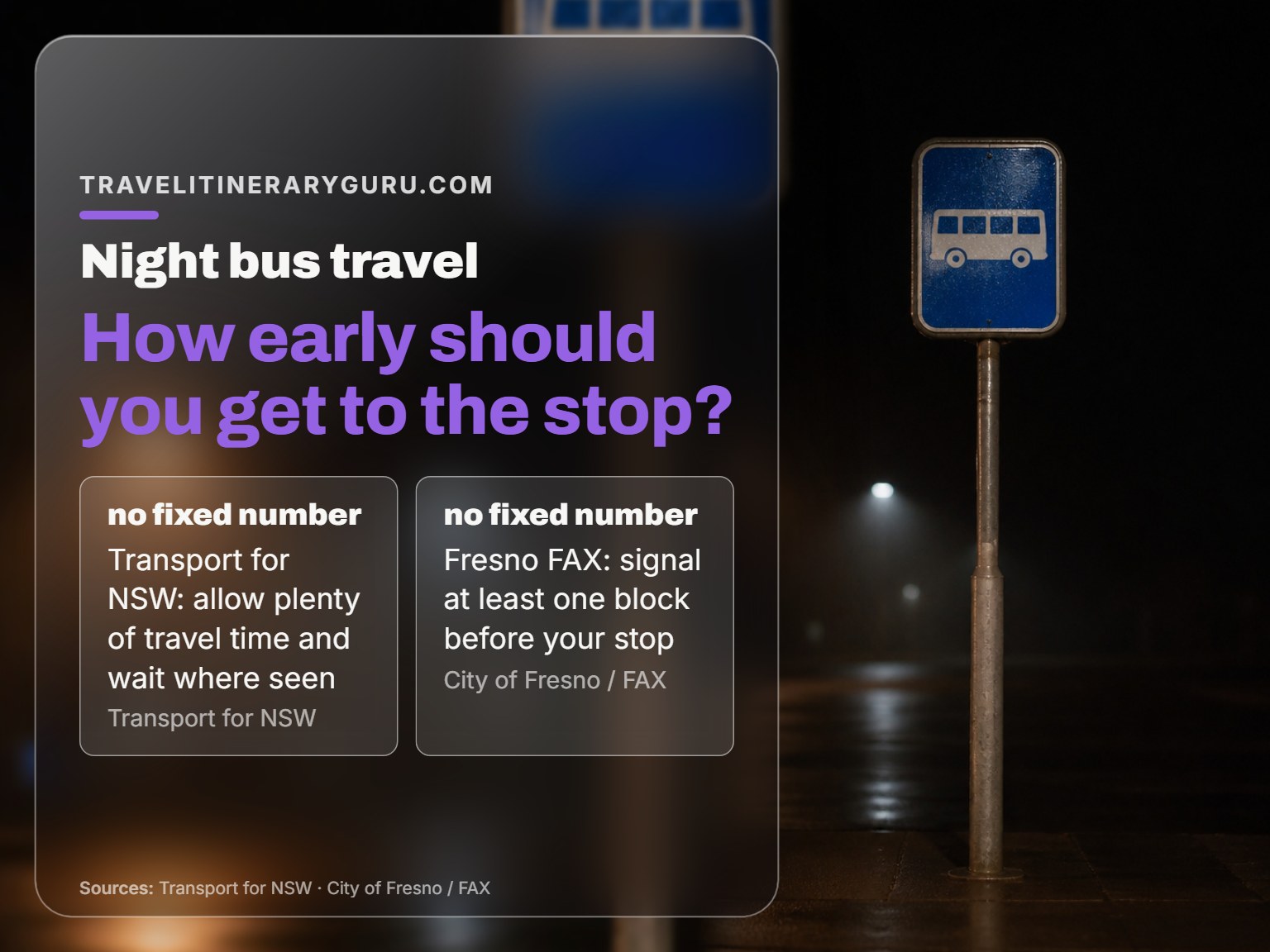
No two operators give the same answer to how to travel by night bus, and the gap between them is wide enough to matter.
FlixBus recommends arriving at your stop at least 15 minutes before departure, and it warns that the bus won’t wait for late passengers. Busbud’s overnight-travel guide suggests 20 to 30 minutes at a bus station. Transport for NSW and Fresno FAX both decline to set a fixed buffer, and instead put the burden on you to signal in time.
What Each Operator Actually Says
- FlixBus: at least 15 minutes, plus a check of your booking confirmation for the exact boarding location, since many stops sit at street level.
- Busbud: 20 to 30 minutes.
- Transport for NSW: no fixed number. Allow plenty of travel time and wait where the driver can see you.
- Fresno FAX: no fixed number either. Signal a minimum of one block before your stop.
Fifteen minutes is a floor. If the stop is street level and you’ve never seen it in daylight, add the time it takes to find it twice.
I’ve started treating the buffer as the time it takes me to locate the stop, not the time I spend standing at it.
Common mistake: Treating the departure time as the deadline. On a night bus the deadline is the moment the doors close, and FlixBus’s own guidance is that the bus won’t wait.
Most of this gets settled when you’re booking intercity bus tickets, because the confirmation email is the only place the exact boarding point reliably appears.
Can You Get Off Between Stops at Night?
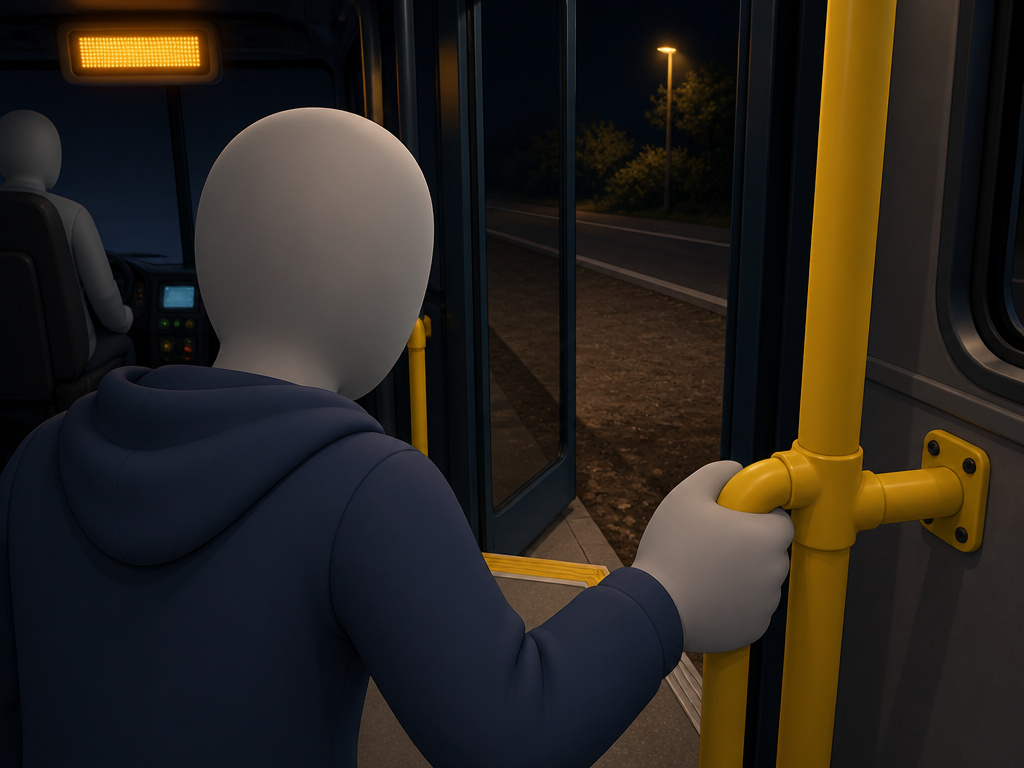
This one catches visitors every time.
Montreal runs a formal policy called Between Stops. From 7:30 p.m. To 5:30 a.m. All year round, any customer travelling alone or with children can get off the bus between two stops on a route. It applies on regular and night buses.
It doesn’t apply on shuttles, express buses, or buses running on the Pie-IX BRT. The STM’s stated reason is schedule reliability: a bus that stops anywhere can’t hold a headway on a dedicated corridor.
Before you start: Stepping off between two stops puts you on a live road, often with no lighting and no footpath. The driver makes the final call on whether the spot is safe, so ask a stop ahead and accept a no. If you use a wheelchair, the drop point has to be somewhere the ramp can deploy, which rules out plenty of otherwise quiet corners.
Most night travel safety tips come down to two things: being seen by the driver, and never rushing a step. The same bus travel safety logic applies at 2 a.m., with one addition. Darkness removes the visual cues you’d normally use to judge a stop.
Where to exit is the one place the rulebooks openly disagree. Fresno asks passengers to leave through the rear doors if possible, so new passengers can board at the front. Transport for NSW takes the opposite line: use whichever doors are most convenient, and use the front doors if you need assistance.
Rear doors win on a full bus when you’re able-bodied and the front is clogged. Front doors win when you need the driver’s help, when you’re unsteady on your feet, or when you’re travelling with a pram. The Transport for NSW bus safety guidance also gives priority boarding to passengers with a disability, with the driver assisting on and off.
The visual cue that your stop is coming is the Next Stop sign behind the driver’s cabin, which lights up once anyone has pressed the button. If you can’t reach it, ask another passenger.
A few rules hold regardless of city:
- Wait until the bus comes to a complete stop before leaving your seat.
- Keep both feet planted on the floor while seated, in case the bus stops suddenly.
- Use the handrail on the way down and mind the gutter.
Why Your Seat Choice Changes How You Sleep
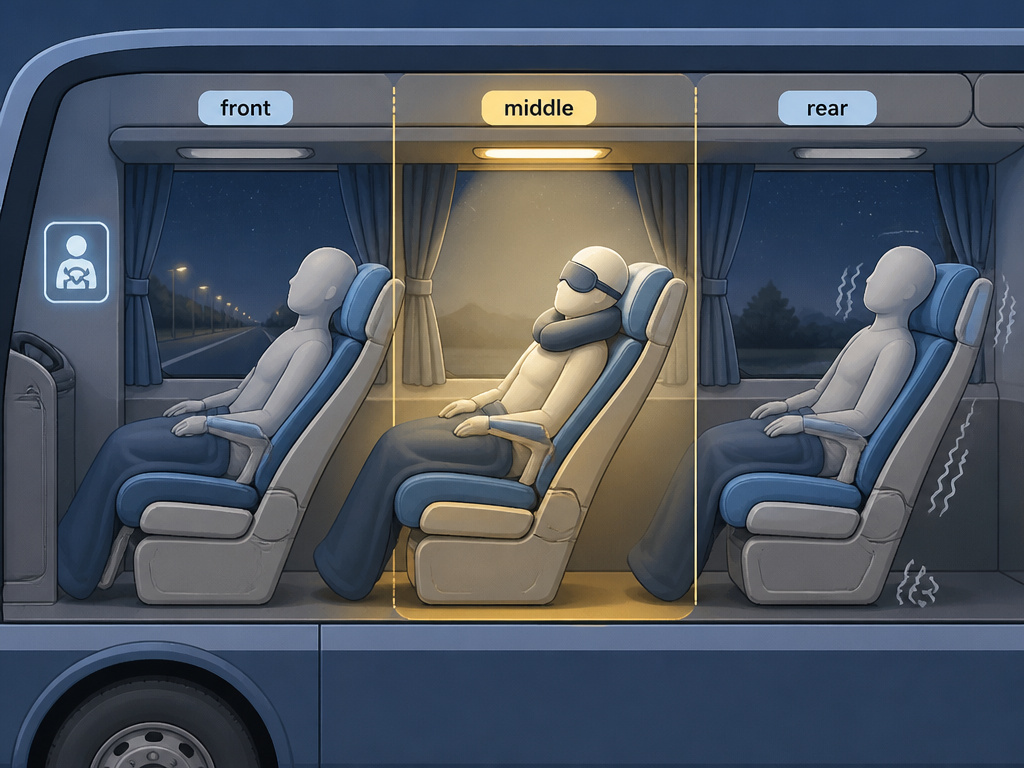
Seat position does more for your sleep than anything you pack.
Busbud’s overnight guide is direct about it: middle seats give the best comfort and the best odds of sleeping, rear seats ride bumpier, and front seats are more distracting. Transport for NSW gives the opposite instruction to a different group, telling riders with limited mobility or who feel unsteady on their feet to sit near the front.
Both are right, because they’re solving different problems. Busbud is optimising sleep quality. NSW is optimising stability and access to the driver.
Seat Position: Two Schools of Thought
If you’re able-bodied and trying to sleep, the middle wins.
If you’re unsteady, travelling with a pram, or you’ll need help getting off, the front wins and sleep quality becomes the secondary concern.
Stop count is where the advice gets thinner. Busbud recommends choosing night routes with as few stops as possible, because each stop risks lights coming on and a PA announcement. Neither Montreal nor Boston frames stop count as a sleep variable; Montreal presents its longer night routes as a feature, since they cut transfers.
FlixBus suggests a travel pillow, an eye mask, or earplugs, and notes that onboard services are subject to availability.
The packing essentials for an overnight bus are short: a pillow that holds your chin, a layer you can take off, and your valuables somewhere on your body rather than in the overhead. Most sleep tips for overnight travel carry over to a reclining seat without much adjustment.
Where Standard Night Bus Advice Falls Apart
FlixBus stops are often at street level, and that one detail breaks a long list of assumptions.
A street-level stop has no waiting room, no staff, and no guaranteed lighting. FlixBus tells riders to check the booking confirmation for the exact boarding location for that reason.
The Sunday Gap and Other Edge Cases
- Fresno has no overnight service and nothing on Sunday. Late-night runs on select routes go until about midnight Monday through Saturday, so a Saturday-night plan doesn’t carry into Sunday.
- Older buses may not kneel. NSW notes that a driver may be unable to lower the bus for boarding, which makes accessibility fleet-dependent rather than guaranteed.
- Airport coverage is separate from general night coverage. In Montreal, the 747 shuttle runs 24/7, and night routes 356 and 378 also serve the airport. Elsewhere, you need to check.
| What goes wrong | Why | What to do |
|---|---|---|
| Stranded after midnight on a Sunday | No overnight service, and Fresno runs none on Sunday | Plan the Saturday night bus or another mode |
| The bus sails past your stop | The driver never saw you | Stand where you can signal and be seen |
| Doors close before you reach them | The driver isn’t obliged to reopen once departed | Ring the bell with plenty of time |
| You can’t get off between stops | Between Stops excludes shuttles, express, and Pie-IX BRT | Check the route type before you rely on it |
The wider intercity bus travel picture matters here too, because a route that works on paper can still leave you at a kerb at 3 a.m. Check before you book.
If you want one answer for a US overnight run, start with FlixBus, whose onboard services are subject to availability.
Where this goes sideways: Booking a night bus to skip a hotel night, then arriving somewhere with no staff, no waiting room, and no transport until morning.
Frequently Asked Questions
Is it safe to sleep on a night bus?
Operator guidance treats night buses as ordinary scheduled service, and Transport for NSW notes that police and transport officers regularly patrol buses and interchanges. The practical risks sit closer to you: leaving valuables visible, missing your stop, and stepping off somewhere unlit. FlixBus’s own advice is to keep valuables close to you.
Do night buses run every night?
It depends entirely on the city. Montreal’s core night buses run from 1 a.m. To 5 a.m. Seven nights a week. Boston runs most routes from 5 a.m. To 1 a.m., with some routes also running from 1 a.m. To 5 a.m. Fresno has no true overnight service, and its late-night routes run only Monday through Saturday.
What happens if I miss my stop?
You’ll likely end up at the end of the line, where Fresno’s rules require all passengers to exit the bus. Transport for NSW is clear that once a bus has departed a stop, the driver isn’t obliged to reopen the doors. Ring the bell early and watch for the Next Stop sign behind the driver’s cabin.
Can I get off between stops on a night bus?
In Montreal, yes, under the Between Stops policy, from 7:30 p.m. To 5:30 a.m. All year round. It covers regular and night buses, and it excludes shuttles, express buses, and the Pie-IX BRT. The driver still decides whether the spot is safe.
How do I find a night bus route in a city I don’t know?
Start with the transit agency’s own site rather than an aggregator. Montreal numbers its night lines in the 300s and prints those numbers in black on stop signage, which makes them easy to spot. Boston publishes a dedicated page for every route with alerts and stop changes. In Fresno, the night service map is the only reliable source for which routes run late.
Before You Go
The one number that should change your plan is the arrival time.
The second is the boarding buffer. If your stop is street level, add time to find it. If it’s a staffed station, follow the operator’s own figure, and FlixBus’s figure is 15 minutes.
This all changes on a route where the bus is the only option. Then the arrival-time math doesn’t disappear, it just stops being a choice, and the pillow that holds your chin becomes the thing you don’t leave home without.
Most night bus advice won’t tell you that, because the version that sounds most efficient is the one that gets shared.
