
How to Navigate Public Transit in Japan: Step-by-Step
This post contains affiliate links. As an Amazon Associate, we earn from qualifying purchases.
To navigate public transit in Japan, get an IC card (Suica or PASMO in Kanto, ICOCA or TOICA elsewhere), tap in and tap out, and check the IC symbol before boarding any bus — because not every bus takes cards, and cash rules differ between flat-rate and distance-based routes.
The IC card is the default answer, but it’s not a universal key. Highway buses don’t take cards at all, some regional transport doesn’t either, and a card issued in one area may not work in another. That last point trips up more travelers than any fare question, because the card in your pocket feels like it should work everywhere. Learning how to navigate public transit in Japan means accepting that it doesn’t.
What follows covers the card you should buy, the exact payment rules for both bus systems, the one national pass that fails on a municipal subway, and the etiquette that keeps you from being the person everyone remembers.
Key Takeaways
- Buy an IC card on arrival — the deposit is 500 yen and it’s refundable when you return the card to a ticket counter.
- Check for the IC symbol before boarding a bus. No symbol means cash only, and on non-flat-rate buses, if you overpay, no change is given.
- The JAPAN RAIL PASS does not work on Kyoto City Bus & Subway, despite covering JR lines in Tokyo.
- Tourist passes need your passport at purchase, and they’re sold at Tokyo Metro Pass Offices, some station information counters, and Bic Camera stores.
- Trains stop around midnight. Japan’s public transport does not run all night, so plan your last ride or budget for a taxi.
Which IC Card Should You Actually Buy?
Suica and PASMO are the two most commonly used IC cards in the Kanto area, and either one works for the vast majority of Tokyo trips. Outside Kanto, ICOCA and TOICA show up depending on the region. If you’re flying into Tokyo and staying in Tokyo, the choice barely matters.
Here’s where it gets less simple. Depending on the card, you may only be able to use it in certain areas and with certain forms of transportation. That’s the official wording from the Japan National Tourism Organization, and it’s worth reading twice, because the marketing around IC cards implies universal coverage that the fine print doesn’t support.
IC cards in Japan operate as prepaid, rechargeable fare media accepted across most urban rail and bus networks, but coverage varies by card issuer, region, and transport mode. Travelers should verify acceptance before relying on a single card for a multi-region trip.
If you’re arriving as a tourist and want to skip the deposit entirely, Welcome Suica is a deposit-free IC card available at certain places in the Kanto area, valid for up to 28 days. It doesn’t come with a refundable deposit because there’s no deposit to refund. For a two-week trip, that’s the cleaner option.
For everyone else, the standard card works fine. The deposit fee for most cards is 500 yen, and you get it back when you return the card to a ticket counter at the end of your stay. You can add money at almost all train stations using the automatic ticket machines.
You can also set up Suica or ICOCA on an iPhone through Apple Wallet and use it on trains, buses, taxis, and some stores. Be aware that mobile IC cards may not work on all smartphones, so don’t count on it as your only plan.
The Deposit Math on a Two-Week Trip
Five hundred yen sits on the card the whole trip. You get it back at the end if you return the card. If you’re the type who leaves with a drawer full of foreign transit cards, Welcome Suica sidesteps the question.
How Much Do Subway Fares Actually Cost?
Tokyo Metro tickets cost from 180 to 330 yen depending on how far you travel. Toei fares run a little higher, ranging from 180 to 430 yen. The gap between the two systems is real, and it’s the reason a mixed Tokyo Metro and Toei itinerary can cost more than you’d expect when you compare a how to navigate public transit in Japan.
Tokyo’s subway network covers more than 280 stations, so the distance-based pricing makes sense once you’ve seen the map. Short hops inside a single ward stay cheap. Cross-city runs push toward the top of the range.
| System | Fare Range | Best For |
|---|---|---|
| Tokyo Metro | 180 to 330 yen | Most central Tokyo trips |
| Toei | 180 to 430 yen | Routes Tokyo Metro doesn’t cover |
| JR lines in Tokyo | JAPAN RAIL PASS accepted | Pass holders, longer hops |
| Kyoto City Bus & Subway | JAPAN RAIL PASS not accepted | Kyoto-only travel |
If you’re riding the subway several times in one day, Tokyo Metro and Toei both offer discount tickets for frequent subway travel. The tourist pass is the better-known option: unlimited travel on all subway lines as a 24-, 48-, or 72-hour ticket. You will need to bring your passport to prove you’re a visitor.
Those passes are sold at Tokyo Metro Pass Offices, Tourist Information counters at some subway stations, Bic Camera stores, and tourist information centers around the city. Not every station sells them, so buy one when you see one rather than assuming the next station will have them.
The 160 cm Rule That Catches Shinkansen Travelers
Oversized baggage on the Tokaido, Sanyo, Kyushu, or Nishi Kyushu Shinkansen is where a lot of first-time travelers get stopped at the platform. If your bag’s total dimensions exceed 160 cm, you need a dedicated seat reservation. Not a bigger seat. A reservation specifically for the oversized bag.
Most travelers never hit that number. A standard carry-on is well under it. But if you’re moving with a large suitcase or a bike box, measure before you book, because the rule is enforced at boarding, not at the ticket window.
For a deeper look at what to bring and what to leave, the guide to the best luggage for Japan covers the sizing that actually works on Japanese trains.
If you are moving between cities with a suitcase, the practical rules for transit with luggage matter more than the train timetable itself. Most train and bus stations have lockers, and there are apps that let you reserve baggage storage at affiliated shops if the lockers are full.
Easy to miss: The 160 cm rule applies to total dimensions, not just length. A long but slim bag can still cross the threshold once you add height and depth.
How Do You Pay for a Bus in Japan Without an IC Card?
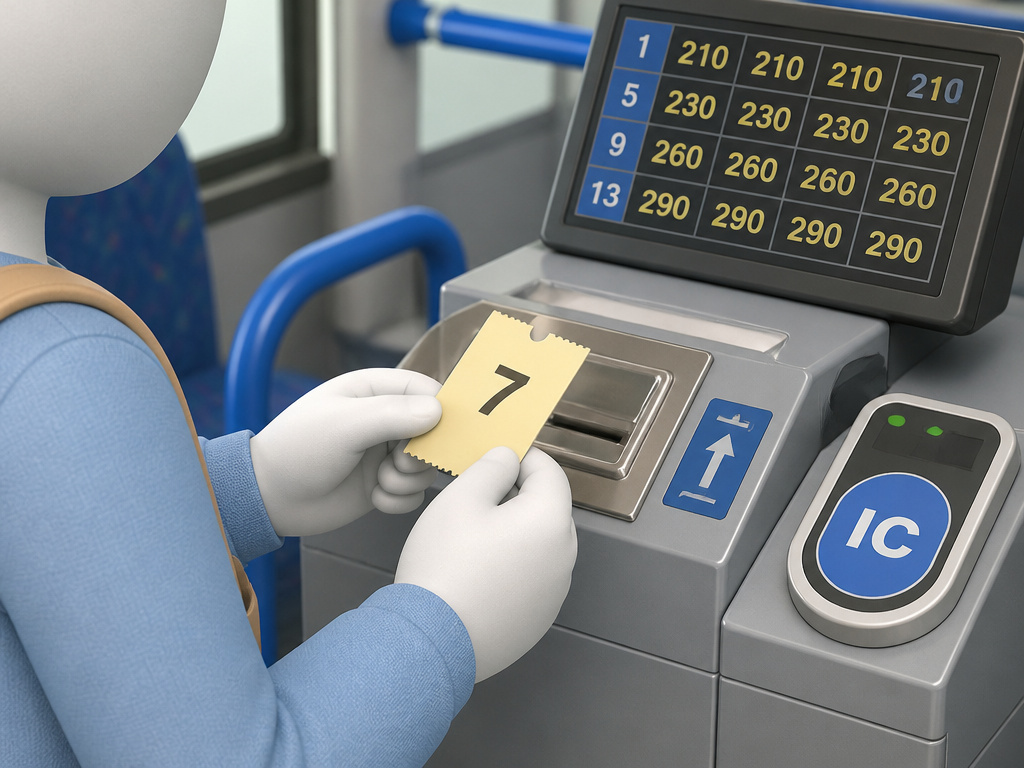
Two bus systems operate in Japan, and the payment rules are opposite. Get this wrong and you’ll either hold up the line or lose money, so the how to navigate public transit in Japan question matters here.
On distance-based buses, you board at the rear, take a numbered ticket from the box, and pay the exact fare at the front when you exit. As you approach your stop, check the screen at the front of the bus and find your number along with the corresponding fare. If you overpay on this system, no change is given.
On flat-rate buses, you board at the front and pay when you get on. If you overpay here, change is typically returned. Most buses also have exchange machines for cash payments.
| Bus Type | Board At | Pay When | Change Given? |
|---|---|---|---|
| Distance-based | Rear | On exit, at front | No |
| Flat-rate | Front | On entry | Yes, in most cases |
| IC card (any bus) | Either | Tap on, tap off | N/A |
If you use an IC card on a bus, tap it once when you get on and again when you get off. Not all buses accept IC cards, so check for the IC symbol at the bus stop or at the bus entrance before you commit. If there’s no IC symbol, you’re paying cash.
What most people get wrong: Assuming the bus takes cards because the train did. Highway buses and some regional transport don’t accept IC cards at all, and the IC symbol is the only reliable signal.
Where the JR Pass Quietly Stops Working
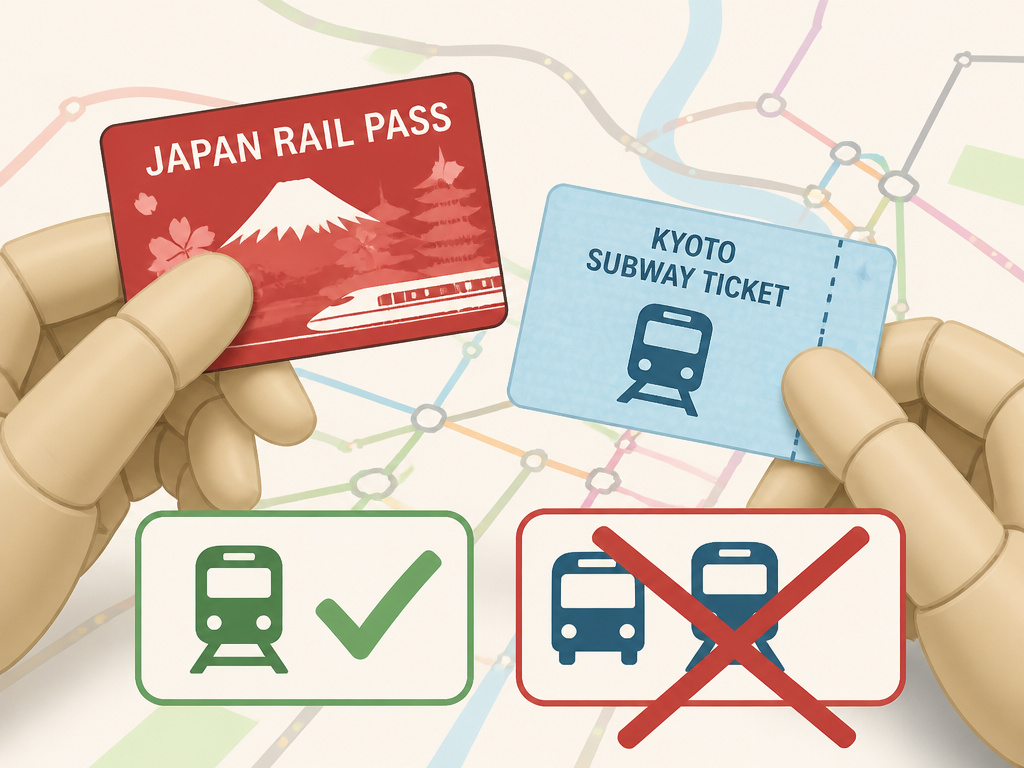
The JAPAN RAIL PASS is accepted on JR lines in Tokyo, which is where most travelers form their impression of it. It is not accepted on Kyoto City Bus & Subway. The JAPAN RAIL PASS is not accepted on Kyoto City Bus & Subway.
The practical consequence is simple. If you’re basing yourself in Kyoto and relying on the subway and city buses to get around, the pass does nothing for you on those systems.
For foreign tourists, KANSAI ONE PASS is an IC card for foreign tourists visiting Japan.
Skip this if: Your trip is Tokyo-only and you’re staying inside the JR Yamanote loop. The pass earns its keep on long-distance shinkansen runs, not on short urban hops.
What Time Do Trains Stop Running in Japan?
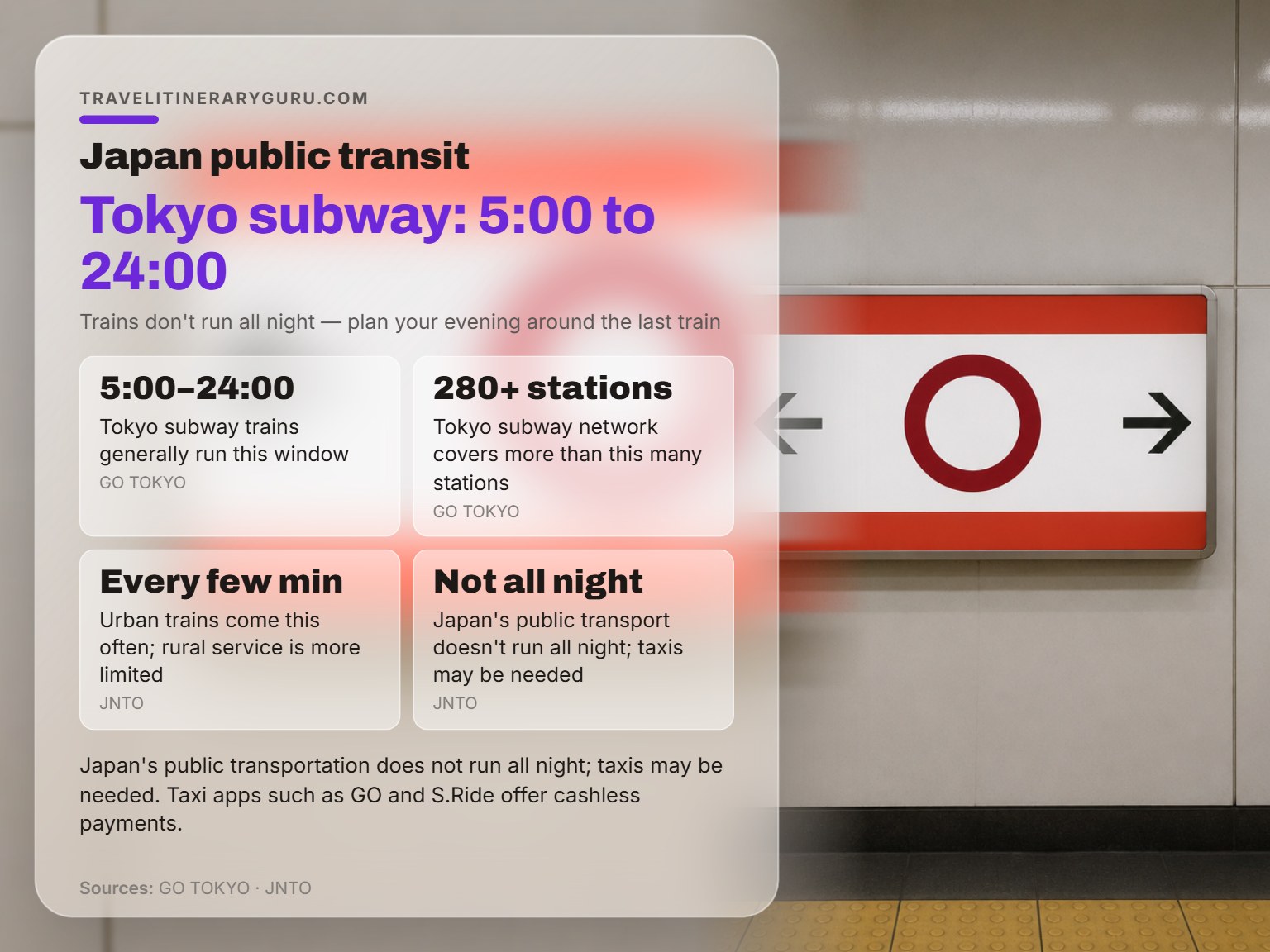
Tokyo subway trains generally run from 5:00 to 24:00. That’s the official window from the Tokyo Metropolitan Government’s guide, and it’s the number to plan your evening around. Japan’s public transportation does not run all night, and taxis become the only option after the last train.
In major cities, trains come every few minutes. In rural areas, services can be more limited and require advance planning.
When you do need a taxi, apps such as GO and S.Ride offer quick dispatch, arrival alerts, direct messaging, and cashless payments.
The Signage System That Makes Tokyo Navigable
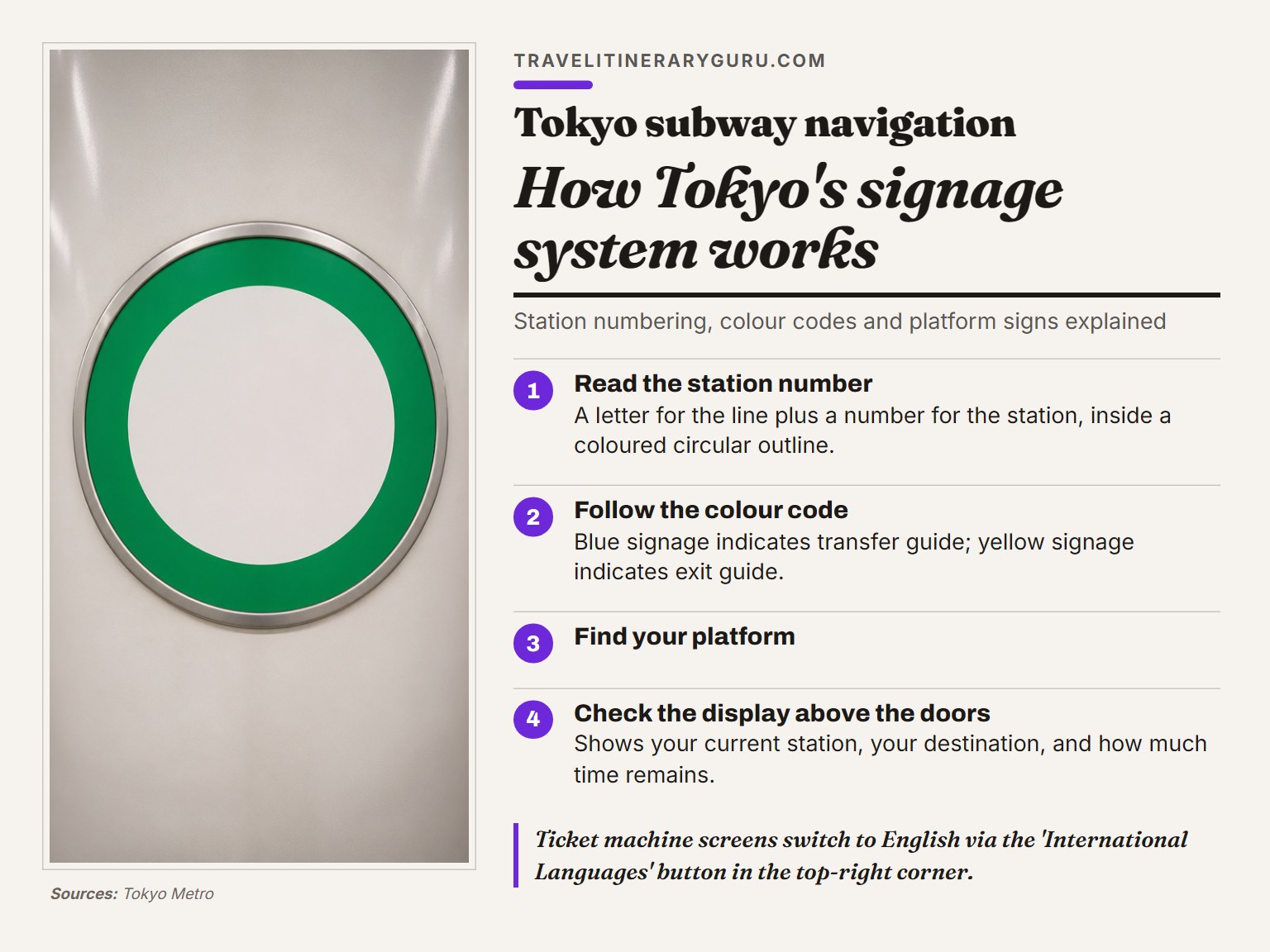
Tokyo Metro uses a station numbering system: a letter for the line plus a number for the station, inside a colored circular outline. Once you know your line letter, you can find your stop on any map in the station without reading Japanese.
The color code matters too. Blue signage indicates transfer guide. Yellow signage indicates exit guide. Follow the wrong color and you’ll end up on the wrong platform, which in a station like Shinjuku is a real time cost.
Find your platform by looking for your train line and direction on the sign. The sign shows the direction with numbers and station names, along with the main stops in each direction. Once you’re on the train, information displays above the doors show your current station, your destination, and how much time remains.
Worth knowing before you start: The ticket machine screen can be switched to English by pressing the “International Languages” button in the top-right corner. It’s the first thing to look for if the interface is in Japanese.
Where Sources Disagree on Paying for Tickets
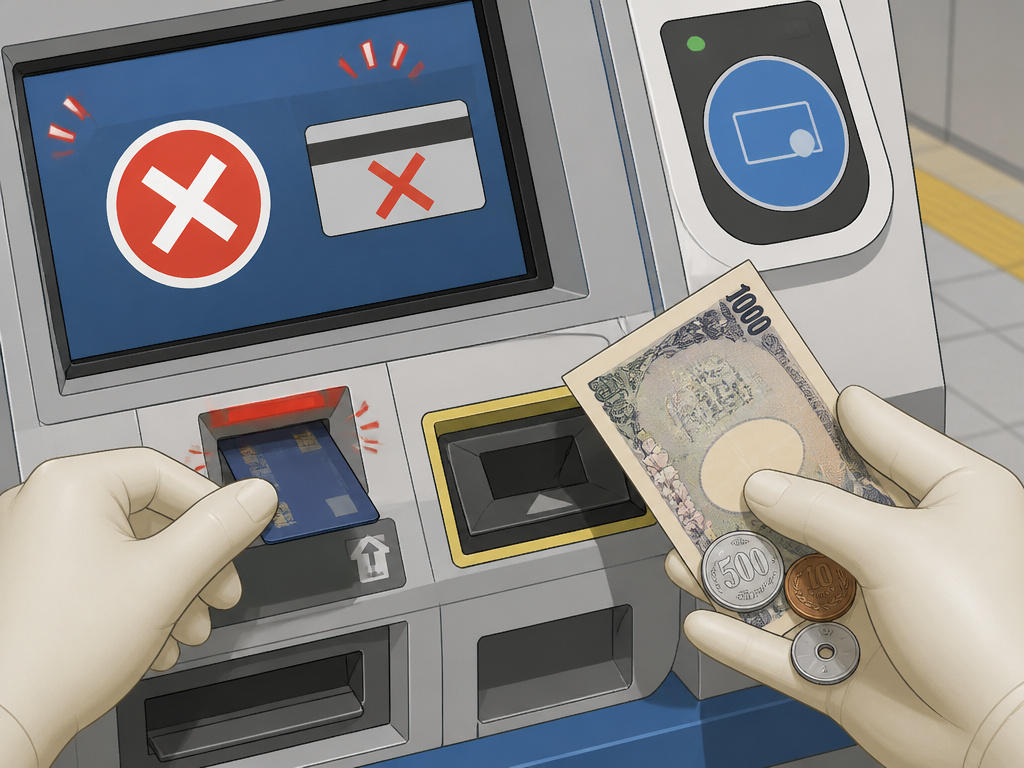
Tokyo Metro states plainly that credit cards cannot be used at its ticket machines except when purchasing passes. That’s an operator-specific restriction, not a national rule. The Japan National Tourism Organization and JR West are both silent on credit card acceptance at ticket machines, which means the restriction isn’t repeated or confirmed for other operators.
The safe read: assume card payment works for passes and not for single tickets, and carry cash for the rest. If you’re buying a tourist pass, the credit card is usually fine. If you’re topping up an IC card, use cash.
Common mistake: Trying to buy a single-ride ticket with a credit card at a Tokyo Metro machine. The transaction will fail, and the line behind you will notice.
For a broader look at how contactless payment systems work across different transit networks, the guide to contactless payment covers the card types and terminal behavior you’ll encounter.
The Etiquette Rules That Actually Get Noticed
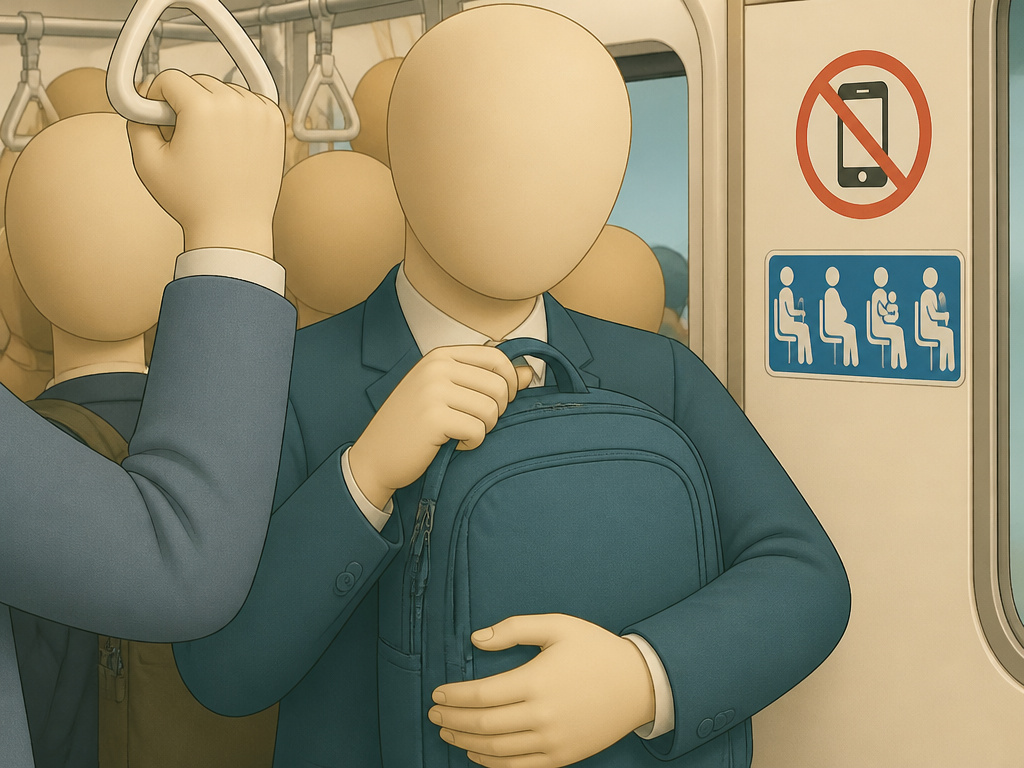
Japanese transit etiquette is less about strict rules and more about not creating what locals call meiwaku, a disruption to the shared space. A few of the behaviors are universal. A few aren’t.
Refrain from talking on the phone while on the train. On long-distance trains like the shinkansen, it’s acceptable to use the corridor between cars for calls. People typically don’t make phone calls or play sound from mobile devices on public transport, and the standard is followed closely enough that a loud call stands out.
Take your backpack off and either carry it by hand or put it on the luggage rack so you don’t bump into others. On crowded trains, you may see people wearing backpacks on their front. That’s regarded as good manners because it prevents inadvertently knocking the people standing close behind you.
Give up your seat in the priority seat area. Women-only cars operate during morning rush hour. No smoking or vaping on public transit.
Check where to line up when waiting for public transport. Markings on the ground show where to stand, and standing in the right spot lets people get on and off quickly, which keeps services on schedule.
If you want the fuller picture of how these customs fit together, the guide to Japanese etiquette goes deeper than the transit-specific rules.
The Apps That Replace the Paper Map
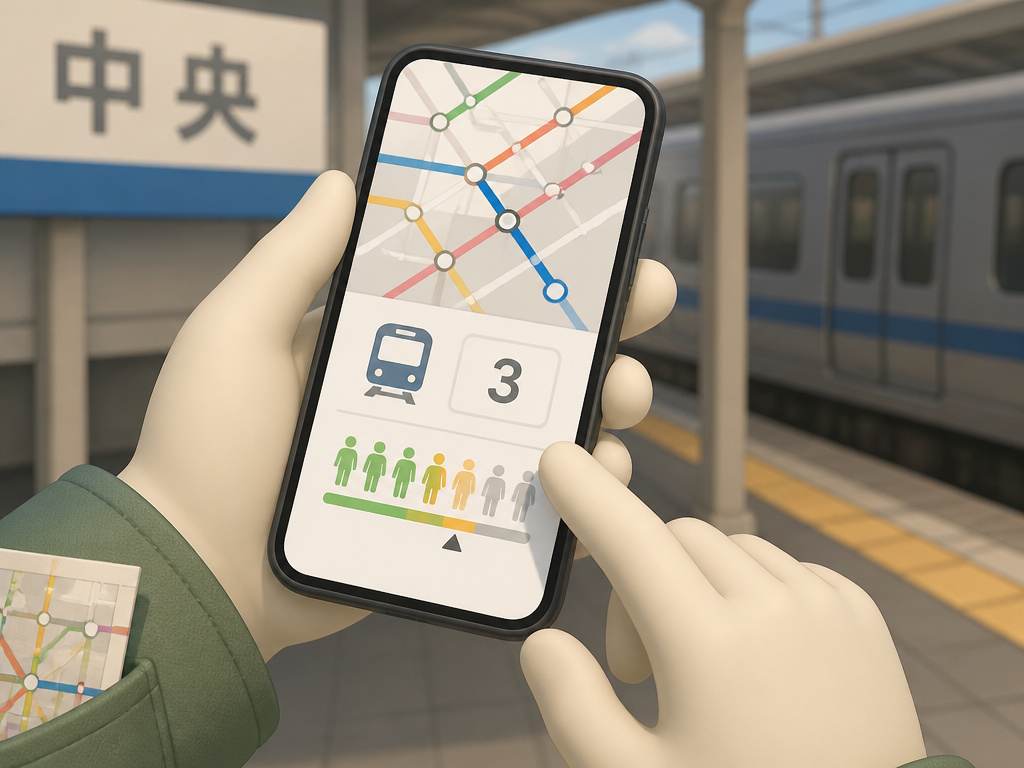
Google Maps works well in Japan and, for train travel, includes platform information, travel costs, and how crowded the carriages are at that time of day. That last feature is more useful than it sounds when you’re deciding whether to take the next train or wait for a quieter one.
Other options include Japan Transit Planner and CityMapper. The “Tokyo Metro For Tourists” app searches routes across trains, buses, taxis, and shared bicycles, and provides real-time crowding and train location info. Japan Travel – Trip, Transit & Rail (Navitime) covers restaurant options, tourist destinations, route guidance, and ticket purchase links.
For translation, Google Translate offers photo, voice, and text modes. VoiceTra is a speech translation app that supports over 31 languages. Either one handles a station attendant conversation.
I’ll be honest about my own bias here: I plan the transit card and the two or three lines I’ll actually use before I land, then download the offline map. That’s the whole prep. Ten minutes at a kitchen table beats twenty minutes of confused scrolling in a station concourse.
Do You Need an Airport Train or a Taxi?
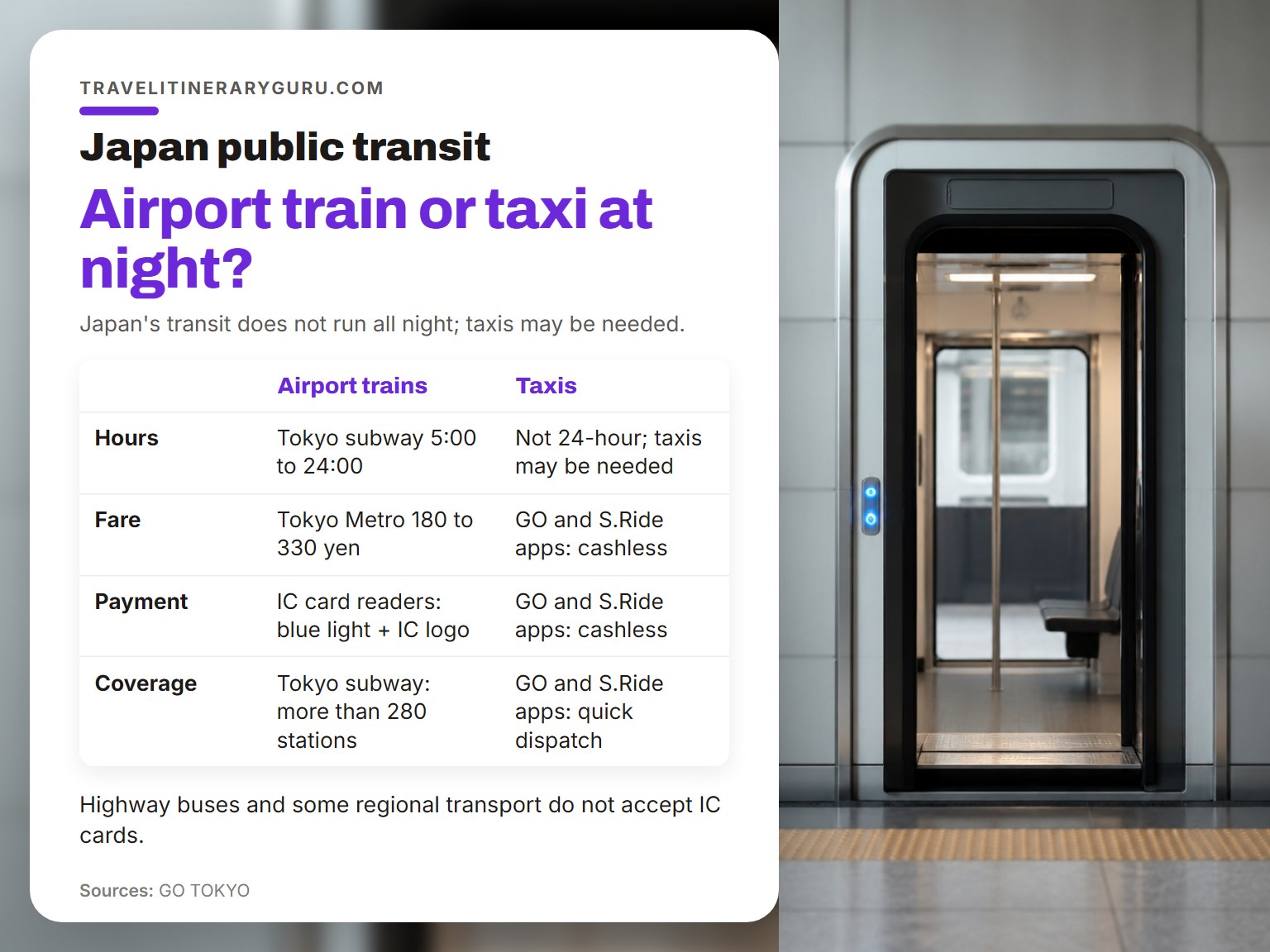
If you’re arriving late at night after the last train, a taxi may be needed. The comparison of airport trains versus taxis covers the specific routes where the math flips.
If no IC symbol is present on a bus, payment must be in cash, and highway buses and some regional transport do not accept IC cards.
Frequently Asked Questions
Can I use my Suica card anywhere in Japan?
No. Suica and PASMO are the most commonly used IC cards in the Kanto area, and ICOCA and TOICA appear in other regions. Depending on the card, you may only be able to use it in certain areas and with certain forms of transportation. Check the IC symbol on the bus or at the station before you assume the card works.
What happens if I underpay my fare?
Use a fare adjustment machine inside the ticket gate. Use a fare adjustment machine inside the ticket gate. Paper tickets are collected on exit, so if you’ve already passed the gate with an underpaid ticket, you’ll need to find the adjustment machine before the exit turnstile.
Is the JAPAN RAIL PASS worth it for a Tokyo trip?
For Tokyo-only travel, probably not. The pass is accepted on JR lines in Tokyo, but most short urban hops are cheap enough that the pass doesn’t pay for itself. It earns its keep on long-distance shinkansen runs. And it isn’t accepted on Kyoto City Bus & Subway at all.
Do buses in Japan take credit cards?
Not directly. Cash or IC card is the standard. Some buses have exchange machines for cash payments, and if there’s no IC symbol at the stop or the entrance, you’ll need cash. On distance-based routes, bring exact fare, because no change is given if you overpay.
How late do trains run in Japan?
Tokyo subway trains generally run from 5:00 to 24:00. Japan’s public transportation does not run all night, so if you’re out past midnight, plan on a taxi. Apps like GO and S.Ride offer quick dispatch, arrival alerts, direct messaging, and cashless payments.
Can I set up my IC card on my phone?
Yes, if your phone supports it. Suica and ICOCA can be set up or transferred onto iPhones via Apple Wallet and used on trains, buses, taxis, and some stores. Be aware that mobile IC cards may not work on all smartphones, so don’t rely on it as your only payment method.
The Bottom Line
One rule most guides skip: if your trip crosses regions, buy your IC card in the region you’ll spend the most time in, and don’t assume it works everywhere else. A Suica bought in Tokyo may not be usable on every form of transport in Kansai, and the fine print on that is real.
Your first step this week: before you book anything, open Google Maps and plot the two or three lines you’ll actually use from your hotel to the places you care about. That’s the entire unfamiliarity problem solved. The rest is tapping a card on a blue light and listening for the beep.
