
How to Travel by Public Transit With Luggage: Limits Vary
This post contains affiliate links. As an Amazon Associate, we earn from qualifying purchases.
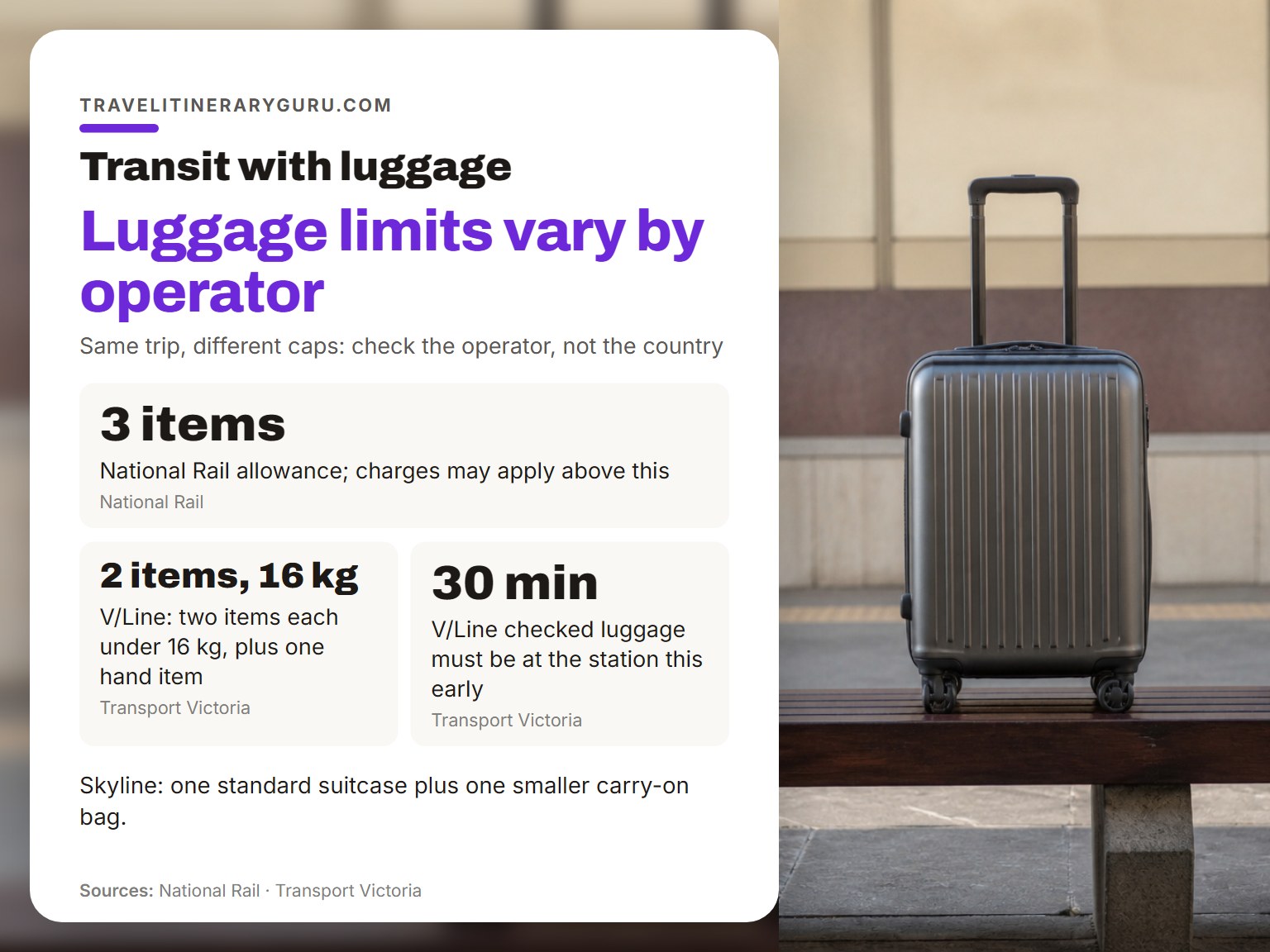
To travel by public transit with luggage, carry it yourself and check your operator’s item cap before you board: National Rail and Thameslink allow 3 pieces at no extra cost, V/Line allows 2 items under 16 kg each, and Honolulu’s Skyline allows one suitcase plus a carry-on.
Weight is where the published numbers split hardest. Thameslink caps assisted luggage at 23 kg per item, V/Line draws the line at 16 kg per item with a 32 kg total, and Ferrotramviaria’s free piece tops out at 10 kg.
What follows covers how each operator counts a bag, the weight and size caps that get checked at the barrier, what’s banned outright, and the pre-boarding routine that keeps a connection from turning into a scene.
Key Takeaways
- Three pieces is a UK habit. National Rail and Thameslink both allow 3; V/Line allows 2 items plus 1 hand item; Skyline allows one suitcase and one carry-on.
- Weigh the bag at home. Thameslink’s assisted-luggage cap is 23 kg per item, V/Line’s is 16 kg per item, and Ferrotramviaria’s free piece is 10 kg.
- National Rail bars items over 1 metre in any dimension that you can’t carry without assistance, while Thameslink caps assisted luggage at 30x70x90 cm and Ferrotramviaria’s free piece is limited to 75x50x25 cm.
- Never leave a bag unattended. Thameslink treats unattended items as suspicious, and they can be removed or destroyed.
- Book assistance before you travel. Thameslink staff can’t carry luggage beyond the station, and their assisted cap is 23 kg per item.
What Counts as One Piece of Luggage
A set of golf clubs counts as one piece of luggage on V/Line services. So do snow skis with poles and boots.
That single line tells you more about transit luggage than any packing list. Operators count items, not bags, and the counting rules are where trips go wrong.
V/Line treats a set of golf clubs, or snow skis with poles and boots, as a single piece of luggage. Prams and strollers travel as luggage up to 20 kg. Personal shopping trolleys are permitted on Victorian public transport; supermarket trolleys are not. Checked luggage is a separate service, available on five V/Line lines only.
National Rail counts the same way: up to 3 pieces, packed securely and light enough to carry with ease. The wording leaves room, because the real test is whether one person can manage the item alone.
Ferrotramviaria counts differently again. One free piece, capped at 10 kg and 75x50x25 cm, then up to two more pieces at a standard fare ticket.
Bag Shape Matters More Than Bag Size
Stairs decide this one. A backpack with a real harness beats a wheeled case on a station staircase, and European stations are full of staircases.
For most rail trips a backpack with a real harness is the default pick. It rides on your back, so a flight of stairs stops being a problem. If you’d rather have a clamshell that opens flat in a small hotel room, a clamshell backpack does the same job with a shorter back panel.
If your itinerary leans on intercity rail, it’s worth reading up on luggage for European trains and streets before you buy anything. The other route is a wheeled case paired with one of the travel backpacks with a luggage sleeve, which lets you stack both into one unit while you’re moving between stations.
Weigh your bag the night before any trip that involves a train connection. It has saved me a scene at a barrier.
How Many Bags Can You Bring on Public Transit?
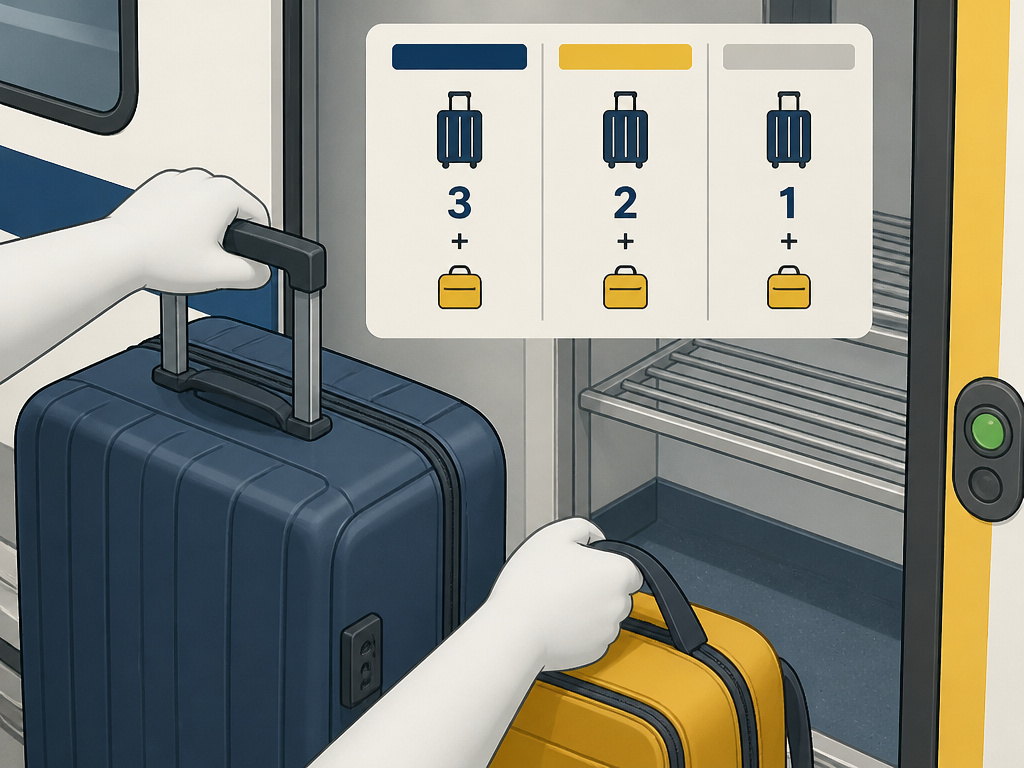
Three pieces on National Rail and Thameslink. Two items plus a hand item on V/Line. One suitcase and one carry-on Skyline. Ferrotramviaria gives you one free piece and charges a standard fare ticket for up to two additional pieces.
Four operators, four different answers. Anyone writing a single global rule for how to travel by public transit with luggage is guessing.
| Operator | Free allowance | Weight or size cap |
|---|---|---|
| National Rail (UK) | Up to 3 pieces | Over 1 m barred if unmanageable |
| Thameslink (UK) | Up to 3 pieces | 23 kg and 30x70x90 cm per assisted item |
| V/Line (Victoria) | 2 items plus 1 hand item | Under 16 kg each; 32 kg total |
| Skyline (Honolulu) | 1 suitcase plus 1 carry-on | Must stay beside the passenger |
| Ferrotramviaria (Italy) | 1 piece | 10 kg and 75x50x25 cm |
The Victorian rules on bringing luggage on public transport still stop at two items.
Charges are the second disagreement. National Rail may charge extra for more than 3 items, for luggage occupying seats needed by passengers, or for anything larger than 1 metre. Thameslink charges only when luggage takes a seat someone needs.
V/Line goes the other way entirely. You can’t purchase an additional luggage allowance, so the second item is the ceiling.
Common mistake: Buying the extra piece at the gate. On V/Line you can’t purchase an additional luggage allowance, so a third bag has nowhere to go.
Auckland Transport does not publish numeric limits in its guidance. Its guidance is to check with the operator, and on trains specifically with Transdev, before you travel.
23 kg, 16 kg, or 10 kg: Which Weight Cap Applies?
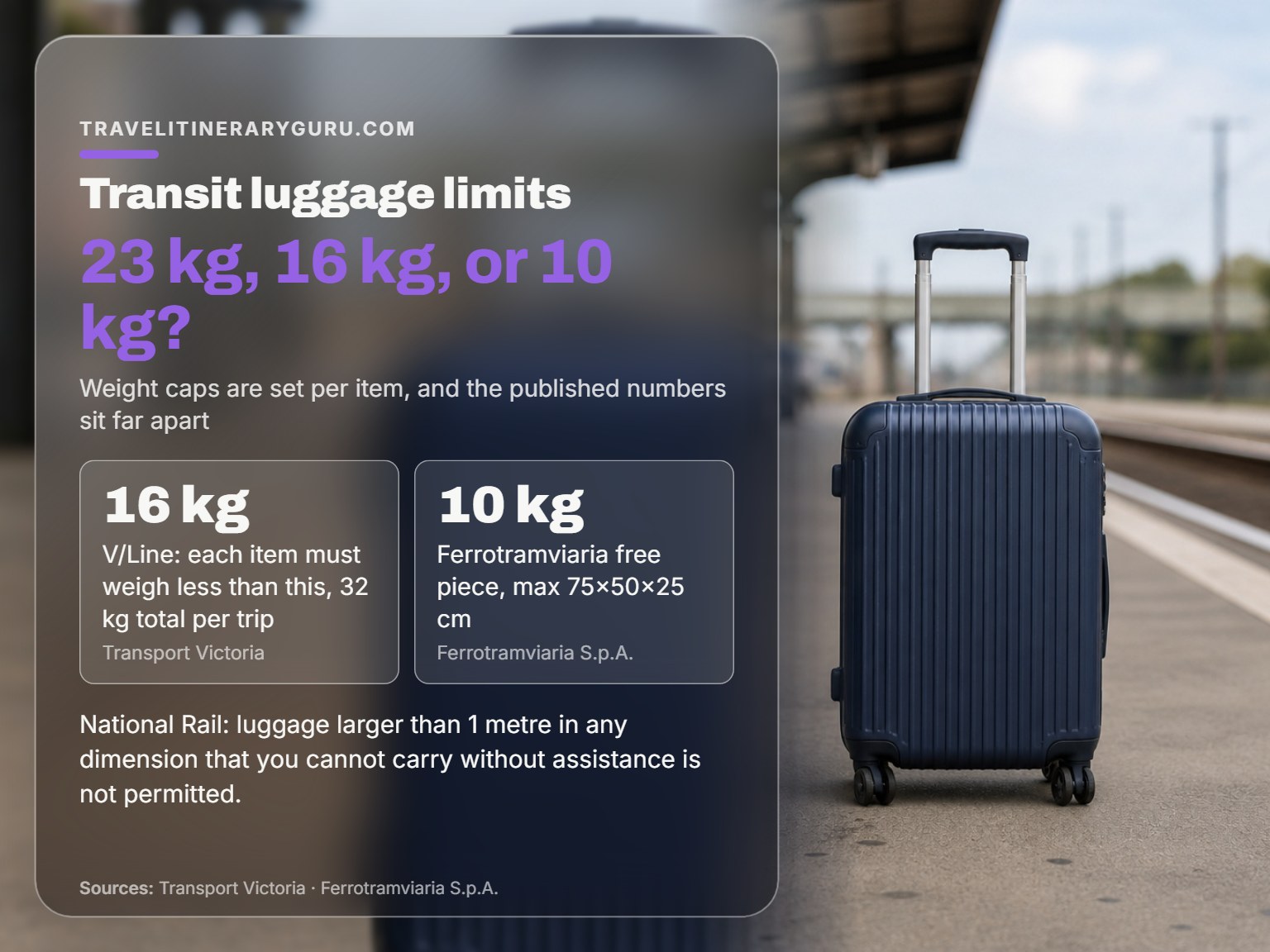
Weight caps on transit are set per item, and the three published numbers sit a long way apart. Thameslink’s assisted-luggage limit is 23 kg per item, with a maximum size of 30 cm x 70 cm x 90 cm. V/Line wants each item under 16 kg, with a 32 kg total across the trip. Ferrotramviaria’s free piece is 10 kg.
The caps exist because of boarding time. A bag one person can’t lift slows every stop, and National Rail is explicit that luggage blocking doors or aisles causes train delays and safety issues.
The 1 metre rule works the same way. National Rail bars items larger than 1 metre in any dimension that you can’t carry without assistance. Canoes, hang-gliders, large furniture and large musical instruments all fall under it.
That rule catches more travellers than the item count does, and it’s the how to travel by public transit with luggage question I’d check first.
A heavy case on a telescopic handle digs a hard line into your palm by the second flight of stairs. That’s the physical version of the rule.
Three ways to cut weight fast, in the order I’d do them:
- Move the heavy small stuff to a jacket pocket. Chargers, adapters, a paperback. It comes off the bag weight and stays with you.
- Wear the bulkiest layer onto the train rather than packing it, which matters most on a shoulder-season trip where you’re carrying both a coat and a fleece.
- Split the toiletries into two smaller bottles instead of one large one, so nothing has to be decanted at the last minute.
- Leave the second pair of shoes at home. It’s the single heaviest item people pack and never use.
If you can’t lift your loaded bag onto an overhead rack without help, it’s too heavy for a transit day. Repack it or use a checked service.
What Happens When You Exceed the Cap
National Rail may charge extra for more than 3 items, for luggage occupying seats needed by passengers, or for luggage larger than 1 metre in any dimension. Thameslink charges when luggage occupies seats needed for passenger use.
V/Line has no paid upgrade path. The two-item, 32 kg limit is the ceiling, and the hand-luggage piece sits outside that 32 kg rather than inside it.
Ferrotramviaria shows how far an airport exemption can stretch, which is one more reason airport trains deserve their own check before you fly.
What You Can’t Bring on Board, and What to Do Instead
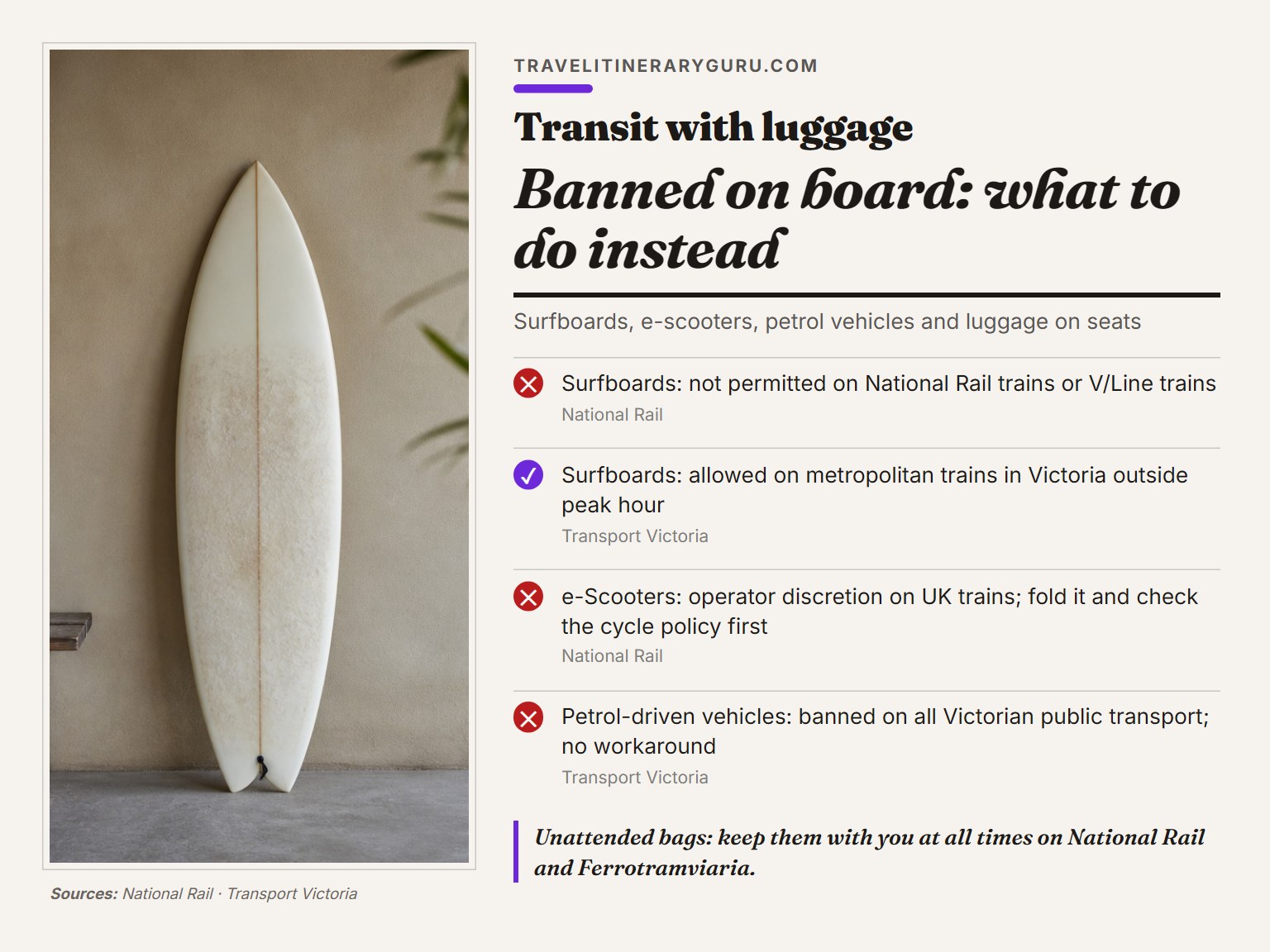
Surfboards are the clearest example of a transit rule that varies by network. National Rail lists them as not permitted on trains, while metropolitan trains in Victoria allow a surfboard if you avoid peak hour and keep it clear of doors and aisles.
Victoria splits the difference by service type. Surfboards, sailboards and canoes are banned on V/Line trains. Metropolitan trains in Victoria allow a surfboard if you avoid peak hour and keep it clear of doors and aisles. Metropolitan trams, buses and regional town services don’t allow them at all.
| Item | Where it’s banned | What to do instead |
|---|---|---|
| Surfboards | National Rail trains; V/Line trains | Use a metropolitan train outside peak hour |
| e-Scooters | Operator discretion on UK trains | Fold it and check the cycle policy first |
| Petrol-driven vehicles | All Victorian public transport | No workaround; leave it behind |
| Luggage on seats | Skyline bans occupying extra seats | Keep it in front of you or at your feet |
| Unattended bags | National Rail, Thameslink, Ferrotramviaria | Keep it with you at all times |
Motorcycles, mopeds, motor scooters and motorised cycles aren’t allowed onboard National Rail services. E-Scooters are a per-operator decision, and where they are allowed they should be folded and meet the same luggage requirements as anything else.
Victoria bans petrol-driven vehicles outright. Electrically driven mobility aids are allowed, but they have to meet the mobility aid specifications.
The Airport-Stop Exemption That Breaks the Pattern
Ferrotramviaria waives its own limits for journeys that start or end at the Airport stop. Up to three pieces per person, free, with no size and weight limitations, as long as they don’t disturb or damage other passengers.
That’s a notably larger allowance than Ferrotramviaria’s normal cap.
Where the rules stay tight and the carriages stay full, a station locker beats hauling a case around. That’s why public transit in Japan rewards travellers who build a locker stop into the day.
How to Travel by Public Transit with Luggage: The 5-Step Routine
It’s easy to book a morning walking tour and an afternoon museum without checking the distance between them. I spent far too long on public transit and missed the museum entirely. Order matters.
Before you start: A loaded case on a station staircase is the most common way travellers get hurt on transit. Keep one hand free for the handrail, and take the lift when your bag is heavy enough to pull you off balance. At Skyline stations, use the elevators if you can’t manage the stairs.
- Weigh the bag before you leave home. If it’s over the operator’s cap you find out at your front door instead of at the barrier. Thameslink’s assisted limit is 23 kg per item; V/Line’s is 16 kg.
- Check the item count against the operator, not the country. National Rail and Thameslink allow 3 pieces; V/Line allows 2 plus a hand item. Skip this and a two-bag trip can become a chargeable one.
- Book assistance if you can’t manage the bag alone. Thameslink’s assisted travel team handles one hand item plus up to two luggage items, so the booking has to match what you’re actually carrying.
- Check step-free access at both ends. Thameslink recommends checking whether your departure and destination stations have step-free access before you travel with heavy luggage. A station with no lift turns a simple change into a stair carry.
- Arrive early if you’re using a checked service. V/Line checked luggage has to be at the station at least 30 minutes before the scheduled departure, and you need the luggage tag receipt to collect it at the other end.
Tapping through with contactless payment keeps one hand free for the bag, which matters more than it sounds when you’re moving a case through a narrow gate.
Where Do the Bags Go Once You’re On?
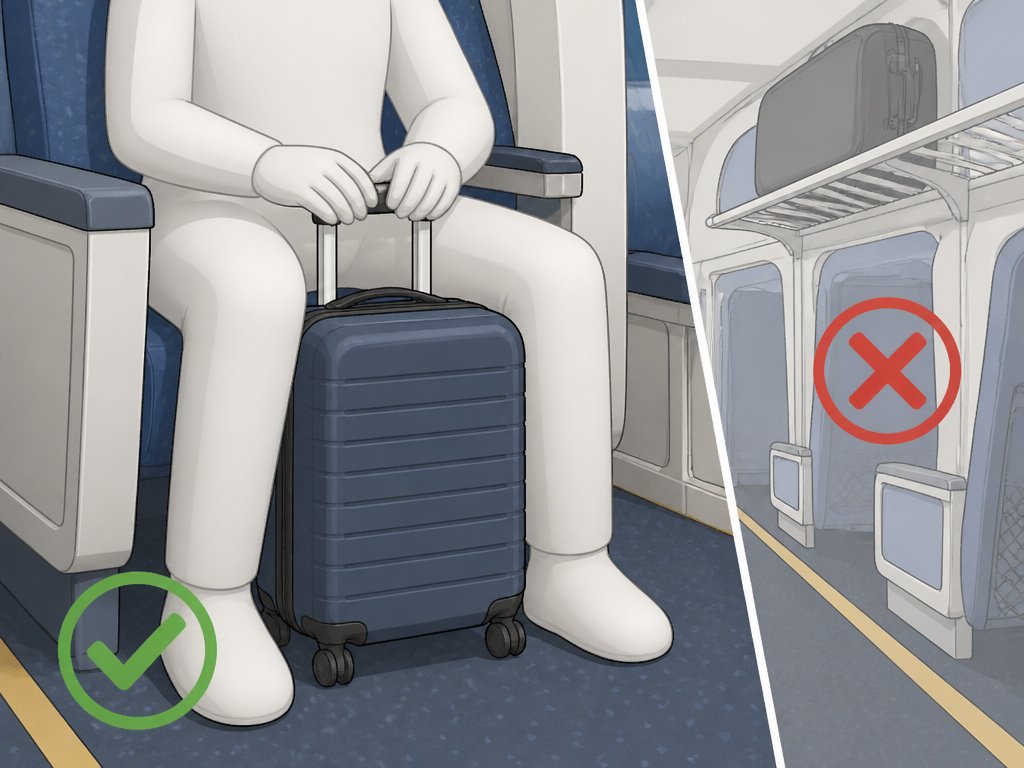
Three places a bag can sit on a moving train: the luggage rack, the floor in front of your feet, and the aisle. The aisle is the one that gets you moved.
That aisle case is exactly what National Rail’s guidance addresses. Luggage must not block doors or aisles, because blocked doors cause train delays and safety issues. It also can’t sit in the places reserved for wheelchair users.
On the platform, a hard case rolling over the gap plate makes a noticeable noise. Everyone hears it. Nobody can get past it.
Seats are the other flashpoint. National Rail allows luggage on a seat, but only if that seat isn’t needed by another passenger, and a fee may apply if it is, while Skyline in Honolulu bans occupying extra seats outright. The Skyline luggage regulations go further and ban occupying extra seats outright.
Supervision rules are the ones people break without noticing. National Rail says luggage must not be left unattended at a station or on a train, Ferrotramviaria requires luggage to stay under the traveller’s supervision at all times, and Thameslink warns that unattended items may be treated as suspicious. Ferrotramviaria requires luggage to stay under the traveller’s supervision at all times. Thameslink warns that unattended items may be treated as suspicious and could be removed or destroyed under security procedures.
A bag left at the end of the carriage while you walk to the toilet counts as unattended.
Worth knowing before you start: Under Thameslink’s security procedure, an unattended bag can be removed.
A packed carriage with bags at your feet is also a common place to lose a wallet, so avoiding pickpockets starts with keeping medication, keys and valuables in your hand luggage rather than in a case on the rack.
Getting Help When You Can’t Carry It Yourself
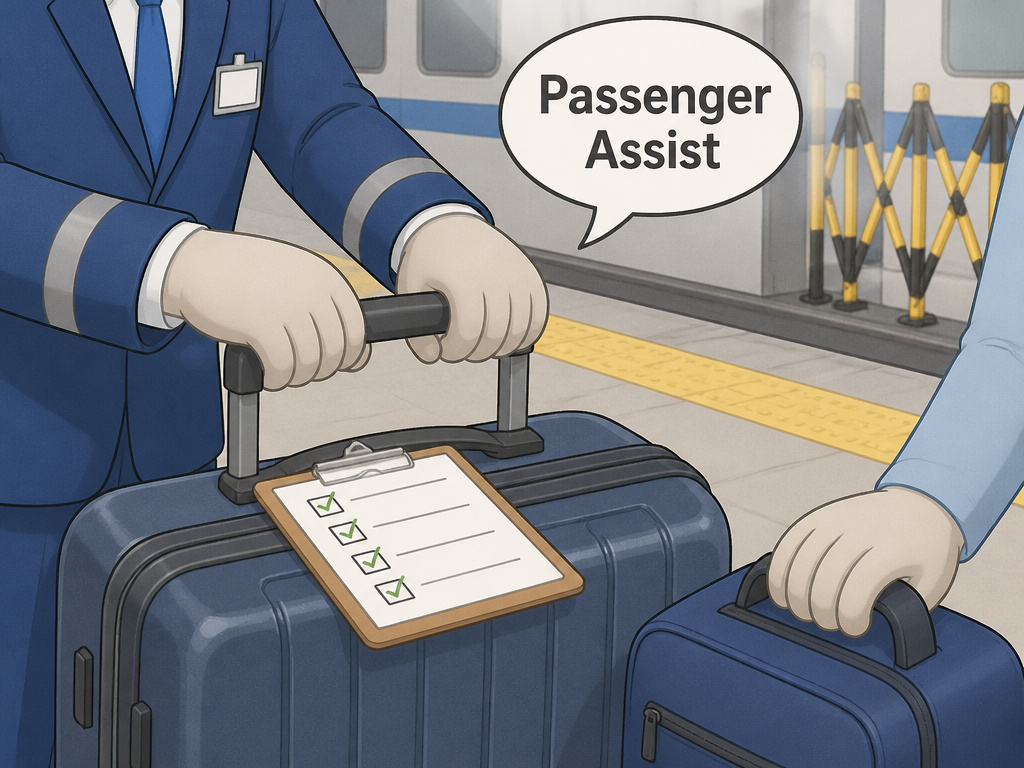
Ask for help before you travel. The barrier is the worst place to start.
National Rail will help disabled or restricted-mobility passengers with luggage, provided it’s no more than 3 items and can be managed by 1 person. You can request it through Passenger Assist in advance or on the day at the station, and the luggage should be packed properly and be a reasonable size, shape and weight.
Thameslink’s assisted travel team works to hard numbers instead. Each larger item is capped at 23 kg and 30 cm x 70 cm x 90 cm, and staff assist with one hand item plus up to two luggage items. Staff can’t help with heavy bags, anything over those limits, or carrying luggage beyond the station.
Assisted Luggage Limits and Who Qualifies
The two UK operators disagree on where the help stops. National Rail states no station-boundary restriction on assistance, while Thameslink states plainly that staff can’t carry luggage beyond the station.
That difference matters if your journey involves a change, so ask at the point of booking which operator is running each leg.
Where to ask for help, by network:
- National Rail: Passenger Assist, booked in advance or requested at the station on the day.
- Thameslink: the assisted travel team, booked ahead so arrangements can be made.
- V/Line: station staff, train conductors and coach drivers, who can help when boarding, alighting or transferring between services.
Auckland Transport doesn’t publish limits at all. Its advice is to check with Transdev before you travel.
It’s better to book assistance and not need it than to stand at a barrier hoping someone’s free.
If you’re travelling with a wheelchair or a mobility aid, accessible transit in Europe varies enough between networks that the operator’s own page is the only reliable source.
Frequently Asked Questions
Can I bring a suitcase on a train without paying extra?
Usually, yes. National Rail and Thameslink both allow up to 3 pieces at no extra cost, and V/Line allows 2 items plus a hand item free of charge. Charges apply when you exceed the operator’s cap or when your luggage takes a seat another passenger needs.
How heavy can my bag be on public transit?
It depends entirely on the operator. Thameslink caps assisted luggage at 23 kg per item, V/Line requires each item to weigh under 16 kg with a 32 kg total, and Ferrotramviaria’s free piece is limited to 10 kg. Weigh the bag before you travel.
Can I put my luggage on a seat?
On National Rail, yes, but only if the seat isn’t needed by another passenger, and a fee may apply if it is. Skyline in Honolulu bans occupying extra seats outright. Keep the bag in front of you or beside your feet.
Are surfboards allowed on trains?
National Rail lists surfboards as not permitted. In Victoria they’re banned on V/Line trains, trams, buses and regional town services, but metropolitan trains allow them outside peak hour if they don’t block doors or aisles. V/Line coaches may carry them on coastal routes if space allows.
What happens if I leave my bag unattended?
Thameslink treats unattended items as suspicious, and they can be removed or destroyed under security procedures. National Rail simply requires that luggage isn’t left unattended at a station or on a train. Keep it with you.
The Bottom Line
Item count, item weight, and the largest dimension are the key numbers for travelling by public transit with luggage. Get those three right and the rest of the trip takes care of itself.
Here’s the threshold. If your loaded bag is over 16 kg, check the operator’s assisted-luggage cap before you book anything else. Thameslink will handle 23 kg per item, V/Line requires each item to come in under 16 kg, and Ferrotramviaria’s free piece stops at 10 kg.
The first thing to do is put your loaded bag on a scale and note the number. That number decides which operator’s rules you’re actually travelling under.
One concession. None of this arithmetic helps if you’re travelling with a pram or a mobility aid. Prams and strollers are accepted up to 20 kg on V/Line, and mobility aids have their own specification check, so start with the operator’s accessibility page rather than the item count.
