
What to Keep in a Road Trip Emergency Kit: Flat List First
This post contains affiliate links. As an Amazon Associate, we earn from qualifying purchases.
What to keep in a road trip emergency kit starts with a flat baseline: one gallon of water per person, a three-day food supply, jumper cables, a flashlight with extra batteries, a first aid kit, and a basic tool kit. Then tier up for winter. Manitoba Public Insurance is the only major source that splits the kit into stages. Standard, Winter Emergency, and Winter Survival, and each tier is a superset of the one below it.
That staging matters more than any single item on the road trip preparation checklist. A flat “car kit” that works in San Diego in July will get you through a Manitoba January about as well as a recipe with no resting time gets you a tender roast. You followed the steps. The result is still tough.
What follows: the baseline kit, the winter tier, and the four places where the official sources genuinely disagree, water duration, fire extinguisher rating, tire sealant versus spare, and whether you stay in the car or call for help.
Key Takeaways
- One gallon of water per person is the floor; Cal OES says per day for several days, Washington DOH states no duration at all.
- Pack at least a three-day food supply (Cal OES) and keep it in airtight plastic bags, dated and replaced every six months.
- ABC-rated fire extinguisher is required by Cal OTS and Washington DOH; ReadyWisconsin and Massachusetts MEMA list one unrated, and FEMA, Michigan MIREADY, Cal OES, and Toyota omit it or describe it without a class.
- Winter is a separate kit, not a seasonal swap. Manitoba MPI adds a hatchet, chains or metal mats, gas line anti-freeze, and at the top tier a compact stove with fuel.
- Photograph your rental car’s existing damage before you drive off. That is a driving-category rule, not a kit rule, and it saves more money than any single item on this list.
What to Keep in a Road Trip Emergency Kit
The baseline kit is the one every state agency agrees on in substance, even when they disagree on detail. Water, food, jumper cables, flashlight, first aid kit for car, basic tools. Michigan MIREADY adds a manual can opener and a battery or hand-cranked radio. Cal OES adds an extra key fob or hidden key plus extra fob batteries, a failure mode the other nine sources in this research set ignore completely.
A road trip emergency kit is a supply cache sized to keep one vehicle’s occupants self-sufficient until help arrives. Washington State DOH sets the readiness threshold at 24 hours minimum. Water is stored at one gallon per person, food at a three-day supply, and the whole kit refreshes every six months with dates written on every food and water item.
That 24-hour figure is the number to hold onto. It is not a target for how long you’ll be stranded. It is the floor the state health department uses to size the kit.
Water, Food, and the Container Rule Nobody Mentions
Water quantity is where the sources split. Cal OES says one gallon per person per day for several days. Washington DOH says one gallon per person with no duration attached. Manitoba MPI just says “container of water” and leaves it there.
The what to keep in a road trip emergency kit container rule is the genuinely useful detail. Washington DOH recommends storing water in large soft-drink containers and warns against milk cartons and glass bottles because they decompose or break. That is a storage constraint no other source in this set raises, and it is the kind of thing you only learn after a milk carton splits across the trunk carpet.
Food follows the same pattern. Cal OES says at least a three-day supply. Washington DOH says emergency food, no duration, and adds a rule that matters more than the quantity: avoid foods that make you thirsty. Choose whole grain cereals and foods with high liquid content. Include food for infants and anyone on a special diet.
I get why the “just grab protein bars” advice sounds right. But a kit full of salty snacks and no water discipline turns a two-hour delay into a genuinely bad afternoon.
The Tools Tier: Jumper Cables, Shovel, and What Length Actually Matters
California OTS is the only source in this set that specifies jumper cable length: 12 feet. That number is not arbitrary. California OTS specifies 12 feet as the jumper cable length for a roadside emergency kit.
The rest of the tool tier is consistent across sources:
- Small shovel, jumper cables, tow chain (Washington DOH)
- Shovel, tow rope or chain, booster cables, flashlight, first aid kit, basic tool kit, flares, fire extinguisher (Manitoba MPI)
- Basic tool kit: pliers, wrench, screwdriver (Michigan MIREADY)
- Spare tire, jack, lug wrench, duct tape, jumper cables, tire pressure gauge, foam tire sealant (Toyota)
The jack and lug wrench deserve a specific callout when you prepare your car for a road trip. California OTS insists both be present and that the driver know how to use them. A jack you have never operated is a heavy metal object, not a tool.
Common mistake: Packing a spare tire and assuming the jack is in the trunk with it. Rental cars and used vehicles routinely ship without one, and you will discover that at the worst possible moment. Check before you leave home, not on the shoulder.
Signaling and Visibility: Flares, Whistles, and the HELP Sign
California OTS gets granular here in a way the federal guidance does not.
The whistle is a genuine split. Cal OES and Washington DOH both list one. The other eight sources in this research set do not mention it. If you are stranded in a place where your voice will not carry, a whistle costs nothing and weighs nothing.
Which Emergency Kit Items Do the Sources Actually Disagree On?
Three items split the sources cleanly, and the honest answer is that the disagreement is real. There is no single correct kit.
Here is where they land:
| Item | Strict reading | Loose reading |
|---|---|---|
| Fire extinguisher | ABC-rated (Cal OTS, Washington DOH) | Unrated or omitted (ReadyWisconsin, Michigan, FEMA) |
| Tire sealant | Nice-to-have only (Cal OTS) | Kit item (ReadyWisconsin, Toyota) |
| Water duration | Per day for several days (Cal OES) | No duration stated (Washington DOH) |
The fire extinguisher split is the most consequential. Cal OTS and Washington DOH both require an ABC-rated unit. ReadyWisconsin and Massachusetts MEMA list one without a rating. FEMA, Michigan MIREADY, Cal OES, and Toyota either omit it or describe it without a class. If you are buying one, get the ABC-rated version, which is what Cal OTS and Washington DOH specify for a vehicle emergency kit.
Tire sealant is a strategy question, not a product question. ReadyWisconsin and Toyota treat foam sealant as a kit item. California OTS lists “fixa flat” only under nice-to-have extras and instead insists the jack and lug wrench be present and the driver know how to use them. Those are opposite answers to the same failure mode. California OTS lists ‘fixa flat’ only under nice-to-have extras and instead insists the jack and lug wrench be present and the driver know how to use them, while ReadyWisconsin and Toyota list foam tire sealant as a kit item.
Do You Need a Different Kit for Winter Driving?
Yes, and this is the single biggest gap in most road trip kit advice. Manitoba Public Insurance is one of the sources in this research set that escalates the kit in defined stages, and the escalation is substantial.
Standard Emergency Equipment is the baseline: shovel, tow rope or chain, booster cables, flashlight, first aid kit, basic tool kit, flares, fire extinguisher. Winter Emergency Equipment adds a hatchet, chains or metal mats, windshield scraper, snow brush, gas line anti-freeze, winter clothing, winter boots, winter hat, mitts, and blankets, and you may also want to look at the best emergency sleeping bags for car use.
Winter Survival Kit adds waterproof matches, a compact stove with fuel, candles, a sheet of plastic or canvas, light rope, a blaze orange flag, a carbon dioxide indicator, aluminum foil, tissues, 1.5 kg metal cans with plastic lids, dry foods and soups, and plastic utensils.
That carbon dioxide indicator is a detail you will not find anywhere else. It is listed by Manitoba Public Insurance as part of the Winter Survival Kit, relevant if you are running a stove or heater inside a vehicle.
Manitoba MPI also adds a procedural rule absent from every other source: always ensure your vehicle’s fuel tank is full when driving in winter conditions. Michigan MIREADY and FEMA both say the same thing for a different reason, a full tank keeps the fuel line from freezing and gives you range if you need to evacuate or the power goes out.
What Should You Do If You Get Stranded?
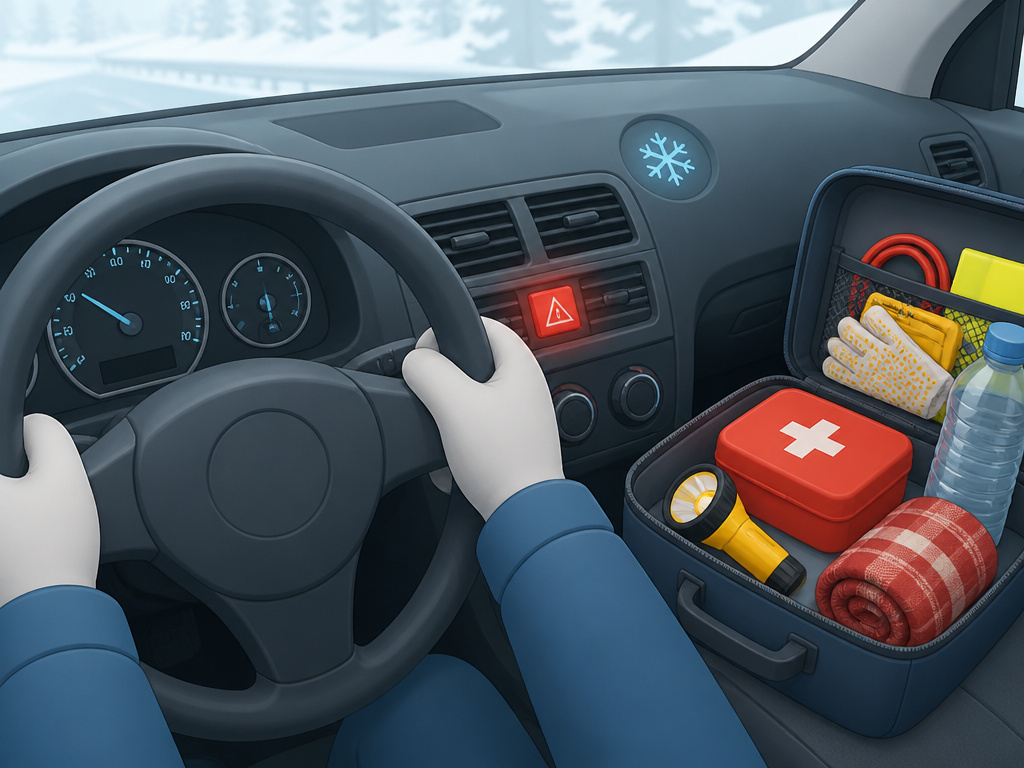
The sources give opposite instincts on this one: Manitoba Public Insurance says if you become stranded, your chances of survival are better when you stay with your vehicle, while California OTS directs drivers to call CHP or local law enforcement for assistance to get you off the road.
Manitoba Public Insurance is direct: if you become stranded, your chances of survival are better when you stay with your vehicle. California OTS instead directs drivers to call CHP or local law enforcement for assistance to get you off the road. Those are two different positions: Manitoba Public Insurance says stay with your vehicle, while California OTS says call CHP or local law enforcement for assistance to get you off the road. The instruction to “get you off the road” means get the vehicle off the travel lane, not get yourself out of the car.
FEMA and Michigan MIREADY add a set of procedural rules that belong on the same card as your kit list:
- Disable cruise control on slippery, icy, or snowy roads. Disable cruise control on slippery, icy, or snowy roads, as Ready.gov and Michigan MIREADY advise.
- If it becomes hard to control the car, pull over, stop, and set the parking brake.
- If a power line falls on your car, stay inside until a trained person removes the wire.
- Avoid overpasses, bridges, power lines, and signs if the emergency could affect roadway stability.
- Do not drive through flooded areas.
Where this goes sideways: Treating the kit as the whole plan. A fully stocked trunk and no idea what to do when the car stops moving is a supply cache with no procedure attached. Read the five rules above once before your next long drive. That is the entire ask.
The Kit Refresh Schedule Most People Skip
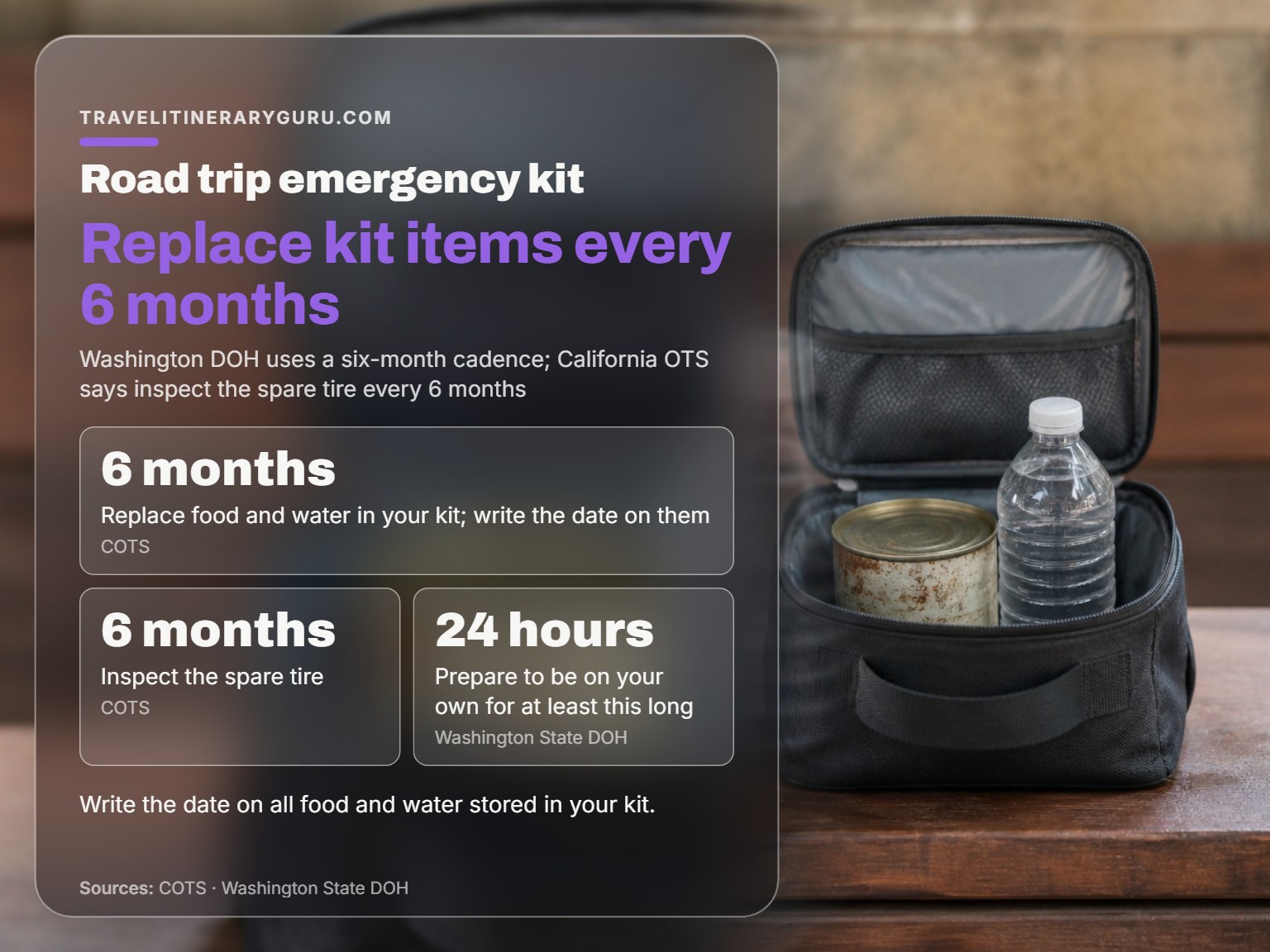
Washington DOH is specific: write the date on all food and water stored in your kit, and replace items every six months. Toyota says to check and update regularly without naming an interval. California OTS says inspect the spare tire every six months.
The six-month cadence lines up across Washington DOH and California OTS, and it is the right interval for a practical reason. Washington DOH says to replace items every six months and write the date on all food and water stored in your kit. Washington DOH says to replace items every six months.
What most people get wrong: Building the kit once and calling it done. A kit you built and never checked may have expired food, dead batteries, and a fire extinguisher that needs inspection. Date everything on the day you pack it and set a phone reminder for six months out.
Frequently Asked Questions
How much water should I keep in a road trip emergency kit?
Cal OES says one gallon per person per day for several days. Washington State DOH says one gallon per person with no duration specified. For a practical kit, one gallon per person per day for several days is the safe reading. Store it in large soft-drink containers, and avoid milk cartons or glass bottles. Washington DOH specifically warns they decompose or break.
Is a fire extinguisher required in a car emergency kit?
It depends on which agency you follow. Cal OTS and Washington DOH both specify an ABC-rated fire extinguisher. ReadyWisconsin and Massachusetts MEMA list one without a rating. FEMA, Michigan MIREADY, Cal OES, and Toyota either omit it or describe it without a class. If you carry one, the ABC-rated version covers the widest range of vehicle fire types.
Should I pack tire sealant or a spare tire?
Both strategies appear in official guidance. ReadyWisconsin and Toyota list foam tire sealant as a kit item. California OTS lists it only under nice-to-have extras and instead insists the jack and lug wrench be present with the driver knowing how to use them. Sealant handles a puncture; a spare handles a blowout. If you have room for both, carry both.
How often should I replace items in my emergency kit?
Washington State DOH says every six months and recommends writing the date on all food and water. California OTS says inspect the spare tire every six months. Toyota says check and update regularly without naming an interval. Six months is the number to use.
What should I add to a road trip emergency kit for winter?
Manitoba Public Insurance has the most complete winter list: a hatchet, chains or metal mats, windshield scraper, snow brush, gas line anti-freeze, winter clothing, winter boots, winter hat, mitts, and blankets. At the top tier, add a compact stove with fuel, waterproof matches, candles, a blaze orange flag, and a carbon dioxide indicator. Keep the fuel tank full in winter conditions.
Do I need an extra key fob in my emergency kit?
Cal OES is the only source in this research set that requires an extra key fob or hidden key plus extra fob batteries. No other source mentions it. Cal OES requires an extra key fob or hidden key plus extra fob batteries, a small item with an outsized payoff.
Before You Go
One rule most kit lists skip entirely: the kit is sized to your climate, not to a generic checklist. A flat list that works in California in April will not carry you through a Manitoba January, and Manitoba Public Insurance is one of the sources in this research set that treats that as a structural problem rather than a footnote.
So here is the specific threshold. If you drive in winter conditions, build the winter tier, hatchet, chains or metal mats, gas line anti-freeze, winter clothing, blankets. If you do not, the baseline kit plus a full fuel tank is enough.
The first thing to do this week is smaller than that. Write today’s date on every food and water item in your kit. Two minutes. That is the whole ask.
Everything above assumes you check the kit every six months. A kit you built two years ago and never opened is not a kit. It is a plastic bin with expired granola bars in it.
