
How to Choose an Airline for a First International Trip
This post contains affiliate links. As an Amazon Associate, we earn from qualifying purchases.
Choosing an airline for a first international trip comes down to four things: total door-to-door time, connection protection, baggage terms, and who is actually liable when something breaks. The fare is the smallest part of that list, and it is the one most first-timers compare first.
That order sounds backwards if you have only ever booked a domestic flight. On a domestic hop, a missed connection is an inconvenience. On an international itinerary it can strand you in a terminal with no legal claim to a hotel room, because the protection you assumed you had was never attached to the ticket in the first place. Knowing how to choose an airline for a first international trip means checking that protection before you book.
What follows walks through the four checks in order, then the passport, insurance, and safety questions that sit underneath all of them. By the end you will be able to read any itinerary and spot the two or three things that actually decide whether the trip works.
Key Takeaways
- Check the connection airport before the fare. A short connection at a sprawling hub is the single most common first-timer failure, and a missed onward flight on separate tickets is your problem, not the airline’s.
- Allow more than the published minimum connection time, because the MCT is the shortest workable gap, not the comfortable one.
- Buy one ticket from origin to final destination if you want care and compensation to follow you through the whole journey.
- Pre-purchase extra baggage online. Airport fees run higher, and allowances can differ between legs even when you have already paid.
- Passport validity is not one number. Aim for at least 6 months beyond your return date, and check the destination’s own rule separately.
Why the Cheapest Fare Is Rarely the Cheapest Trip
The fare you see on a comparison site is one line in a longer invoice. Add the bag you will need for two weeks, the seat you will want on a nine-hour leg, the airport transfer at 5 a.m. Because the cheap departure left before the trains started, and a positioning flight to reach the cheaper departure city. That is the real number.
The US Department of Transportation’s Getting the Best Airline Fares page is blunt about how the discount gets built. Typical requirements for the lowest fares include a round-trip purchase, buying at least 14 or 21 days before departure, paying within 24 hours of making the reservation, a Saturday-night stay, and a maximum trip length of 30 days. Each of those is a constraint on your trip, not just a discount.
Then there is the flexibility question. Airlines sell different fare products with different change conditions and fees. The Australian air passenger travel guide puts it plainly: stop and consider before booking a very cheap deal that is going fast, because it may come with extra costs later.
That is the trade when you compare a how to choose an airline for a first international trip. You are not buying a seat. You are buying a set of conditions.
What most people get wrong: Comparing airlines on the headline fare alone. The bag fee, the seat fee, and the change fee are all part of the price, and a fare that looks higher at the search stage often wins once those are added.
What Is Minimum Connection Time and Why Does It Decide Your Booking?
Minimum connection time is the shortest amount of time needed for you and your luggage to switch from one flight to another. It differs between airports, airlines, and international versus domestic connections, so there is no universal number to memorise.
The official definition is worth reading twice, because the second half is the part people skip:
Minimum connection time (MCT) is the shortest amount of time needed for a passenger and their luggage to transfer between two flights. It varies by airport, airline, and whether the connection is international or domestic. The published figure is a floor, not a recommendation, and it assumes normal operations at both ends.
Here is the practical version. Reduce the risk of missing a connection by allowing more than the MCT between flights. That is the Australian government’s own advice, and it exists because the published minimum assumes everything runs on time, your inbound flight parks at the gate it was scheduled for, and you already know which terminal you are walking to.
The separate-ticket trap
The MCT does not protect you if you buy multiple flights separately rather than as part of a single booking from your origin to your final destination. This is the single most expensive misunderstanding in first-time international booking.
With separate bookings, you may need to self-transfer at the connecting airport. That can mean collecting your bags, clearing customs, checking in again, and passing back through airport security. None of those steps are the airline’s responsibility, and there is no carrier liability for the missed onward flight.
The UK Civil Aviation Authority describes the other side of the same coin. If your booking includes two or more flights booked together as one journey, often with one airline or an alliance, your entitlement to care and compensation for delays is based on the last airport in your journey. One ticket, one chain of responsibility.
| Booking Type | Who Handles a Missed Connection | What You Get If It Happens |
|---|---|---|
| Single ticket, origin to destination | The airline, through the whole journey | Re-routing or refund, plus care during the wait |
| Two separate tickets | You, at the connecting airport | Nothing from either carrier; you rebook and pay |
| Single ticket on an alliance | The alliance, based on the last airport | Care and compensation through to the final leg |
Which Airport Should You Connect Through?

Connection airport choice matters more than most first-timers expect, and it is the decision you make before you ever see a fare.
Three things drive it. The first is physical size. The third is the weather profile. Poor weather, including fog, causes delays and diversions, particularly for smaller aircraft or remote airports, so a short domestic hop feeding into an international service is the riskiest leg in the itinerary.
The Smartraveller overseas air travel guide is worth reading before you commit to a route. It notes that security regulations overseas may differ from the rules you know, and that some countries or airlines install additional screening measures at short notice. Those changes cause airport delays that no connection time calculator accounts for.
Easy to miss:
Who Is Actually Liable on a Codeshare?
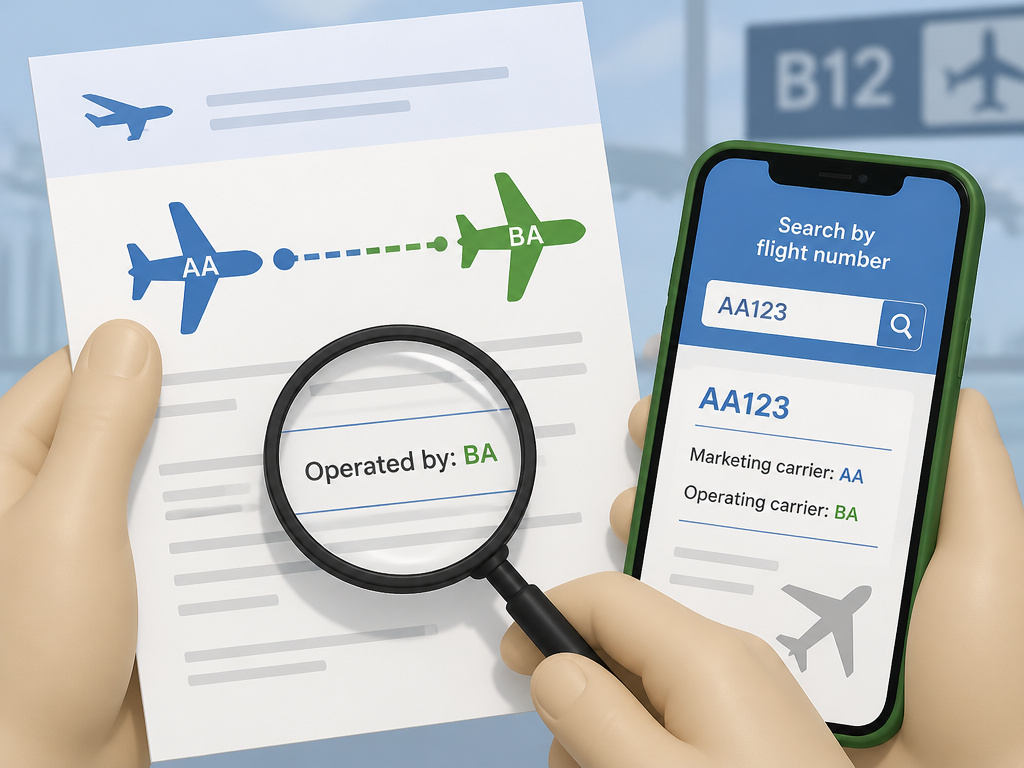
The IATA two-letter prefix on a flight number identifies the marketing carrier, not necessarily the operating carrier. That distinction decides who you talk to when something goes wrong.
That arrangement is a codeshare. You can identify the operating carrier by searching the flight number or looking for the words “operated by” on the itinerary.
The two regulators describe the disclosure differently, and it is worth knowing both. The UK Civil Aviation Authority states that for codeshares, the airlines will tell you as soon as possible who is operating your flight, because it affects check-in procedures and your rights if something goes wrong. The Australian guide goes further and splits the liability: the operating carrier handles airport, onboard, and disruption matters, while ticketing matters such as pre-travel itinerary changes and refunds sit with the issuing airline or agent.
That split is not a contradiction between the two sources. It is a division of labour that most passengers never learn until they are standing at a transfer desk being told the wrong airline’s name.
Worth knowing before you start:
Do You Need Travel Insurance Before You Book the Flight?

Buy it as soon as you pay for the trip. That is the Australian government’s guidance, and the reason is simple:
Travel insurance covers missed flights, medical emergencies, and lost or stolen items during your trip. The type of cover varies considerably, so read the terms and conditions rather than the summary box.
Skip this if: You are booking a package holiday with ATOL protection and a credit card.
Passport Validity, Baggage, and the Rules That Catch People Out
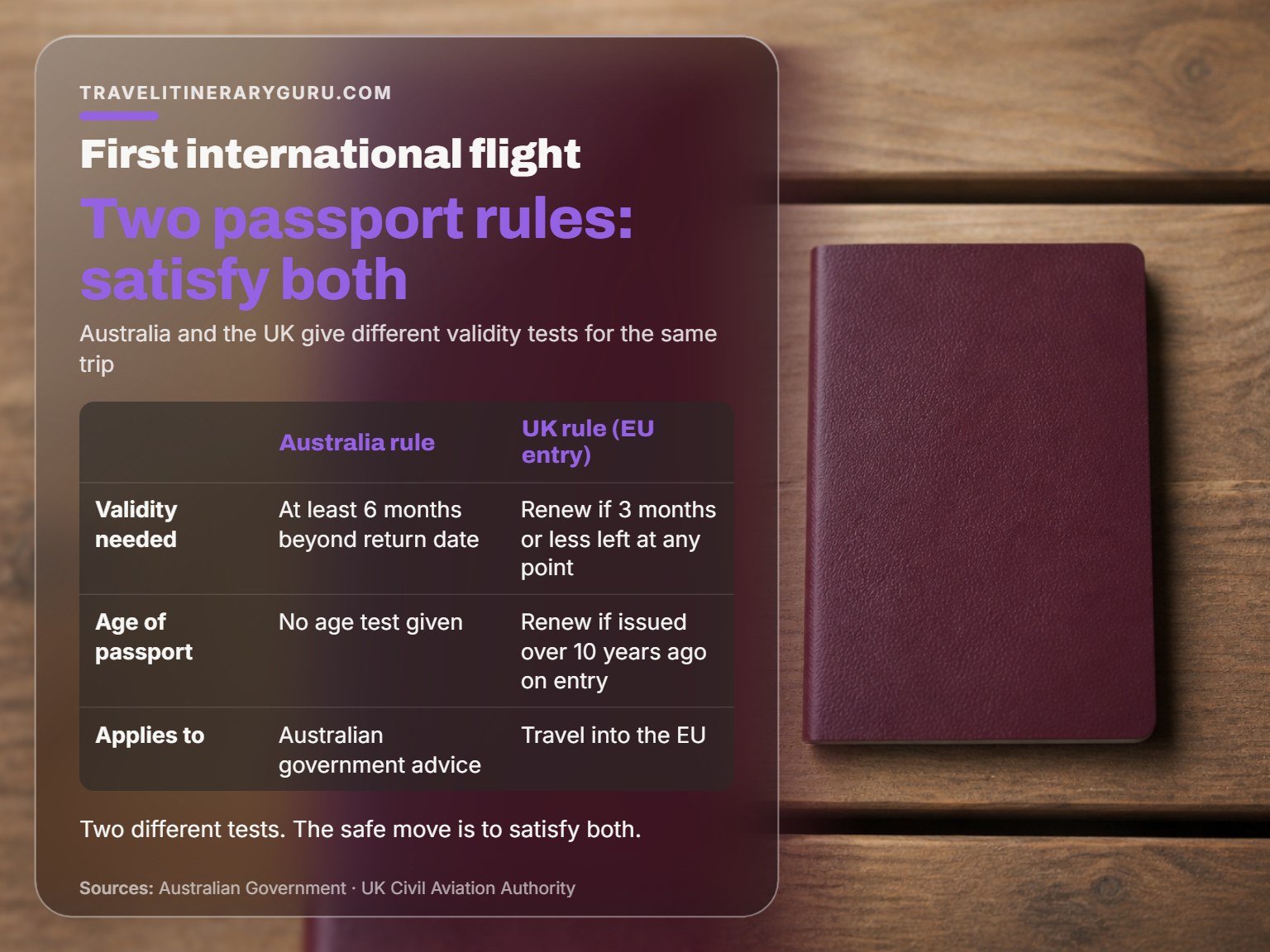
Passport validity is the check most first-timers do last, and it is the one that can cancel a trip outright.
The Australian government advises aiming for at least 6 months of validity beyond your return date. The UK Civil Aviation Authority gives a different rule for travel into the EU: renew if the expiry date falls within 3 months or less at any point of your trip, or if the passport was issued more than 10 years ago from the day you enter an EU country. Those are two different tests, and the safe move is to satisfy both.
Baggage rules have their own trap. Pre-purchase extra baggage online, because the fees charged at the airport are higher.
For the physical side of packing, the international travel luggage question is worth settling before you book the fare, because the bag you own determines which fare class actually works for you. A pre-trip checklist is the other half of that, and it is the difference between arriving at the airport calm and arriving at the airport doing arithmetic about your carry-on.
Your rights when the flight is disrupted
| Trigger | What the Airline Owes You | Source |
|---|---|---|
| Delay of at least 2 hours | Information on assistance, refunds, and compensation | GOV.UK / DfT |
| Delay over 5 hours | Refund within 7 days plus a return flight, where applicable | GOV.UK / DfT |
| Cancellation | Choice of refund or alternative travel arrangements | UK CAA |
| Denied boarding | Volunteers sought first; refund within 7 days or re-routing | GOV.UK / DfT |
| Extraordinary circumstance | No compensation available | GOV.UK / DfT |
Two details in that table are worth pulling out. The airline may only pay a refund in vouchers if you agree to it, so a voucher offer is not the same as a refund offer. And if a long delay or cancellation is caused by an extraordinary circumstance, compensation is not available, which is why the reason for the disruption matters as much as the length of it.
How Do You Check an Airline’s Safety Record Before Booking?
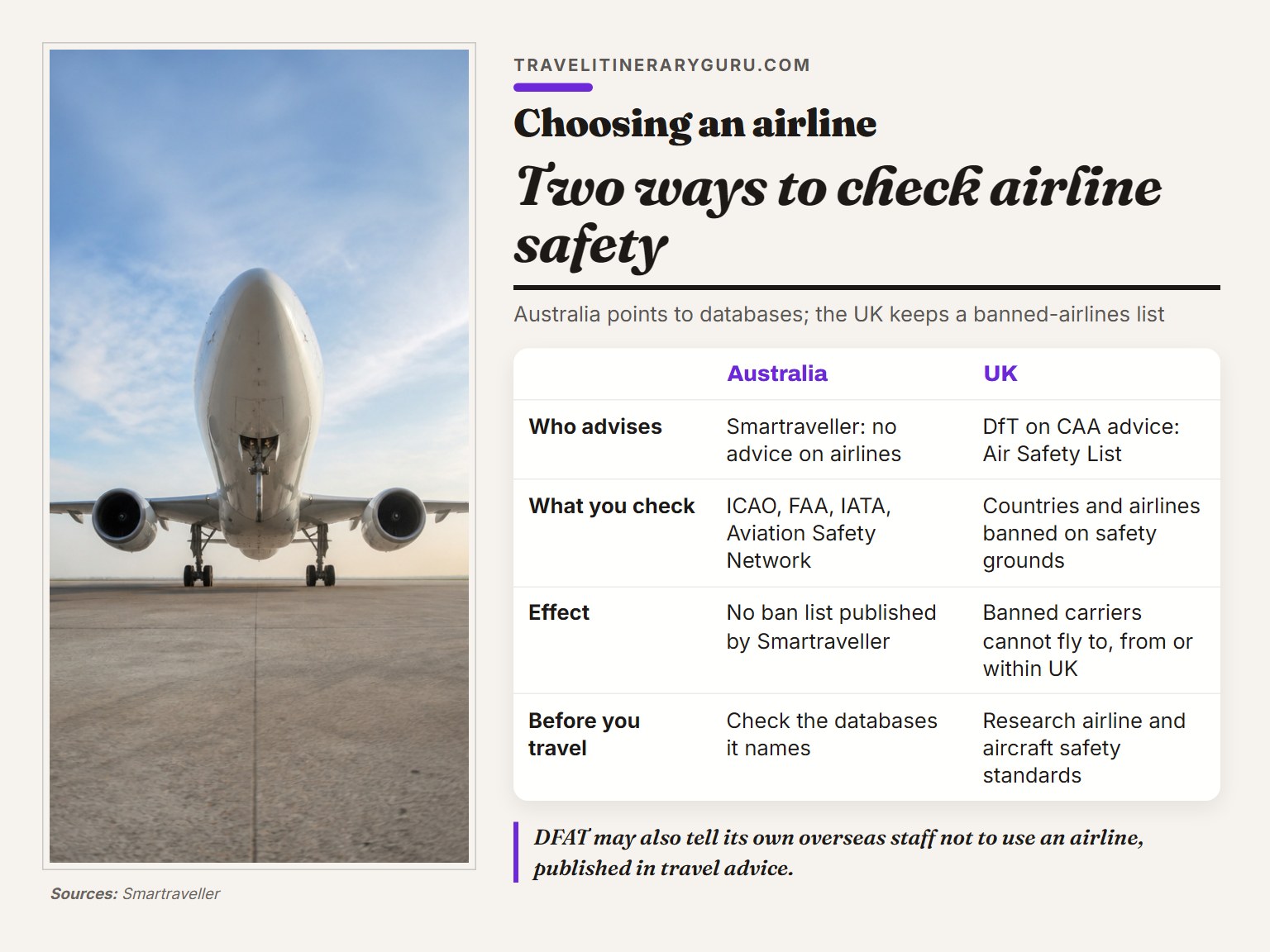
Smartraveller states plainly that it cannot advise on the safety of individual airlines or flight paths. It directs travellers to ICAO, the US FAA, IATA, and the Aviation Safety Network as sources instead.
The UK government takes the other approach. It maintains the UK Air Safety List, based on advice from the UK Civil Aviation Authority, containing the countries and airlines subject to an operating ban on safety grounds. Those carriers cannot fly to, from, or within the UK. The guidance is direct: before you travel, research the safety standards for any airlines and aircraft you plan to take.
Both are defensible. If you are flying into or out of the UK, the Air Safety List is the fastest check. If you are not, the databases Smartraveller names are the ones to use, and the same page notes that flights over or near conflict areas may be restricted to particular routes or altitudes.
The part nobody mentions: DFAT sometimes tells its own staff working overseas not to use a particular airline when it has safety concerns, and publishes that in the travel advice for the relevant destination. The restriction exists even where the general public advice does not name the carrier.
Frequently Asked Questions
How far in advance should I book a first international flight?
There is no single answer, and the two positions are worth holding at once. The US Department of Transportation advises planning as far ahead as you can, because most airlines set aside only a few seats at the lower rates and the real bargains sell out quickly. The same page notes that airlines also run fare sales several times a year, often in early autumn or just after New Year. If you have flexibility, watch for a sale. If you have fixed dates, book early.
Is it cheaper to book two one-way tickets instead of a round trip?
Sometimes, but you are trading protection for the saving. Two separate one-ways are two separate bookings, which means the MCT does not protect you if the first flight is late and you miss the second. You would self-transfer, re-check bags, and pay for the replacement flight yourself. Price the one-way option, then decide whether the saving is worth carrying that risk.
What happens if my flight is cancelled?
The airline should give you the choice of a refund or alternative travel arrangements to get you on your way as soon as possible, or at a later date at your convenience. If the delay exceeds 5 hours, the airline must offer a refund within 7 days and a return flight to your first point of departure where applicable. A refund in vouchers is only valid if you agree to it.
Do I need to tell the airline about a disability or mobility aid in advance?
Yes, and earlier than you would think. Let your airline know at least 48 hours before departing. If you have a disability or reduced mobility, you are legally entitled to assistance, and airports and airlines must provide free-of-charge help during your journey. Try to provide the airline with the value of your mobility equipment and confirm with them whether it is covered in the event of damage.
How do I know which airline is actually operating my flight?
Search the flight number or look for the words “operated by” on your itinerary. The two-letter IATA prefix on a flight number identifies the marketing carrier, which is not necessarily the operating carrier. For codeshares, the airlines will tell you as soon as possible who is operating the flight, because it affects check-in procedures and your rights if something goes wrong.
Should I use a travel agent or book direct?
Both work, and the trade-offs differ. Travel agents usually do not charge a fee, because they earn a commission from the airline, and they can access consolidator seats that are not sold directly. Those seats can carry more severe restrictions than the airline’s own deep-discount fares, particularly if the flight is delayed or cancelled. If you book direct with the airline, that airline is responsible for resolving any issue with your flight.
The Bottom Line
If you take one thing from this, take the connection rule. Allow more than the minimum connection time, and buy one ticket from origin to final destination rather than stitching two together. That single decision protects more of your trip than any fare comparison will.
Here is the concession, though. Everything above assumes a conventional itinerary. If you are booking a one-way on one carrier and a separate one-way back on another, you have deliberately given up the protection, and the trade can still be worth it when the routing is better and the price gap is real. Just go in knowing you are the one holding the risk, and build in a genuine buffer at both ends.
One step for this week: pull up your draft itinerary and check two things. First, the operating carrier on every leg. Second, whether the connection is a single ticket or two. Those two answers tell you more about how your trip will actually go than the fare you paid for it.
And buy the insurance the day you pay for the flight. Not the week before you leave.
