
How to Use a Red-Eye Flight to Save a Travel Day
This post contains affiliate links. As an Amazon Associate, we earn from qualifying purchases.
To use a red-eye flight to save a travel day, pick a weekend departure rather than a weekday one. Weekend red-eyes are 22% cheaper than daytime flights, while weekday red-eyes cost close to 10% more. Land early, stay awake through the local day, and go to bed on local time.
That 22% weekend gap is the part you control before you book. The arrival window is the part you have to survive after. One analysis of US flight data puts 73% of red-eyes on the ground between 5:00 and 6:59 am. Knowing how to use a red-eye flight to save a travel day means that gap is where a saved travel day quietly turns into a lost one.
What follows: how to pick the right night, how to shift your sleep in the two days before you fly, and how to run the arrival day so the trip starts on day one instead of day two.
Key Takeaways
- Book the weekend red-eye. Weekend red-eyes are 22% cheaper than daytime flights, while weekday red-eyes cost close to 10% more.
- Shift your sleep 1 hour per day for 2-3 days before the flight, in the direction you’re traveling. West means later. East means earlier.
- Plan on 4 hours 48 minutes in the air, the median gate-to-gate time for a US red-eye.
- Stay awake through the local day after you land. A 20-30 minute nap is fine. Anything longer pushes your night sleep later.
- Skip it if you need to be sharp before noon. 39% of Americans would rather fly daytime with a screaming baby aboard than take a typical red-eye.
Why the Weekend Red-Eye Saves Money and the Weekday One Doesn’t
Weekend red-eyes came in 22% cheaper than daytime flights. Weekday red-eyes moved the other way, costing close to 10% more.
Red-eye fares were compared across 10 US nonstop routes and five carriers, with prices collected during the week of June 8-12, 2026, roughly three months before departure. Weekend red-eyes averaged 22% below daytime fares. Weekday red-eyes averaged about 10% above daytime fares.
The two sources that ran the numbers, NapLab and Laters.com, both land on that split. The editorial guides don’t. One Mile at a Time and Simple Flying both say red-eyes are cheaper, full stop, with no weekday or weekend distinction.
That how to use a red-eye flight to save a travel day disagreement matters more than it looks. If you read the editorial version and book a Tuesday red-eye expecting a deal, you’ve paid a premium for a worse night’s sleep.
| Departure night | Red-eye vs daytime fare | Who it fits |
|---|---|---|
| Weekday (Mon-Thu) | Close to 10% more expensive | Travelers booking on weekdays |
| Weekend (Fri-Sun) | 22% cheaper | Travelers booking on weekends |
| Full sample | 8% cheaper on average | Average across all days |
The US DOT’s own fare page points the same way. Its DOT airline fare guidance notes that the best deals tend to fall on Tuesday through Thursday, or from Friday night through Sunday morning, and that late-night departures are one of the windows carriers discount.
One caveat worth carrying: the 8% figure is an average. Treat it as a direction, not a law.
I get why the “red-eyes are cheaper” line sounds right. It’s true on average. It flips on a Tuesday.
That’s the trap with weekday red-eyes. You pay more, you sleep worse, and you land at 5 am with nothing open.
What Time Does a Red-Eye Leave, and When Do You Land?
US red-eye scheduling is narrower than most travelers expect. One self-computed, non-official analysis counted 6,326 departures in the 11 pm hour in July 2026, against 47,716 in the 7 am hour.
That thin late-night schedule is the first how to use a red-eye flight to save a travel day thing to plan around. Fewer planes in the air means fewer rebooking options when something slips.
| Measure | Figure | What it means for you |
|---|---|---|
| Most common departure hour | 11:00 pm-11:59 pm (40% of red-eyes) | Late-night departure |
| Typical landing window | 5:00-6:59 am (73% of red-eyes) | Early-morning arrival |
| Median gate-to-gate time | 4 hours 48 minutes | Median scheduled time |
| Late-night departures, July 2026 | 6,326 in the 11 pm hour | Fewer late-night departures |
Easy to miss: TSA checkpoint hours vary by airport. Check your specific airport’s late-night hours before you book a late departure.
There’s no single definition of a red-eye, and the sources split on it. One Mile at a Time argues that a Tokyo to New York flight leaving at 10:05 am and landing at 9:00 am could be considered a red-eye. Simple Flying keeps it simple: depart at night, land in the morning. Laters.com draws the line at an 11 pm departure that lands early the next day.
A red-eye cabin goes quiet in a way a daytime cabin never does. The lights drop, the cart stops rolling, and the only sound left is the low drone of the engines and one person two rows back coughing.
On a longer long-haul flight, that quiet window is the only real sleep you’re going to get.
Protect it.
The median US red-eye runs 4 hours 48 minutes gate to gate, and that’s scheduled time.
How Do You Shift Your Sleep Before a Red-Eye?

Two nights out from an eastbound red-eye, your bedtime is still set to home time. That’s the problem the next 48 hours are meant to fix.
The CDC’s Yellow Book chapter on CDC Yellow Book jet lag gives the protocol. Shift sleep 1 hour later per day for westward travel, or 1 hour earlier per day for eastward travel. The window is the 2-3 days before the trip.
Before you start: The CDC puts a useful melatonin dose at 0.5-1 mg and advises against anything above 5 mg. Antihistamines, long-acting benzodiazepines, and long-acting benzodiazepine receptor agonists are on the CDC’s avoid list. They can worsen cognitive impairment, raise fall risk, and cause stomach side effects.
- Pick the direction before you pick anything else. Westbound means 1 hour later each day. Eastbound means 1 hour earlier.
- Start 2-3 days out. That’s the CDC’s window.
- Skip the long nap on travel day. A 20-30 minute nap helps. Anything longer may interfere with nighttime sleep.
- Cut alcohol and caffeine before boarding. Alcohol shortens the time it takes to fall asleep and then fragments that sleep. Caffeine has a half-life of roughly 5 hours.
Going West Is Easier, and There’s a Reason
The CDC says westward travel is easier to adapt to than eastward travel because the average intrinsic circadian rhythm is slightly longer than 24 hours. The agency’s average adaptation rate is 1.5 hours per day going west and 1 hour per day going east.
Simple Flying agrees on the direction: anyone traveling east is at a disadvantage compared to anyone traveling west.
Melatonin Timing: 90 Minutes Before Bed Going East
For eastward travel, the CDC says to take melatonin 90 minutes before bed. Timing is the part people get wrong. Taking melatonin when your body clock already expects it isn’t as effective. That window is roughly 12-5 am body-clock time. A dose at the wrong hour can push your clock further out of line instead of pulling it back.
The CDC’s sleep strategy has a rival. Simple Flying recommends a single front-loaded block instead: get extra sleep the night before and plan nothing for the next day. Those are different mechanisms. The CDC shifts the clock in daily steps. The Simple Flying version banks sleep and buys a recovery day.
I now treat the two nights before an eastbound flight as part of the trip rather than normal life.
Getting the shift wrong is what produces jet lag in the first place, and the symptoms follow the clock rather than the flight.
Airlines hand out eye masks, but the free ones don’t block light well enough, which is why Simple Flying’s advice is to bring your own. A decent eye mask is the cheapest sleep upgrade on the plane.
The Arrival Day Plan That Actually Protects Your Travel Day
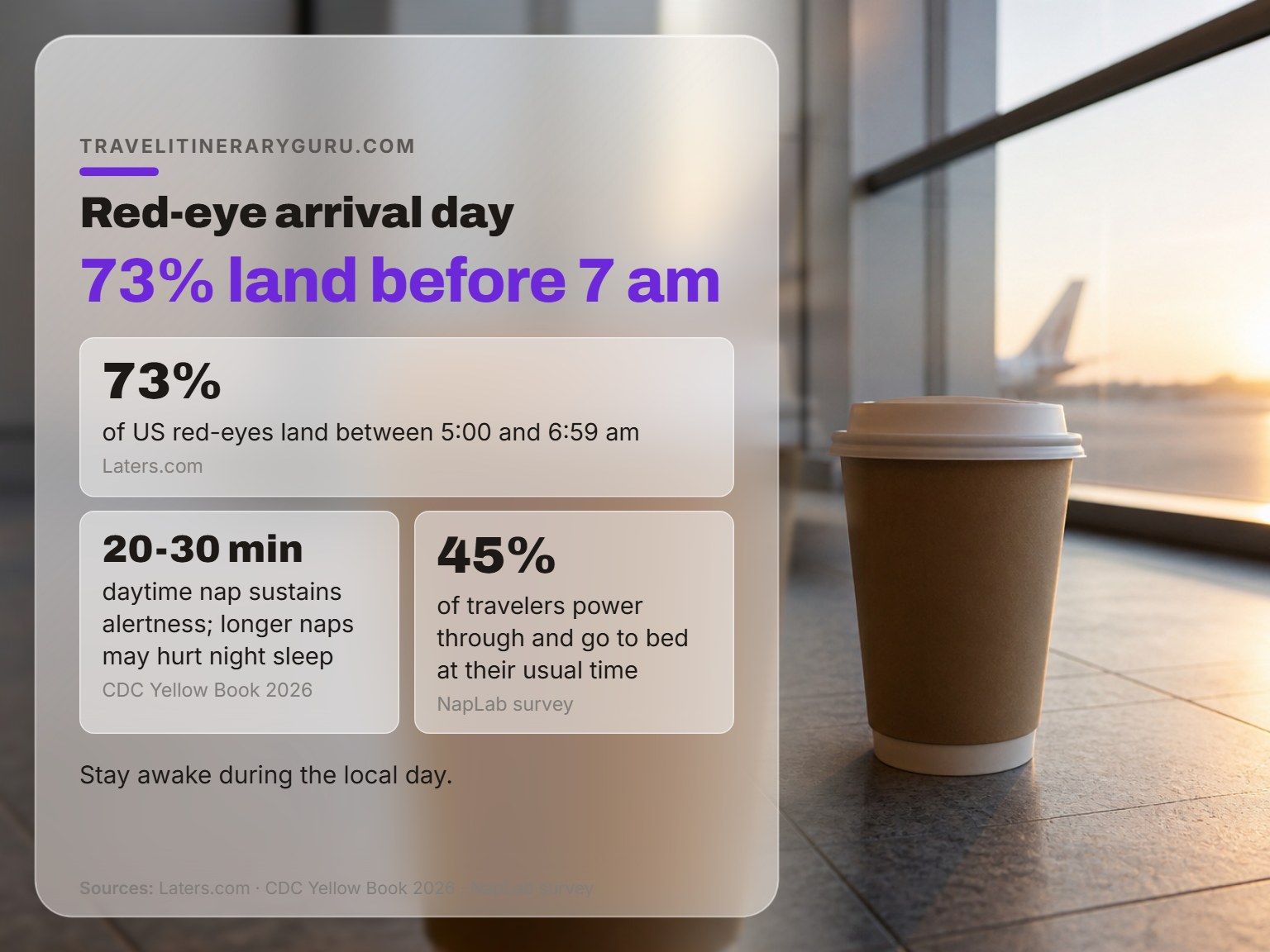
Landing at 5:40 am puts you in a city where nothing opens for another four hours. That’s the gap the arrival plan has to cover.
73% of US red-eyes land between 5:00 and 6:59 am, well before standard hotel check-in.
The CDC and the traveler-facing guides pull in opposite directions on what to do next. The CDC says staying awake through the local day increases your drive for sleep and helps you sleep that night. Simple Flying’s advice is to plan nothing for the next day, which is a recovery day in everything but name.
Both can be true. You can stay awake and still keep the day light.
- Book the room for the night before you land. It’s the single move that turns a 5 am arrival into a usable morning.
- Get into daylight early. Morning light is the strongest signal your body clock takes.
- Cap your nap at 20-30 minutes. The CDC sets that ceiling because longer naps push your night sleep later.
- Keep the first afternoon light. A museum, a walk, a long lunch. Anything that isn’t a dark hotel room and a bed.
The 20-30 Minute Nap Rule, and Why Longer Backfires
The CDC’s nap guidance is narrow on purpose. 20-30 minutes sustains alertness during the local day, and anything longer interferes with the sleep you need that night.
Travelers mostly ignore it. In NapLab’s survey, 29% take a nap after the flight, 21% go straight to sleep at their destination, and 45% power through to their normal bedtime.
I’d take the power-through group over the nap group. Going to bed at your normal hour after a red-eye is the version that resets you fastest, and the nap is a tool for getting you to 9 pm, not a substitute for the night.
Caffeine is another split, and it’s mostly a question of hours. The CDC says minimize caffeine to maximize in-flight sleep. Simple Flying suggests grabbing a coffee in the morning to recover. NapLab found 28% of travelers use caffeine as part of their recovery plan. All three can be right, because they’re describing different parts of the day.
The first hour after a 5 am landing has a texture to it: fluorescent terminal light, cold tile, and coffee that tastes like it was brewed at midnight.
That’s why the travel day deserves as much planning as the destination days. A red-eye only pays off if the day it buys is already mapped into your travel itinerary.
Otherwise you land into a blank morning.
Booking the Red-Eye: Which Night, Which Route, Which Fare Rule

Fare timing beats fare hunting, and almost nobody plans for it. The DOT’s fare page notes that carriers sometimes release more discount seats for a flight just before the advance-purchase deadline expires.
Frequently Asked Questions
How do I choose between a Friday night and a Sunday night red-eye?
Both fall inside the weekend window, so price is rarely the deciding factor. Pick based on what waits for you on the ground. A Friday departure hands you a full weekend at the destination, while a Sunday departure usually means landing straight into a work or school morning. If the arrival day is a workday, the sleep debt is harder to absorb.
Can I sleep on the plane and still adjust to the new time zone?
Yes, but keep it short and timed to the destination clock. A three to four hour block that ends an hour or two before landing works well, because it mimics a nap rather than a full night. Sleeping the entire flight often leaves you groggy and makes the first local evening drag. Set an alarm so you wake before the cabin lights come on.
What should I avoid eating or drinking on board?
Skip alcohol and heavy meals, and go easy on caffeine unless it lands near your destination morning. Alcohol fragments sleep and dehydrates you at altitude, which makes the arrival day much harder. Water and a light snack keep you functional without weighing you down. If you do want coffee, time it for the last hour of the flight.
Is a red-eye worth it for a short trip of only two or three days?
Usually not. The recovery cost eats a large share of a short trip, and you may spend the first day foggy rather than out exploring. Red-eyes pay off best on trips of four nights or more, where one rough morning is a small fraction of the total. For a quick weekend hop, a daytime flight often leaves you with more usable hours.
