
Cruise Packing Checklist for a First Cruise: What to Skip
This post contains affiliate links. As an Amazon Associate, we earn from qualifying purchases.
A cruise packing checklist for a first cruise starts with three things the cruise lines won’t chase you about: a passport valid at least 6 months past your sail date with 2 or more blank pages, medications with a doctor’s letter, and a non-surge power strip with USB ports. Everything else is wardrobe.
Those three items decide whether you board at all. The State Department sets the passport bar at 6 months of remaining validity, and it warns that a spent shell casing in your bag lining can get you arrested in a foreign cruise port. The wardrobe question is real. It’s also the only part you can fix at a gift shop.
What follows is a checklist built backward from the trip itself: the documents that get you on the ship, the carry-on that covers the first afternoon, the two packing formulas and who each one actually fits, and the re-run I do 72 hours before sail date.
Key Takeaways
- Passport valid 6 months past your sail date, with 2 blank pages. The State Department recommends carrying the book even when a birth certificate would be accepted.
- Pack a non-surge power strip with regular outlets and USB ports. On Holland America’s Volendam and Zaandam, there are no bedside USB outlets.
- The 5-4-3-2-1 rule fits a week; the 333 method fits 3 to 5 days. Both fail if you pack for the weather you imagined instead of the forecast.
- Medications travel in their original containers, with more doses than the trip needs. Foreign equivalents may not exist.
- Your checked bag arrives a few hours after you board, so the carry-on carries your passport, a change of clothes, and your medication.
Where a Cruise Packing Checklist for a First Cruise Actually Starts
Two numbers decide whether you get on the ship: 6 months of passport validity beyond your travel dates, and 2 or more blank pages. The U.S. Department of State sets both for world and long-term cruises.
The U.S. Department of State requires a passport valid at least 6 months beyond travel dates, with 2 or more blank pages for world and long-term cruises. Cruise lines may require a passport book even when U.S. Customs and Border Protection does not, and the State Department recommends carrying one regardless of itinerary.
Closed-Loop Itineraries: The Birth Certificate Exception
A closed-loop cruise starts and ends at the same U.S. Port. On those sailings, Carnival’s document list accepts alternatives to a passport. That’s the narrow case, and it’s the one people quote at you when you ask whether you need a passport at all.
What Should Be in Your Carry-On Day One?
Here’s the sequence I use, in order:
- Put every medication in the carry-on. A checked bag that arrives late is an annoyance. Medication that arrives late is a different trip.
-
Add a swimsuit, sunglasses, and a phone. Carnival’s carry-on list is built around using the first afternoon instead of waiting on a suitcase.
-
Keep it light enough to carry up the gangway yourself. You’ll be handling it for a few hours, and nobody’s helping.
The 5-4-3-2-1 Rule vs the 333 Method
The 333 method is 3 tops, 3 bottoms, and 3 pairs of shoes that all mix and match. Princess recommends it for cruises of 3 to 5 days.
| Packing Formula | Best For | What Breaks It |
|---|---|---|
When the 5-4-3-2-1 Rule Falls Apart
When the 333 Method Wins
The catch is formal nights. Carnival describes dinner as smart-casual for women and slacks with a collared shirt for men, with formal night allowing cocktail dresses, gowns, suits and ties, or tuxedos. Three tops and three bottoms won’t cover both unless one of the three is the dressy one.
This is where packing cubes stop being a gimmick. Princess lists them for separating outfits and saving space, and on a formula-based pack they’re what keeps day four from becoming a rummage.
I don’t pack from a formula anymore. I build the list from the day-by-day plan first, then let the formula check my work afterward. The clothesline still doesn’t make the bag.
Can You Bring Full-Size Toiletries on a Cruise?
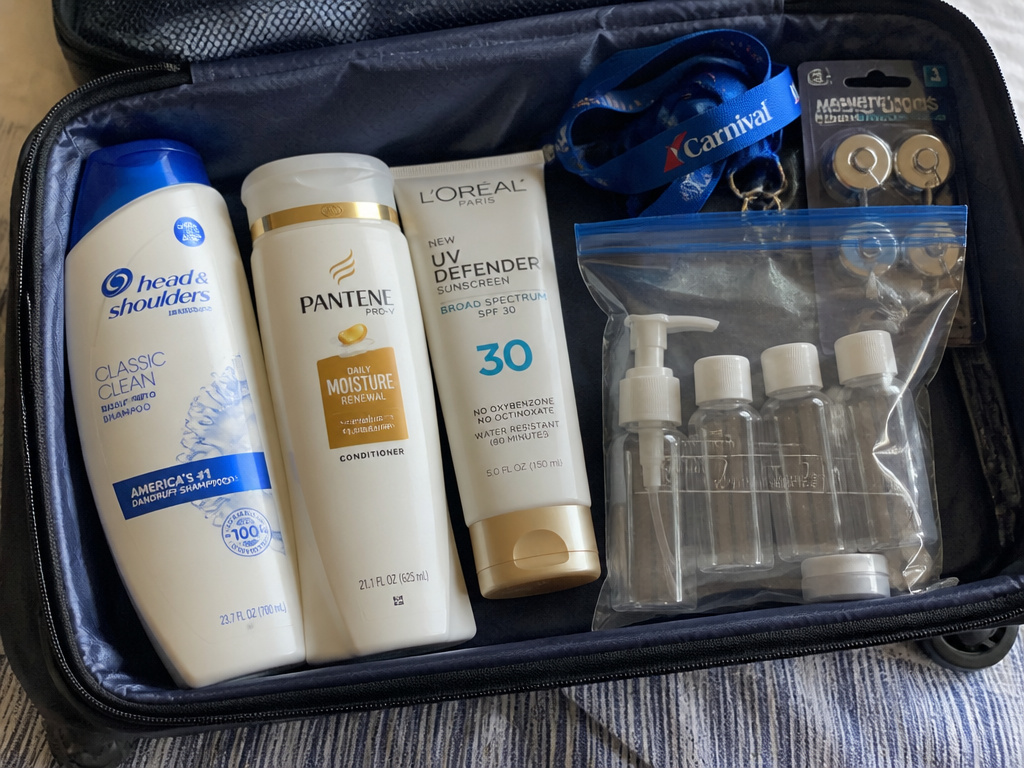
Yes, in the bag that gets checked. Princess Cruises states that cruise ships don’t enforce the same liquid limits as TSA, so full-size shampoo, conditioner, and sunscreen can go in your checked cruise luggage.
The 3-1-1 rule is an airline rule, not a cruise rule. It caps carry-on liquids at 3.4 oz per container, one quart-size clear bag, one bag per passenger. Princess notes it still applies to your airline carry-on if you’re flying to the departure port.
So the split is simple: full-size in the checked cruise bag, travel-size in the quart bag you fly with.
- Full-size toiletries in the checked bag. No cruise liquid limit applies.
- A quart-size clear bag for the flight, with 3.4 oz containers inside.
- Reef-safe sunscreen, not just any sunscreen. Carnival says most snorkel tours now permit only eco-friendly or reef-safe formulas on excursions. AAA’s checklist lists reef-safe sunscreen without tying it to a specific activity.
- SPF 30 or higher. That’s Carnival’s number.
- A wrinkle-release spray. Royal Caribbean doesn’t allow irons or steamers on board.
I packed an umbrella, a sewing kit, and a collapsible water bottle “just in case” for a week in Phoenix in July. The sewing kit is still in the original packaging. Toiletries are where that instinct does the most damage, because they’re the heaviest things in the bag and the easiest to buy ashore.
Common mistake: Packing for the destination’s average weather instead of the forecast for your actual dates. A Caribbean sailing in the middle of a wet week needs a different bag than the same itinerary in a dry one, and the average tells you nothing about either.
The rest of the small stuff fits in one pouch. The best travel essentials for a cruise cabin are a refillable water bottle, ear plugs, a lanyard for your cruise card, and magnetic hooks. AAA’s checklist includes every one of them.
That’s the whole toiletry decision.
Power Strips, Plugs, and Two Holland America Ships That Break the Rule
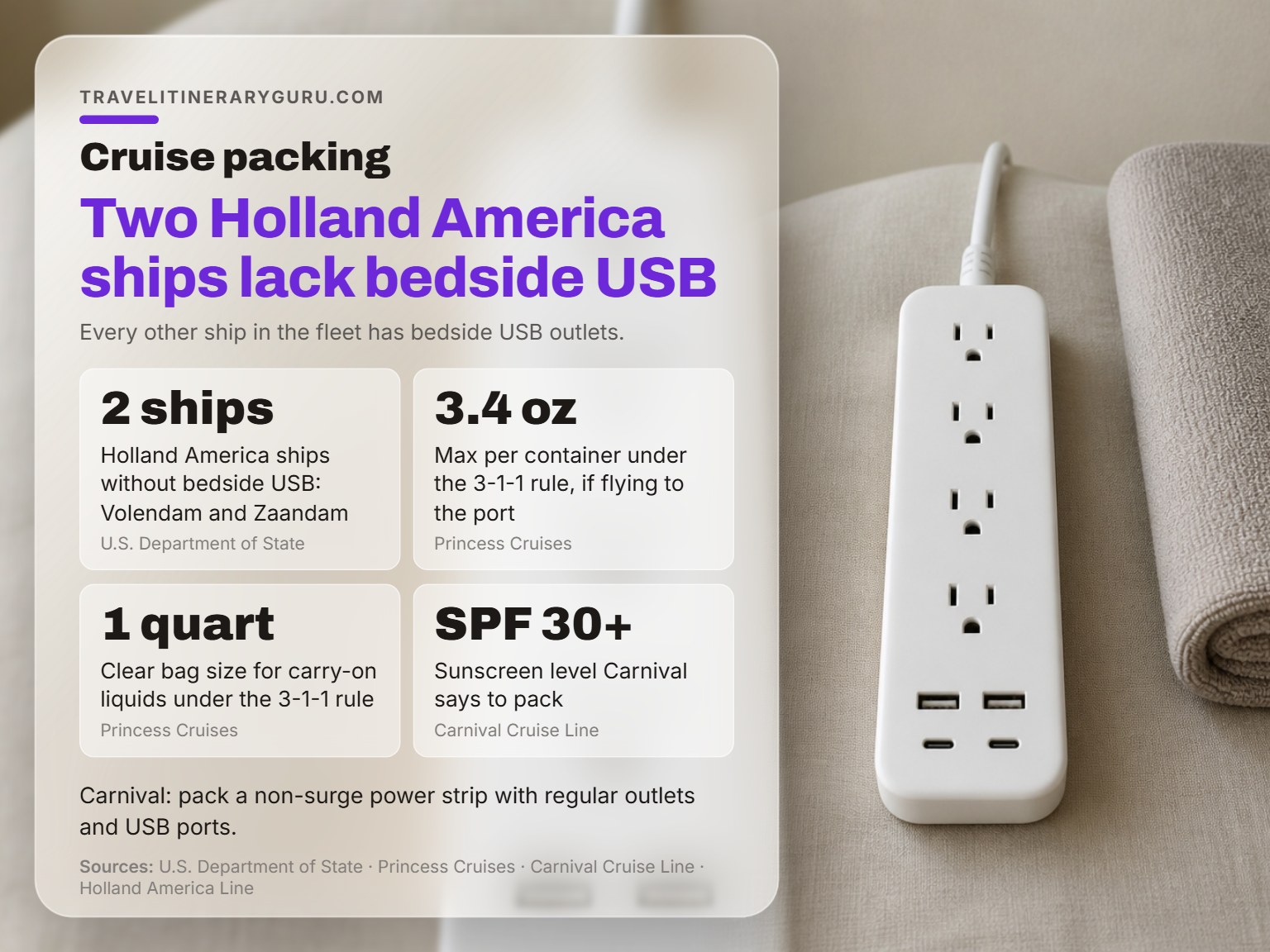
Holland America Line fits bedside USB outlets on every ship in its fleet except two: Volendam and Zaandam.
That single exception changes what you pack. On most Holland America sailings you can leave the adapter block at home and charge a phone from the nightstand. On Volendam or Zaandam, you can’t. Holland America’s packing and luggage FAQ documents the exception ship by ship.
Carnival’s guidance is specific: pack a non-surge power strip with a few regular outlets and USB ports. AAA’s checklist says “travel power strip” with no surge qualifier at all. Those aren’t opposite instructions, just different levels of specificity. Carnival names the qualifier. AAA doesn’t. Buy the non-surge version.
Adapters are the other split. Condé Nast Traveler reports that nearly every cruise ship is equipped with both American and European plugs, and suggests a travel adaptor mainly for extra travel or long layovers. AAA’s checklist simply says to pack adapter/converters if needed. Neither is wrong. The second one just leaves the decision to you.
| Symptom | Likely Cause | Fix |
|---|---|---|
| Phone won’t charge at the nightstand | Volendam or Zaandam | Bring the non-surge strip |
| Outlets are all full by 9pm | Phones, tablets, camera, watch | Multi-port USB charger |
| Clothes are creased on night one | No irons or steamers allowed | Wrinkle-release spray or a hot shower |
| Everything’s damp after a port day | Wet swimwear in the suitcase | Resealable plastic bags |
Outlet count and counter space track the cabin you book. Before you pack around a charging setup, it’s worth knowing which cruise cabin types you’re actually in.
Buy the non-surge strip. It’s there to multiply outlets, and it’s the version Carnival’s own checklist names.
Two ships. That’s it.
Build the Medication and Seasickness Kit Before You Sail
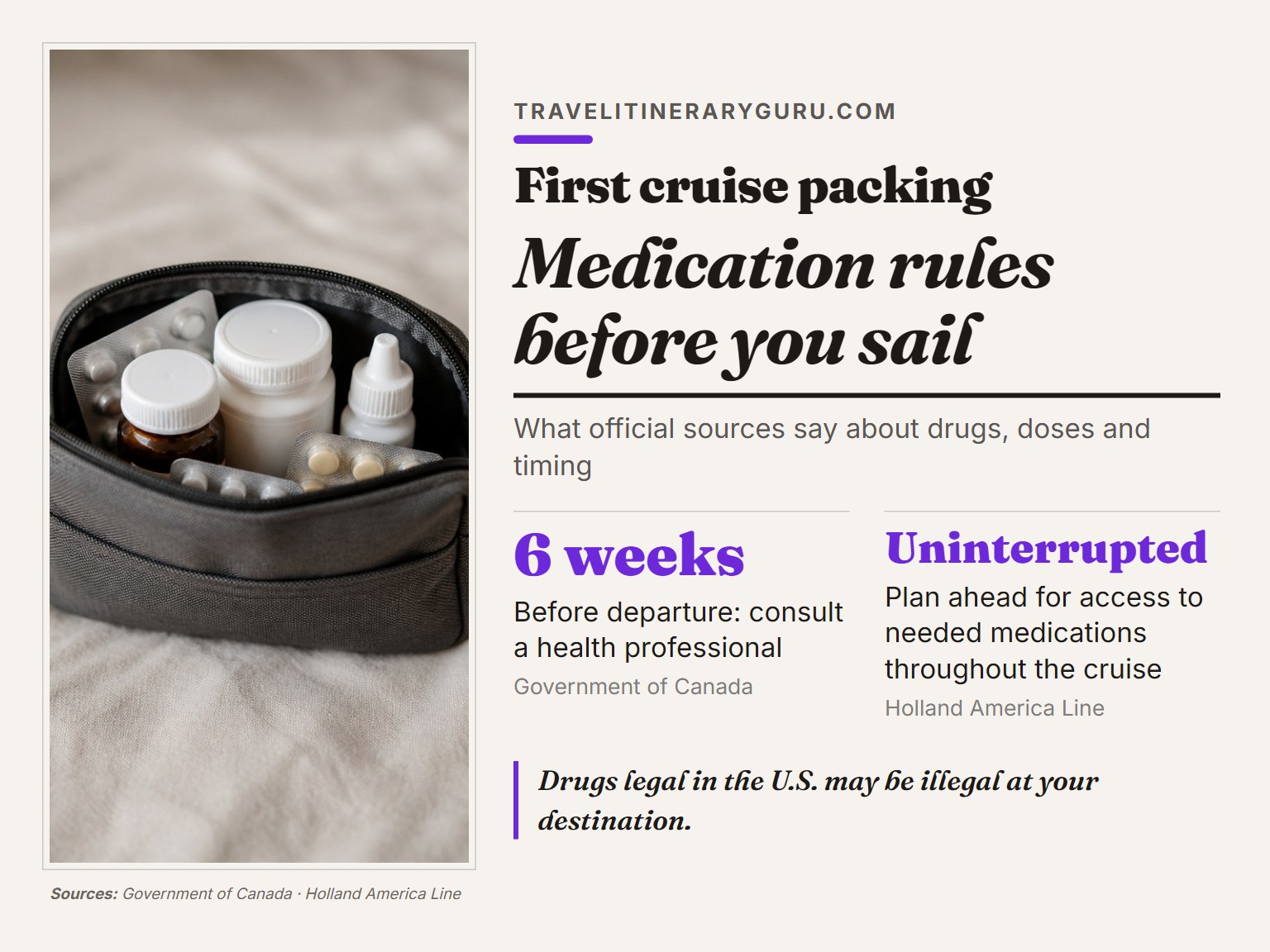
Medication is the one item on this list that can turn a port call into a legal problem.
The State Department’s guidance is blunt: drugs that are legal in the U.S. May be illegal at your destination, and a prescription bottle alone might not be enough proof. A doctor’s letter may be required. The same page advises carrying extra doses beyond your trip length, because foreign equivalents may not exist.
Holland America’s advice points the same direction from a different angle: plan ahead so you have uninterrupted access to needed medications throughout the cruise. The two sources frame the same risk differently. The State Department treats it as a legal problem at the port. Holland America treats it as a supply problem on board.
The Government of Canada’s cruise traveller’s checklist puts the health conversation at about 6 weeks before departure, which is earlier than most people start thinking about a cruise.
Seasickness Remedies: What Each Source Recommends
Three sources, three lists. Carnival names pills, wrist bands, skin patches, and ginger chews. Condé Nast Traveler names Dramamine and Sea-Bands, and recommends them specifically if you’ve been seasick before or it’s your first cruise. AAA’s checklist just says motion sickness remedies.
The pattern is worth noticing: the more specific the source, the more it assumes you’ll be seasick. If you’ve never been motion sick, ginger chews and a wristband are plenty. If you have been, read up on how to avoid seasickness before you book, not after.
Carnival’s first-aid list is the longest of the three, and it fits in one toiletry bag:
- Pain relievers, cough drops, and allergy medicine
- Adhesive bandages and antiseptic wipes
- Antacids
- Antibacterial hand gel
- Seasickness remedies, in whatever form you’ll actually take
- A dedicated pouch. A travel medicine kit keeps it in one place instead of scattered across the cabin.
Where this goes sideways: Packing medication in the checked bag. That bag arrives a few hours after you do at best, and if it’s delayed at the port, you’re managing a chronic condition from a cabin with nothing in it.
Pack it in the carry-on.
The 72-Hour Pre-Departure Re-Run
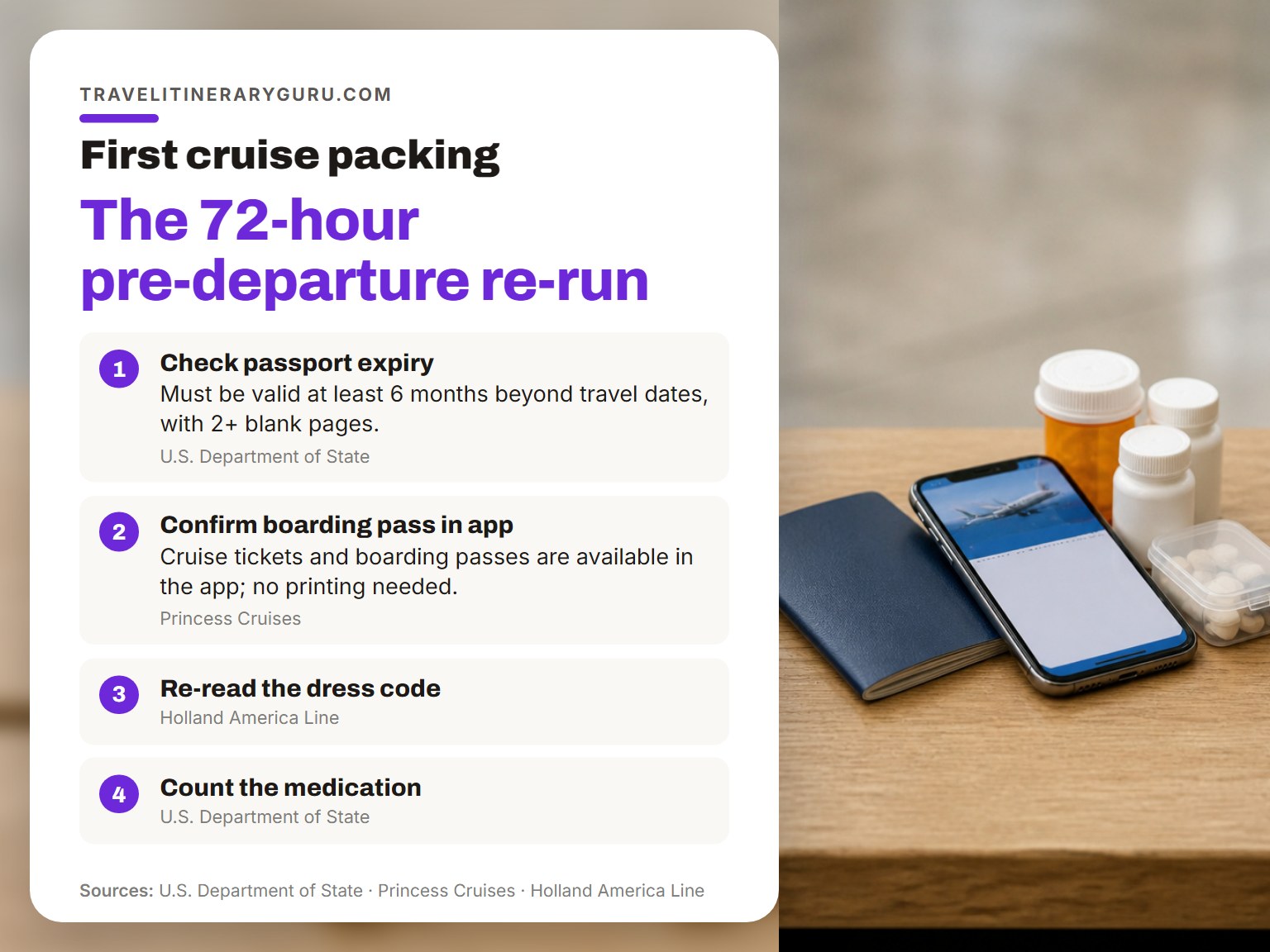
The last pass happens three days out, not the night before.
A day-before check is a panic. A three-day check is a fix window. There’s enough time to renew something, replace something, or call a doctor. I re-run the documents and confirmations list 72 hours before sail date, and it has caught more problems than any packing list I’ve used.
Fair warning: this part is boring, and it’s the part that matters.
- Check the passport expiry against the 6-month rule, not against the sail date. This is the one people get wrong.
- Confirm the boarding pass is in the app. Princess makes cruise tickets and boarding passes available in its app, and no printing is needed.
- Re-read the cruise line’s dress code. Holland America’s dining rooms prohibit shorts, beachwear, tank tops, and distressed jeans at table-service restaurants.
- Count the medication. More doses than the trip needs, in the original containers, with the letter.
- Check the forecast for your actual dates, not the destination’s averages.
- Empty and wipe out every bag that has held a firearm. Shell casings in a lining are an arrest risk at a cruise port.
Most of this fits inside a pre-trip checklist you run a week out, which gives you a second pass at 72 hours. By then the cruise packing checklist for a first cruise is mostly done. A passport problem found three days out is fixable. Found at the pier, it isn’t.
I’m bad at this part when things go wrong. If a plan falls apart mid-trip, my instinct is to rebuild the spreadsheet instead of enjoying the detour, and I have to consciously fight it. The 72-hour re-run exists partly so the trip itself doesn’t need one.
Three days. That’s the window.
Frequently Asked Questions
Do I need a passport for a closed-loop cruise?
It depends on the itinerary, and that’s the trap. The State Department recommends carrying a passport book even when U.S. Customs and Border Protection doesn’t require one, and cruise lines may require one anyway. Carnival accepts a passport, an enhanced driver’s license, or a government-issued birth certificate on closed-loop itineraries. The safest read is to carry the book.
Can I bring an iron or steamer on a cruise?
No. Royal Caribbean states that irons and steamers aren’t allowed on ships. Pack a wrinkle-release spray instead, or hang the garment in the bathroom during a hot shower. Both are Royal Caribbean’s own suggestions.
Where should I pack my medication?
In your carry-on, in the original containers, with more doses than the trip requires. The State Department warns that a prescription bottle alone may not be enough proof abroad and that a doctor’s letter may be required. Holland America’s guidance adds that you should plan ahead for uninterrupted access throughout the cruise.
Is a power strip allowed on a cruise ship?
Carnival’s checklist recommends a non-surge power strip with regular outlets and USB ports. AAA’s checklist lists a travel power strip without the surge qualifier. Buy the non-surge version.
How early should I start packing for a cruise?
The Government of Canada recommends a health consultation about 6 weeks before the trip, which is the earliest item on the list. Documents and confirmations get re-run about 72 hours out. The clothes can wait until the week of.
What should I wear to dinner on a cruise?
Carnival describes dinner as smart-casual for women and slacks with a collared shirt for men, with formal night allowing cocktail dresses, gowns, suits and ties, or tuxedos. Royal Caribbean keeps swimwear, tank tops, and bare feet to the pool deck, and accepts jeans, polos, and blouses in its restaurants. Holland America’s dining rooms prohibit shorts, beachwear, tank tops, and distressed jeans at table-service restaurants.
The Bottom Line
If your passport has less than 6 months left after your sail date, stop and renew it before you do anything else on this list. That’s the one item with no workaround at the pier.
Everything else can be bought. Sunscreen, a power strip, a wrinkle-release spray. All of it exists in a port gift shop, at a markup, on the day you need it.
This whole approach assumes you’re willing to spend an hour building the list from your actual itinerary. If you’d rather not, the 5-4-3-2-1 rule covers a week-long sailing and the 333 method covers 3 to 5 days. Neither will tell you what to leave out.
And the part I’d defend in an argument: the item you’ll regret isn’t the one you forgot. It’s the one you packed for a trip you didn’t take.
