
When to Visit New Orleans for Festival Season?
This post contains affiliate links. As an Amazon Associate, we earn from qualifying purchases.
New Orleans festival season has no fixed date. Mardi Gras Day 2027 falls on February 9, and the season opens January 6, but the date moves every year because it is tied to Easter. Jazz Fest 2027 runs the weekends of April 22-25 and April 29-May 2. Everything between those two anchors is a timing decision, which is why knowing when to visit New Orleans for festival season matters.
That movable anchor is why the when to visit New Orleans for festival season question makes generic “best time to visit” advice fail here. Mardi Gras Day always lands 47 days before Easter Sunday, per New Orleans & Company, the city’s official destination marketing organization. Because Easter can fall anywhere from March 22 to April 25, Mardi Gras Day swings from as early as February 3 to as late as March 9.
What follows: the date mechanics that decide your window, the two festival anchors worth building a trip around, the crowd trap most visitors walk straight into, and the hurricane-season overlap that catches people who book fall without checking a calendar. I’ll also show where the official tourism board and the independent travel sources actually disagree, because they do.
Key Takeaways
- Mardi Gras Day is 47 days before Easter, so it moves between February 3 and March 9. Check the year before you book anything.
- The final five days before Fat Tuesday are the busiest, and the biggest parades begin one week out. Come early in the season and you get parades without the crush.
- Jazz Fest 2027 runs April 22-25 and April 29-May 2 at the Fair Grounds Race Course, and it drives hotel demand across the whole city.
- Hurricane season runs June 1 to November 30, with peak risk mid-August to early October. Book flexible rates if you’re traveling then.
- Midweek stays cost less than weekend stays in every season. Sunday through Thursday is the single easiest saving on the calendar.
The Mardi Gras Date Rule That Decides Your Whole Trip
Mardi Gras Day is not a fixed holiday, and that one fact reshapes every trip planned around it. New Orleans & Company states the rule plainly: Fat Tuesday always falls on a Tuesday, exactly 47 days before Easter Sunday.
Easter itself moves between March 22 and April 25. Run that math and Mardi Gras Day lands anywhere from February 3 to March 9. In 2026, Fat Tuesday falls on February 17. In 2027, it’s February 9.
Mardi Gras Day falls 47 days before Easter Sunday, which places it between February 3 and March 9. Carnival season always opens on January 6, Epiphany, giving the city a six-to-eight-week celebration window that varies in length from year to year.
That six-to-eight-week season is the part visitors underestimate. New Orleans & Company confirms the season lasts 6-8 weeks annually, which means there’s a long runway of parades before the famous final week.
What the official date rule means for your booking window
If you’re targeting Fat Tuesday itself, you’re targeting the most expensive week of the year. Flights and hotels fill fast, and New Orleans & Company’s own guidance is blunt: plan your trip as soon as possible.
The alternative is the early-season window. Parades roll in neighborhoods across the city on weekends beginning on Twelfth Night in January, well before the super-krewes take over.
New Orleans & Company names three early-season parades specifically for crowd avoidance: Krewe of Barkus, the Intergalactic Krewe of Chewbacchus, and ‘tit Rex. Barkus parades through the French Quarter with dogs and their owners. Chewbacchus is the sci-fi parody krewe. ‘tit Rex runs tiny shoebox floats through the Marigny.
One warning worth flagging: Krewe du Vieux is not a family parade. New Orleans & Company describes its themes as risque and meant for adults only.
How Long Does Mardi Gras Actually Last?
Longer than the news coverage suggests. The season opens January 6 and runs to Fat Tuesday, and the shape of it matters more than the length.
The biggest celebrations and parades begin one week before Mardi Gras Day, according to New Orleans & Company. Before that week, parades roll on weekends in neighborhoods across the city. During that final week, a marathon of parades and super-krewes rolls every single night.
The independent aggregator besttimestotravel.com frames the same build differently. It describes the parade season as building over the two to three weeks before Fat Tuesday, with the final five days the busiest.
Those two descriptions aren’t contradictory, but they weight the ramp-up differently. The DMO points to a hard one-week switch. The aggregator sees a longer, softer build. Either way, the practical takeaway is the same: the last five days are the peak.
Where this goes sideways: Booking a hotel the week of Fat Tuesday and assuming you’ll watch parades from the sidewalk. The main route runs down St. Charles Avenue, and the crowds along it in that final week are dense enough that you’ll spend more time holding your spot than watching the floats.
The route, so you know where to stand
The main parade route runs the length of Saint Charles Avenue. Parades begin rolling on Napoleon and Tchoupitoulas, turn down St. Charles toward downtown, then make a final turn on Canal Street toward the river.
Routes vary by krewe, so check individual krewe maps before you commit to a corner. New Orleans & Company recommends staying Uptown on St. Charles Avenue or downtown near Canal Street if you want to be on the route.
For families, the recommendation is more specific. New Orleans & Company points to Uptown for both lodging and parade viewing. Besttimestotravel.com agrees and draws the line clearly: the Uptown routes along St. Charles and Napoleon are fine for kids, while Bourbon Street and the French Quarter during Carnival are an adult scene.
The Krewe Lineup, and Why It Changes Your Dates
Krewes aren’t interchangeable. Each one has a signature, and if you’re chasing a specific throw or a specific vibe, the krewe schedule is your real calendar.
| Krewe | Signature | When It Rolls |
|---|---|---|
| Krewe of Muses | All-female; shoes are the signature throw | Thursday of the final week |
| Krewe of Endymion | Largest parade; extravagant floats | Saturday of the final week |
| Krewe of Zulu | One of the oldest majority Black krewes | Mardi Gras Day |
| Krewe of Rex | The symbolic King of Carnival | Mardi Gras Day |
| Krewe of Barkus | Dogs parade through the French Quarter | Early season |
The flambeaux tradition is worth knowing about before you go. Flambeaux have lit Mardi Gras parades since 1857 and are still used today, carried by walkers who are thrown change as thanks.
One more Mardi Gras morning detail that most first-timers miss: the North Side Skull and Bones Gang roams the streets of the Treme beginning at dawn every Mardi Gras morning. If you want to see it, you’re setting an alarm.
Skip this if: You’re traveling with young kids and planning to stay near Bourbon Street during the final week. The Uptown routes give you the same parades with room to breathe and a much shorter walk back to a hotel.
Jazz Fest Is the Other Anchor, and It Moves Too
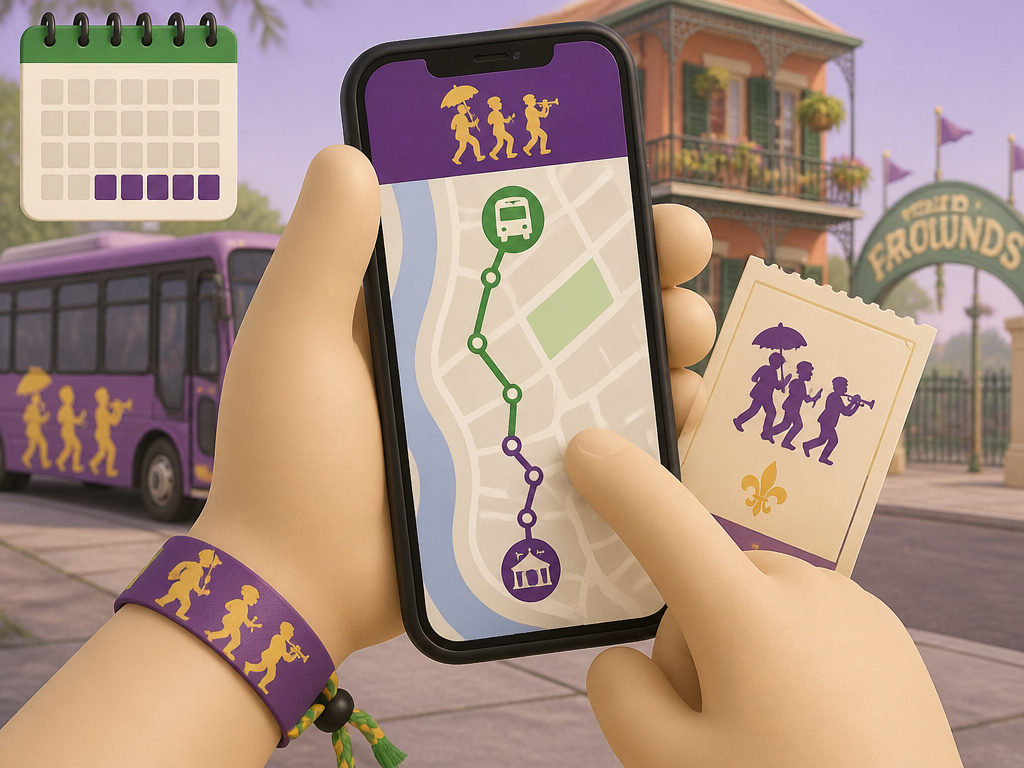
Jazz Fest 2027 returns Thursday to Sunday on the weekends of April 22-25 and April 29-May 2, per New Orleans & Company. It’s held at the historic Fair Grounds Race Course and welcomes hundreds of thousands of visitors annually.
The crowding effect is citywide, not just at the gates. Travelwithdande.com notes that Jazz Fest starts during the last weekend of April and drives hotel prices up fast. That’s a personal travel blog, so treat it as opinion-level, but it matches the DMO’s own advice to book early.
Transportation is where most people make a mistake. The official Jazz Fest Express Shuttle is the only shuttle that drops passengers directly inside the Fair Grounds gates. It runs round-trip service from four departure points, including the French Quarter at the Steamboat Natchez Dock, 400 Toulouse.
If you’re weighing how to split your days between festival time and everything else, the honest answer is that a Jazz Fest weekend eats a full day each time you go. Work out your how many days in New Orleans before you build the festival in, not after.
What About the Rest of the Festival Calendar?
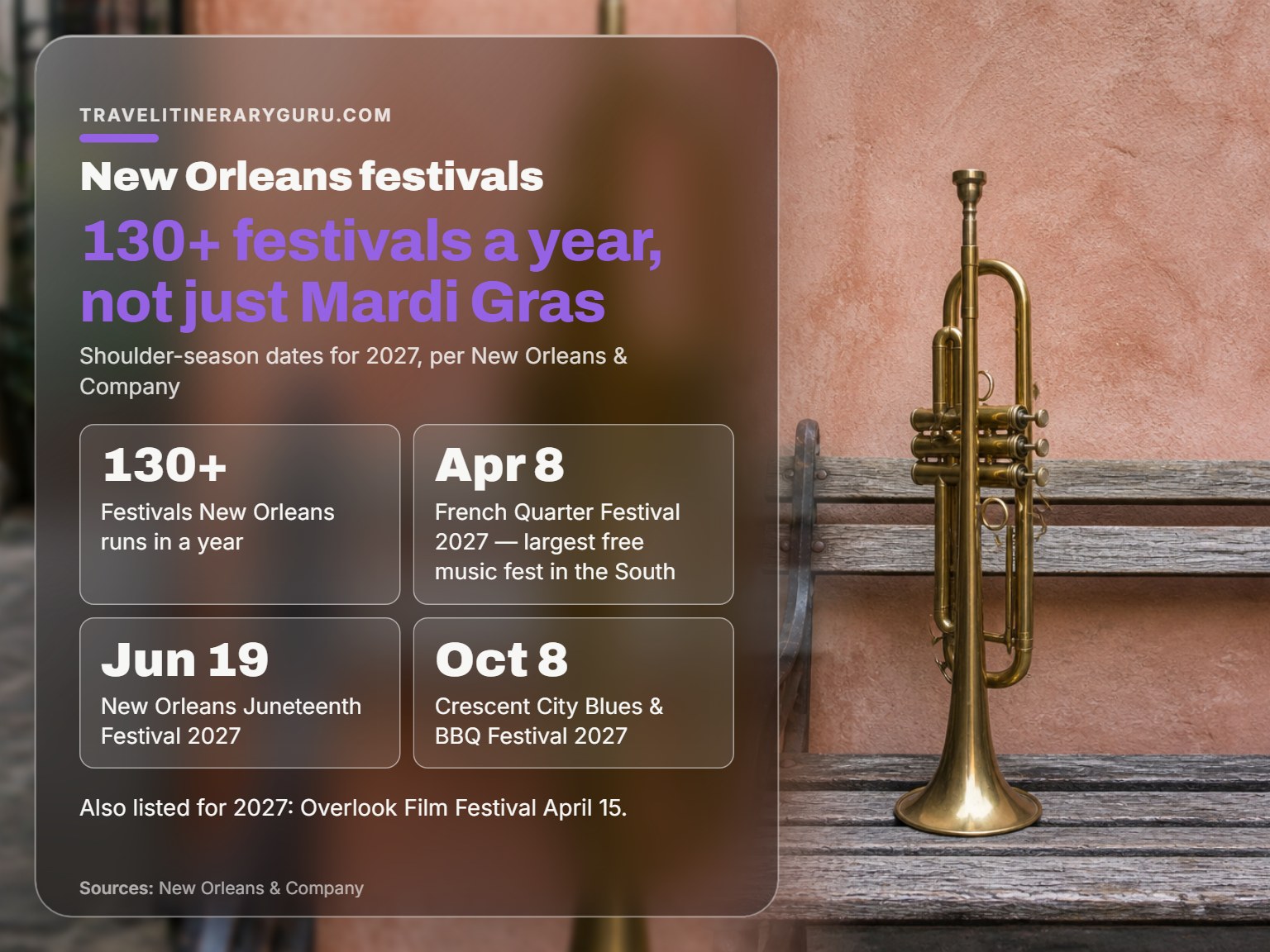
New Orleans runs over 130 festivals a year, according to New Orleans & Company. The two anchors get the attention, but the shoulder calendar is where the value sits.
| Festival | Typical Timing | What It Is |
|---|---|---|
| French Quarter Fest | Mid-April long weekend | Largest free music festival in the South |
| ESSENCE Festival of Culture | Early July | Concerts and programming at the Superdome and Convention Center |
| Satchmo SummerFest | Early August | Tribute to Louis Armstrong in the French Quarter |
| Crescent City Blues & BBQ Festival | Mid-October | Blues and barbecue in the fall shoulder |
| Po-Boy Festival | October or November | Oak Street food festival |
For 2027 specifically, New Orleans & Company lists French Quarter Festival on April 8, the Overlook Film Festival on April 15, the New Orleans Juneteenth Festival on June 19, and the Crescent City Blues & BBQ Festival on October 8.
Halloween is the one people don’t plan for. Travelwithdande.com describes it as a second Mardi Gras, with costumed crowds, ghost tours, and the Krewe of Boo parade. That’s blog-level framing, but the crowd effect is real.
If you want to build a trip around the smaller stuff, there’s a whole layer of New Orleans hidden gems that only shows up when the big weekends are quiet.
When Should You Actually Go? The Sources Don’t Fully Agree
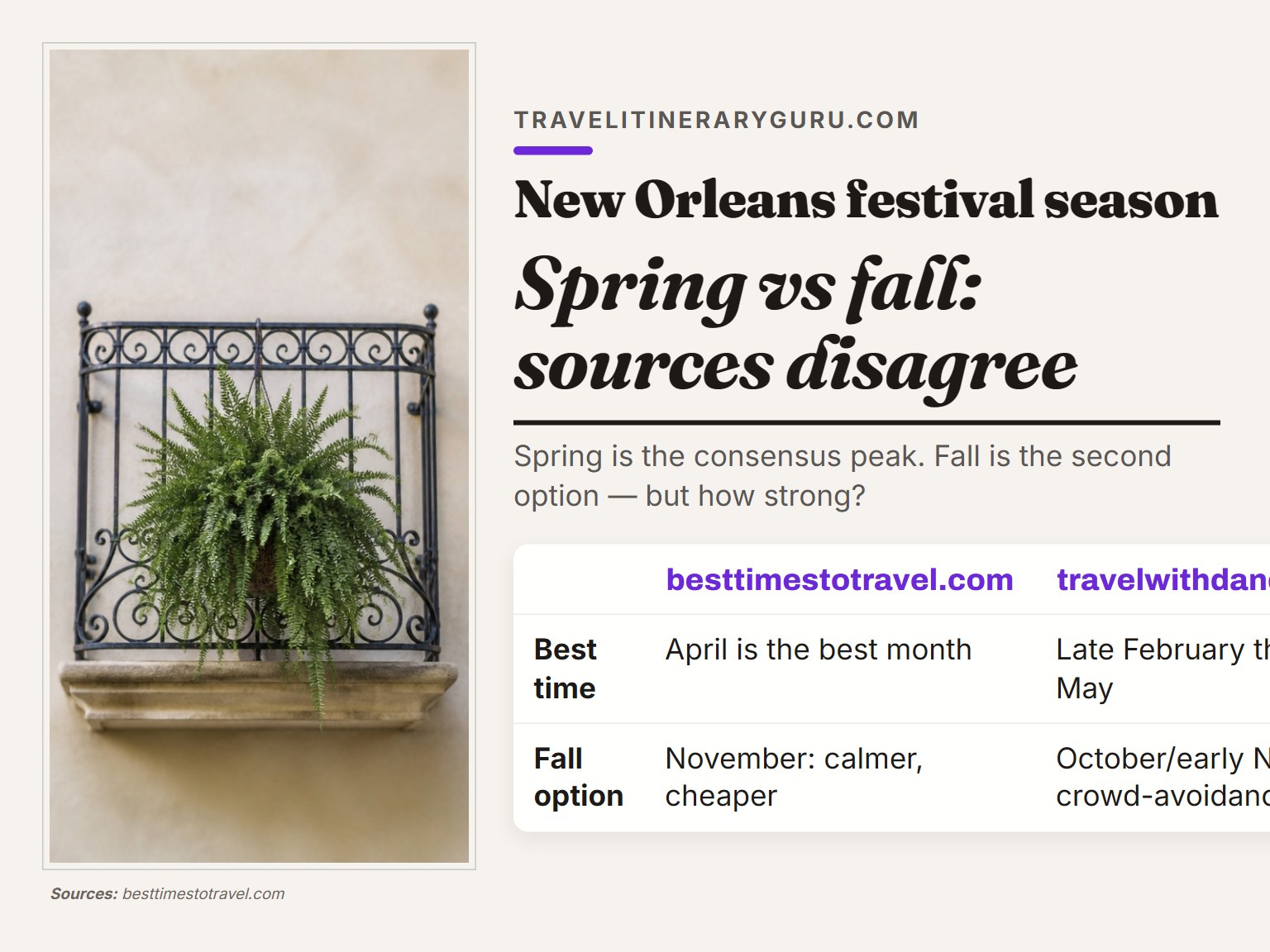
Here’s where I have to be straight with you, because the advice you’ll find online splits in a way that matters.
New Orleans & Company, the official DMO, takes the broadest position: there really isn’t a bad time to visit, and every month has something enticing. That’s the tourism board’s line, and it’s worth reading as exactly that.
Besttimestotravel.com names April outright as the best month, citing French Quarter Festival, the first weekend of Jazz Fest, crawfish at their best, and warm weather before the summer humidity. It calls November the calmer, cheaper alternative.
Travelwithdande.com lands slightly differently again. It says the best time is late February through May, with October and early November as the crowd-avoidance alternative. That source treats fall as a fallback. Besttimestotravel.com treats fall as closer to co-equal with spring.
So: spring is the consensus peak, fall is the consensus second option, and the disagreement is only about how strongly to weight fall. If you want the shoulder-season version of this argument applied generally, the same logic shows up in Deep South travel tips for the wider region.
What about summer and hurricane season?
Summer in New Orleans is hot and very humid from June through September, with highs near 90°F (32°C) and afternoon storms, per besttimestotravel.com. The same source says summer is hot and very humid, and walking the Quarter in August is punishing.
The workaround is a split day. Plan outdoor walking for mornings and evenings and spend afternoons in museums and restaurants. That’s the aggregator’s advice, and it’s the right shape for any hot-weather city.
Hurricane season runs June 1 to November 30, with the highest risk for New Orleans falling between mid-August and early October and peaking around early to mid-September. Both besttimestotravel.com and travelwithdande.com give the same window, so there’s no disagreement to resolve there.
The mitigation both sources recommend is identical: buy travel insurance at the time of booking, and stay flexible during late August and September. If you’re building a trip in that window, there’s a full walkthrough on planning around hurricane season worth reading before you book.
The part nobody mentions: The cheapest months and the riskiest months are the same months. August and September are the cheapest time to visit per besttimestotravel.com, followed by June and July, and they overlap the peak of hurricane season. The discount is real. So is what you’re being paid to accept.
The Week After Mardi Gras Is the Window Nobody Talks About
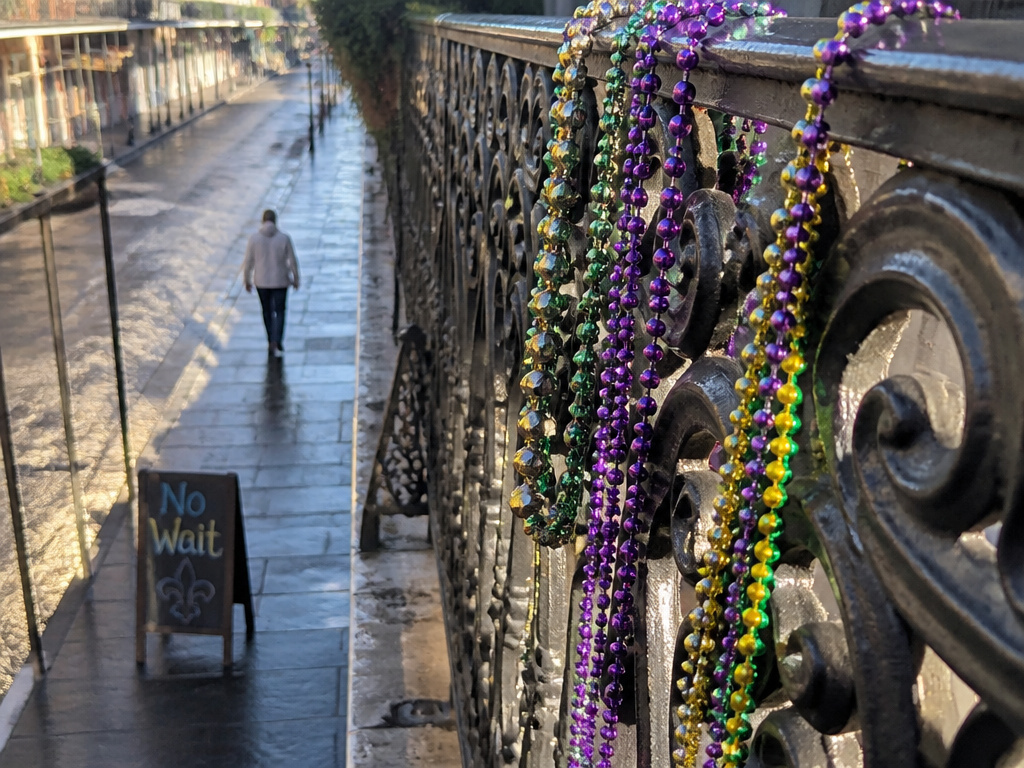
Mardi Gras ends, the crowds leave, and the city stays open. That’s the gap I keep coming back to.
Frenchmen Street is half-empty, hotel rates drop, and the city is still fully staffed and open.
Frenchmen Street is worth knowing about regardless of when you go. Besttimestotravel.com describes it as three blocks of clubs with live bands from early evening on, and calls it the locals’ answer to Bourbon Street. Walk the French Quarter and Jackson Square early, before the day-trippers arrive.
The lesson generalizes. A basic hotel room ran far above its normal rate and every restaurant had a long wait.
Worth knowing before you start: Mardi Gras dates and Jazz Fest dates are the two that move hotel pricing across the whole city. Check both before you book flights, because a “quiet week” in one calendar year is a peak week in the next.
Does the Day of the Week Matter More Than the Month?
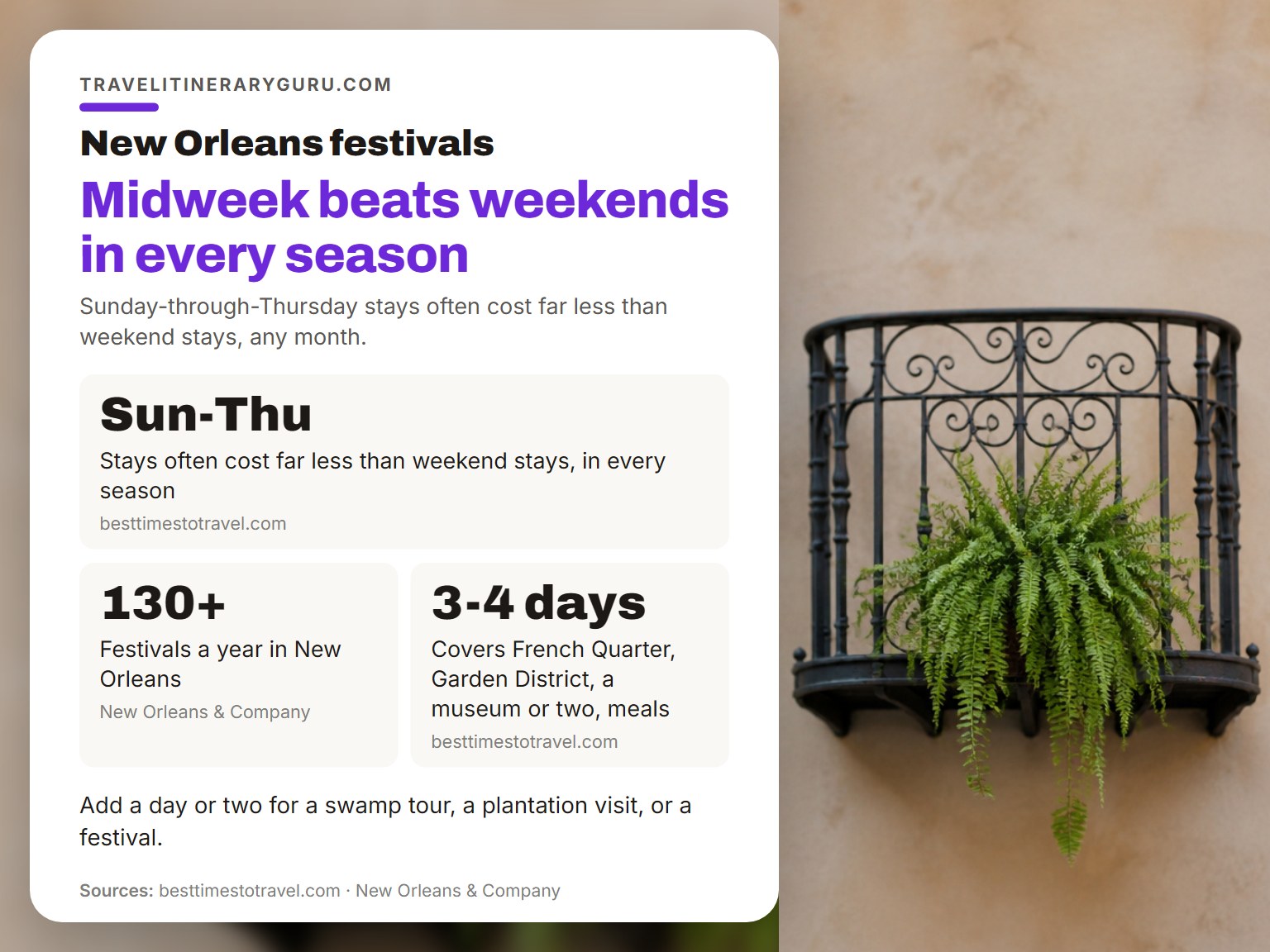
More than most people think. Besttimestotravel.com states it directly: Sunday-through-Thursday stays often cost far less than weekend stays in every season. That holds whether you’re visiting in April or August.
The reason is straightforward. Weekend demand stacks on top of whatever festival is running, and festival demand stacks on top of that. A midweek stay during a shoulder month is the cheapest combination on the board.
The exception is Frenchmen Street, which doesn’t get going until early evening. That’s a night stop, not a morning one.
If you’re building a short trip, a 2-day New Orleans itinerary has to make harder choices about which anchor gets the morning slot. Three to four days covers the French Quarter, Garden District, a museum or two, and a few good meals, per besttimestotravel.com. Add a day or two for a swamp tour, a plantation visit, or a festival.
One last thing on festival days specifically: live music at parade volume for hours on end does damage you won’t notice until the next morning. A pair of festival earplugs is cheap insurance, and brass bands at close range are exactly the scenario they’re built for.
Easy to miss: The “best” time for a landmark and the “best” time to visit a city aren’t the same question.
Frequently Asked Questions
When is Mardi Gras in 2027?
Mardi Gras Day 2027 is February 9, and the season opens January 6. The date moves every year because Mardi Gras Day always falls 47 days before Easter Sunday, which places it between February 3 and March 9 depending on the year.
What is the best month to visit New Orleans?
Besttimestotravel.com points to April, citing French Quarter Festival, the first weekend of Jazz Fest, crawfish season, and warm weather before the summer humidity, while travelwithdande.com says the best time is late February through May. November is the calmer, cheaper alternative. The official tourism board takes a broader position, saying there isn’t a bad time to visit, while besttimestotravel.com names April and travelwithdande.com says late February through May.
Is it worth going to New Orleans during hurricane season?
It’s workable, and the cheapest months fall inside the season. Hurricane season runs June 1 to November 30, with peak risk mid-August to early October. Buy travel insurance when you book and keep your dates flexible if you’re traveling in late August or September.
How many days do you need for a New Orleans festival trip?
Three to four days covers the French Quarter, Garden District, a museum or two, and a few good meals. Add a day or two if you’re building around a festival, a swamp tour, or a plantation visit. Jazz Fest weekends effectively consume a full day each.
Should I go to Mardi Gras or Jazz Fest?
They’re different trips. Mardi Gras is a citywide street celebration spread over six to eight weeks, with the biggest parades in the final week. Jazz Fest is a ticketed festival at the Fair Grounds Race Course over two weekends. Mardi Gras is free and dispersed; Jazz Fest is concentrated and paid.
What should I wear to a Mardi Gras parade?
Dress comfortably and wear closed-toe shoes, per New Orleans & Company. Costumes are very common and especially encouraged on Fat Tuesday.
The Bottom Line
One threshold decides most of this: if your travel dates are flexible, book the week after Mardi Gras rather than the week of it. Frenchmen Street empties out, hotel rates drop, and every restaurant and bar is still fully open. You get the city without the crush.
If you can’t move your dates, work the midweek angle instead. Sunday-through-Thursday stays cost less than weekend stays in every season, and that saving stacks with a shoulder month.
Those two dates set hotel pricing across the entire city, and everything else on the calendar is a smaller decision.
Fair warning on the fall window: October and November are genuinely good months here, but they sit inside hurricane season. The advice holds until you’re booking late August or September, and then the calculus flips. Insurance and flexible rates stop being optional and start being the plan.
