
3-day Chicago Itinerary for First-Time Visitors
This post contains affiliate links. As an Amazon Associate, we earn from qualifying purchases.
Build a 3-day Chicago itinerary for first-time visitors around one anchor per day: the Loop and the river on day one, Museum Campus and Navy Pier on day two, a neighborhood on day three. The CTA’s eight ‘L’ lines and 145 stations make a car unnecessary.
That ticket split is the first thing to plan around. Three institutions share one stretch of lakefront, and one source advises picking exactly one for a morning. The Field Museum suits natural-history fans, the Shedd Aquarium suits families, and the Adler Planetarium suits anyone drawn to space and shows.
What follows is the day-by-day shape, the two observation decks compared honestly, and the points where the major guides disagree with each other. One of those disagreements changes how you should treat Museum Campus.
Key Takeaways
- One anchor per day. Three days covers downtown and the near North Side. Push further and you spend the trip on transit.
- Book the observation decks before you fly. Both sell timed tickets, popular slots tend to book up quickly, and sunset is a popular time.
- Museum Campus is three institutions, so pick one institution per morning instead of trying to see two.
- Cloud Gate before 10am. By midday the plaza is genuinely crowded.
- Leave the car at home. The ‘L’ and the buses reach everything in this plan.
What a 3-Day Chicago Itinerary for First-Time Visitors Can Realistically Cover
Three days in Chicago is a downtown trip, and pretending otherwise wrecks it. The plans that actually work scope themselves to the Loop, the Riverwalk, Museum Campus, and Navy Pier. Everything else needs its own trip.
CTA ‘L’ service comprises eight lines and 145 train stations, with 129 bus routes filling the gaps every few blocks. Only the Red and Blue Lines run around the clock. The Blue Line connects O’Hare to the Loop in about 40 to 45 minutes; the Orange Line runs Midway to the Loop in about 25 to 30 minutes.
I’ve tested this on my own trips. Done properly, by neighborhood rather than by landmark, Chicago rewards more time than three days allows. Three days works when you accept the downtown-and-lakefront boundary and stop there.
Getting the how many days in Chicago question right before you book matters more than any packing list. A 3-day Seattle itinerary looks nothing like this one.
Three days is still enough to see the landmarks properly. It is not enough to see all of them.
Day One: The Loop, the River, and the Skydeck
Day one lives entirely inside the Loop, which makes it the easiest day to get right. Start at Millennium Park, where entry is free and Cloud Gate needs no ticket and no advance booking. Arrive before 10am if you want a photo without a wall of people; by midday it’s genuinely crowded.
The ‘L’ rumbles over the Chicago River on the way in, and the carriage goes quiet for a second as the skyline opens up. That’s the moment the city clicks.
The Art Institute of Chicago holds more than 300,000 works of art. It’s the country’s second-largest art museum, and it deserves a real block of time rather than a rushed hour.
The order that works:
- Millennium Park and Cloud Gate first, before 10am.
- The Art Institute of Chicago straight after, while your legs are fresh.
- The Chicago Riverwalk, a 1.25-mile path running continuous from Lake Street to the lakefront.
- An architecture boat tour from the Riverwalk docks. Most operators run March through November, so book a summer departure ahead.
- Skydeck at Willis Tower in the late afternoon.
Easy to miss: The Riverwalk is continuous from Lake Street to the lakefront. Walk it as one 1.25-mile stretch instead of doubling back at the Michigan Avenue bridge.
Skip the boat tour between December and February. Most operators run from March through November.
Which Observation Deck Should a First-Timer Pick?
The archived Fodor’s guide treats Chicago’s two observation decks as interchangeable.
Skydeck at Willis Tower sits on the 103rd floor of Chicago’s tallest building, which is 110 stories and 1,450 feet to the top. The Ledge glass box extends from the facade more than 1,300 feet above ground level, and it’s included in Skydeck admission. On a clear day the view reaches up to 50 miles into four states.
360 Chicago occupies the 94th floor of 875 North Michigan Avenue, the tower formerly known as the John Hancock Center until 2018. It looks out over the city and Lake Michigan from 1,000 feet up.
The two buildings sit about 2 kilometers apart on Wacker Drive.
Skydeck vs 360 Chicago: The Straight Comparison
| Viewpoint | Height and location | What it does better |
|---|---|---|
| Skydeck at Willis Tower | 1,300+ ft, 103rd floor, the Loop | The Ledge glass box, included with admission |
| 360 Chicago | 1,000 ft, 94th floor, Michigan Avenue | Lake Michigan filling the whole window |
| Lakefront Trail | Ground level, 18 miles of paved path | A paved path along Lake Michigan |
Common mistake: Confusing the two decks. The Skydeck is inside the Willis Tower in the Loop; 360 Chicago is on Michigan Avenue. They’re about 2 kilometers apart.
The archived New York Times Chicago travel feature names the Hancock and the Sears Tower as interchangeable stops. Choose Chicago presents them as two distinct experiences, and the independent Chicago guides deliberately visit both, Skydeck on day one and 360 Chicago on day two at sunset.
Book a timed slot rather than a walk-up. Both decks sell timed tickets and sunset is the popular time, so the evening entries are the ones to lock in first.
If you only do one, take the Skydeck for the Ledge. Take 360 Chicago if you want the lake view.
Day Two: One Museum, Navy Pier, and the Sunset Deck
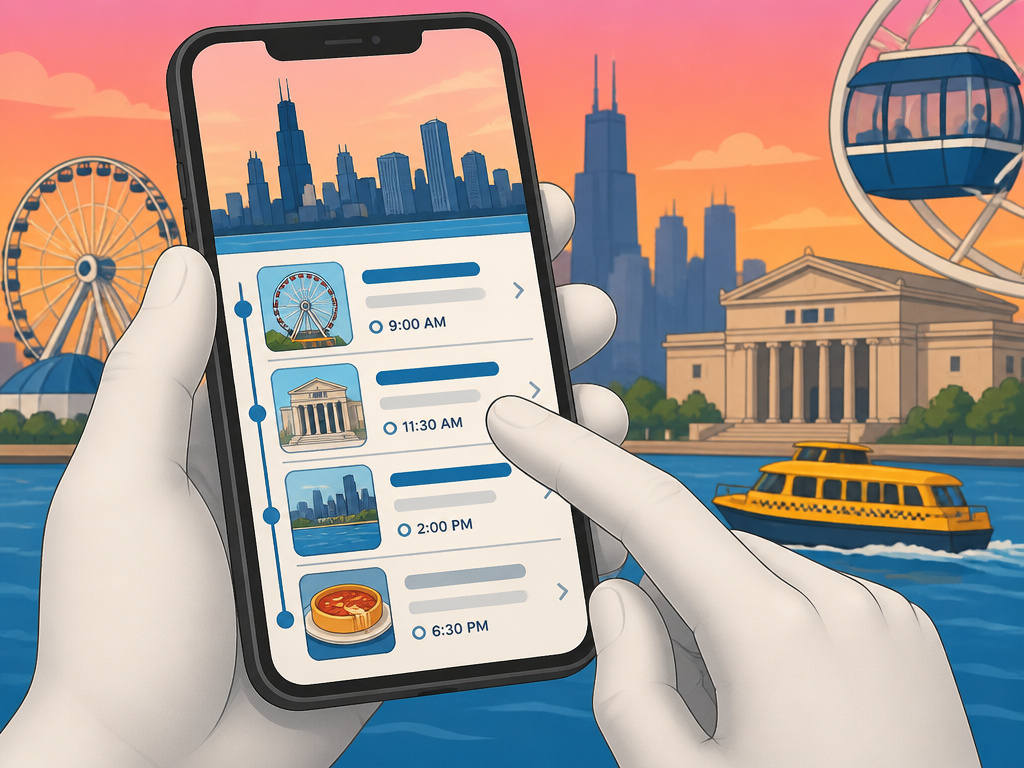
Three institutions sit on the Museum Campus, and that number decides your morning. The Field Museum, the Shedd Aquarium, and the Adler Planetarium share one stretch of lakefront.
The Field, the Shedd, or the Adler?
- The Field Museum suits natural-history fans. Its collection runs to over 24 million objects.
- The Shedd Aquarium suits families and anyone who wants marine life.
- The Adler Planetarium suits space fans and dome-show people. Choose Chicago calls it the country’s oldest planetarium; another guide calls it the first planetarium in the US. Same building, different superlative.
Budget the whole morning for one. Seeing two properly before lunch isn’t realistic.
Afternoon belongs to Navy Pier. The Centennial Wheel soars nearly 200 feet and is climate-controlled. Summer fireworks run every Wednesday and Saturday from Memorial Day to Labor Day.
The Shoreline Sightseeing Water Taxi is the scenic way to link the Museum Campus to Grant Park and Navy Pier. It’s seasonal and runs daily in the warmer months, so treat it as a summer tool only.
Navy Pier, or Wicker Park Instead?
One guide offers Wicker Park as the substitute if Navy Pier isn’t your thing. Choose Chicago treats the pier as a default stop. The split is real, and it comes down to who’s traveling with you.
I’d take Navy Pier with kids and Wicker Park without them. The pier is an afternoon of rides, food, and the Centennial Wheel; Wicker Park is a neighborhood afternoon built around its dining scene.
End the evening at 360 Chicago. Choose Chicago notes that sunset is a popular time to visit.
What to book before you land:
- Timed tickets for both observation decks, evening slots first.
- A summer architecture boat tour departure, since those fill ahead.
- The Art Institute, after checking artic.edu for current details and free-admission days.
- The Second City, which sells out well in advance.
Day Three: Neighborhoods, Theaters, and Room to Wander
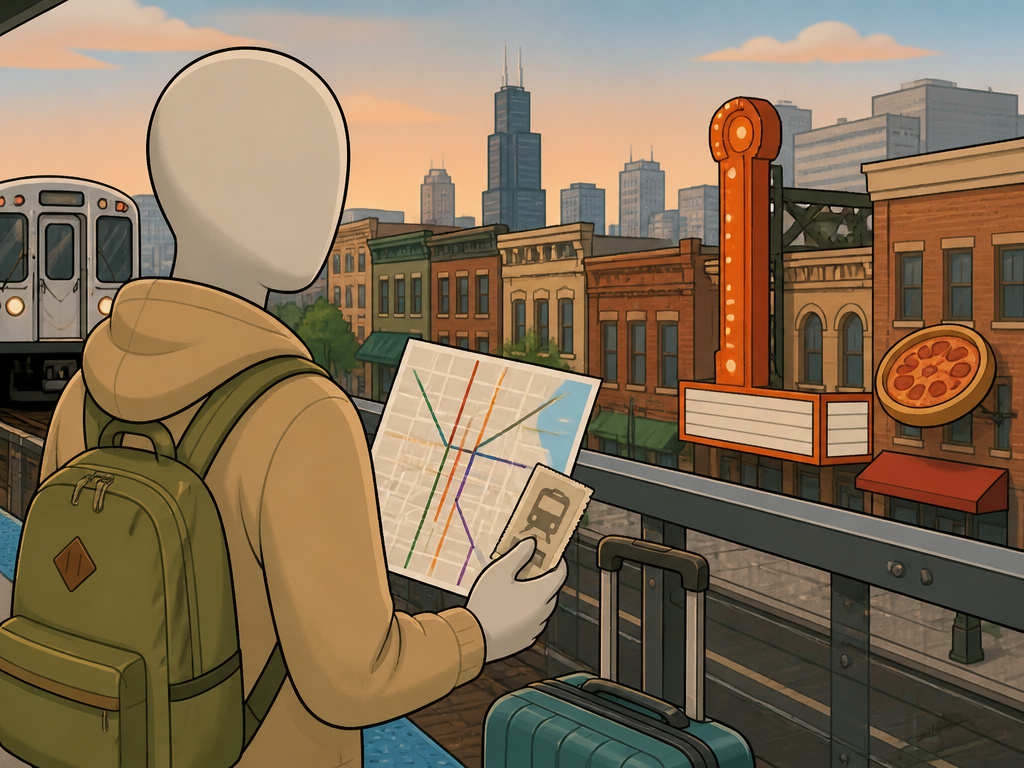
By the third morning the Loop starts to feel like a set you’ve already walked through. That’s the signal to leave it.
I learned this the expensive way. For years I treated a packed itinerary as proof of good planning. Then I took a trip where every hour was booked and came home more tired than when I left. Now every day I design gets at least one free block, and on a three-day trip that block belongs on day three.
Chicago Greeter runs free neighborhood visits led by locals, and you can customize them for language and interests. It’s the cheapest way out of the downtown bubble with someone who actually lives there.
The theater side is where Chicago embarrasses most cities. It has more Tony Award-winning theaters than any other city and more than 200 storefront theaters. Chicago Theatre Week lands in February, and Hot Tix sells half-priced tickets all year.
Book The Second City well in advance; the sketch revues are the reason people build an entire evening around Old Town. Across the avenue, the Old Town Ale House pours until last call at 4am.
Logan Square sits 20 minutes northwest of downtown, and Giant there takes reservations that are genuinely essential.
One anchor per day, and let the rest happen. Three days with five planned stops each is a commute with better architecture.
Deep dish takes a while to bake, so order before you’re hungry. Giordano’s is where most first-timers end up, and the wait is part of the experience rather than a problem with it.
If you want to push past the downtown core, the hidden gems in Chicago are mostly neighborhood-scale: a garden, a bar, a stretch of lakefront. None of them are downtown, and all of them cost you a train ride.
Is Hyde Park Worth Adding to a Three-Day Trip?
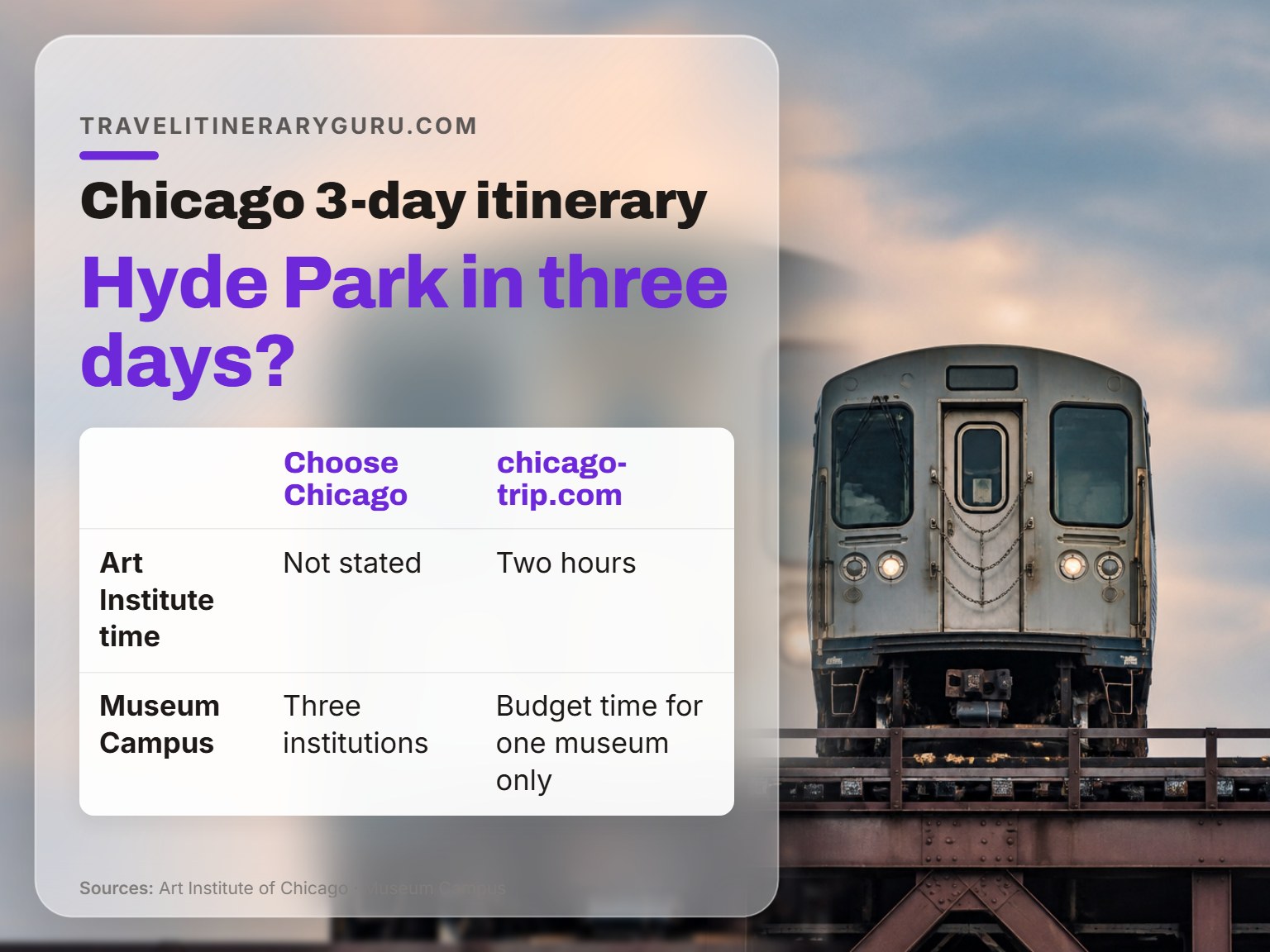
The Obama Presidential Center and Osaka Garden are the two Hyde Park entries on Choose Chicago’s own three-day itinerary. The independent guides disagree, and one excludes Hyde Park and the South Side outright, saying those neighborhoods need their own time.
Both positions hold up. The deciding factor is travel time, not interest.
Add Hyde Park and something else has to come out of the plan. The round trip is the reason, not the neighborhood.
Where the Guides Disagree
| Question | One view | The other view |
|---|---|---|
| How long for the Art Institute? | Two hours, per chicago-trip.com | At least three hours, per VanSledright Travel |
| Museum Campus | One cluster to visit, per Choose Chicago | Three separate tickets, pick one, per chicago-trip.com |
| Which observation deck? | Interchangeable, per the archived Fodor’s guide | Two distinct experiences, per Choose Chicago |
| Hyde Park in three days? | Yes, on the official three-day list | No, it needs its own trip |
One smaller discrepancy is worth knowing. An attraction page still carried a note that Cloud Gate was closed for renovation through spring 2024, while the city’s visitor guide lists it as an open, ticket-free stop. Check the current status before you plan photos around it.
One guide lists advance reservations as required at the Art Institute; another treats walk-up entry as possible and points you to artic.edu for current details and free-admission days. Settle it before day one, because a museum morning that falls through reshuffles everything after it.
What Chicago Teaches You About Any Three-Day City
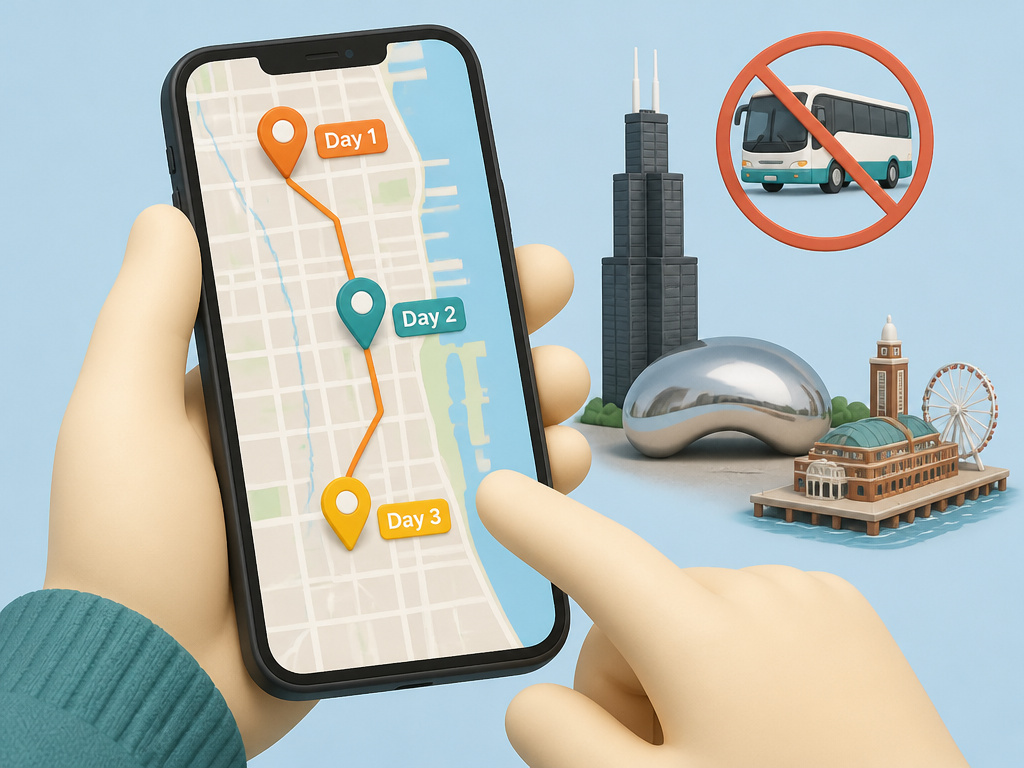
New York, Miami, Seattle, San Francisco: every one of them breaks a three-day plan the same way Chicago does.
The failure mode is identical. You build a list of landmarks, you map them, and you spend the trip in transit watching the city through a window.
I’ve planned enough of these to know the fix is the same everywhere. One anchor per day, one neighborhood per day, and one free block you refuse to fill.
A 3-day New York City itinerary has to solve that at a much bigger scale. A 3-day Miami itinerary solves it with water instead of architecture. A 3-day San Francisco itinerary solves it across a smaller, hillier footprint.
Skip the hop-on hop-off bus, by the way. You see the same handful of stops as every other passenger, on somebody else’s schedule. Big Bus Tours runs a fine operation; the format is the problem.
Frequently Asked Questions
Is three days enough for a first visit to Chicago?
It’s enough for the landmarks, not for the whole city. Three days covers the Loop, the Riverwalk, one museum, Navy Pier, an observation deck, and a single neighborhood. Done by neighborhood rather than by landmark, Chicago wants four.
Do you need a car in Chicago?
No. The CTA runs eight ‘L’ lines and 145 train stations, plus 129 bus routes with stops every few blocks. Only the Red and Blue Lines run 24 hours, and everything in a downtown three-day plan sits within walking distance of a station.
Which observation deck is better for a first-timer?
Take the Skydeck at Willis Tower if you want The Ledge and the daytime panorama. Take 360 Chicago if you want Lake Michigan filling the window. They’re about 2 kilometers apart on Wacker Drive, run by different companies, and plenty of people do both.
What’s the fastest way from O’Hare to downtown?
The CTA Blue Line, which runs directly to the Loop in about 40 to 45 minutes. From Midway, the Orange Line takes about 25 to 30 minutes. Buy a Ventra card at the airport station before you need it.
When should you visit Navy Pier for fireworks?
Summer fireworks run every Wednesday and Saturday from Memorial Day to Labor Day. Both nights draw crowds, so arrive early or watch from the water on a boat tour.
Is the Art Institute of Chicago free?
No. One guide lists advance reservations as required, and another suggests checking artic.edu for current details and any free-admission days. Millennium Park and Cloud Gate next door are free and need no ticket.
The Bottom Line
Everything above assumes you’re staying downtown. If you’re basing yourself out near the airports or in Oak Park, the transit math changes and the day-one order falls apart.
Before you book anything else, check the two observation deck calendars and lock a timed slot for day one afternoon and day two at sunset. Those two slots shape the rest of the plan.
A 3-day Chicago itinerary for first-time visitors works when it stays downtown and leaves room to breathe. Three days done well here feels like four. Three days crammed feels like one long commute.
And if the plan goes sideways on day two, let it. The best afternoon of your trip is probably the one you didn’t schedule.
