
How to Book a Last-Minute Vacation: Step-by-Step
This post contains affiliate links. As an Amazon Associate, we earn from qualifying purchases.
To book a last-minute vacation, start with the rule that decides your options: the DOT 24-hour cancellation protection applies only to tickets bought at least seven days before departure, and it doesn’t cover bookings made through third-party agents. Past that, refundable rates and flexible dates do the work.
Seven days is where the federal protection stops. Book six days out and the 24-hour window is gone, and AAA defines last-minute as anywhere from a few days to a few weeks before departure, so a six-day booking sits inside that range. Knowing how to book a last-minute vacation means understanding that three levers stay in your hands: the airline’s own policy, the hotel’s rate terms, and the order you book in.
What follows walks those levers in the order they matter: the airline rule and its seven-day limit, the rate terms that decide whether a hotel gives your money back, the price windows the booking sites actually publish, and the document check that can end a trip even when flights and rooms are wide open.
Key Takeaways
Does the 24-Hour Airline Refund Rule Apply to Your Trip?
The Hold Option United Doesn’t Offer
Why an OTA Booking Erases the Federal Refund Right
The Two Cancellation Clocks, and Why Conflating Them Costs You
The error runs in both directions. Someone who cancels a hotel booking 24 hours after making it may still be inside the free window, because the hotel clock counts down to arrival rather than up from booking. Someone who assumes the airline’s 24-hour rule covers a hotel booking is applying a rule that has nothing to do with how to book a last-minute vacation.
I stopped keeping itineraries on paper years ago, because one date change meant rewriting whole pages. A shared digital document updates everyone in seconds, and that matters far more on a last-minute trip than on a planned one.
Common mistake: Treating the 24-hour airline rule as a general travel cooling-off period. It covers flights bought directly from the airline, at least seven days out. Hotels, rental cars, and third-party bookings run on their own terms.
Two clocks govern the same trip, and they never sync up.
Flexible Rate vs Advance Booking Rate: Which One Wins

Two rate types sit side by side on most IHG property pages, and the gap between them is where last-minute trips get expensive.
The flexible rate lets you change your mind. Payment is charged at or near check-in, dates and room are usually changeable without a fee, and cancellation is free up to 24-48 hours before arrival at most properties.
The advance booking rate, sold under names like Advance Saver, Book Early and Save, or Stay Longer and Save, runs typically 10-20% below the flexible rate. It’s also charged in full at booking and non-refundable, so cancelling forfeits the cost of the stay.
A non-refundable rate looks identical to a flexible one on the search results page. The difference lives one click deeper, in a line that says the deposit is charged in full at booking.
| Term | Flexible Rate | Advance Booking Rate |
|---|---|---|
| Payment timing | Charged at or near check-in | Charged in full at booking |
| Cancellation | Free up to 24-48 hours before arrival at most properties | Non-refundable; cancelling forfeits the stay |
| Changing dates or room | Usually no fee | May incur a fee or forfeit the rate |
| Typical price | Standard rate | 10-20% below the flexible rate |
So which one wins? For a trip booked inside seven days with firm dates, the advance rate is the better buy, because you aren’t going to move a trip that starts this weekend. For anything with a moving part, the flexible rate wins, and the margin is wide.
Here’s the arithmetic that decides it. The 10-20% you save on an advance rate is the discount you’re paid for giving up the right to cancel. Cancel anyway and you forfeit the whole stay, not the discount.
Which Rate to Pick, by Trip Type
- Firm dates, booked inside a week: take the advance rate. There’s no window left for plans to change.
- Anything with a maybe in it: flexible. You’re paying a premium for the option to walk away.
- Business travel and short booking windows: IHG’s own rate guide points the flexible rate at this use case, because the dates are the least predictable part.
- A booking where you’re stacking a member rate: IHG One Rewards member-exclusive rates apply to both rate types, so the discount stacks either way.
Both rate types earn IHG One Rewards points on qualifying room spend when you book direct on IHG.com or the app. That’s the practical reason to book direct rather than through an intermediary, because the points only attach to the direct booking.
IHG publishes the flexible and prepaid rate terms side by side, which is the fastest way to see exactly what you’re trading away.
One caveat the rate page states outright: cancellation, payment, and change policies vary by hotel and rate, and you should review the specific terms shown at checkout before confirming. Most properties means most, not all.
If you want the widest window you can get, free cancellation is the rate type to look for, but read the terms at checkout rather than the brand-level summary.
If a hotel rate is non-refundable, treat the discount as a bet rather than a saving. You’re wagering the full cost of the stay against the chance that nothing changes between now and check-in.
Read the terms at checkout. Not the marketing page.
When Should You Book a Last-Minute Trip?
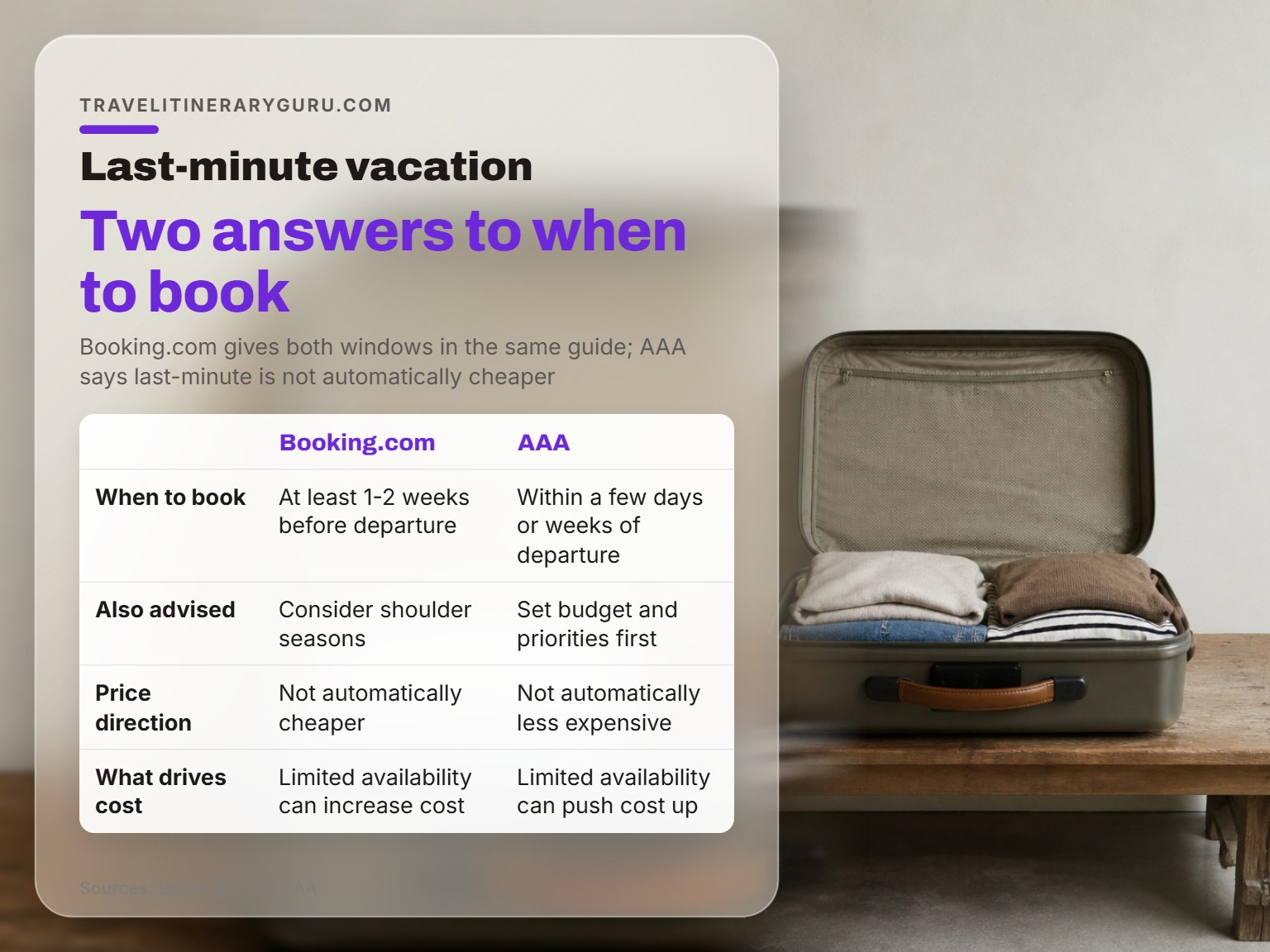
Booking.com’s own guide gives two different answers to the how to book a last-minute vacation question, and they don’t agree with each other.
The first answer: book at least 1-2 weeks before departure for last-minute deals. The second, from the same guide: book in advance, usually 6-8 weeks before departure, rather than waiting until the last minute.
Both sit in the same document, and the tension is real. The 1-2 week window is when last-minute inventory is still broad enough to compare. The 6-8 week window is when fares are still low.
Booking.com also notes that in most cases flights don’t get cheaper closer to departure. Airlines generally raise prices in the last 2-3 weeks before a flight, when business travelers tend to book. That’s the mechanism behind the second window: business travelers are less price-sensitive, so the airline prices for them.
AAA takes a different angle on the same question. It states that last-minute vacations aren’t automatically less expensive, and that limited availability can push up the cost of flights, accommodations, and rental cars, especially around holidays, major events, and peak travel periods.
Read those two positions side by side and both hold. Booking.com is describing routes with unsold seats. AAA is describing thin inventory. Different conditions, different outcomes, and both can be true on the same day for different routes.
| Factor | Pushes Fares Up | Pushes Fares Down |
|---|---|---|
| Demand | A holiday weekend | Midweek in the off-season |
| Seasonality | Summer break | The destination’s off-season |
| Competition | A route served by one airline | A route served by several airlines |
| Fuel costs | A sharp rise in oil prices | Stable or falling oil prices |
Booking.com flags seasonality as its own lever, noting that a last-minute booking in September or January tends to land better than the same booking in July or December.
If your dates are open, when to book flights is worth reading before you search, because the timing of the search changes what you’ll see.
The trips I’ve regretted most were the ones where every option I actually wanted was already gone. I spent the first day adjusting to a hotel I’d never have picked, and the saving never felt worth it.
Timing beats tools.
The Booking Order That Keeps Your Money Recoverable
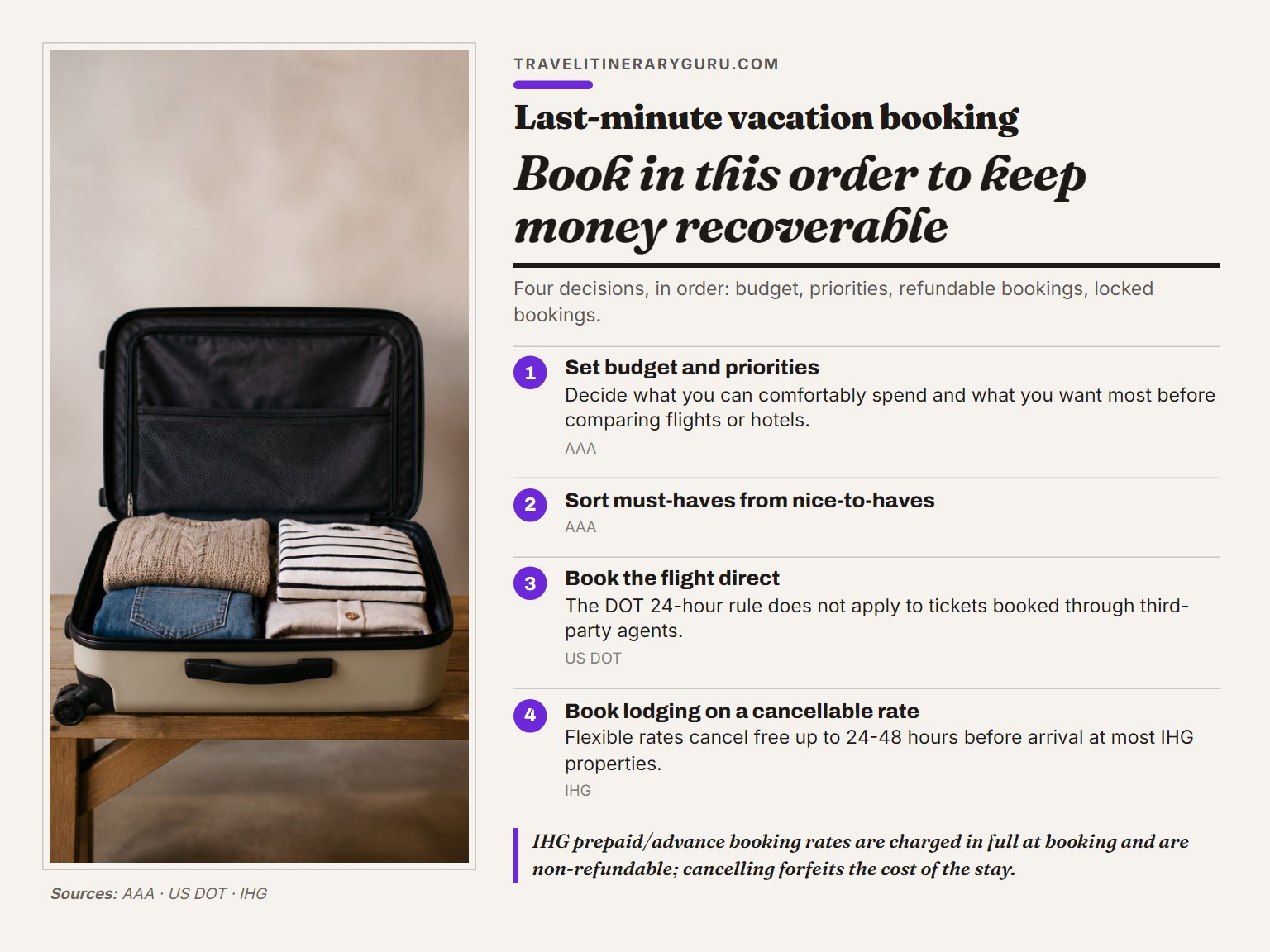
Four decisions, in this order: what you can spend, what you can’t give up, which bookings are refundable, and which ones are locked.
I learned the order the hard way. A cheap hotel looked close to everything I wanted until I mapped the three priorities for that trip and realized it sat a 40-minute walk from all of them. The rate was fine. The location wasn’t.
That’s why the priorities come before the prices. Once you know which three things matter most, a property that fails on any of them is off the list regardless of what it costs, and you stop burning search time on places you’d never book.
Before you start: A non-refundable rate is charged in full at booking and cancelling forfeits the stay, so confirm your dates before you take the discount. Passport validity is destination-specific, so check entry rules before you pay for anything. And a third-party reservation falls outside the DOT 24-hour rule, so book direct if you want the federal protection.
- Set the budget and the three priorities first. AAA’s guidance is to decide what you can comfortably spend and what you want most from the trip before you compare a single flight or hotel. Skipping this step is how a modest trip turns into an expensive one.
- Sort must-haves from nice-to-haves. A nonstop flight, an accessible room, a pet-friendly hotel, or a convenient location may be essential. A specific brand, a room view, or a departure time is usually easier to bend. Get this wrong and you’ll reject good options for bad reasons.
- Book the flight direct from the airline. This is the step that keeps the DOT 24-hour protection alive. Book through an agent and you’ve traded a federal right for whatever the agent’s contract happens to say.
- Book the lodging on a rate you can cancel. Flexible rates cost more and cancel free up to 24-48 hours before arrival at most IHG properties. Take the advance rate only when the dates are certain.
- Add the ground pieces last. Rental cars and airport transfers are the easiest components to change and the ones most likely to be repriced, so they go at the end of the order.
If you’re still deciding how much flexibility the flight itself needs, how to book a flexible flight covers the fare classes that allow changes without a penalty.
The ground pieces deserve their own pass. A rental car booked in a hurry is where add-on charges accumulate, and pre-booked airport transfers are usually cheaper than the rank outside arrivals.
Where the Order Breaks Down
The order breaks when you book the flight before you’ve checked the documents. AAA’s guidance is to verify passport validity, visa requirements, and destination entry rules before booking, because a flight and a hotel being available doesn’t mean you can enter the country.
Don’t take an advance rate on a trip more than a couple of weeks out if anything about it is unsettled. IHG’s prepaid rates are charged in full at booking, so a change of plans costs you the entire stay rather than a fee.
Don’t book a third-party ticket and then call the airline to cancel it. The DOT rule doesn’t reach that booking, and the airline will send you back to the agent, which burns days you don’t have on a short-notice trip.
Valid documents plus flexible destination options is the combination AAA identifies as giving travelers the most choices on short notice. That’s the trade to make in the right order: documents first, destination second.
Check the paperwork before you fall in love with a destination.
Where the Cheap Last-Minute Fares Hide
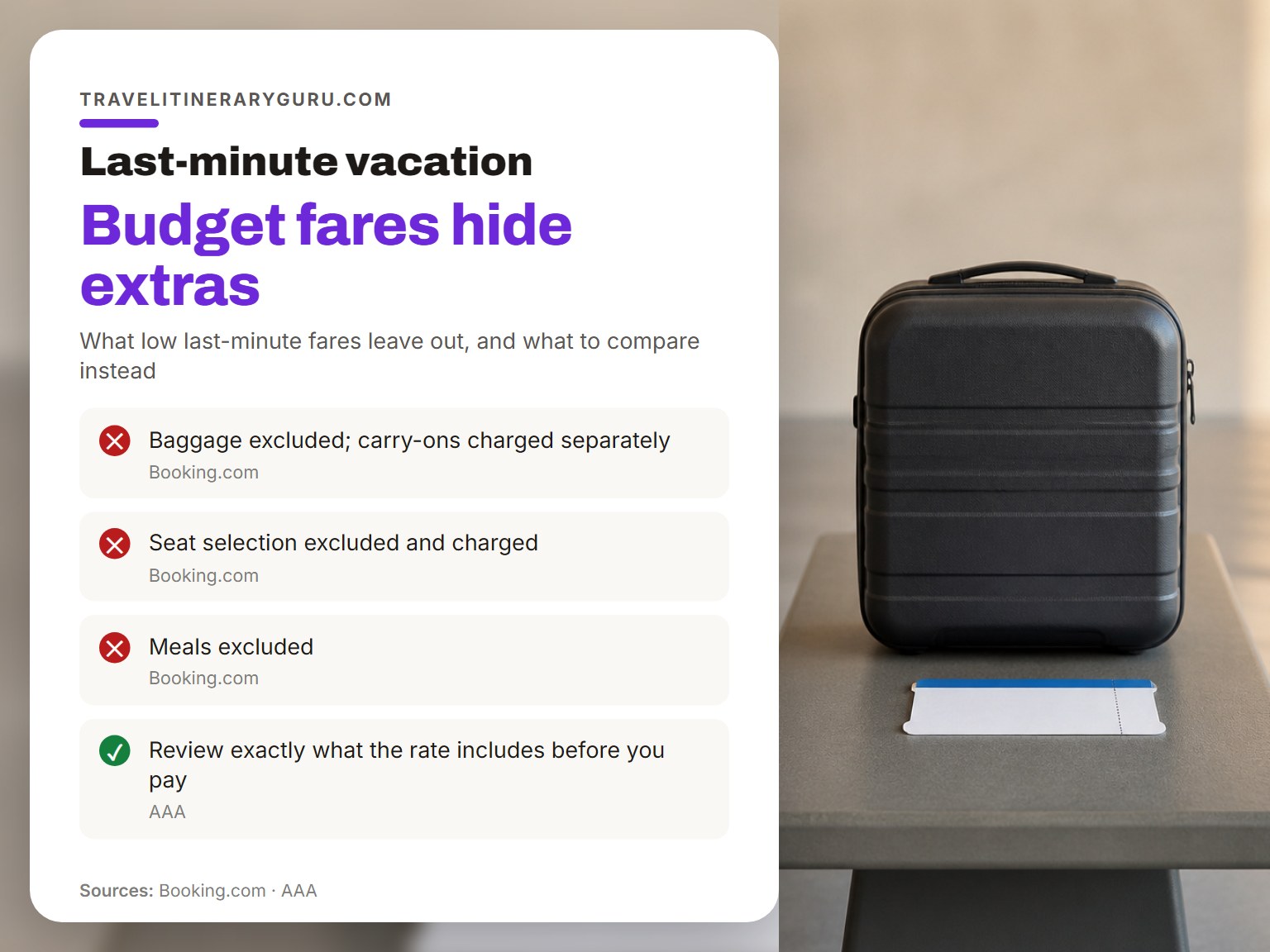
Spirit, Frontier, Allegiant, Southwest, Ryanair, and easyJet all sell low last-minute fares, and Booking.com names every one of them. The catch is what the fare leaves out.
Booking.com notes that budget carriers typically exclude meals, seat selection, and baggage, and that they charge extra for carry-ons, seat choices, and snacks. AAA’s counterweight is to compare the total cost and quality of several options before booking, and to review exactly what the rate includes.
Budget fares look cheapest on the results page and often aren’t at checkout. Run the total before you commit.
- Baggage. Booking.com lists baggage among the extras these carriers exclude, and carry-ons are charged separately.
- Seat selection. Also excluded, and also charged.
- Meals and snacks. Excluded, and sold on board.
- The total, not the headline. AAA’s guidance is to compare total cost and quality across several options, and to review exactly what the rate includes before you pay.
Off-peak hours are one of Booking.com’s core recommendations, and red-eye and early-morning flights are the example it gives, since lower demand tends to produce more competitive fares. AAA frames the same choice as a must-have question: departure time is often the easiest thing to adjust, but comfort and accessibility needs can make a particular time essential.
If you’re weighing one, red-eye flights are worth planning around rather than just booking, because the arrival day is where the trade-off shows up.
A red-eye drops you into a terminal in the small hours, when the concourse is quiet enough to hear the floor polisher running and every coffee stand has a line.
Nearby airports are the next lever. Booking.com suggests broadening the search, noting that many cities have multiple airports within 20 to 50 miles and that the savings can hold up even after you factor in extra transportation. AAA’s position is that a convenient location may be essential and that total cost and quality should be compared first. Both describe the same trade: a cheaper fare against a longer ground transfer.
Layovers work the same way. Booking.com notes that direct flights usually carry a premium and that adding stops can lower the fare. AAA’s warning is that a nonstop flight may be essential for some travelers, which turns a cheaper connecting itinerary into a bad fit rather than a bargain.
Booking.com also suggests self-connecting through multiple one-ways for a deeper discount, and notes it may take longer to arrive. If you go that route, a tight connection is the piece to plan around, since the two tickets are separate bookings.
The bundling advice cuts the other way. The same Booking.com guide recommends last-minute packages that bundle flights, hotels, and rental cars, which it says can reduce the overall cost. That sits alongside its advice to book two one-way tickets, even on different airlines, and self-connect. The two strategies pull in opposite directions, and both come from the same OTA guide, which has a commercial interest in the booking structure it recommends.
Price alerts are the low-effort option. Booking.com recommends setting them up with an online travel agency so you’re notified when a route’s price moves, and notes that Genius loyalty members may have access to flight price alerts after signing in, with availability varying by market, route, and account status.
Set the alert before you need the flight. Not after.
Check the Documents Before You Compare Prices
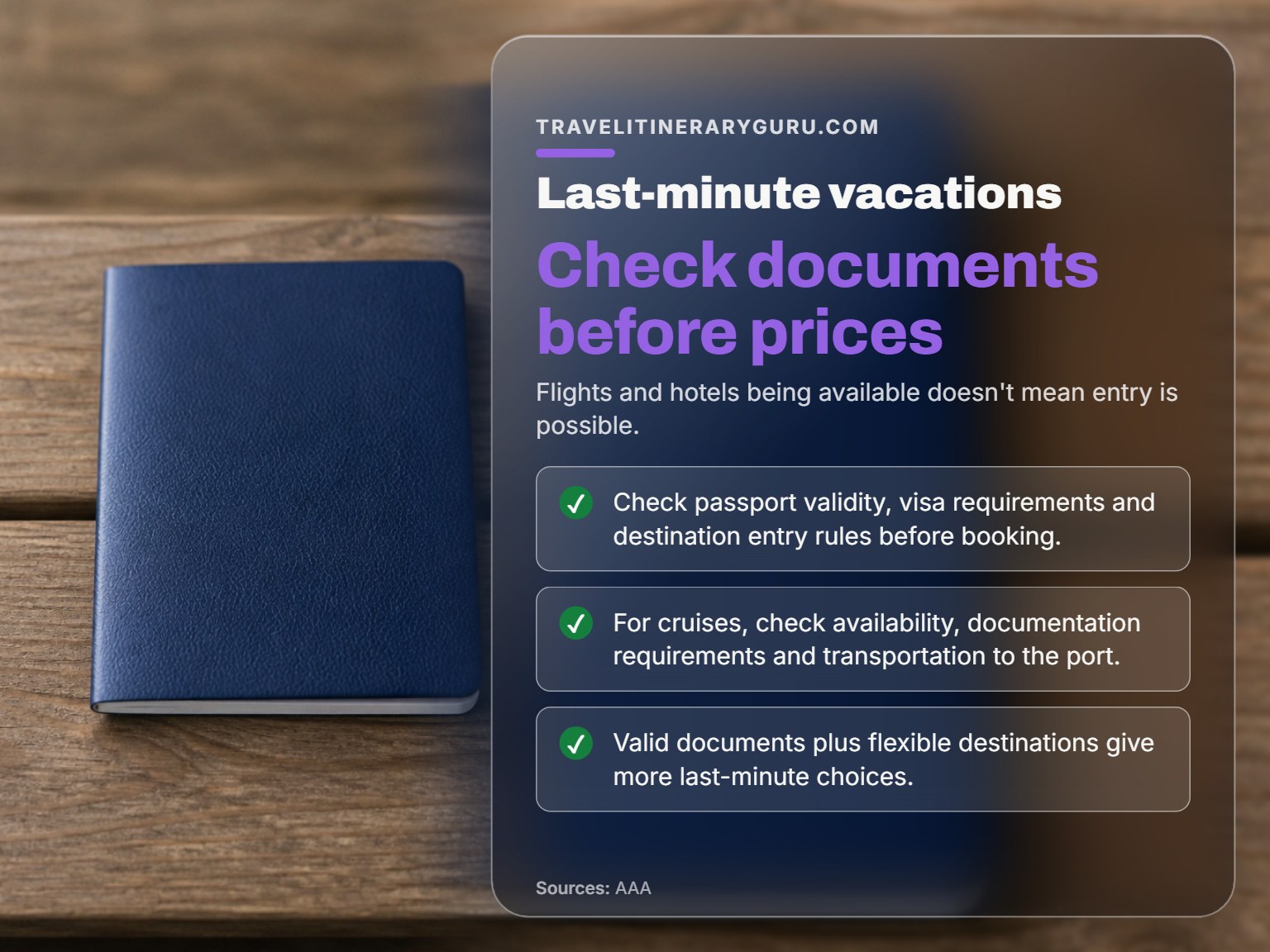
Check your passport before you check prices.
AAA is direct about this. Flights and hotels being available doesn’t mean entry is possible, and passport processing and visa timelines can disqualify a destination regardless of inventory. Passport validity rules are destination-specific, so the requirement that matters is the one for the country you’re entering.
Booking.com’s guide covers flight availability and pricing without addressing entry requirements at all. That’s the gap worth noticing: the cheapest fare in the results is irrelevant if the destination’s visa timeline runs longer than your trip window.
- Passport validity. Destination-specific, and the rule that applies is the one for the country you’re entering.
- Visa requirements. Check before you book, not after.
- Destination entry rules. AAA’s guidance is to verify these before booking anything.
- Cruise documentation and port transport. For a sailing, AAA notes that availability, documentation requirements, and transportation to the port determine whether the trip is realistic.
Transportation to the port is part of that check, which is why airport transfers belong in the planning stage rather than the arrival-day stage.
A passport that expires in a few months looks completely ordinary until an agent counts the months against the destination’s rule.
Travelers who already hold valid documents and can flex on destination have more choices on short notice, per AAA. That’s the whole trade in one sentence, and it’s why the document check goes first.
I check the passport first, every time. It costs nothing and it eliminates more bad options than any price comparison will.
Documents decide the destination. Not the other way around.
Frequently Asked Questions
Does the 24-hour cancellation rule apply to every airline ticket?
No. The DOT requirement covers tickets purchased at least seven days before scheduled departure, and airlines aren’t required to offer both a hold and a refund option. United, for example, offers the refund path and doesn’t offer a hold. Book through an OTA or a travel agent and the federal rule doesn’t apply at all.
Can I get a refund if the airline cancels my flight?
Yes, if you bought the ticket directly from the airline. DOT states you’re entitled to an automatic refund when the airline cancels or significantly changes your flight and you decline the changed flight, a rebooking, a travel credit or voucher, and alternative compensation. Airlines aren’t required to offer a rebooking, though they often do, and they can set a deadline for you to accept one.
Is a last-minute vacation cheaper than booking ahead?
Not automatically. AAA states that last-minute vacations aren’t automatically less expensive and that limited availability can raise the cost of flights, hotels, and rental cars around holidays and peak periods. Booking.com says deals on next-week departures are possible, and that airlines generally raise prices in the last 2-3 weeks before a flight. Both can be true on different routes.
Should I book a non-refundable hotel rate to save money?
Only if the dates are certain. IHG’s advance booking rates run typically 10-20% below the flexible rate, but they’re charged in full at booking and non-refundable, so cancelling forfeits the cost of the stay. Flexible rates cost more and cancel free up to 24-48 hours before arrival at most IHG properties.
Do I need to check my passport before booking a last-minute trip?
Yes. AAA advises checking passport validity, visa requirements, and destination entry rules before booking, because flights and hotels being available doesn’t mean entry is possible. Passport validity rules are destination-specific, and travelers with valid documents and flexible destination options have more choices on short notice.
How far in advance should I book a last-minute flight?
Booking.com gives two windows: at least 1-2 weeks before departure for last-minute deals, and 6-8 weeks in advance if you can manage it. It also notes that fares generally rise in the last 2-3 weeks before departure, when business travelers book. If your dates are fixed, earlier is the safer side of that range.
Before You Go
One threshold decides most of this. If your departure is at least seven days out and you’re booking direct with the airline, you have the DOT 24-hour protection and you can book with a clear head. Inside seven days, you’re on the airline’s policy alone, so read it before you pay.
The first thing to do this week is boring. Open your passport and check the expiration date against the entry rule for the country you’re considering. That single check eliminates more bad options than any price comparison will.
This all assumes you’re booking a flight on a carrier with published terms. If you’re driving, the math changes. AAA notes that road trips and drive-to getaways are easier to arrange on short notice because they don’t depend on flight availability, and a weekend road trip may need only a day or two of planning.
Here’s the part I’d defend in an argument. On a last-minute trip, I’d rather pay more for a rate I can cancel than save 10-20% on a rate I can’t. The discount is real, and so is the chance that something moves.
