
Travel Adapter Types Explained: Which Plug Do You Need?
This post contains affiliate links. As an Amazon Associate, we earn from qualifying purchases.
Travel adapter types explained in one line: all of them change pin shape only, and none converts voltage. A Type C plug fits sockets with 4.0 to 4.8 mm round contacts on 19 mm centres, and IEC 60884-2-5 caps travel adaptors at 250 volts and 20 amps. Match the socket first, then read the label.
The 250-volt, 20-amp ceiling in that answer is where the category quietly splits. Anker’s A92A2 is rated 230 volts at 13 amps. Conair’s TS240AP and Adam Elements’ T45 both sit at 8 amps. One standard sets the outer boundary; four adapters sit at three different points inside it.
What follows is the map: the plug types you’ll actually meet, the line between an adapter and a converter, how to read an amp rating off a label, and the three places where “universal” stops being universal.
Key Takeaways
- Pin shape only. No travel adapter converts voltage or frequency, and Apple, Conair and Adam Elements each say so in their own manuals.
- IEC 60884-2-5 caps travel adaptors at 250 volts and 20 amps, and it doesn’t cover adaptors that let you plug in two devices at once.
- A 3-port adapter isn’t a 3-device charger. Anker’s A92A2 caps combined USB output at 15.0W no matter how many ports you fill.
- “Universal” has holes. Anker’s A9215 takes Type A and Type C plugs but explicitly excludes Type E and Type F.
- Check the voltage line on every appliance before it goes in the bag. Conair lists fire, electric shock and injury as the outcome of getting it wrong.
Travel Adapter Types Explained: Pin Shape Only
Every travel adapter does one job. It moves metal pins into a different arrangement.
A travel adaptor is a passive interface between two incompatible plug geometries. It carries mains current through metal contacts without altering voltage, frequency or waveform. IEC 60884-2-5:2017 limits travel adaptors to a voltage rating above 50 V and not exceeding 250 V, and a current rating not exceeding 20 A.
Apple states the same thing in plain language. The adapters in its World Travel Adapter Kit change the physical pin or blade shape of your power adapter, and they do not convert electrical voltage or frequency. The kit holds five adapters, each identified by a letter.
The IEC 60884-2-5:2017 standard is the document that draws the outer boundary. Its second edition cancels and replaces the 1995 first edition, and it limits travel adaptors to a voltage rating above 50 V but not exceeding 250 V, with a current rating not exceeding 20 A.
One clause in that standard matters more than the rest. Travel adaptors that allow the simultaneous connection of two or more plugs aren’t covered by it at all.
The list of what you’re actually buying is short:
- It carries mains current from one pin geometry to another.
- It lets a plug enter a socket it was never designed for.
- It does not convert voltage.
- It does not convert frequency.
Most travel adapters on the market solve that same problem in slightly different plastic. Knowing it narrows the shopping list fast.
The multi-plug exclusion is a notable clause. It means a two-outlet travel adapter sits outside the only standard written for its category.
The Plug Types You’ll Meet, Region by Region
Type C is the closest thing the world has to a default plug. The IEC’s own reference lists it as fitting sockets that accept 4.0 to 4.8 mm round contacts on 19 mm centres.
Type C fits sockets with 4.0–4.8 mm round contacts on 19 mm centres. The IEC international plug types guide is the reference worth checking before you buy anything, because the letter on the packaging means nothing without the socket it has to enter.
The groupings below come from the adapters’ own manuals and spec sheets, not from a marketing page:
| Plug Type | Where It Appears | What To Know |
|---|---|---|
| Type C | Europe, Middle East, parts of Africa and Asia | Fits 4.0-4.8 mm round contacts on 19 mm centres |
| Type A | North America, Caribbean, Japan | Supported by the Anker A9215 AC port |
| Type G | Great Britain, Ireland, Hong Kong, Singapore | One of five lettered adapters in Apple’s kit |
| Type E / F | Continental Europe | Not supported by the Anker A9215 |
| Type K / O | Denmark, Thailand | Neither is in Ceptics’ 12-piece set; both accept Type C |
Type C, the One That Fits Almost Everything
Type C’s advantage is mechanical. Its contacts are narrow enough to seat in sockets built to a wider standard, which is why Denmark’s Type K outlets and Thailand’s Type O outlets both accept it.
Neither type appears in the 12-piece Ceptics set, and neither needs to.
For a single-country trip, a dedicated European travel adapter may be simpler than a universal block.
Do You Actually Need a Universal Travel Adapter?
For a one-country trip, a single-region plug adapter wins on weight and size.
The three options break down like this:
| Option | Best For | The Trade-Off |
|---|---|---|
| Universal adapter block | Multi-country trips, one bag | Bulky, with parts that can break |
| Single-region plug adapter | One country, one socket type | Useless the moment you cross a border |
| Multi-piece plug set | Long trips, many countries | More pieces to lose in a hotel room |
Wirecutter’s top pick for a universal adapter is the Anker Nano Travel Adapter. Its upgrade pick is the Epicka Universal Travel Adapter TA-105 Max, which delivers 75 watts of total USB power and measures 3.3 by 2.1 by 2.2 inches, roughly the size of a baseball.
Wirecutter also notes the honest downside. Universal adapters are bulky, they have parts that can break, and most take longer to charge a phone or tablet than a USB wall charger.
The Anker A9215 Nano carries a 125V input rating at 6 amps, and its AC port takes Type A plugs directly, so a single Japan travel adapter covers the whole trip.
Before you start: Unplug the adapter from the wall and from the device before you detach or swap anything; Apple’s instructions specify sliding the AC plug up and away, never twisting it or pulling at an angle. A single-voltage appliance on the wrong mains voltage is the real hazard, and Conair’s manual names the outcome: fire, electric shock, injury to persons, or damage to the appliance.
Four checks, in this order:
- Read the input voltage printed on the appliance. A 120V-only appliance on a 240V supply is the failure Conair describes as fire, shock or injury.
- Identify the socket type at your destination. Get it wrong and the adapter may not fit the socket.
- Compare the adapter’s AC rating to your load. An 8-amp adapter and a 13-amp adapter have different current ratings.
- Confirm your device actually charges over USB. Conair’s manual notes that some cameras ship with a USB cable for data transfer only, and plugging one in can cause damage.
Why Doesn’t a Travel Adapter Convert Voltage?
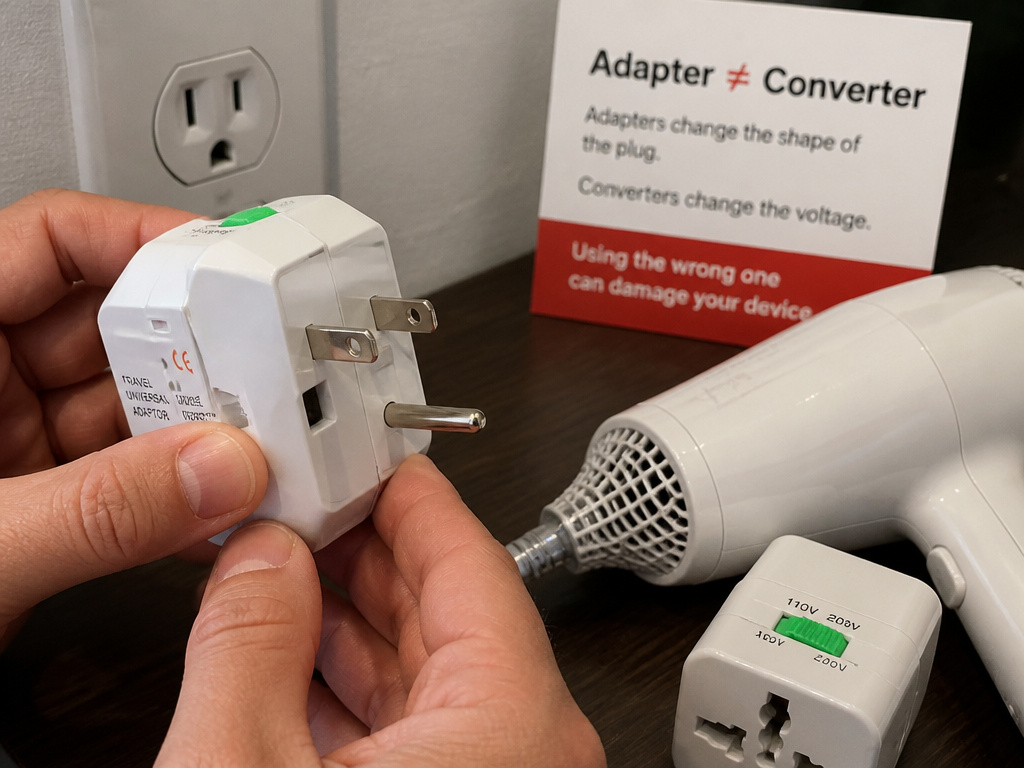
Apple, Conair and Adam Elements each warn in different words that their adapters do not convert voltage.
Conair’s TS240AP is not a voltage converter, and the manual directs you to use it only with appliances rated for both 120 and 240 volts. Adam Elements’ T45 does not convert voltage either, and its instructions tell you to confirm the outlet has the proper voltage before you use the adapter. Apple’s kit changes pin shape and nothing else.
The three manuals agree on that point and split on the next one. Adam Elements bans high-draw appliances outright: no hairdryers, irons or kettles. Conair doesn’t ban them by name, but it requires a dual-voltage appliance with the selector switch set correctly before you operate anything.
Apple adds a warning that has nothing to do with pin shape. Even inside the 100-240V, 50-60Hz range its adapters support, electrical spikes and brown-outs can damage electrical equipment.
Where this goes sideways: Trusting the adapter’s voltage range to protect the appliance. The range describes what the adapter tolerates, not what your device was built for, and a single-voltage appliance fails within seconds of the first switch-on.
Here’s how the symptoms map to the causes:
| Symptom | Likely Cause | Fix |
|---|---|---|
| Adapter fits, device won’t run | Appliance is 120V-only on a 240V supply | Use a converter or transformer, not an adapter |
| USB port dead, AC side fine | USB charger circuit has failed | Conair says the AC side stays usable |
| Hairdryer trips the adapter | Load exceeds what the adapter is built for | Adam Elements bans hairdryers, irons and kettles |
| Plug won’t seat in the socket | Wrong plug type for the region | Match the socket type before you leave home |
If your appliance is single-voltage, a bigger adapter won’t help. You need a travel power converter, which is a different device with a different job.
Reading the Label: Amps, Watts, and What Reaches Your Phone
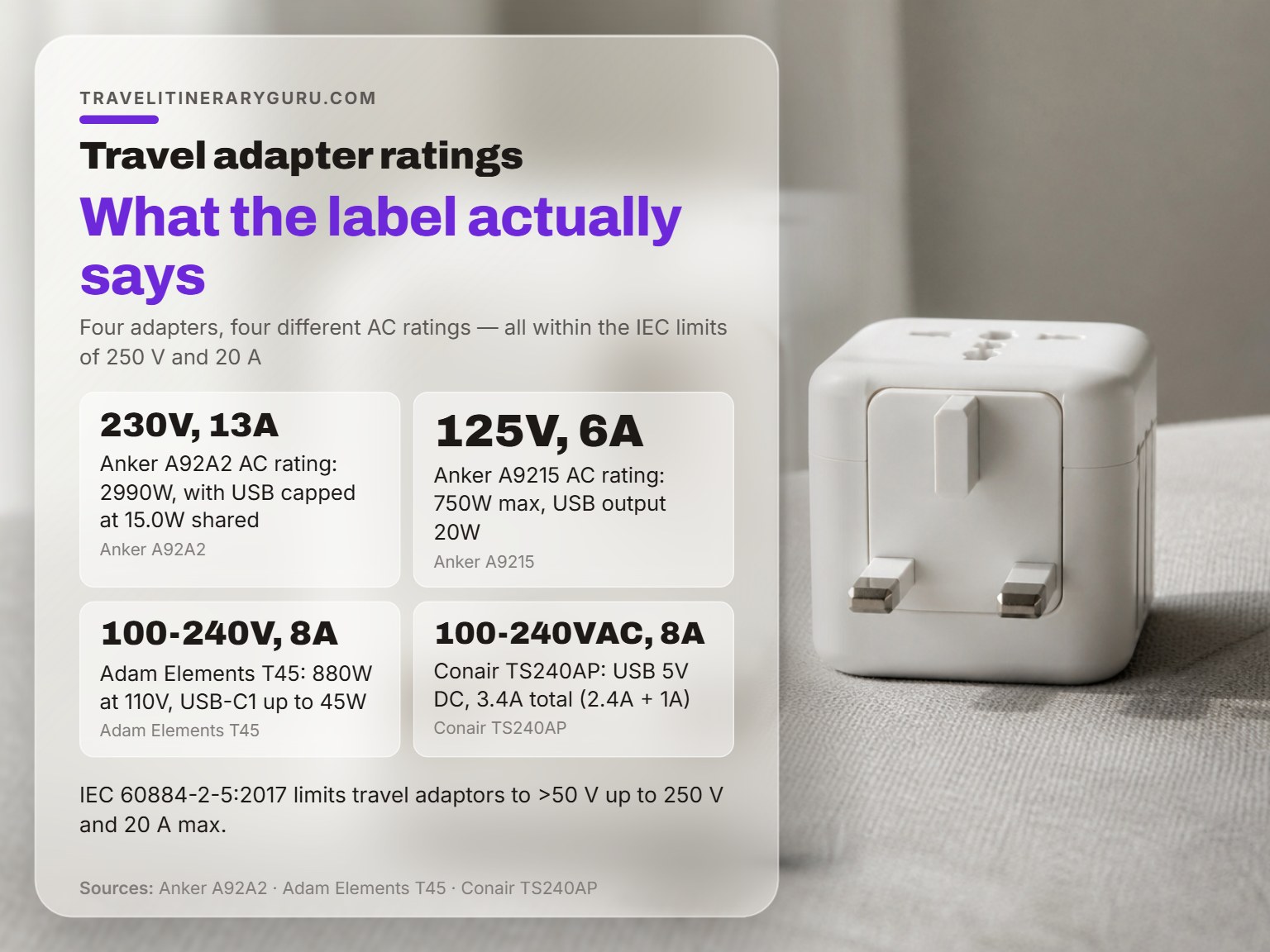
Picture one outlet, three devices, and a block with a shared output limit.
The printed ratings are where the real differences live:
| Model | AC Rating | USB Output |
|---|---|---|
| Anker A92A2 | 230V, 13A, 2990W | 15.0W shared across every port |
| Anker A9215 | 125V, 6A, 750W | 20W |
| Adam Elements T45 | 100-240V, 8A (880W at 110V) | 45W max on USB-C1 |
| Conair TS240AP | 100-240VAC, 8A | 5V DC, 3.4A total |
Read that column of AC ratings again. The IEC ceiling for travel adaptors is 250 volts and 20 amps, and not one of these four adapters reaches it.
That gap is the point. There’s no shared rating across brands, so the number on the box is the only thing you can compare.
Three Ports, One Shared 15 Watts
The Anker A92A2 advertises three ports and caps combined output at 15.0W regardless of configuration. Its USB-A port alone delivers 12W max; each USB-C port delivers 15W max on its own, though the combined output is capped at 15.0W.
Fill two ports and the budget doesn’t grow. Fill three and it still doesn’t.
Adam Elements handles it differently on the T45, splitting 30W plus 10.5W across two ports. Same “multi-port” marketing, materially different power delivery.
Three ports on a travel adapter are three outlets sharing one budget. Read the shared maximum, not the per-port number; that’s the figure that decides how long your phone sits on the nightstand.
What to look for on any label, in order of how much it matters:
- The shared USB maximum, which is almost always lower than the sum of the ports.
- The AC rating, which sets the ceiling on what you can plug into it.
- The voltage range, which tells you which mains supplies the adapter tolerates.
- The fuse rating, if the adapter has a replaceable one.
The part nobody mentions: A 3-port adapter that charges three devices at once is charging all three slowly. If you need speed, carry a separate USB wall charger and leave the block for the AC outlet.
What Breaks First: Fuses, Ground Pins, and the Multi-Plug Gap
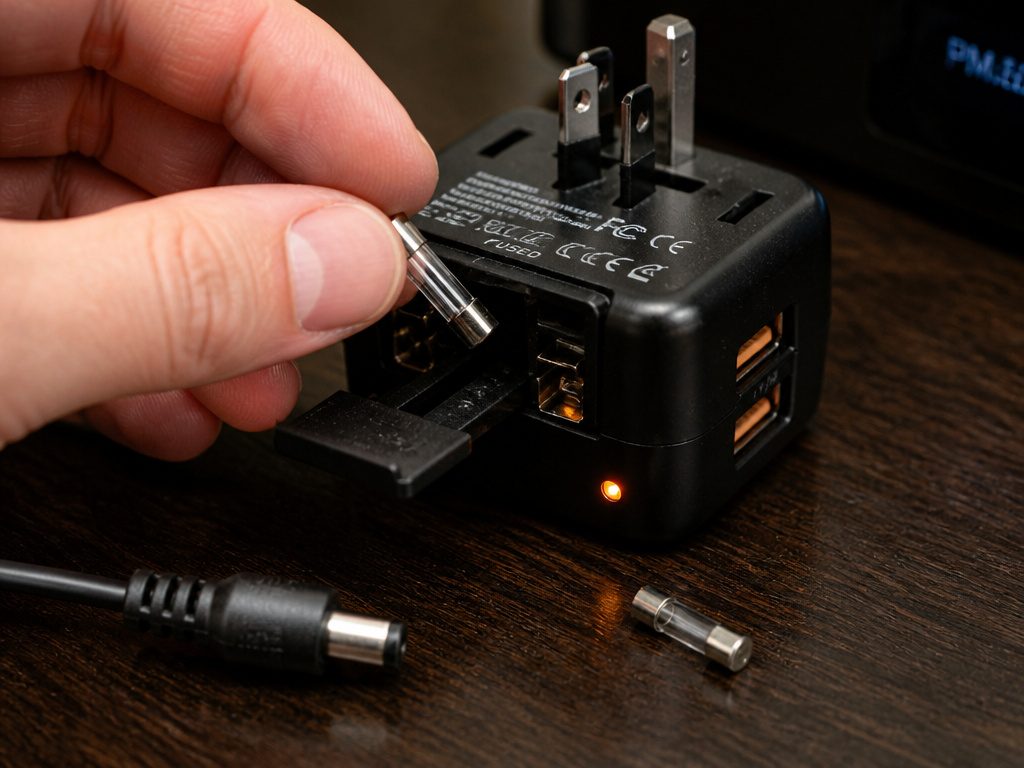
Adam Elements uses a common 8A fuse in the T45, the kind you can find in most electronics stores. It isn’t covered under the three-year warranty, and the manual is specific about the procedure: unplug the travel adapter before you change it.
The indicator light is the whole diagnostic on the Conair TS240AP. When the unit is plugged in and the light is on, both the AC and USB sides are working. If the light is dark, the AC portion still works but the USB charger function is defective.
That’s a genuinely useful thing to notice in a hotel room at night.
ITU-T L.1002 explains why cables fail before housings do. A detachable DC cable is required for universal power adapters because the DC cable is generally the weakest point and the main point of failure. For higher power categories above 60W, captive cables are permitted if the design needs them, but detachable cables are strongly recommended.
The same recommendation covers grounding, and this is where the manuals go quiet. ITU-T L.1002 considers Class II equipment because the safety ground on a grid socket isn’t always available, and in many countries grounding isn’t compulsory in home wiring at all. Conair’s manual doesn’t mention grounding anywhere.
Then there’s the multi-plug gap. IEC 60884-2-5 excludes travel adaptors that allow the simultaneous connection of two or more plugs, and Conair’s TS240AP has two outlets and two USB ports.
Regulators don’t even agree on what the product is. Hong Kong’s Electrical and Mechanical Services Department treats any adaptor that can engage a local socket as a non-travel adaptor subject to full safety regulation, per its government travel adaptor leaflet.
What actually fails, in rough order of frequency:
- The fuse, on any adapter that has a replaceable one.
- The USB charging circuit, which dies while the AC side keeps working.
- The housing or internal parts, which Wirecutter flags as breakable.
- The cable, which ITU-T L.1002 calls the main point of failure on any adapter that has one.
I’d rather carry one adapter and a separate USB wall charger than a five-port block. Wirecutter notes most universal adapters charge a phone slower than a good USB wall charger, and a block that dies takes every port down with it.
Adapters That Look Universal but Aren’t
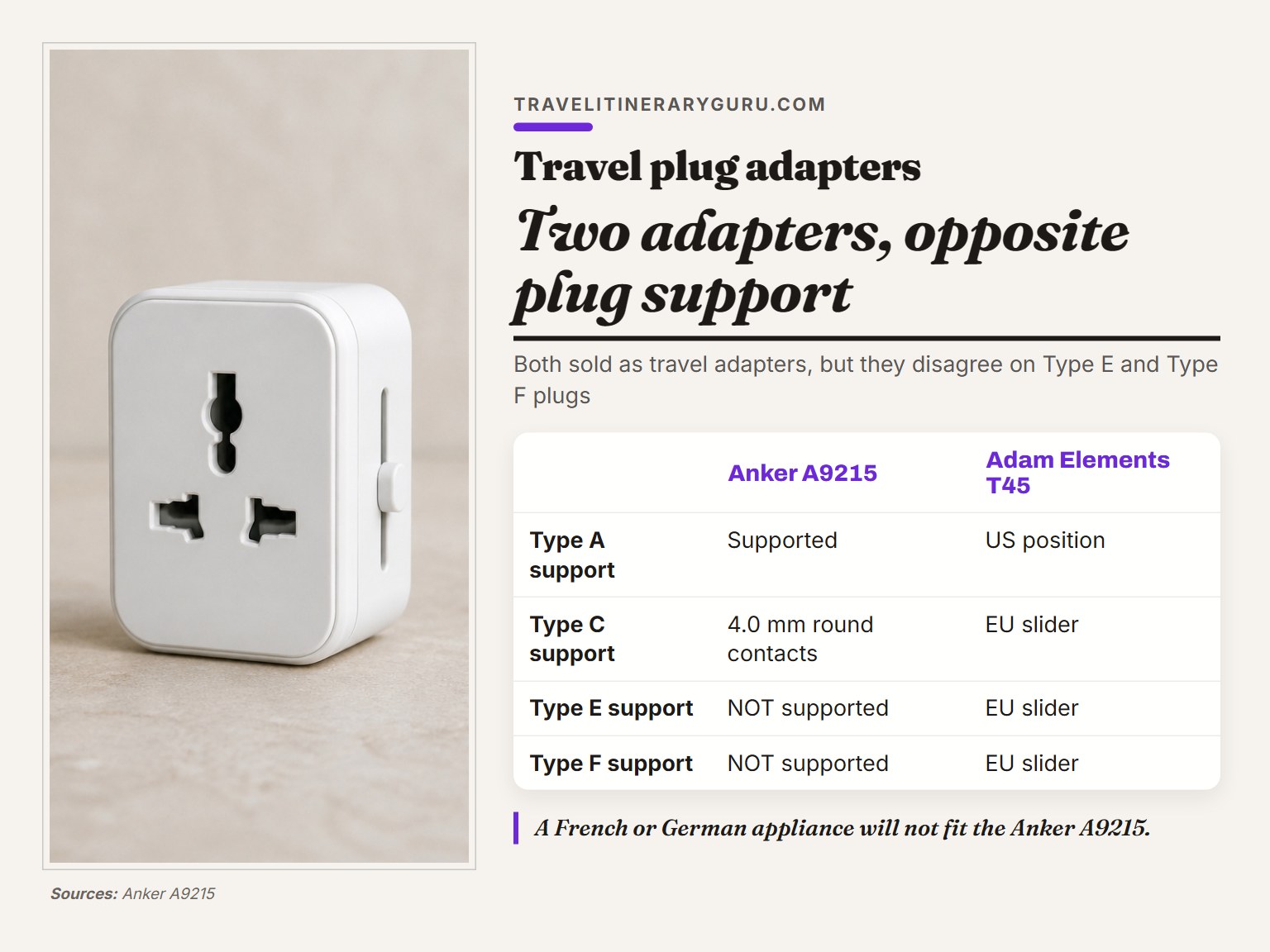
The word “universal” on the box is doing less work than you think.
Anker’s A9215 is sold as a travel adapter and its AC port supports Type A plugs and Type C plugs with 4.0 mm round contacts. Type E and Type F plugs are not supported. A French or German appliance will not fit it.
Adam Elements goes the other way with the T45, which ships with an EU slider alongside its US, UK and AU positions. Two products, same category, opposite answers on the same plug types.
The Type E and F Blind Spot
Wirecutter found the same pattern at the country level. The outlet types included with the Anker Nano, and with nearly all universal adapters, cover many countries, but parts of Africa, parts of India, and some parts of Europe aren’t covered.
The 12-piece Ceptics set contains plug types that aren’t in the universal-adapter picks or the smaller Ceptics set, including adapters covering parts of India, South Africa and Brazil.
It isn’t complete either. The only two plug types it omits are Type K, which is specific to Denmark and a few other countries, and Type O, which is Thailand. Both of those outlets accept Type C plugs, so the gap closes itself.
Apple’s version of the problem is mechanical rather than geographic. Its kit uses an AC Connector 2 connection point, and Apple AC plugs and travel adapters aren’t cross-compatible between AC connector types. Buy the wrong generation and the kit is unusable, no matter how many countries it covers.
A few things worth checking before you commit to any of them:
- Whether the adapter supports the specific plug type you’ll meet, not just the region name.
- Whether your device’s AC connector matches the kit, if you’re buying into a brand ecosystem.
- Whether the country you’re visiting appears on the manufacturer’s own coverage list.
- Whether a single-region adapter would do the job for less bulk.
The travel plug adapter types that cover those gaps are often the multi-piece sets, not the one-block designs. Wirecutter’s travel adapter product testing review is worth reading before you buy.
Easy to miss: A travel adapter that fits your destination’s socket and excludes your appliance’s plug. Anker’s A9215 takes Type A and Type C and refuses Type E and Type F, which is exactly the pair a French or German device uses.
Frequently Asked Questions
Do travel adapters convert voltage?
No. Apple states that its adapters change the physical pin or blade shape and do not convert electrical voltage or frequency. Adam Elements says the T45 does not convert voltage and tells you to confirm the outlet voltage first. Conair says the TS240AP is not a voltage converter and directs you to a converter or transformer for single-voltage appliances.
What do the different travel adapter types actually change?
Pin geometry, and nothing else. A Type C plug fits sockets with 4.0 to 4.8 mm round contacts on 19 mm centres, while Type A, Type E, Type F and Type G each require a different socket arrangement. The adapter bridges the two shapes without touching the current.
Can I plug a hairdryer into a travel adapter?
Adam Elements bans hairdryers, irons and kettles from the T45 outright and describes the device as built for phones, laptops and other small appliances. Conair doesn’t ban them by name but requires an appliance rated for both 120 and 240 volts, with the voltage selector set correctly before use.
Why does my travel adapter have an 8A fuse?
Because the fuse is the part designed to fail first. Adam Elements fits a common 8A fuse to the T45, notes that it’s available in most electronics stores, and confirms it isn’t covered under the three-year warranty. Unplug the adapter before you change it.
Is a universal travel adapter worth carrying?
For a multi-country trip, yes, with two caveats. Wirecutter notes that universal adapters are bulky and have parts that can break, and that most charge a phone slower than a dedicated USB wall charger. For a single country, a single-region adapter is lighter and does the same job.
The Bottom Line
Here’s the trigger that decides everything. Read the input voltage on the appliance first. If it says 100-240V, any adapter listed here will work and you can choose on size and plug type. If it says 120V only, no adapter helps and you need a converter.
That single check sorts the whole category into two piles, and it takes about four seconds.
So that’s travel adapter types explained in one sentence: match the socket, then check the voltage. Everything else on the label is detail.
