
How Much Does a Trip to Iceland Cost: Real Numbers
This post contains affiliate links. As an Amazon Associate, we earn from qualifying purchases.
A trip to Iceland costs a foreign visitor about $1,766 on average, spent inside the country over roughly seven nights, according to Statistics Iceland’s tourism satellite accounts for 2025. That works out to about $249 a night, and accommodation alone takes 27.1% of it.
That per-visitor figure is measured, not guessed, and it’s the only official number in this whole how much does a trip to Iceland cost conversation. It also excludes flights on foreign carriers. Fly Delta or United and your true total sits above the average before you’ve bought a single meal.
So what do you actually do with that? You build the budget from the parts that are fixed, then bracket the parts that are quotes. Iceland’s fixed charges are set by public bodies and published. Rooms, cars, and tours are private, and nobody official publishes a typical total for them.
This breaks down what’s fixed in 2026, what the new kilometre fee does to a road trip, and where the honest ranges land for budget, mid-range, and comfortable travel.
Key Takeaways
- Budget roughly $249 a night if you want to match what the average foreign visitor actually spends, per Statistics Iceland’s 2025 data.
- The kilometre fee is ISK 6.95/km for cars and SUVs, but rental companies add roughly ISK 1.86/km in administration, so your invoice reads closer to ISK 8.81/km.
- Lodging tax is ISK 800 per room-night at hotels and guesthouses, ISK 400 per pitch at campsites, and it’s charged per unit, not per person.
- Rental insurance and paid parking are the two costs that surprise people most, at roughly ISK 4,000 a day for a small car and ISK 1,000 per car at the big south-coast stops.
- Travelling alone raises the mid-range daily figure sharply, because one person carries a whole room.
What the Fixed Costs Actually Are in 2026
Start here, because these are the numbers nobody can quote you out of. Iceland’s lodging tax has been ISK 800 per room-night since 1 January 2025, set by Iceland Revenue and Customs, with campsites and motorhome pitches at ISK 400. It’s charged per accommodation unit, so a couple pays it once, not twice.
Park parking at the national-park stops runs from ISK 1,000 per car. Þingvellir, Seljalandsfoss, and Skógafoss all charge it now, and the list keeps growing.
The airport transfer is the other fixed line. Public Strætó route 55 from Keflavík to Reykjavík costs ISK 2,400 one way and takes cards on board. The Flybus to the BSÍ terminal is ISK 3,999, or ISK 5,299 with hotel drop-off.
Iceland’s fixed visitor charges in 2026 are set by public bodies and transport operators: an ISK 800 lodging tax per room-night on top of 11% VAT on rooms, park parking from ISK 1,000 per car, and airport bus fares from ISK 2,400 one way. Rooms, meals, car rental, and tours are priced privately, and no official source publishes a typical total for them.
That last sentence matters more than it looks. Two of the sources I checked give a daily figure, and two refuse to. Guide to Iceland says a trip runs “around 100 USD to 200 USD per day.” Packzup states flatly that official sources publish no typical daily total, so it gives none. Map of Iceland agrees: “There is no honest daily figure.”
I get why people want one number for how much does a trip to Iceland cost. I used to build a spreadsheet for every trip and hunt for the single figure that would let me stop thinking. But a daily average that spans $100 to $200 is a $100-a-day error bar, which is useless for a decision.
How the 2026 Kilometre Fee Changed the Maths
On 1 January 2026, Iceland moved most road taxation off the fuel pump and onto distance driven. Act No. 100/2025 passed Alþingi on 18 December 2025, and it replaced the earlier oil-fee and kilometre-fee laws, including the 2024 version that applied only to electric and plug-in hybrids. Petrol and oil fees on fuel were abolished at the same time.
Two things followed. Fuel fell by roughly a third, to around ISK 279 a litre. And a per-kilometre charge appeared.
The statutory rate is ISK 6.95 per kilometre for vehicles with permissible total weight up to 3,500 kg. That covers cars, SUVs, and most small campervans. Above that weight the rate climbs: ISK 9.85/km for 3,501–5,000 kg, ISK 10.44/km for 5,001–6,000 kg, and ISK 11.06–13.18/km for 6,001–10,000 kg. Motorcycles up to 400 kg pay ISK 4.15/km.
Here’s the part that catches people. The ISK 6.95 rate is what the state charges. Rental companies add an administration fee for reading and reporting the odometer, typically around ISK 1.86 per kilometre including VAT, so what reaches your invoice is nearer ISK 8.81/km.
| Vehicle band (permissible total weight) | Statutory rate | Daily-fee alternative |
|---|---|---|
| 0–3,500 kg (cars, SUVs, small campervans) | ISK 6.95/km | ISK 1,390/day |
| 3,501–5,000 kg | ISK 9.85/km | Not available |
| 5,001–6,000 kg | ISK 10.44/km | Not available |
| Motorcycles up to 400 kg | ISK 4.15/km | Not available |
Some suppliers bill a flat ISK 1,390 to 1,550 a day instead of metering. That’s a real fork in the road: a flat daily rate comes out higher on a short trip and lower on a long one.
Easy to miss: The kilometre fee is outside the VAT base only if the rental company separates it on the invoice, states it separately, and charges it without markup. Any administration fee on top is VAT-able. Check the line items before you assume the number is clean.
Reykjavik.tours puts the Ring Road kilometre fee at roughly $75 for a visitor, and Play Iceland’s metered calculation lands at ISK 14,200 on a ten-day June trip.
Where the Money Actually Goes on a Real Trip
Play Iceland prices three complete trips for two people, excluding international flights. These are independent estimates, and they show the range honestly.
| Trip style | Total (2 people) | Per person per day |
|---|---|---|
| Budget: 7 days September, small car, campsites, cooking | 269,000 ISK ($2,151) | 19,200 ISK ($154) |
| Mid-range: 10 days June, 4×4, guesthouses, dinner out | 897,000 ISK ($7,189) | 44,900 ISK ($359) |
| Comfortable: 8 days July, large 4×4, hotels, glacier tours | 1,134,000 ISK ($9,086) | 70,900 ISK ($568) |
Look at the mid-range line and where it splits. Car rental takes 23% at 203,000 ISK. Rental insurance adds 59,800 ISK, or 7%. Fuel is 42,900 ISK at 5%. The kilometre fee is 14,200 ISK at 2%. Parking is 10,000 ISK at 1%.
Accommodation is the biggest single line at 238,000 ISK, 27% of the total. Food comes in at 190,000 ISK, 21%. Activities and entry fees take 140,000 ISK, 16%.
Accommodation and the rental car are also the two lines you control most. Moving from hotels to guesthouses, or from July to September, changes the total far more than eating cheaply does. That’s the whole game right there.
What most people get wrong: Cutting food first. Food is 21% of a mid-range trip and it’s the line that makes the trip worth taking. Accommodation is 27% and it’s a bed. Cut the bed, not the meal.
Reykjavik.tours runs the same exercise for one person flying from the US and gets a mid-range week at $3,577 including the flight, or about $418 a day without it. Their accommodation line is $1,372 for seven nights, the flight $650, food $560, car rental $455, activities $265, fuel $200, and the kilometre fee $75.
Different scope, different total. Play Iceland excludes flights entirely and prices for two. Reykjavik.tours includes the flight and prices for one. Neither is wrong. They’re answering different questions.
Why Solo Travelers Pay So Much More
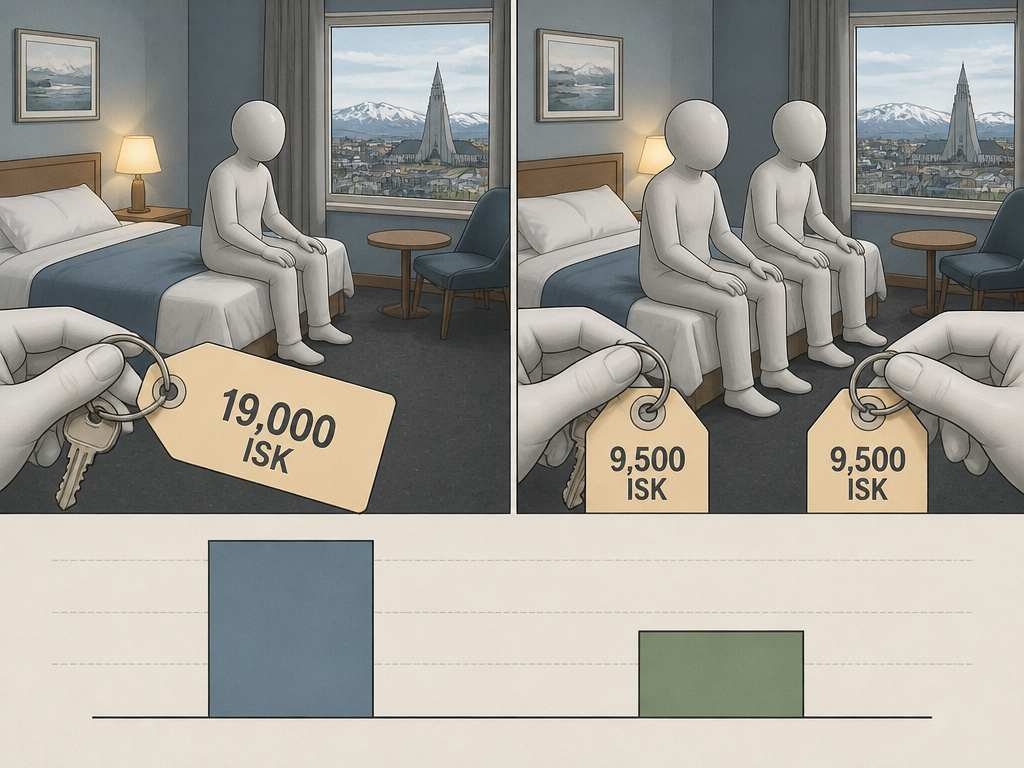
One person carries a whole room. That’s the entire mechanism, and it’s brutal.
Play Iceland states it directly: a solo traveller pays far more per head because one person carries a whole room. Their worked example puts a solo traveller in hotels at about $354 a day, where a couple camping pays $152 each.
The lodging tax is charged per room-night, not per person, so that part doesn’t double. But the room rate itself does. A guesthouse room at 19,000 ISK is 19,000 ISK whether one person sleeps in it or two.
Reykjavik.tours measured the same effect: travelling as a pair cuts per-person cost by 18% to 33% compared with going alone. The biggest saving shows up in the comfortable tier, where the 4×4 and the hotel room make up most of the cost.
If you’re going solo, the maths pushes you toward two things. Campsites and hostels, where you pay per person, and campervans, where the bed travels with you. A solo trip needs a different budget structure than a shared one, not just a smaller version of the same one.
What Rental Insurance and Parking Really Add
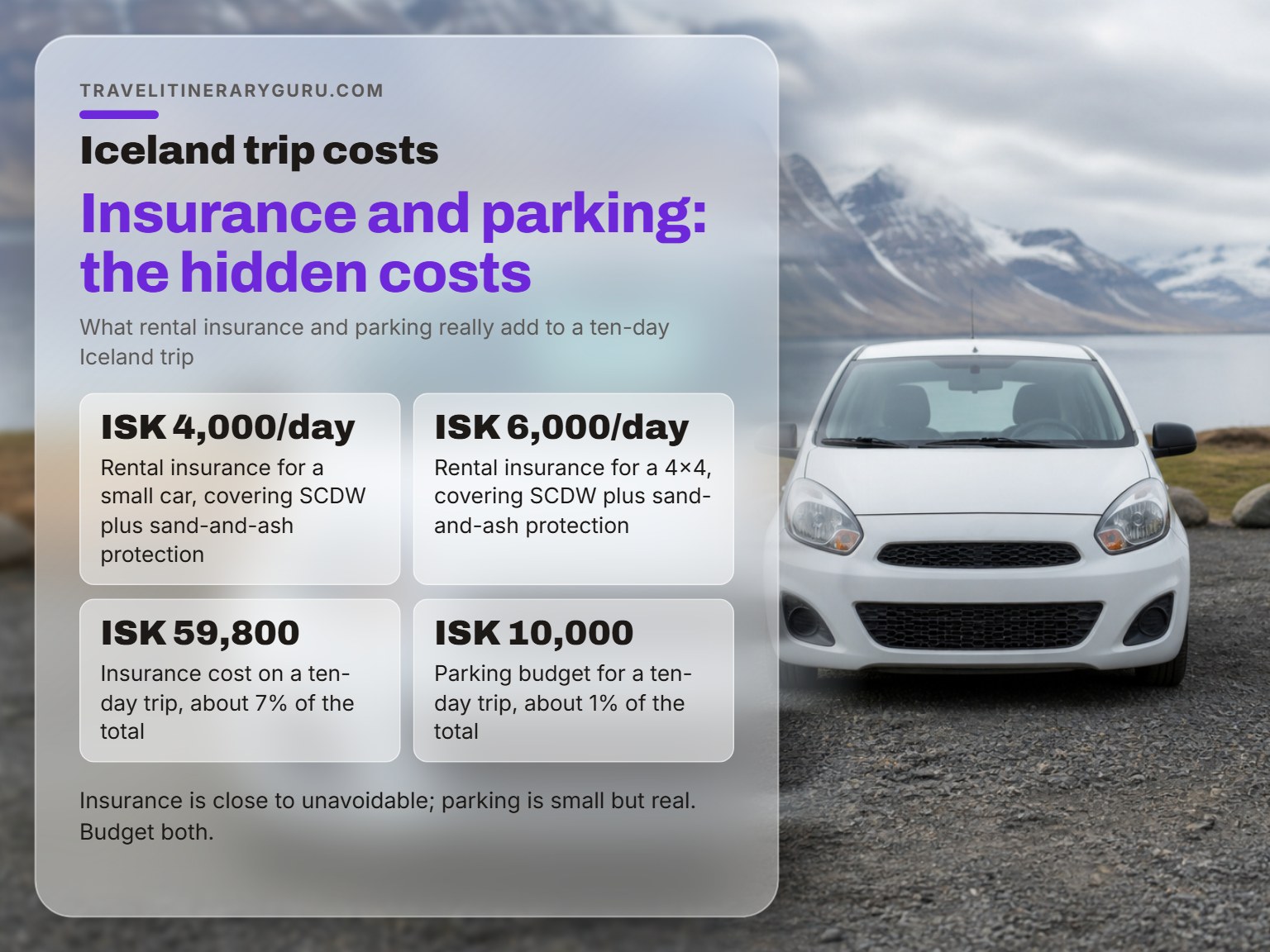
These two lines are where budgets quietly break, and neither is optional in practice.
Rental insurance runs about ISK 4,000 a day for a small car and about ISK 6,000 a day for a 4×4, covering SCDW plus sand-and-ash protection. Published Icelandic supplier rates put SCDW at roughly ISK 1,990 a day for small cars and ISK 2,990 for 4x4s, with sand-and-ash protection at the same rates again.
On a ten-day trip that’s 59,800 ISK, or about 7% of the total. It’s also the line most people forget entirely when they build a budget from the headline rental rate.
Skip this if: You’re staying in Reykjavík the whole time and not driving outside the capital area. Sand-and-ash protection exists because volcanic ash and wind-blown gravel destroy paint and glass on the open road. In the city, you’re paying for a risk you won’t meet.
Parking at the paid stops is ISK 1,000 per car, and the list is growing. Þingvellir, Seljalandsfoss, and Skógafoss all charge it. Play Iceland budgets 10,000 ISK for parking on a ten-day trip, about 1% of the total.
In central Reykjavík the picture is different. Zones P2 through P4 charge ISK 240 an hour.
The honest version: insurance is close to unavoidable, and parking is small but real. Budget both, and stop pretending the rental rate is the rental cost.
How Much Does a Week in Iceland Cost for Two People?
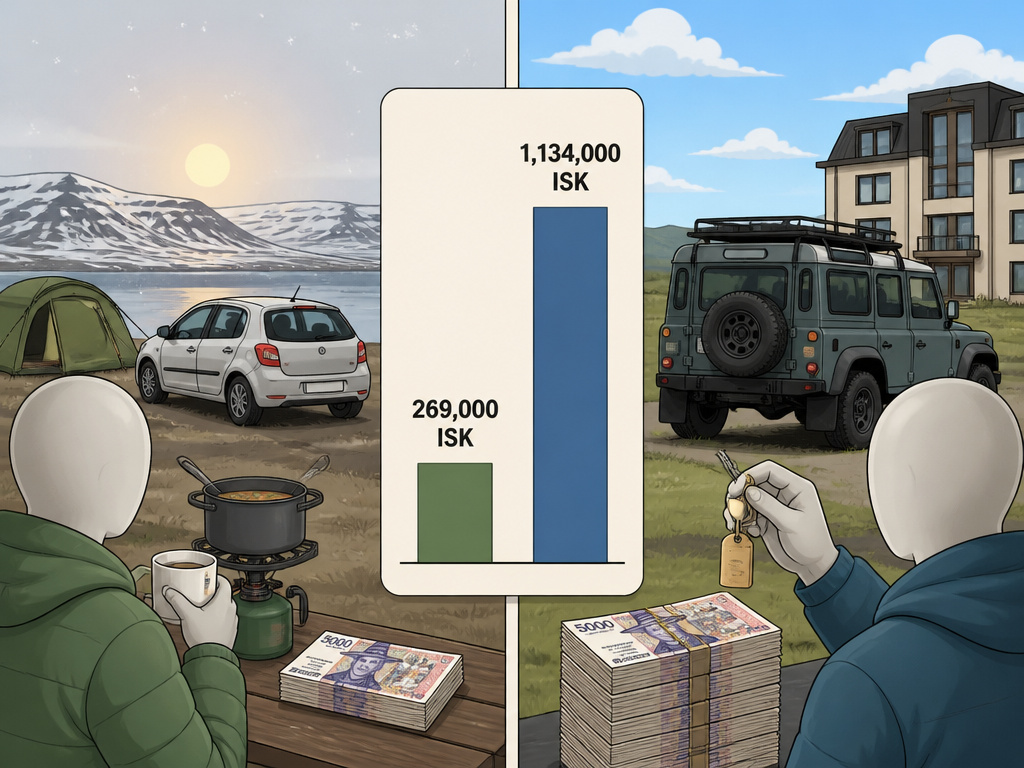
A seven-day September self-drive for two, with a small car, campsites, cooking most meals, and the south coast, comes to about 269,000 ISK, or $2,151, per Play Iceland’s calculation. Their realistic range runs from 166,000 to 411,000 ISK depending on how prices fall.
A comparable July trip with a premium 4×4 and hotels runs closer to 1,134,000 ISK, or $9,086. Flights sit on top of both figures.
That’s a five-fold spread between the cheapest and most expensive version of the same seven days. Month and bed choice drive almost all of it.
Play Iceland’s cheapest-month analysis makes the seasonality concrete. The same ten-day Ring Road trip that costs about 885,000 ISK in June comes to about 708,000 ISK in February. January, February, and November are the cheap months. The trade-off is four to five hours of daylight, frequent road closures, and weather that rewrites itineraries.
A winter trip needs more slack and sometimes an extra night, which eats into the saving. Fair warning: the daylight constraint isn’t a minor inconvenience. It’s the thing that determines whether you see the country or just drive through it.
If you’re chasing the aurora specifically, the best time for northern lights overlaps with the cheapest accommodation months, which is a rare case where the budget answer and the experience answer point the same direction.
What a Campervan Saves, and When It Stops Saving
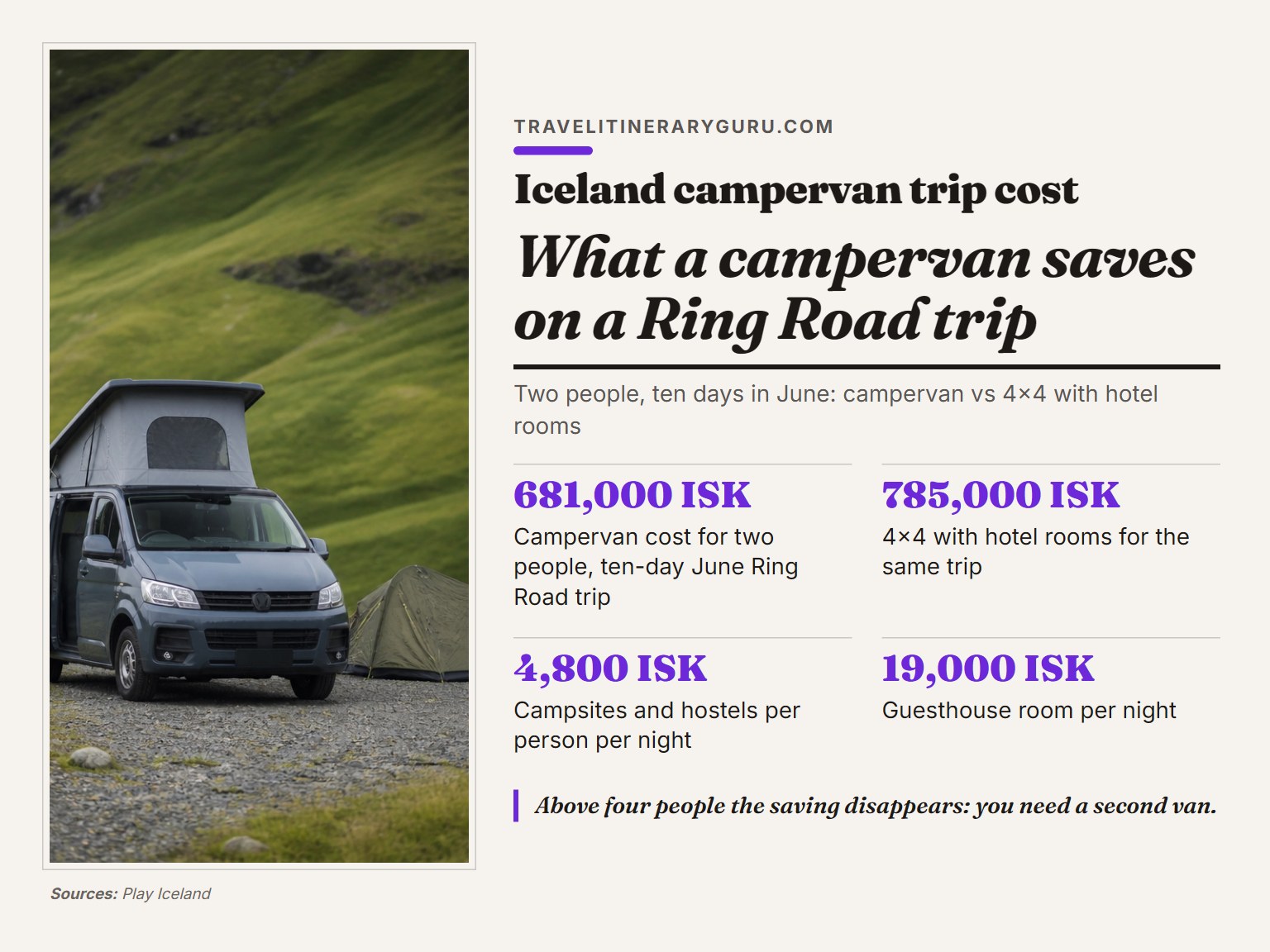
For two people on a ten-day June Ring Road trip, a campervan comes out around 681,000 ISK against about 785,000 ISK for a 4×4 with hotel rooms. That’s roughly 100,000 ISK saved, per Play Iceland’s comparison.
The mechanism is simple. The van costs more per day than the car, but it removes the room entirely, and campsites charge per person at a fraction of a room rate. Campsites and hostels run about 4,800 ISK per person per night against 19,000 ISK for a guesthouse room.
The gap widens at four people, because four campsite pitches still cost less than two hotel rooms. It closes if you would have camped anyway, and it disappears above four people, when you need a second van.
One catch on the kilometre fee. A campervan or motorhome above 3,500 kg permissible total weight jumps to ISK 9.85/km, and the ISK 1,390/day alternative is unavailable. Check the permissible total weight on the registration, not the laden weight, before you compare quotes.
Worth knowing before you start: If a rental company charges the kilometre fee in advance on an estimated distance and you drive less, it must issue a credit note and refund the difference. That’s the Skatturinn rule. Ask whether the estimate is metered or flat before you sign.
Which Costs Do People Forget?
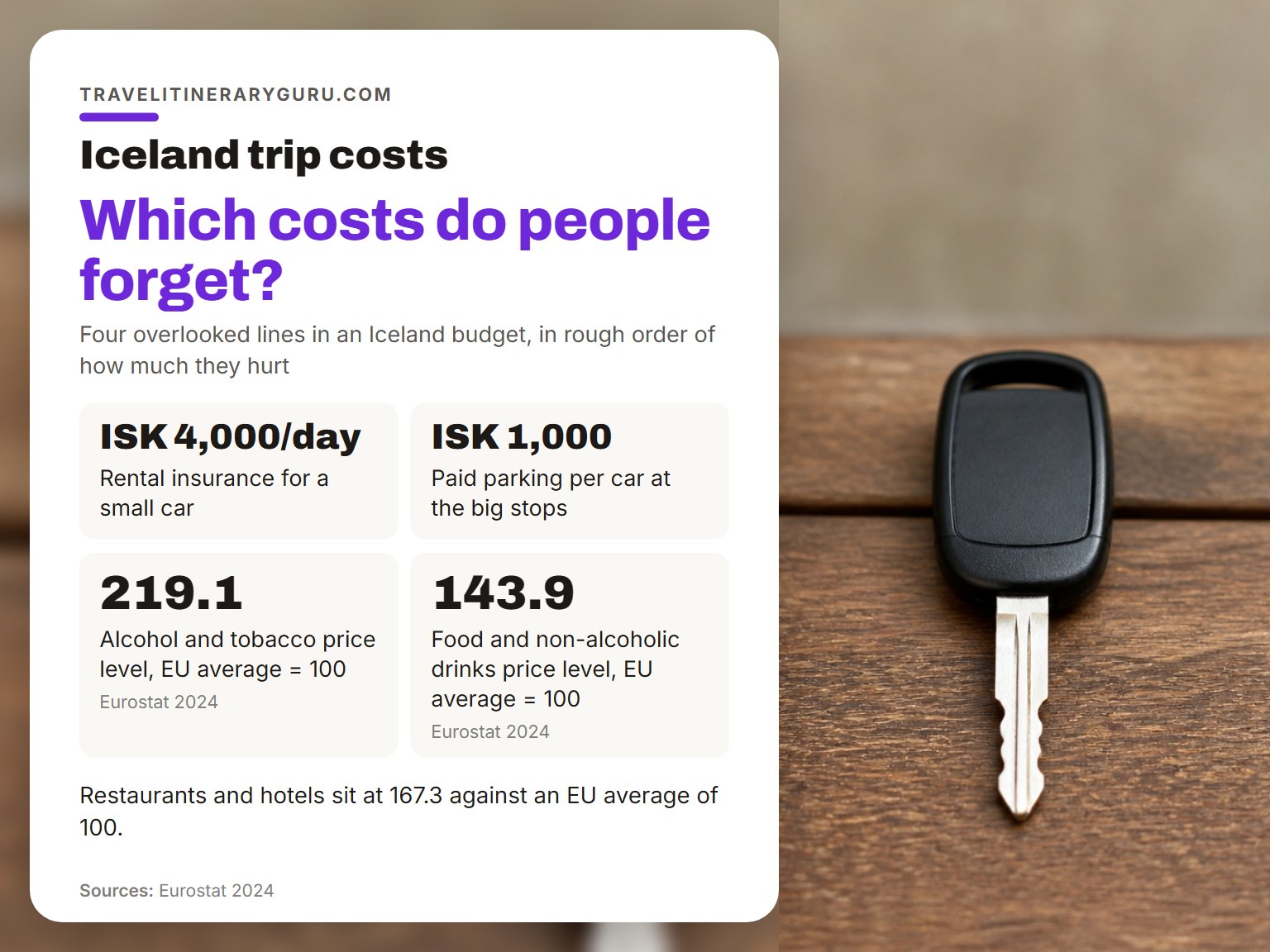
Four, in rough order of how much they hurt.
Rental insurance, at about ISK 4,000 a day for a small car. Paid parking, now ISK 1,000 a car at the big stops. The kilometre fee, which almost no published Iceland budget has been updated for since it took effect in January 2026. And the single supplement, where a solo traveller pays roughly double per head for the same room.
Then the smaller ones. One-way rental fees and F-road surcharges run 15,000 to 40,000 ISK on some itineraries. The Vaðlaheiði tunnel toll is about 1,900 ISK each way, and only if you take it rather than the free mountain road. Gravel protection runs 1,500 to 3,500 ISK a day if you take it.
Alcohol deserves its own line. Eurostat’s 2024 price-level index puts Iceland at 219.1 for alcohol and tobacco against an EU average of 100, more than double. Food and non-alcoholic drinks sit at 143.9. Restaurants and hotels come in at 167.3.
Bought at Vínbúðin, alcohol is merely expensive. Bought in bars, it moves the total noticeably. That’s the difference between a supermarket trip and a night out.
A travel budget spreadsheet helps here mainly because it forces you to list these lines before you book. I’ve watched people build a beautiful budget around the rental rate and then discover the insurance and parking lines in Reykjavík with no room left for them.
How Do You Convert ISK Without Losing Money?
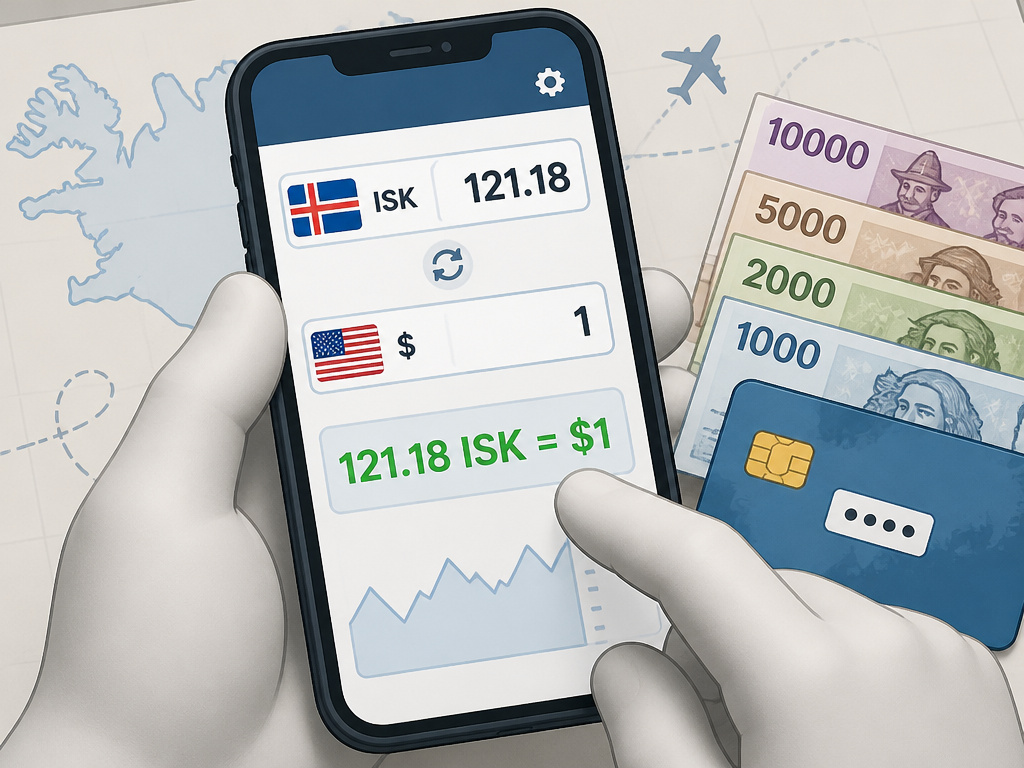
Iceland’s currency is the króna, and the conversion matters more than people expect because the numbers are large.
At the Central Bank of Iceland’s rate of 121.18 ISK per US dollar in September 2026, 1,000 ISK is about $8.20. A workable rule of thumb: knock two zeros off a krona price and subtract about a fifth.
Cards work almost everywhere, including small purchases and city buses, so you don’t need much cash. The airport bus takes cards. Foreign currencies are rarely accepted, and larger purchases may need chip and PIN, so bring a card with a PIN.
The rate moves. ISK figures converted at each year’s average rate mean króna movement changes your dollar total, sometimes meaningfully. A better exchange rate is worth maybe 2% to 3% on the total, which is real money on a $7,000 trip but not the thing that decides your budget.
Frequently Asked Questions
How much does a trip to Iceland cost per day?
There’s no honest single number, which is why the sources split. Statistics Iceland’s 2025 data puts the average foreign visitor at $1,766 over 7.1 nights, about $249 a night. Play Iceland’s trip tiers run from about $154 per person per day on a budget camping trip to $568 on a comfortable July trip with hotels and a large 4×4. Guide to Iceland says $100 to $200 a day; Packzup and Map of Iceland both decline to give a figure at all.
What is the kilometre fee in Iceland?
State road charge of ISK 6.95 per kilometre driven, in force since 1 January 2026 for vehicles up to 3,500 kg permissible total weight, regardless of fuel type. Rental companies add an administration fee of roughly ISK 1.86/km including VAT, so the figure on your invoice is nearer ISK 8.81/km. A full Ring Road loop of 1,332 km comes to about ISK 11,700 at the all-in rate.
Is a campervan cheaper than a car and hotels?
For two people on a ten-day June Ring Road trip, yes, by roughly 100,000 ISK. The van costs more per day but removes the room entirely, and campsites charge per person. The gap widens at four people and disappears above four, when you need a second van. Above 3,500 kg permissible total weight, the van also pays a higher kilometre rate.
What is the lodging tax in Iceland?
ISK 800 per room-night at hotels and guesthouses and ISK 400 per pitch at campsites and motorhome sites, set by Iceland Revenue and Customs from 1 January 2025. It’s charged per accommodation unit per night, not per person, so a couple pays it once. It sits on top of the 11% VAT already inside room prices.
Do I need travel insurance for Iceland?
Yes, and I’ll be blunt about why. I’ve seen a minor injury abroad cost more than the entire trip, and I now treat travel insurance as a fixed cost rather than something to trim. Iceland adds its own argument: speed cameras are common, the fines are large, and rental insurance doesn’t cover medical care.
When is the cheapest time to visit Iceland?
January, February, and November. Rooms and rental cars run a little over half their July rate, and the same ten-day Ring Road trip that costs about 885,000 ISK in June comes to about 708,000 ISK in February. The trade-off is four to five hours of daylight and frequent road closures, so a winter trip often needs an extra night that eats into the saving.
The Bottom Line
If your Iceland budget has a single number in it, you’ve already lost the plot. The sources that refuse to give a daily average are the honest ones, because your car and your bed are quotes, and nobody can quote them for you.
What you can do this week: pull up the permissible total weight on whatever vehicle you’re considering, and check whether your rental company meters the kilometre fee or bills a flat daily rate. Those two facts decide whether your road-trip line comes in at ISK 11,700 or something meaningfully higher, and almost no published budget accounts for either.
Here’s the concession, though. Everything above assumes you’re driving. If you’re basing yourself in Reykjavík and taking day tours, the kilometre fee, rental insurance, and parking vanish from your budget entirely, and the numbers shift toward the tour prices instead. Hotel pickup versus meeting the guide on location can change the price of sightseeing day tours substantially, per Iceland Trip Planner’s data, so that single choice matters more than anything else in a tour-based trip.
And if you’re travelling alone, budget well above the mid-range daily figure before you start planning. Not because Iceland charges solo travellers more, but because a room costs what a room costs, and one person carries all of it.
Internal links embedded: 4 of 9 targets used (solo trip, best time for northern lights, travel budget spreadsheet, better exchange rate). Additional targets available for a follow-up pass to reach the 5-link minimum: [2] daily travel costs, [5] family vacation, [6] city break, [8] trip to Hawaii, [9] trip to Costa Rica.
Outbound authority links: None embedded in body. Recommended primary sources for a Stage 6 pass: Statistics Iceland SAM08000 PxWeb table (https://px.hagstofa.is/pxen/pxweb/en/Efnahagur/…), Ísland.is kilometre-fee guidance page, and Act No. 100/2025 on althingi.is.
