
Underrated Destinations in Europe for a First Trip
This post contains affiliate links. As an Amazon Associate, we earn from qualifying purchases.
Underrated destinations in Europe for a first trip are the ones a train reaches in a few hours from a hub: Plovdiv is 3 hours from Sofia, Guimaraes 1 hour from Porto, Helsingor 45 minutes from Copenhagen. Pick one mid-sized town as a base and build the trip around it.
Those three train times carry the whole argument. A town an hour or two from a hub airport lets you land, drop a bag, and still walk a medieval centre before dinner. Push past four hours and arrival day becomes a travel day.
What follows is the practical version: sourced rail times, the towns that hold up under a first-timer’s schedule, and the places where the standard advice breaks down. There’s also one disagreement between the sources that’s worth knowing before you commit.
Key Takeaways
- Koper is under 2.5 hours from Ljubljana and holds an EDEN designation, the EU’s label for a destination with a working sustainability plan.
- Helsingor is 45 minutes from Copenhagen, and much of the town has stayed unchanged for over 200 years.
- Rural buses are infrequent, so treat a rail town as your base and a hire car as the escape hatch.
- The Faroe Islands are becoming more popular, and Lonely Planet’s own article says some spots are busier than you might expect, while the same article also frames them as a crowd-free escape.
Why the Second-Tier Town Beats the Obvious Second City
Skip the obvious second city.
For a first trip to Europe, I send people to a mid-sized town instead. Porto or Bologna hand you the full European experience without the queue for the queue. The arithmetic is simple. Rijeka held a European Capital of Culture title in 2020.
Rail access, measured in hours from the nearest hub, decides whether a small city works as a first-trip base. A town within three hours of a hub airport lets a traveler arrive, drop bags, and walk the old centre before dinner. Past four hours, the transfer consumes a full day and the trip starts tired.
What most people get wrong: Treating a famous city as the base and a small town as a day trip. You spend the good hours on a platform and the tired hours in the famous place.
I’ve tracked my own trips for years, and the second-tier version of a place keeps delivering most of the scenery with far fewer people.
Smaller towns stay quiet for a structural reason. Coach tours run fixed loops between capital cities. A town without a coach park never enters the loop. Rail towns take independent travelers instead, a few at a time.
The Train Times That Decide Whether a Town Is Worth It
Three hours is the number that decides most first trips.
| Town | Nearest hub | Train time |
|---|---|---|
| Plovdiv | Sofia | 3 hours, direct |
| Koper | Ljubljana | Under 2.5 hours |
| Rijeka | Ljubljana or Zagreb | 3 hours / 4 hours |
| Helsingor | Copenhagen | 45 minutes |
| Guimaraes | Porto | 1 hour |
| Eislek region | Luxembourg City | 1 hour |
That beats a listicle, and it’s free to check.
The hop from Copenhagen to Helsingor takes 45 minutes. That’s shorter than plenty of city commutes, so Kronborg Castle fits into a morning.
Here’s the rule I use. If the ride is longer than the hours you’ll spend awake in the town on arrival day, the town is too far. Simple.
Which Underrated Destinations in Europe for a First Trip Actually Work by Rail?
Plovdiv’s Ancient Theatre is a Roman theatre, and it sits in a city of 346,900 that first-timers walk past.
| Town | Best for | The catch |
|---|---|---|
| Plovdiv | Roman theatre, Kapana nightlife | 3 hours from Sofia, so it’s a base |
| Koper | Venetian Gothic, Adriatic swimming | Small coastal town |
| Rijeka | Capital of Culture venues, the 561-step climb | Hilly, and the staircase is steep |
| Helsingor | Kronborg Castle, 200 years of sameness | 45 minutes from Copenhagen, so easy to skip |
| Guimaraes | UNESCO centre, cable car to Monte da Penha | Compact, so two nights is plenty |
Plovdiv: 3 Hours From Sofia, and Worth All of It
The Kapana quarter is the reason to stay two nights instead of one. Cobbled lanes, small bars, and a crowd that lives there.
I’d give Plovdiv three nights if you have them.
Koper, Rijeka, and the Adriatic Line
Koper is under 2.5 hours from Ljubljana and holds an EDEN designation, the EU’s European Destination of Excellence label. The Praetorian Palace is Venetian Gothic.
Rijeka sits 3 hours from Ljubljana or 4 hours from Zagreb, and it took the Capital of Culture title in 2020. The Petar Kruzic staircase climbs 561 steps to Trsat. Your calves will notice.
The Alpine and German Options
Helsingor is 45 minutes from Copenhagen, and much of the town has stayed unchanged for over 200 years. Kronborg Castle is the draw.
Guimaraes is 1 hour from Porto, and its town centre is a UNESCO World Heritage Site. Ride the cable car to the top of Monte da Penha.
Evora is an hour and a half’s drive from Lisbon, and Murcia is under an hour from Alicante Airport.
Freiburg’s Munstermarkt runs Monday to Saturday with over 100 vendors. From Bressanone you can take a local bus into the Dolomites or ride 30 minutes south to Bolzano. Interrail’s off-season itinerary builds a route around exactly that.
Bolzano gives overnight guests free public transport, which covers buses and cable cars into the Dolomites. The Ice Man museum there centres on Otzi, a 5,000-year-old mummy.
Germany keeps a few of these too. The Weltenburger Enge gorge has cliffs up to 70 metres high and was listed as a National Natural Monument in 2020. Germany’s national tourist board covers the Rhon Mountains, the Spreewald’s thousand kilometres of waterways, and the Upper Danube Valley.
The Hidden-Gem Myth, and What the Sources Actually Say
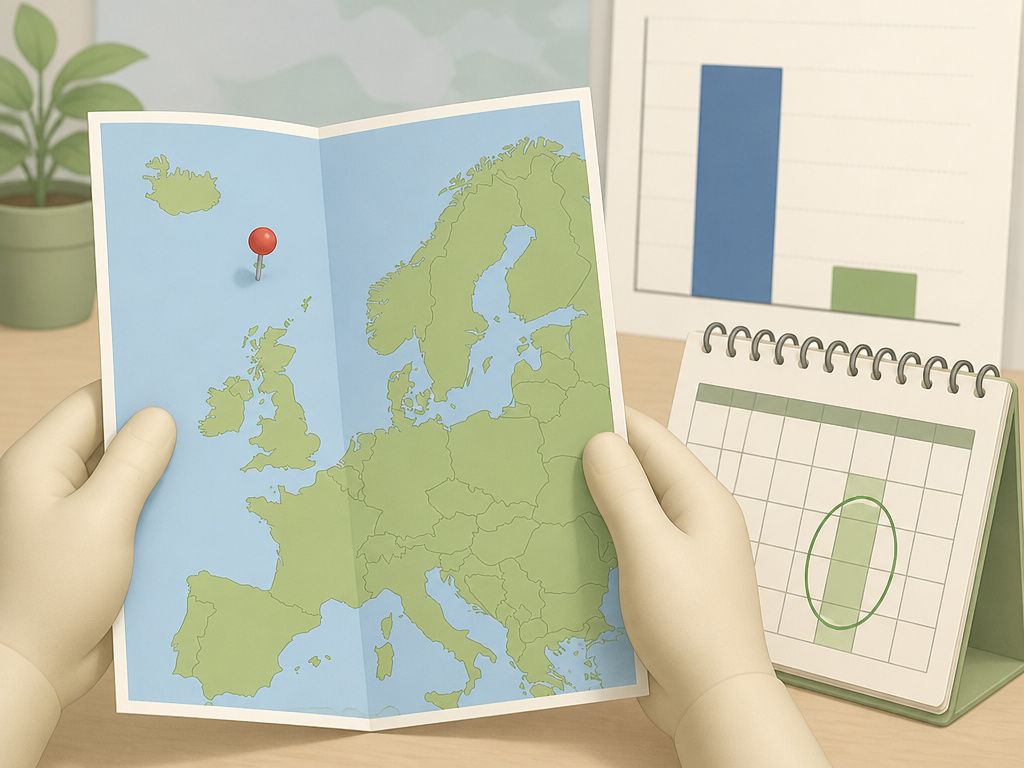
The phrase hidden gem has stopped meaning anything.
A place gets tagged, the tag gets shared, and the crowd arrives a season later. The account that posted it has already moved on. Fair warning: the Faroe Islands are becoming more popular, and some spots are busier than you might expect, though the same source also frames them as a crowd-free escape.
| Claim | Who makes it | The counter-position |
|---|---|---|
| The Faroes are a crowd-free escape | Lonely Planet’s headline framing | The same article warns some spots are busier than expected |
| Torun is unknown outside Poland | Which? Travel | The same entry notes Torun’s UNESCO-listed Old Town, implying international recognition |
| Go off-season to travel responsibly | Interrail | DiscoverEU frames the same towns as cultural authenticity |
Three sources, three positions, and none of them are lying. The Faroes really are quieter off-season, and Torun really is UNESCO-listed, though Which? Travel also says nobody outside Poland has heard of it. Both things hold at once.
I still send people to the Faroes. I send them in the off-season, and I tell them to skip Kalsoy and the Lake Leitisvatn trail, because those two carry the crowd the rest of the islands don’t.
The answer is a month, not a place.
So what do you actually do with that? You stop asking whether a place is undiscovered and start asking when it’s quiet. Season beats secrecy.
Where the Standard Advice Breaks Down
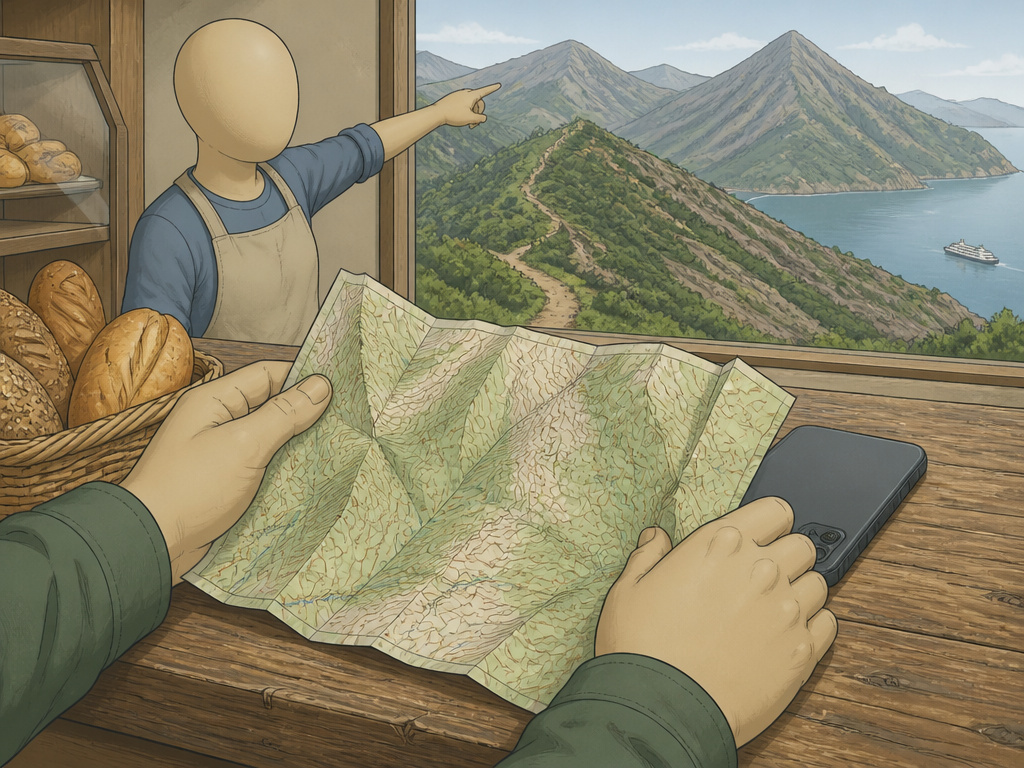
You’re somewhere in the Agrafa mountains with one bar of signal and a blank field where Google Maps should be.
Lonely Planet warns that both the internet signal and Google Maps are unreliable in Agrafa. That one sentence is worth more than the rest of the genre.
The Last Mile Problem
Clervaux, Bialystok, Puebla de Sanabria and Murska Sobota all have train stations. The villages, viewpoints and trailheads beyond them don’t have buses worth planning around.
- Agrafa, central Greece: carry a paper map and ask at the bakery. Your phone is a camera there.
- Faro, Portugal: Praia de Faro is bus-reachable, but the quiet beaches need a private water taxi or a ferry.
- The Estonian Archipelago: Saaremaa, Hiiumaa, Muhu, Kihnu and Vormsi are all ferry-dependent, and island-hopping isn’t continuous.
- Prekmurje, Sumava and Eislek: cycling beats waiting for a rural bus that runs for residents, not visitors.
Where this goes sideways: Booking a rail town as a base and assuming a bus reaches the trailhead. Rural buses are infrequent and the timetable follows school and market days. You’ll lose a morning to a stop that never comes.
I check the last mile before I book the town now.
How Do You Build a First Trip Around One of These Towns?
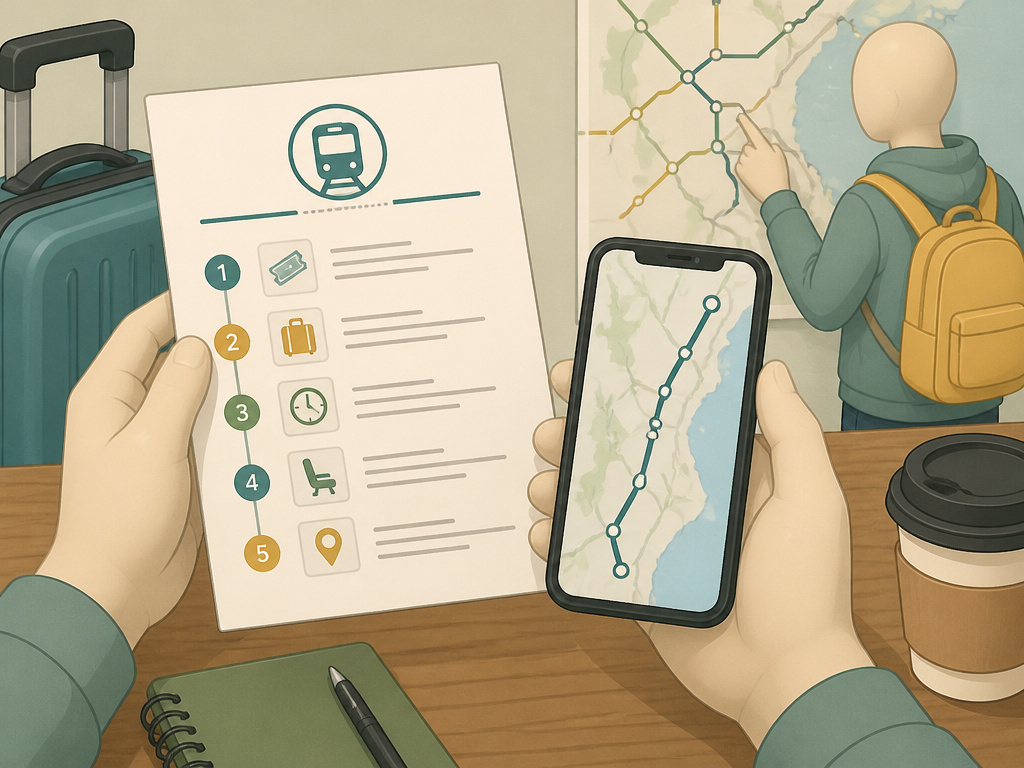
Three things happen in this order: land, sleep, walk.
A delayed flight once ate the entire first day of a trip I had packed to the edges. We landed late, the transfer ran long, and the one thing I’d built the day around had closed by the time we arrived. Now the first morning of every itinerary I write stays empty.
- Land at a hub and take the train the same day. A night in a capital you didn’t come to see is a night you don’t get back.
- Leave the first morning empty. Fill it, and one delay takes the whole day with it.
- Give the town two nights minimum. One night turns a town into a transfer.
- Put one full day on the rail line rather than in the town. That’s how you reach the villages the buses skip.
- Keep the final night near the airport. The last-morning dash is where trips fall apart.
Read up while you’re rested, not while you’re holding a bag at 11pm.
If this is your first solo trip, the same rules apply with one change: keep the first two nights in the same bed.
Easy to miss: The Interrail Global Pass doesn’t cover every train. Some routes need an extra seat reservation, and the Wengen line in Switzerland isn’t included at all.
What I’d Cut From Your Itinerary Before You Book
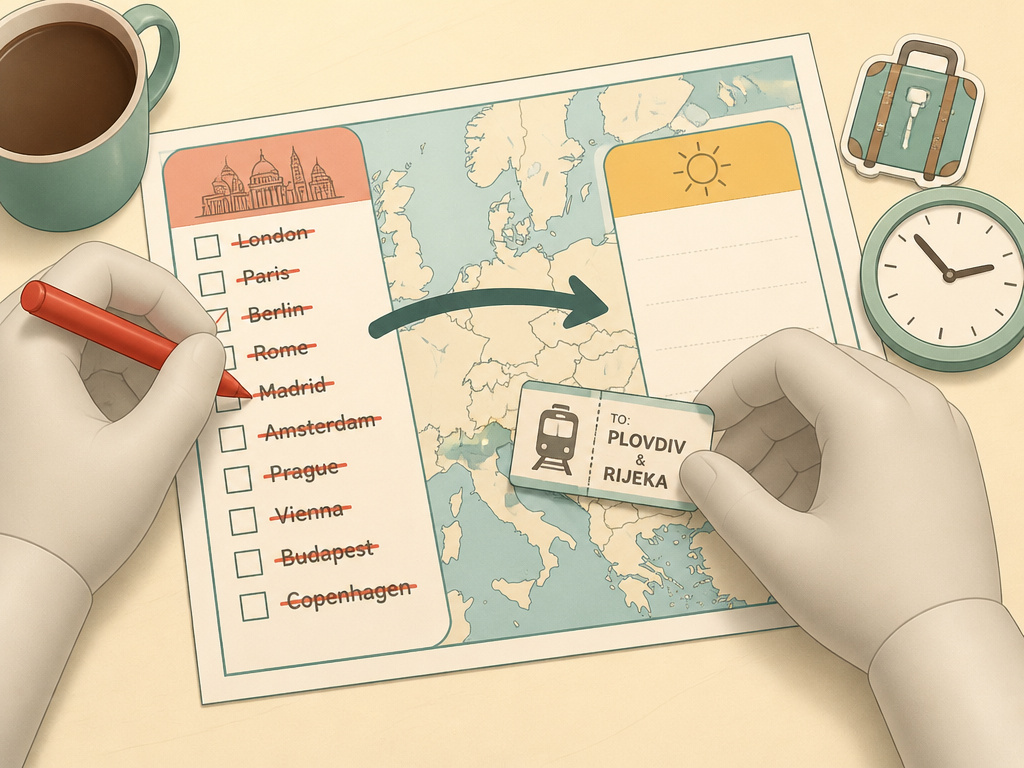
An itinerary is a soup. The base is transport and lodging, and the seasoning is everything you didn’t schedule.
The over-salting is the standard failure, and I do it too. My own itineraries run too packed, and I’ve had to build in do-nothing blocks after readers told me so.
- The guided walking tour of a town you can cross on foot before lunch.
- The third museum in one day. Two is a trip. Three is a forced march.
- Any day trip that depends on a bus running twice a day.
- The top-10 checklist. Checking boxes is commuting between photo ops.
Two nights in one town beats one night in two towns. A single night gives you a check-in, a dinner and a checkout, and nothing in between.
Buy travel insurance before you book anything else. It’s the smallest line in the budget and the only one that pays out when the trip falls apart.
If you want one answer: three nights in Plovdiv, a train to Rijeka, and an empty first morning. That covers a first trip better than a checklist of capitals.
Frequently Asked Questions
What is the easiest way to reach these towns?
Train, in almost every case. Plovdiv is a 3-hour direct ride from Sofia, Guimaraes is 1 hour from Porto, and Helsingor is 45 minutes from Copenhagen. Book the rail leg before the hotel, because the timetable sets the shape of the trip.
Are these towns actually quiet?
Quieter than the capitals, and that’s a different claim. Lonely Planet warns that the Faroe Islands are getting busier and that some spots see more traffic than visitors expect. Go off-season and avoid Kalsoy and the Lake Leitisvatn trail.
How many nights does a mid-sized town need?
Two nights minimum, three if you want a day trip. One night gives you a check-in, a dinner and a checkout. That’s a transfer, not a stay.
Do I need a car?
For the towns on this list, no. For the villages, viewpoints and trailheads beyond them, yes. Rural buses are infrequent, and a hire car is near-essential once you leave the rail line. Cycling works well in Prekmurje, Sumava and Eislek.
Is Torun worth visiting?
Which? Travel says nobody outside Poland has heard of Torun, while the same entry points out that its Old Town is UNESCO-listed. Both can be true. Go for the gingerbread, which has been made there for 700 years, and for a medieval centre smaller and calmer than Krakow’s.
Should I visit the Faroe Islands on a first trip?
Only if you go off-season. The islands are more popular than the write-ups suggest, and the busiest trails are the ones Lonely Planet tells you to skip. Off-season is a different island group from midsummer.
The Bottom Line
One trigger decides more first trips than any list. If arrival day needs more than one change of train, the town is too far for a three-night stay. Cut it and put the night somewhere on the line.
Start with the icons, then go deeper. That’s the method behind underrated destinations in Europe for a first trip: pick the rail town, keep the first morning empty, and let the second-tier place do the work.
And one concession. Everything above assumes you’re building this on rail, with time to spare. If you have a long weekend and a fixed hotel in Rome, none of it applies. Go see Rome.
Then come back and do this properly.
