
How to Choose Between Yellowstone and Yosemite
This post contains affiliate links. As an Amazon Associate, we earn from qualifying purchases.
How to choose between Yellowstone and Yosemite comes down to three things: whether you want to drive or walk, whether you’re chasing wildlife or granite, and how many days you actually have. Yellowstone is a 2.2 million-acre driving park with no internal shuttle; Yosemite Valley is compact enough to cross on foot and by free bus.
Both are UNESCO World Heritage sites. Both pull millions of visitors a year. That’s where the similarity ends, and where the how to choose between Yellowstone and Yosemite question starts to matter.
What follows is the decision framework I use with readers: the driving math, the parking math, the family split that two credible sources genuinely disagree on, and the one logistical fact that kills the “do both in one trip” plan before it starts.
Key Takeaways
- Yellowstone is a driving park. Each main sight can sit 30, 40, or even 60 minutes from the last one.
- Yosemite Valley is a walking park. Park the car once, ride the free shuttle, and reach most valley sights on foot, including Yosemite Falls with a stroller.
- The two parks are 927 road miles apart — about 15 hours 40 minutes with no stops. Pick one per trip.
- No reservations are required to enter either park in 2026, but the entrance fee still applies and lodging books out months ahead.
- Arrive before 9am or after 5pm in spring through fall, or accept that you’ll spend the morning in a queue.
The 2026 Reservation Change Nobody Has Updated Their Guide For
Yosemite will not use a timed reservation system in 2026. The park announced the reversal after evaluating traffic patterns, parking availability, and visitor use during the 2025 season, and concluded that a season-wide reservation requirement wasn’t the most effective tool for the coming year.
That matters because a lot of the advice still circulating online is stale. Lonely Planet’s Yosemite-versus-Yellowstone comparison is framed around a 2022 reservation landscape that no longer exists. The Yosemite entrance reservation requirements page is the only source you should trust on this, and it says plainly: no reservation required to enter in 2026.
Yosemite National Park does not require an entry reservation in 2026. The park entrance fee applies on arrival, and the National Park Service recommends reservations for lodging, camping, and backpacking. Yosemite will instead manage crowds through active parking management in Yosemite Valley and by promoting recreation outside the valley, including Tuolumne Meadows, Wawona, and Hetch Hetchy.
The practical consequence: you can now show up at the gate without a permit, but you can’t show up without a plan. The park is trading a reservation gate for parking pressure.
Yellowstone, for its part, has never required vehicle reservations. No timed entry, no lottery, no permit window. You pay the entrance fee and drive in.
What Replaced the Reservation System
Yosemite’s 2026 strategy leans on active parking management in Yosemite Valley and promoting recreation outside the valley.
The park is also explicitly steering visitors toward weekdays for parking availability and toward destinations outside Yosemite Valley. That’s not marketing language. It’s an operational admission that the valley floor cannot absorb everyone who wants to be there on a Saturday in July.
For a deeper look at how the two parks’ Yellowstone National Park visit logistics compare on the ground, the NPS planning pages are worth an hour of your time before you book anything.
How Many Days Each Park Actually Needs
This is where the two parks stop being comparable.
Yellowstone’s Grand Loop Road connects the park’s core sights. Add the spur roads to the developed areas and you’re looking at more driving than most people plan for. Each main sight can be 30, 40, or even 60 minutes from the last one, and there’s no internal shuttle to bail you out when you compare a how to choose between Yellowstone and Yosemite.
I’ve watched readers try to “do” Yellowstone in two days. It doesn’t work. The Yellowstone itinerary length that actually functions is three days minimum, and four if you want a Lamar Valley dawn drive without sacrificing something else.
Common mistake: Booking two nights in Yellowstone and expecting to see Old Faithful, Grand Prismatic, and the Lamar Valley. The drive time between those three alone eats most of a day, and bison jams don’t care about your schedule.
Yosemite is the opposite problem. The valley is compact, and once you’re parked you can walk or shuttle to most of it. The bottleneck isn’t distance. It’s parking.
That’s the Yosemite math: not miles, but minutes hunting for a space. Most visitors do fine with two full days in the valley, three if they want a Half Dome attempt or a Tioga Road day.
| Park | Core Distance | Realistic Minimum | The Bottleneck |
|---|---|---|---|
| Yellowstone | Grand Loop | 3 days | Drive time between sights |
| Yosemite | Compact valley | 2 days | Parking availability |
| Both, in one trip | 927 road miles apart | 7+ days | The 15 hr 40 min transfer |
If you want the day-by-day version, the Yosemite itinerary breakdowns are more useful than any general guide, because they build in the parking reality rather than pretending it doesn’t exist.
Driving Math vs. Parking Math: Why One Park Feels Bigger
Yellowstone spans 2.2 million acres across three states, with five main entrances, ten visitor centers, and eight developed areas. Yosemite covers nearly 1,200 square miles and was first protected in 1864.
Those numbers suggest Yellowstone is nearly twice the park. In practice, the felt difference is bigger than that, and it’s not about acreage.
Yellowstone’s sprawl is a driving problem. You will spend hours in the car. Cell service is thin, there’s no internal shuttle, and the distances between thermal basins are real. Families who aren’t prepared for that arrive hangry by noon.
Yosemite’s constraint is a parking problem. The valley is compact enough that once you’ve solved the car, everything else is easy. The Yosemite National Park official trip planner frames it exactly that way: Yosemite is a busy place, and you may find yourself stuck in traffic, waiting at the entrance, or unable to find parking.
What most people get wrong: Treating Yosemite like a driving park. If you plan to see the valley from your car, you’ll spend the day in a queue. Park once at Curry Village or Yosemite Village and stay on foot.
Here’s the practical wisdom: solve the bottleneck that matches the park. For Yellowstone, that means fewer stops and longer drives. For Yosemite, it means arriving early enough that the parking solves itself.
The Pre-7am Rule
I now treat park entry like a flight. If I’m not through the gate by 6:45am, I’ve already lost the day.
NPS guidance backs the pattern: arrive before 9am or after 5pm, spring through fall, to avoid peak-hour traffic.
That single habit does more for your trip than any itinerary tweak. It’s also the one thing most guides bury at the bottom of a bullet list.
Which Park Is Better for Families?
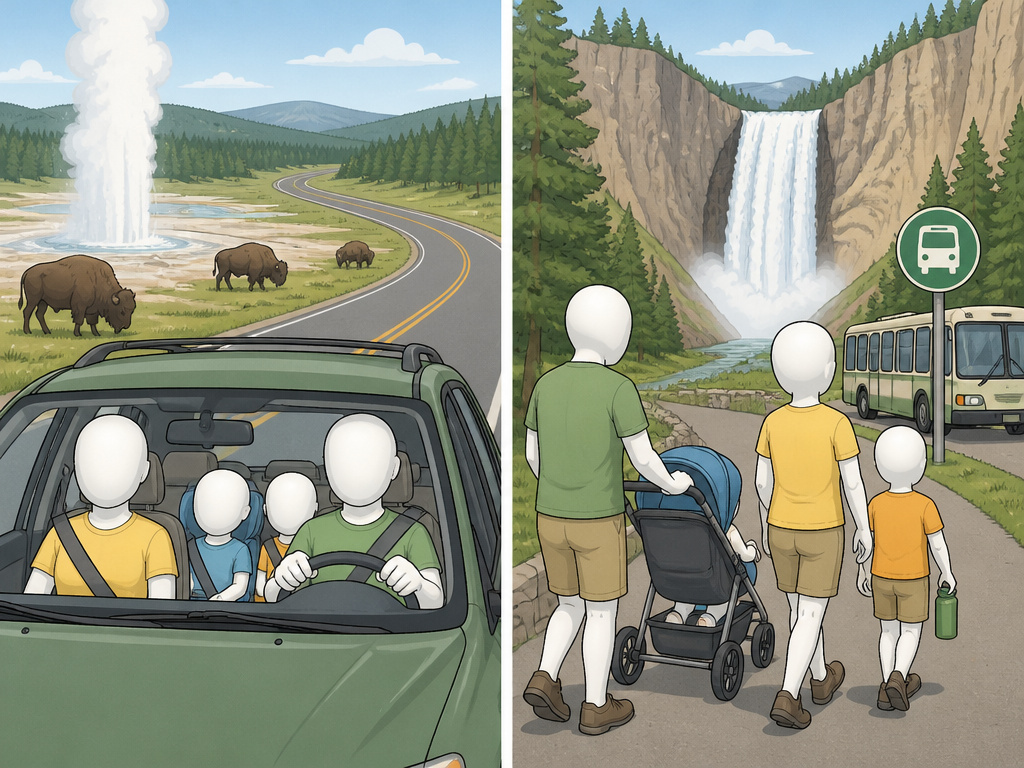
Two credible sources reach opposite conclusions here, and I’m not going to pretend they agree.
Lonely Planet names Yellowstone the best “all-things-for-all-visitors” park. Ascend Travel, writing after doing both parks with kids, argues Yosemite is easier for families because Yosemite Valley is walkable with a free shuttle.
Both are right about different things.
Yellowstone wins on structured engagement. The Junior Ranger Program is genuinely good, the thermal features function like a live science experiment, and bison wandering past the car is the kind of thing kids remember for a decade. What it costs you is car time. Ascend Travel’s honest version: each main sight can be 30, 40, or even 60 minutes from the last one, with no internal shuttle and not much cell service.
Yosemite wins on logistics. You park once, hop the free shuttle, and walk to most things. Yosemite Falls can be walked to with a stroller.
If your kids need structure and science, Yellowstone has the edge. If you need a trip where nobody melts down in hour three of a drive, Yosemite is the answer.
Skip this if: You have a fourth grader and you’re not using the Every Kid Outdoors Pass. It’s free, it covers the whole family’s entrance, and it’s the single easiest win in national park planning.
Shoulder Season Is the Actual Product
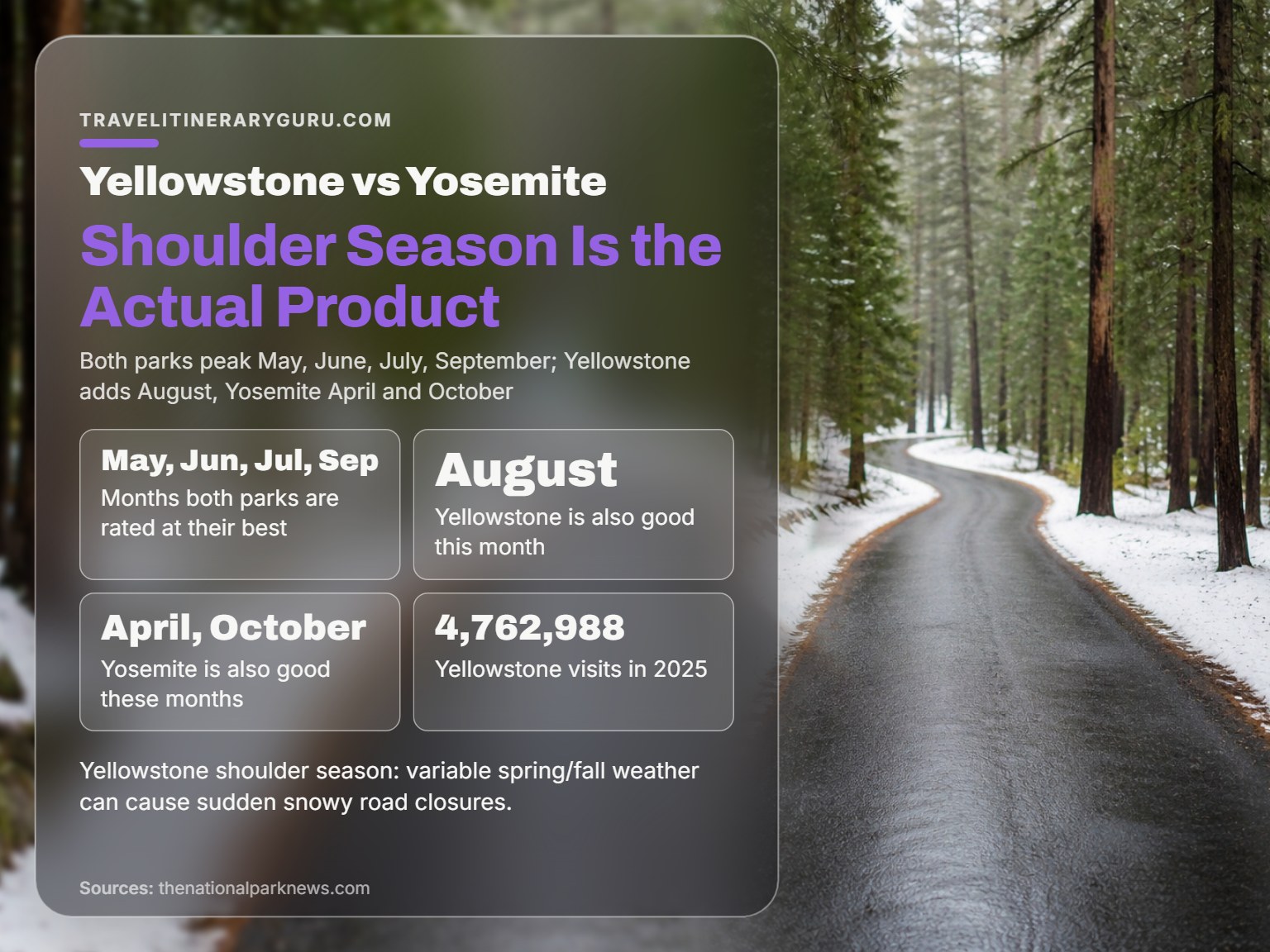
Summer is when both parks are at their best for weather and access, according to thenationalparknews.com, which rates May, June, July, and September as 4 or 5 out of 5 for both parks. Yellowstone is also good in August. Yosemite is also good in April and October.
But millions of people visit Yosemite from April through October, and NPS is explicit that the park is busy throughout that window. Summer means crowds, and summer park crowds are the single biggest variable you can control.
Shoulder season isn’t a compromise. It’s the actual product.
Yellowstone’s shoulder season carries a specific risk that Yosemite’s doesn’t. NPS warns that highly variable spring and fall weather can cause sudden road closures due to snowy conditions, and off-peak road and service closures are routine. Yosemite stays open to many activities through the winter; Yellowstone goes into something closer to hibernation.
Worth knowing before you start: A Yellowstone shoulder-season trip needs a road-closure backup plan. Check the park’s road status page the morning you drive, not the night before.
Wildlife, Waterfalls, and the Honest Split
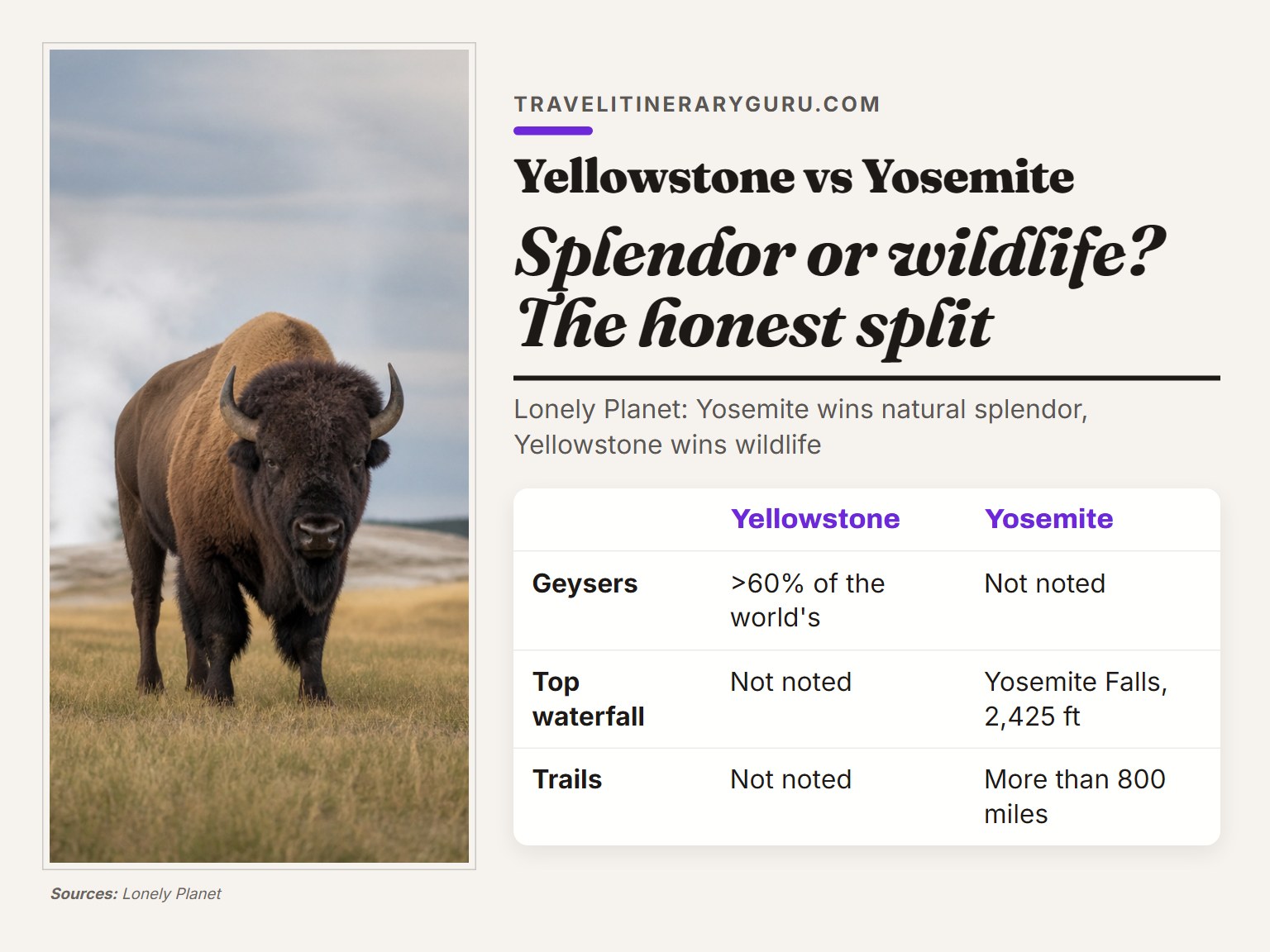
Lonely Planet’s verdict is the one I keep coming back to: Yosemite wins for natural splendor, and Yellowstone wins for wildlife. That’s a clean split, and it holds up.
Yellowstone holds more than 60% of the world’s geysers. Old Faithful, Grand Prismatic, Mammoth Hot Springs. Bison, elk, and the occasional bear. If wildlife is the point of your trip, this is the park.
Yosemite’s case is granite and water. Yosemite Falls drops 2,425 feet in three tiers. Half Dome’s summit trail is a 17-mile round trip from the valley with 4,900 feet of elevation gain. The park has more than 800 miles of hiking trails, from valley-floor loops to serious ascents.
The easy walks are shorter than people expect. Bridalveil Fall is a 0.5-mile round trip. Lower Yosemite Fall is a 1-mile loop. Cook’s Meadow Loop is another mile. You can see the park’s signature sights in a morning without breaking a sweat.
Both parks are ranked by thenationalparknews.com, which puts Yellowstone at #1 and Yosemite at #6 of the 63 parks they’ve visited. That ranking reflects their own weighting, not a universal truth, but it’s worth knowing whose opinion you’re reading.
Getting There, and the 927-Mile Problem
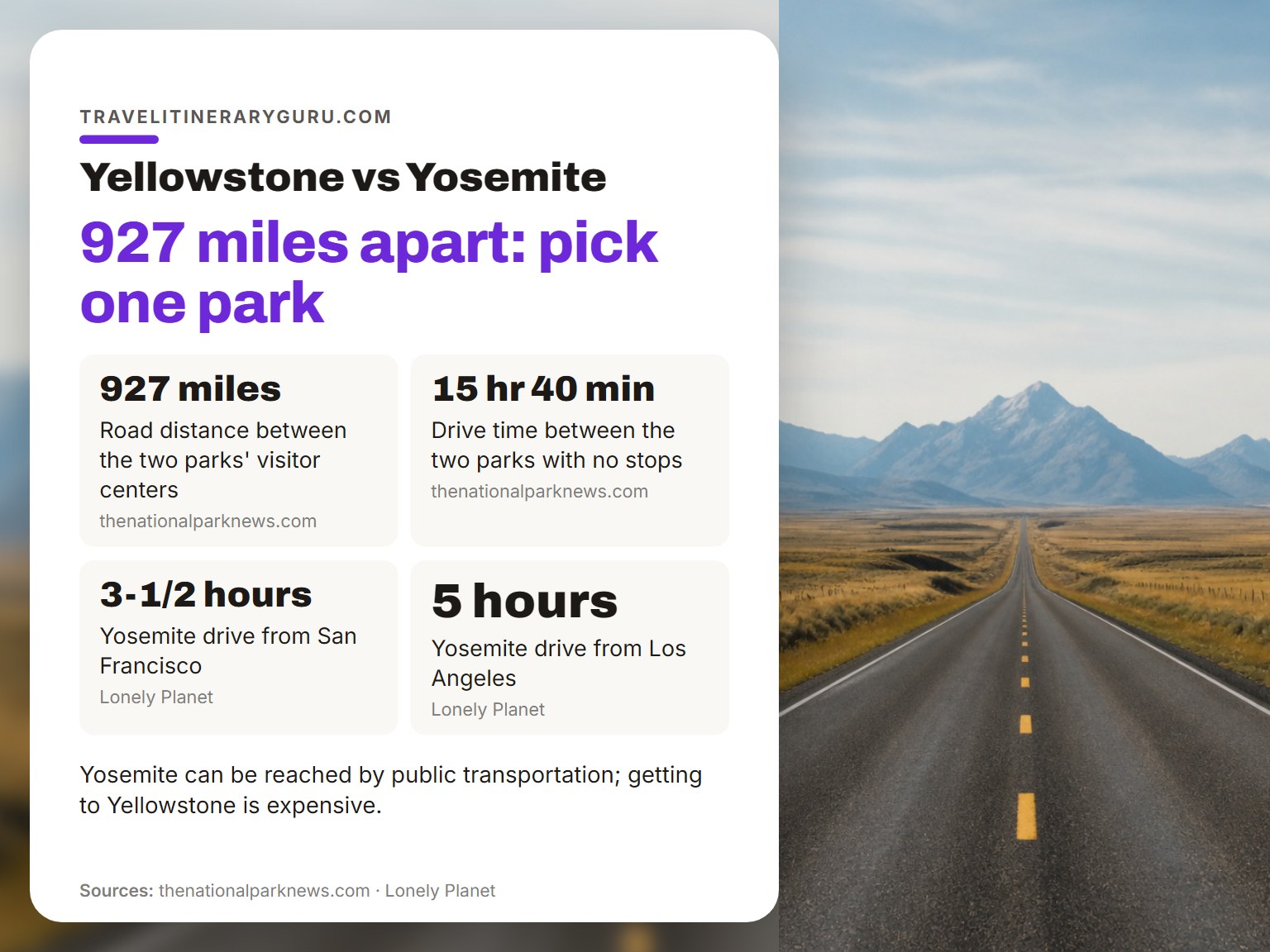
Yosemite is a reasonable drive from San Francisco at about 3.5 hours, and from Los Angeles at about 5 hours. It’s also one of the few national parks easily reached by public transportation, particularly from the Bay Area: Greyhound buses and Amtrak trains serve Merced, where you transfer to buses into the park.
Yellowstone is harder. Getting there is expensive, whether you drive from far away and buy a lot of gas or fly into a nearby airport and rent a vehicle. Lonely Planet calls Yosemite the budget-friendly choice for exactly this reason.
The two parks sit 927 road miles apart. That’s about 15 hours 40 minutes from Old Faithful Visitor Education Center to Yosemite Valley Welcome Center with no stops. Too far for most trips. Most people choose one, or fly between them.
If you’re doing the math on lodging, both parks charge the same entrance fee, and both require early reservations. Yellowstone lodging often needs booking nine months out and you still may not get your first pick. Yosemite’s campsites are almost impossible to reserve due to demand, and the in-park lodges are pricey and often full. The workaround for both is the same: look at gateway towns. For Yosemite, that means Fish Camp, El Portal, Mariposa, or Groveland. For Yellowstone, West Yellowstone and Gardiner.
Booking strategy matters more than most people think. If you’re comparing campground reservations across parks, the mechanics are similar but the timing windows aren’t.
Easy to miss: Yosemite’s campsite price range is real, but “almost impossible to reserve” is also real. Have a gateway-town backup booked before you try for the in-park site.
Frequently Asked Questions
Can you visit Yellowstone and Yosemite in one trip?
Technically yes, but the two parks are 927 road miles apart, which is roughly 15 hours 40 minutes of driving with no stops. Most travelers pick one park per trip or fly between them. If you have fewer than seven days, choose one.
Do you need a reservation to enter Yosemite in 2026?
No. Yosemite will not use a timed reservation system in 2026, and no reservation is required to enter. The park entrance fee still applies on arrival. The National Park Service strongly recommends reservations for lodging, camping, and backpacking.
Is Yellowstone or Yosemite better for young kids?
It depends on what your kids tolerate. Yosemite Valley is walkable with a free shuttle and Yosemite Falls is stroller-accessible, which makes it easier logistically. Yellowstone offers more structured programming like the Junior Ranger Program and better wildlife viewing, but each main sight can be 30 to 60 minutes from the last one.
What’s the best time to visit both parks?
May, June, July, and September rate highest for weather and access at both parks. Yellowstone is also strong in August; Yosemite is also strong in April and October. Yosemite sees millions of visitors from April through October, so shoulder-season timing matters more than the month on the calendar.
How many days do you need at each park?
Yellowstone needs at least three days because of the Grand Loop and the drive time between sights. Yosemite needs two full days in the valley, three if you want a Half Dome attempt or a Tioga Road day.
Do you need a reservation for Yellowstone?
No. Yellowstone does not require vehicle reservations. You pay the entrance fee and drive in. Lodging inside the park still books out months ahead, and spring and fall weather can close roads with little warning.
The Bottom Line
Here’s the call, and I’ll make it plainly.
If you have three or four days and you want wildlife, thermal features, and the feeling of driving across a continent’s worth of landscape, go to Yellowstone. Book four days, not two. The Grand Loop will eat more of your time than you think, and the Lamar Valley at dawn is worth a dedicated morning.
If you have two or three days, you’re traveling with kids or anyone who doesn’t love long car rides, or you want to combine a park trip with San Francisco, go to Yosemite. The valley is walkable, the shuttle is free, and the easy trails are shorter than the photos suggest.
One rule I’d give you regardless of which park you pick: if you haven’t booked lodging yet, stop reading and book it. Both parks’ in-park options are the first thing to go, and gateway-town backups disappear next.
I get why people want to do both. The 927-mile gap between them is the reason you shouldn’t try. Pick one, go deep, and leave the other for the next decade. Your perfect journey is closer than you think, and it’s usually shorter than the spreadsheet says.
