
10 Longest Direct Amtrak Routes in the United States
This post contains affiliate links. As an Amazon Associate, we earn from qualifying purchases.
The 10 longest direct Amtrak routes in the United States all clear the 750-mile federal threshold that defines long-distance service, and the longest of them runs 2,728 miles. The Texas Eagle takes the top spot by that measure, but only when its through cars are coupled to the Sunset Limited. Ranked by published route distance, the ten longest are the Texas Eagle, California Zephyr, Empire Builder, Southwest Chief, Floridian, Sunset Limited, Silver Star, Coast Starlight, Crescent, and Lake Shore Limited.
That through-car caveat is where most 10 longest direct Amtrak routes in the United States lists quietly fall apart. The 2,728-mile figure only exists on the three days a week when a sleeping car and a coach from the Texas Eagle continue as trains 421 and 422 and join the Sunset Limited at San Antonio. Book the Eagle on a Tuesday and you’re on a 1,306-mile train to San Antonio, full stop.
Amtrak runs fourteen long-distance routes as of 2024, serving over 300 stations across 39 states. Those routes form the backbone of the national network, and 22 states see no other Amtrak train at all. What follows is the mileage ranking, the source conflicts the standard listicles bury, and the segments actually worth your time.
Key Takeaways
- The Texas Eagle tops the list at 2,728 miles, but only via through cars to Los Angeles three days a week.
- Route mileages disagree between sources by up to 12 miles — the FRA, the Amtrak study, and Trains all publish different numbers.
- The Cardinal and Sunset Limited are not daily trains. Every other long-distance route runs once per day in each direction.
- Over 80 percent of long-distance passengers ride in coach, and their average trip is 446 miles — nowhere near end to end.
What Counts as a Long-Distance Amtrak Route?
The 750-mile line functions as the threshold that decides which routes get federal support rather than state support.
That distinction matters more than it sounds. State-supported corridors under 750 miles are paid for in part by the states they serve. Long-distance routes are funded federally, which is why the Palmetto at 829 miles sits on the long-distance side of the ledger while the Hartford Line at 63 miles doesn’t.
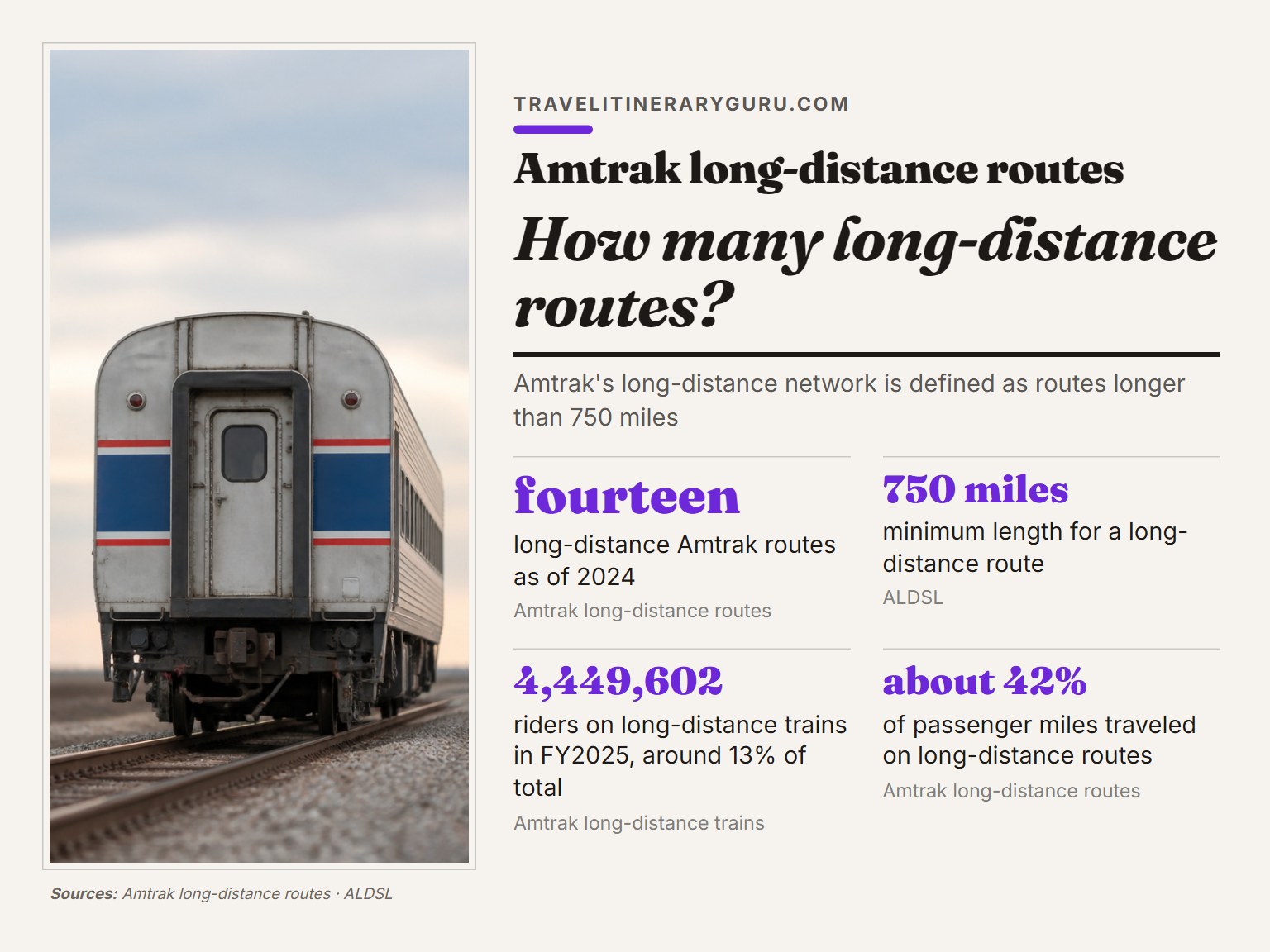
Long-distance Amtrak routes are defined as services longer than 750 miles. Fourteen routes meet that threshold as of 2024, serving more than 300 stations across 39 states. Long-distance trains account for roughly 13 percent of Amtrak ridership but about 42 percent of passenger miles traveled.
Ridership share is small. Mileage share is not. In FY2025 the long-distance group carried 4,449,602 passengers against 15,173,228 on the Northeast Corridor and 14,844,768 on state-supported routes. Long-distance is about 12.9 percent of the total, but those riders cover far more ground per ticket.
The 10 Longest Direct Amtrak Routes, Ranked by Distance
Ranking these by distance means picking a number, and the sources don’t agree on which number. The table below uses the Amtrak Daily Long-Distance Service Study figures where it reports them, and flags the conflicts separately.
| Route | Distance (miles) | Endpoints | Frequency |
|---|---|---|---|
| Texas Eagle (with through cars) | 2,728 | Chicago – Los Angeles | Daily to San Antonio; through cars 3x weekly |
| California Zephyr | 2,438 | Chicago – Emeryville | Daily |
| Empire Builder | 2,205 / 2,255 | Chicago – Seattle / Portland | Daily |
| Southwest Chief | 2,265 | Chicago – Los Angeles | Daily |
| Floridian | 2,076 | Chicago – Miami | Daily |
| Sunset Limited | 1,995 | New Orleans – Los Angeles | 3x weekly |
| Silver Star | 1,522 | New York – Miami | Daily |
| Coast Starlight | 1,377 | Los Angeles – Seattle | Daily |
| Crescent | 1,377 | New York – New Orleans | Daily |
| Lake Shore Limited | 959 | Chicago – New York | Daily |
The Texas Eagle’s 2,728 miles is the longest timetable run in the United States, and it only applies to the through-car configuration. The standalone Chicago–San Antonio segment is 1,306 miles.
The Floridian is the newest entry and the one most lists haven’t caught up with. It is part of the long-distance group that carried 4,449,602 passengers in FY2025.
Worth knowing before you start: The Floridian is explicitly temporary.
How Long Is the Texas Eagle, Really?
Two numbers get published for the Texas Eagle, and both are correct depending on which train you’re describing.
The Chicago to San Antonio route is 1,306 miles. The combined route with the Sunset Limited, running Chicago to Los Angeles, is 2,728 miles. Amtrak’s own Texas Eagle page lists 32 hours 25 minutes to San Antonio and 65 hours 20 minutes to Los Angeles, with a layover of 2 to 5 hours in San Antonio while the through cars are coupled.
That layover is the part nobody mentions in the glossy route descriptions. You sit in San Antonio for two to five hours while a switching crew does the work. If you’re continuing to Los Angeles, you’re on the train for over 65 hours total.
Wikipedia and the FRA both cite 65 hours 45 minutes for the full run, against Amtrak’s 65 hours 20 minutes. A 25-minute gap isn’t worth fighting over, but it tells you something about how loosely these timetables are tracked.
If a multi-city train trip across the country is what you’re after, the Eagle is a strange place to start. It’s the longest route on paper and the least efficient way to actually get anywhere.
Why the California Zephyr Is the One People Actually Book
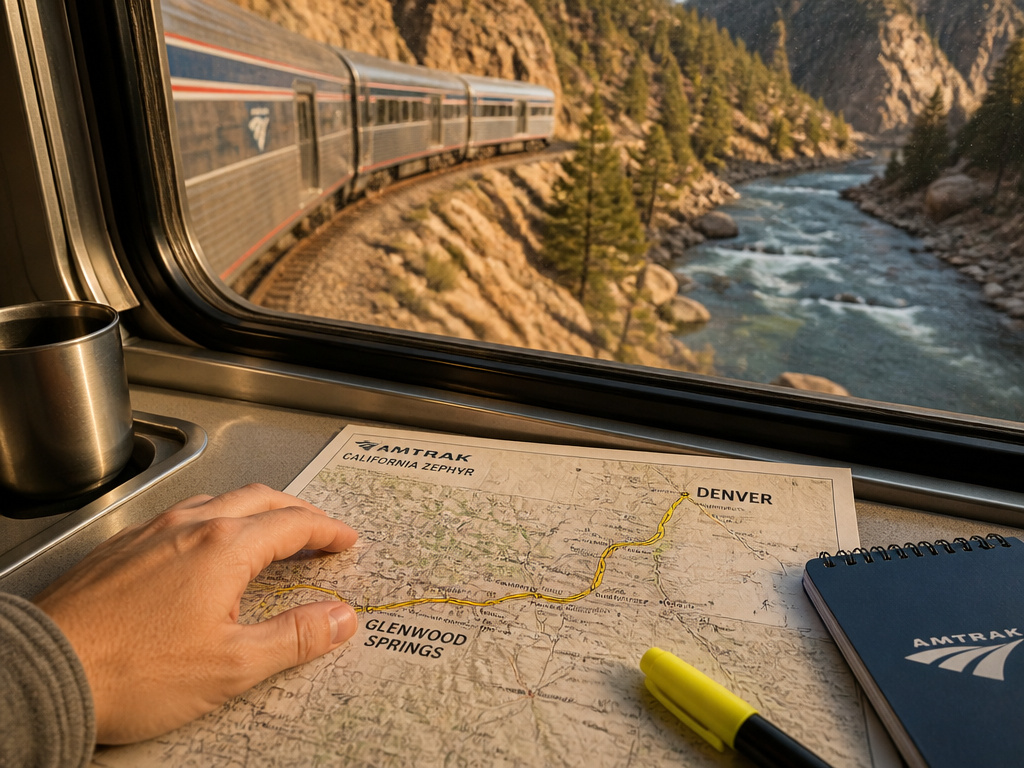
The California Zephyr runs 2,438 miles between Emeryville, California, and Chicago, and it’s the route most people mean when they say they want to take “the train” across America.
The scenery argument on the 10 longest direct Amtrak routes in the United States is real for the Colorado River and Sierra Nevada segments. It’s also oversold for the rest. A large chunk of the Zephyr runs at night or through country that looks like every other stretch of the Great Plains from a train window.
The Zephyr carried 328,665 riders in FY2023. If you’re building a full California Zephyr itinerary, the practical move is to book the Denver–Glenwood Springs segment as a standalone ride rather than committing to the full two-day run.
My honest take: the four-hour stretch west of Denver beats the other 40 hours combined. That’s the part to plan around.
The Empire Builder and the One-Mile Problem
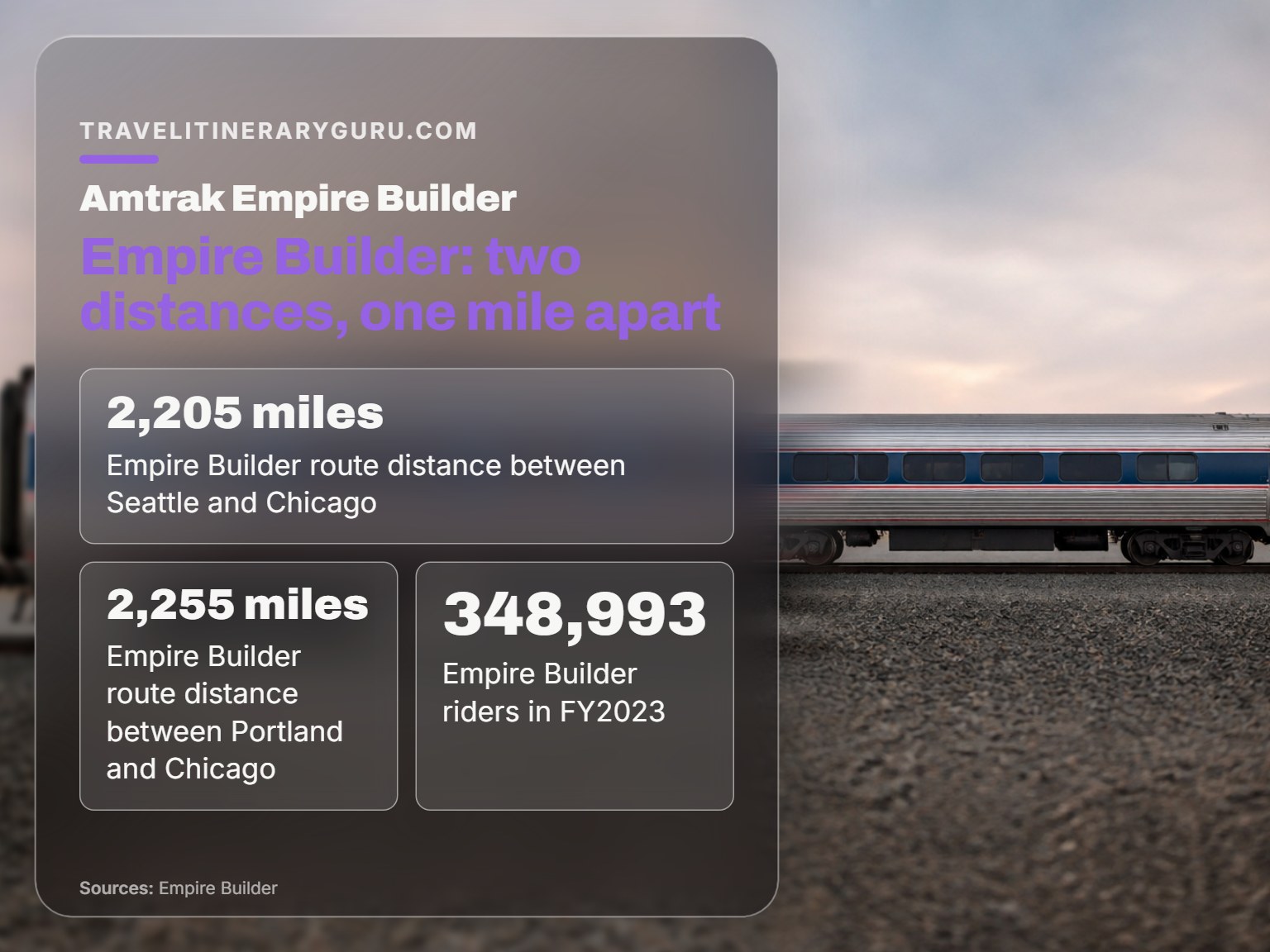
The Empire Builder splits at Spokane, with one section running to Seattle and another to Portland. That’s why it has two published distances: 2,205 miles to Seattle and 2,255 miles to Portland.
The Amtrak Daily Long-Distance Service Study reports those figures. Amtrak’s own route page and Trains both cite 2,206 and 2,257 — one mile more on each. Nobody has explained the discrepancy, and it doesn’t change your trip. It does tell you that route mileage on these trains is measured by more than one method.
The Empire Builder carried 348,993 riders in FY2023. A 5-day Empire Builder itinerary gives you the Glacier National Park stop at West Glacier without forcing you to ride the whole thing.
Easy to miss: The Empire Builder’s two sections mean you can board in Seattle and end in Portland, or vice versa, but not on the same train. Check which section your ticket is on before you book a connecting bus.
The Southwest Chief: 32 Stations, 496 Ways to Ride It
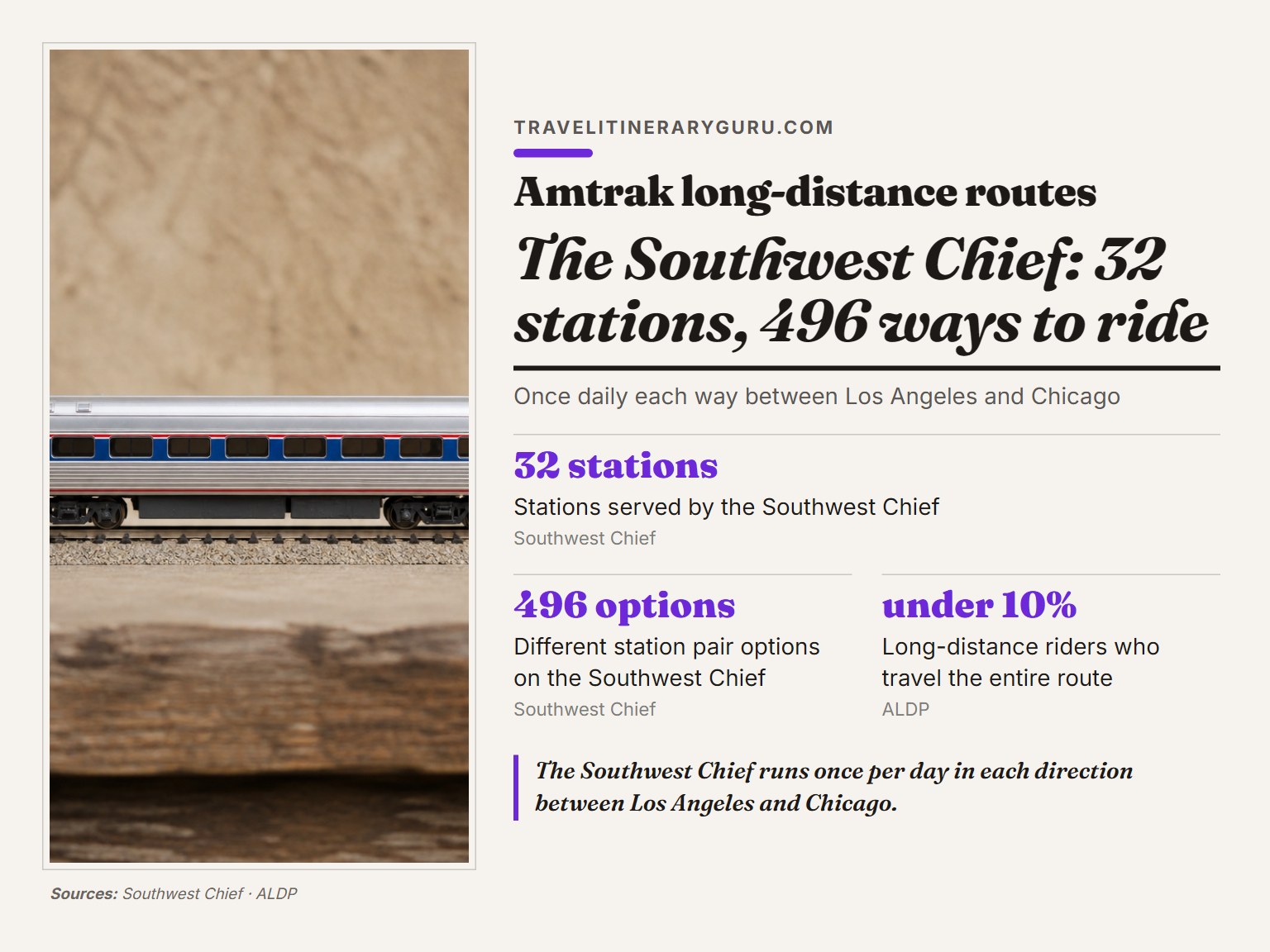
The Southwest Chief runs once per day in each direction between Los Angeles and Chicago, and it serves 32 stations. That creates 496 different station pair options — the highest origin-destination count on the network.
That number matters because it explains who actually rides these trains. Less than 10 percent of long-distance riders travel the entire length of a route. The Southwest Chief functions as 496 separate station pair options that happen to share a consist.
The distance figure is contested too. The Amtrak study says 2,265. Trains cites 2,256, attributing that to Trains. Three sources, three numbers, and the difference between the highest and lowest is nine miles.
If you’re planning a Southwest Chief itinerary, the Flagstaff and Albuquerque stops are the ones worth building around. The Kansas and Missouri stretches are overnight in both directions.
Which Long-Distance Routes Are Not Daily?
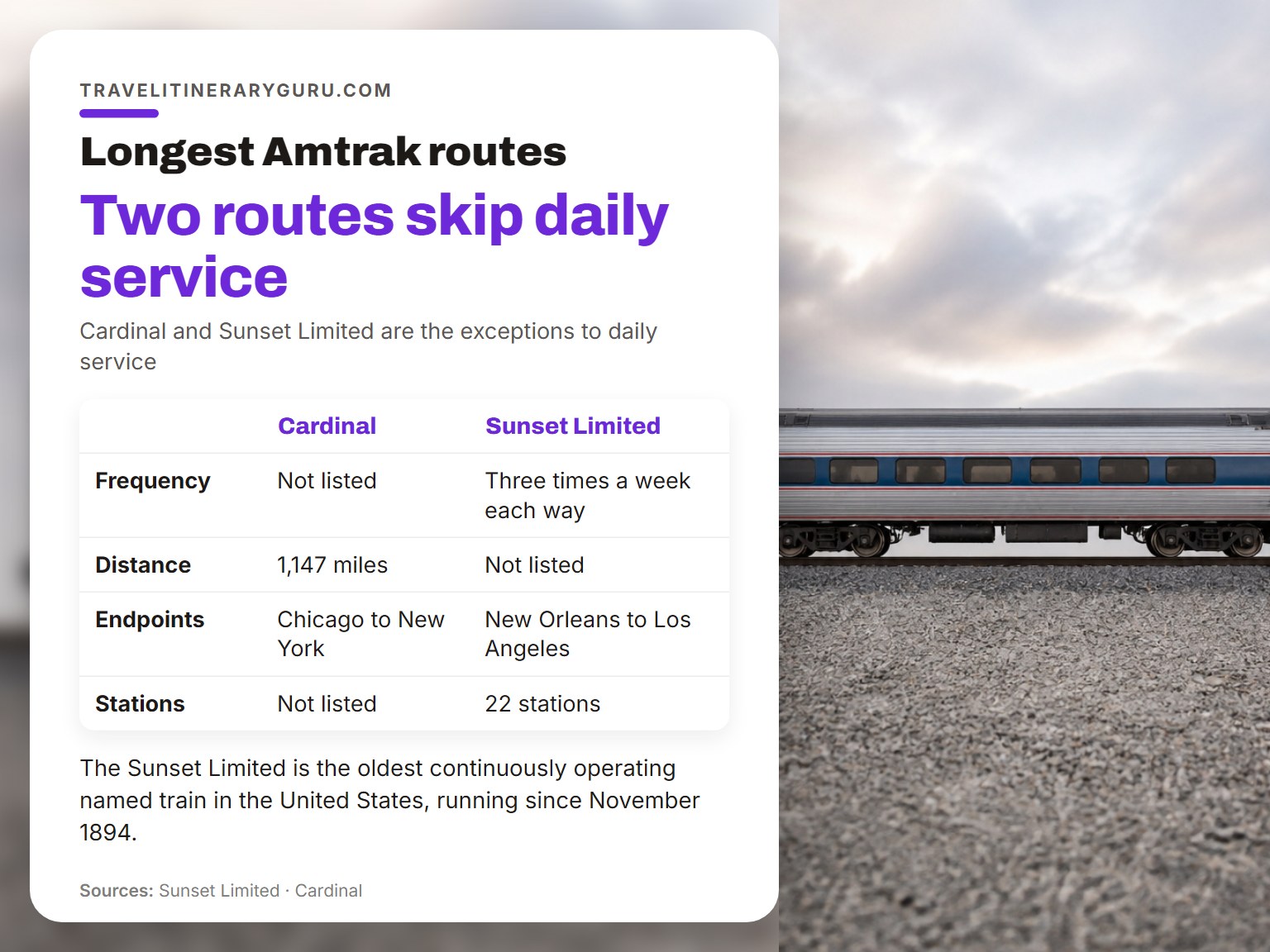
Two routes break the daily pattern: the Cardinal and the Sunset Limited, both running three times a week in each direction.
The Cardinal covers 1,147 miles between Chicago and New York. The Sunset Limited runs 1,995 miles between New Orleans and Los Angeles through Texas, New Mexico, and Arizona, with 22 stations.
The Sunset Limited has the better story. It’s the oldest continuously operating named train in the United States, running since November 1894.
If you’re planning a sleeper train trip on either of these, the three-day-a-week schedule is the constraint that shapes everything else. Miss your departure and you’re waiting until the next one.
Where this goes sideways: Booking the Cardinal or Sunset Limited without checking the day of week. Both run three times weekly, and a missed connection on either can leave you stranded for two days rather than one.
The Silver Star, the Silver Meteor, and the Coastal Split
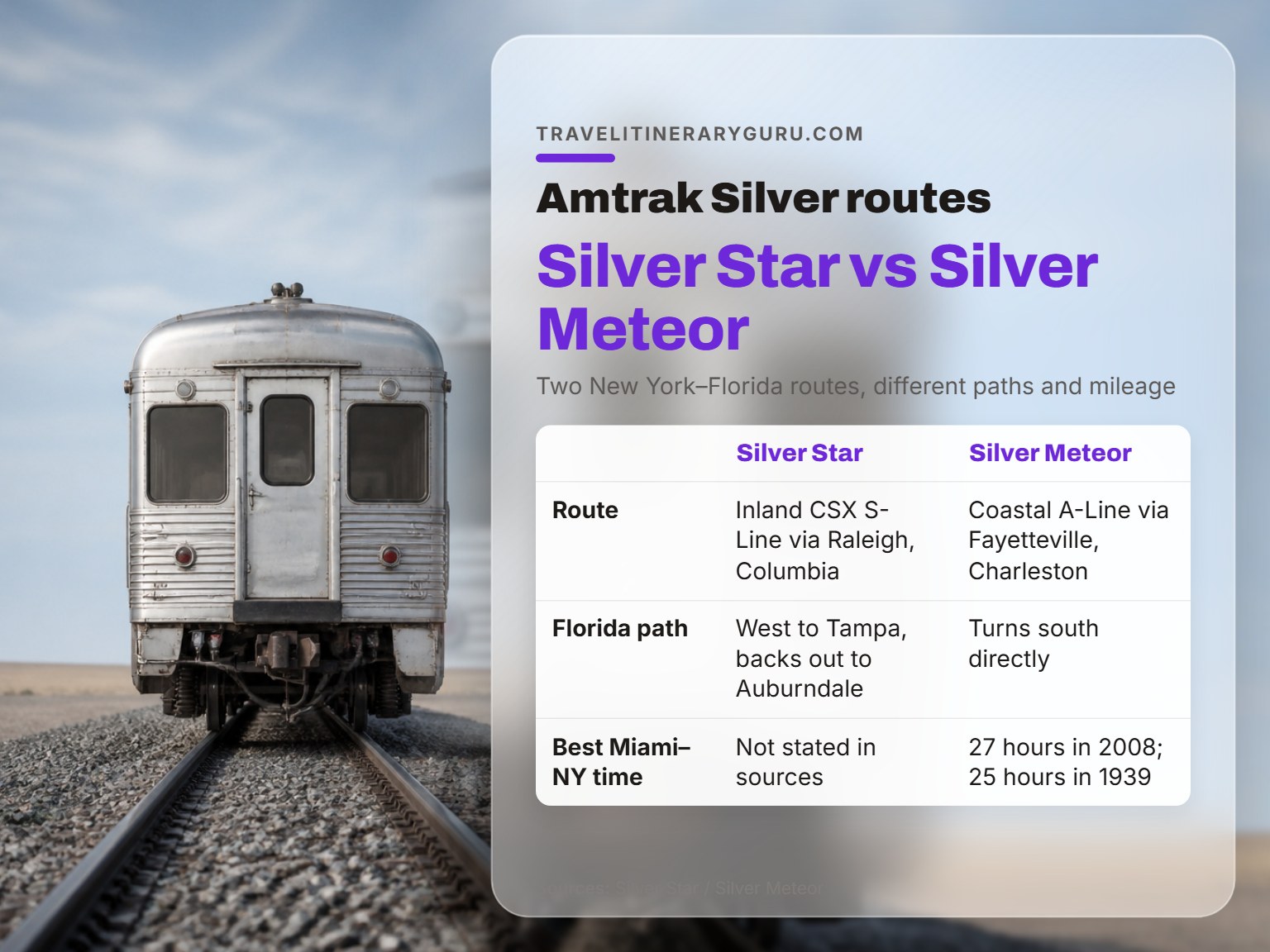
The Silver Star and Silver Meteor both run between New York and Florida, and they take different paths to get there.
The Silver Star takes the inland CSX S-Line to serve Raleigh and Columbia. The Silver Meteor stays closer to the coast on the A-Line through Fayetteville and Charleston. In Florida, the Star continues west to Lakeland and Tampa before backing out to Auburndale and turning south. The Meteor turns south directly.
That routing difference shows up in the mileage. The FRA reports the Silver Star at 1,510 miles. The Amtrak study says 1,522. A 12-mile gap, and no stated reason for it.
The Meteor’s best-ever time between Miami and New York was 27 hours in 2008, against 25 hours in 1939. The train got slower over 69 years. That’s the honest version of the “golden age of rail” story.
If you want the coach vs sleeper math for a route this long, the short version is that over 80 percent of long-distance passengers ride in coach, and their average trip is 446 miles. Sleeper passengers average just over 1,000 miles. The economics only work in your favor on the longer hauls.
The Coast Starlight and the Crescent: Same Distance, Different Trips
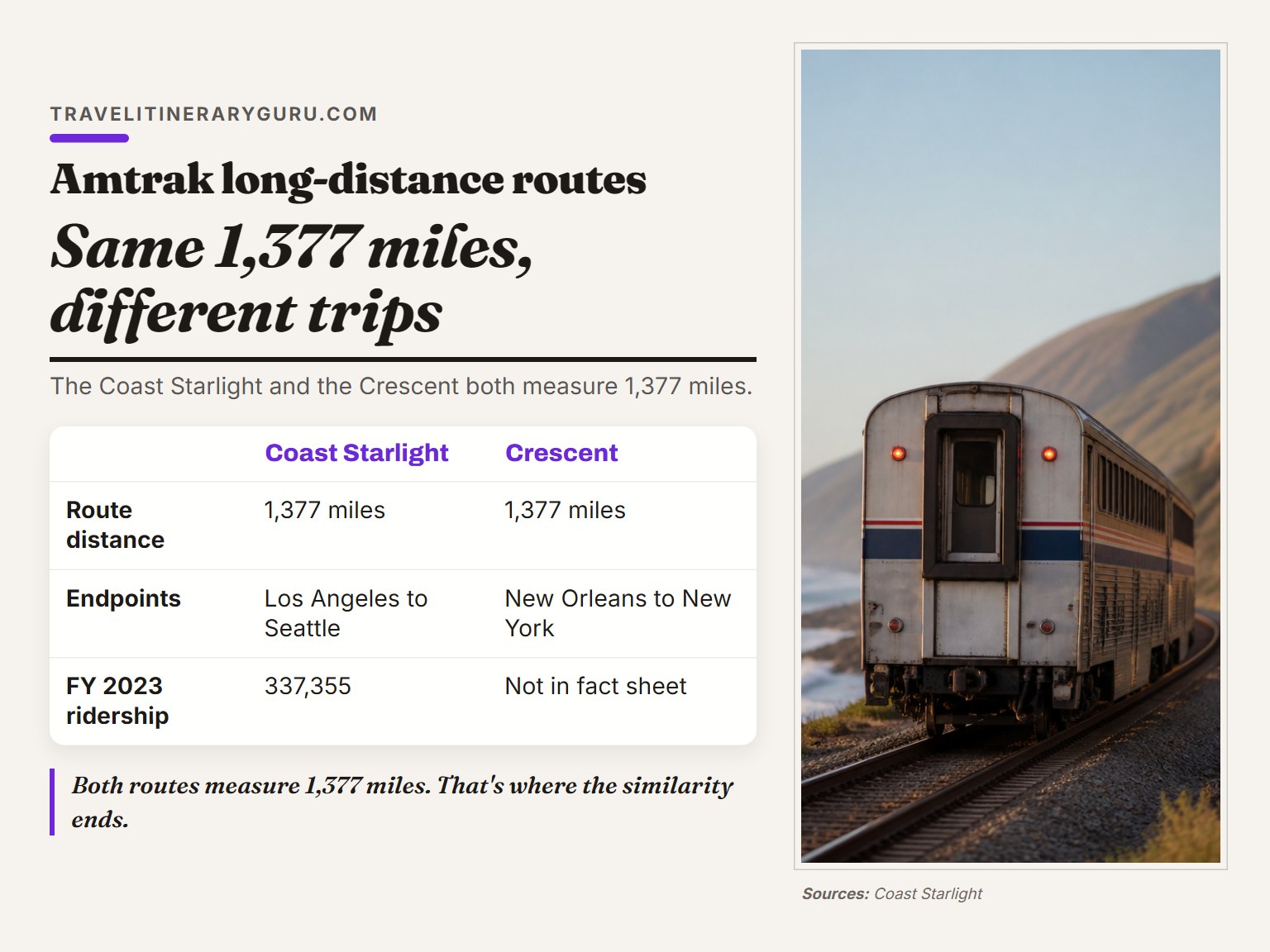
Both routes measure 1,377 miles. That’s where the similarity ends.
The Coast Starlight runs Los Angeles to Seattle along the Pacific coast, and it carried 337,355 riders in FY2023. The Crescent runs New Orleans to New York.
The Starlight’s appeal is the coastline between San Luis Obispo and Salinas, which is genuinely one of the better stretches of scenery on the network. A Coast Starlight itinerary built around that segment makes more sense than riding the full 1,377 miles.
The Crescent’s appeal is different. It’s the train that serves the South on a direct line to New York, and it’s one of the few long-distance routes with a federal complaint history against its host railroad.
That’s the part the brochures skip. Most long-distance routes run over freight railroad track, and the host railroad’s dispatching decisions decide whether your train is on time.
What the Coach Numbers Actually Tell You
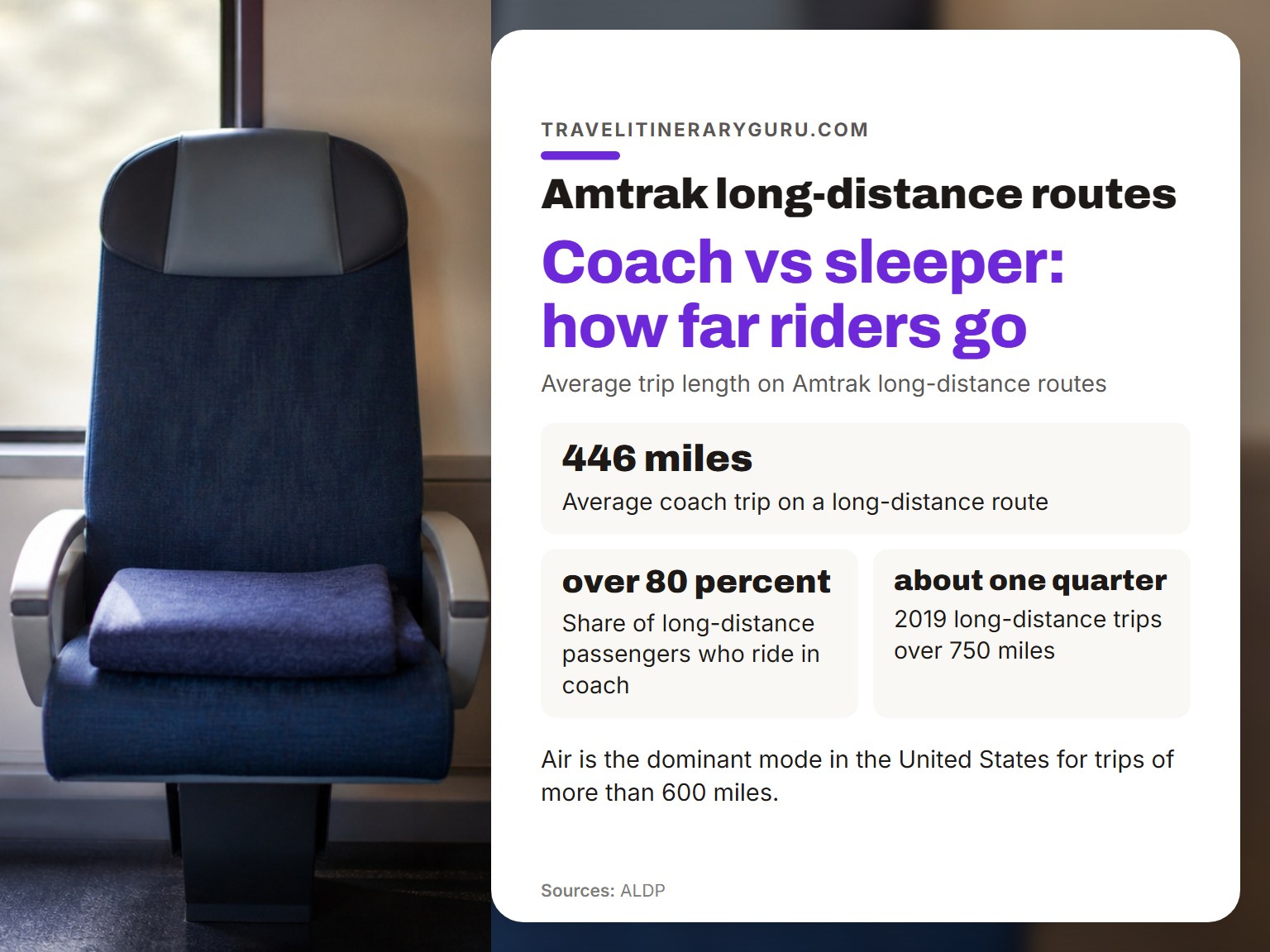
The average coach trip on a long-distance route is 446 miles. The average sleeper trip is just over 1,000 miles. Those two numbers explain almost everything about how these trains are used.
Coach riders are taking the train between two points a few hundred miles apart, often because there’s no flight or bus. Sleeper riders are committing to the overnight experience, and they’re paying for it.
In 2019, only about one quarter of long-distance route passenger rail trips were over 750 miles. Air is the dominant mode in the United States for trips over 600 miles. The train’s advantage comes from the stations in between.
Amtrak long-distance trains provide the only rail service at nearly half of the stations in the system. In many communities, Amtrak is the only intercity passenger service of any kind, because there’s no intercity bus or airline service.
Skip this if: You want to get somewhere fast. Air is the dominant mode for trips over 600 miles for a reason, and no amount of scenery changes the math on a 65-hour transcontinental train.
What’s Changing on the Long-Distance Network
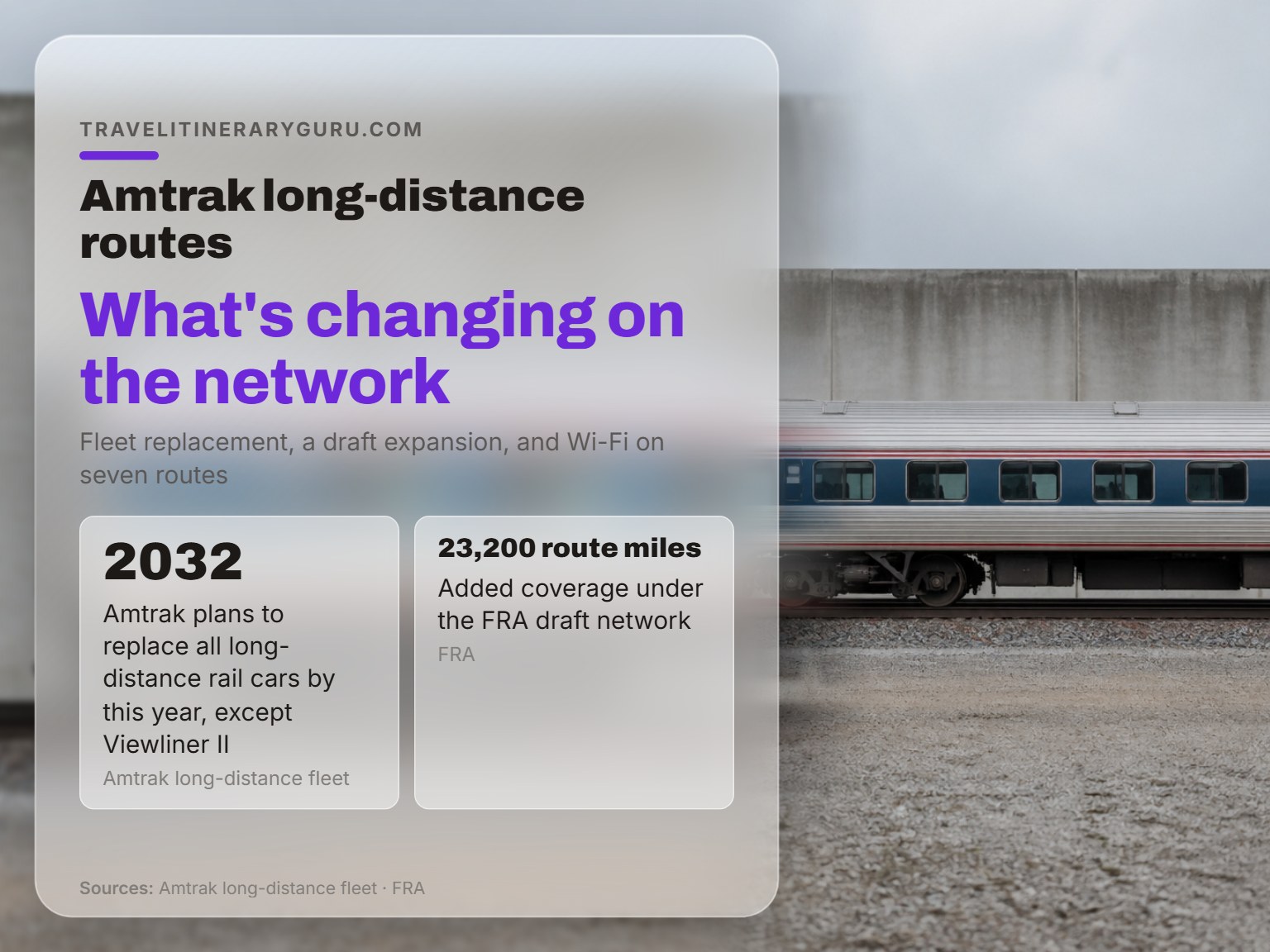
Amtrak plans to replace all of its long-distance rail cars by 2032, except for the Viewliner II fleet. That’s the biggest equipment change on the network in decades.
The FRA released its preferred draft network of fifteen new long-distance routes in February 2024. The plan would add 23,200 route miles, reaching an additional 45 million people, 61 metropolitan statistical areas, 24 congressional districts, twelve National Park Service sites, and two states that currently have no Amtrak service at all: Wyoming and South Dakota.
Free basic Wi-Fi is available on seven long-distance routes: the Auto Train, Cardinal, Crescent, Lake Shore Limited, Palmetto, Silver Meteor, and Floridian. It’s intended to support low-bandwidth use only, and it depends on cell towers along the route, so speed and availability track regional coverage.
If you’re planning around any of this, the Amtrak sleeper car situation is worth understanding before the fleet turns over. The equipment you book today may not be the equipment you ride in 2032.
How the Route Count Got to Fourteen
Amtrak’s day-one network on May 1, 1971 had 184 trains, about 23,000 route-miles, and 314 communities. Route-miles in 1977 were about 27,000.
The FY2019 company profile described a system of about 21,400 route-miles. Amtrak runs trains to more than 500 destinations in 46 states.
The route count itself is unstable. Wikipedia lists fourteen long-distance routes as of 2024. Anyone quoting a fixed number is quoting a snapshot.
Frequently Asked Questions
What is the longest Amtrak route in the United States?
The Texas Eagle holds the title at 2,728 miles, but only when its through cars run combined with the Sunset Limited between San Antonio and Los Angeles. That configuration operates three days a week. The standalone Chicago–San Antonio train is 1,306 miles.
How many states are served only by Amtrak long-distance routes?
The sources disagree. The Amtrak Daily Long-Distance Service Study says 22 of the 46 states served by the Amtrak network are served only by long-distance routes. A separate route network overview says long-distance trains are the only Amtrak trains in 23 of 46 states. Both figures come from Amtrak-adjacent material, and the one-state gap hasn’t been reconciled publicly.
Do all Amtrak long-distance trains have sleeper cars?
Most do. The Palmetto is the exception on the night-travel side, and it’s the one long-distance train that doesn’t involve at least one night of travel. Both coach and sleeper tickets are offered on most routes, though over 80 percent of passengers ride in coach.
How long does the California Zephyr take end to end?
The route covers 2,438 miles between Emeryville, California, and Chicago. Long-distance routes have end-to-end travel times well over 12 hours, and the Zephyr runs two nights. It carried 328,665 riders in FY2023.
Is the Floridian a permanent Amtrak route?
No.
Why do different websites list different mileages for the same Amtrak route?
Because the sources measure differently and publish different numbers. The FRA, the Amtrak Daily Long-Distance Service Study, and Trains all report figures for the same routes, and they disagree by as much as 12 miles. The Southwest Chief is listed at 2,264, 2,265, and 2,256 miles across those three sources.
The Bottom Line
One rule most route lists skip: if a mileage figure has no source attached, treat it as approximate. The FRA, the Amtrak study, and Trains disagree on almost every route on this list, and the honest version of the ranking shows the conflict rather than picking a number and moving on.
If you want a first step this week, pick the segment rather than the route. The Denver–Glenwood Springs stretch of the California Zephyr, the coastline between San Luis Obispo and Salinas on the Coast Starlight, and the Flagstaff stop on the Southwest Chief are the parts worth booking. A multi-city train trip built around three good segments beats one 65-hour transcontinental run every time.
I’ll say the quiet part out loud: the “great American train journey” is usually better in theory than in practice. Long-distance trains are slow, the scenery is often at night or in a tunnel, and a 2,728-mile route that only exists three days a week isn’t a route so much as a scheduling coincidence. Pick the four-hour scenic segment. Skip the 24-hour iconic journey. The Empire Builder and the Coast Starlight both reward that approach.
This all changes if you’re riding for the sake of riding. If the train itself is the destination, the calculus flips entirely, and the longest route on the board is exactly the one you want. Just check the day of week before you book, and budget the San Antonio layover.
